Russia Electronic Chemicals Market Size, Share, By Form (Liquid Chemicals, Gaseous Chemicals, and Solid), By End User (Consumer Electronics, Automotive & EVs, Renewable Energy, Telecommunications, and Industrial Manufacturing), and Russia Electronic Chemicals Market Insights, Industry Trend, Forecasts to 2035
Industry: Chemicals & Materials
Russia Electronic Chemicals Market Insights Forecasts to 2035
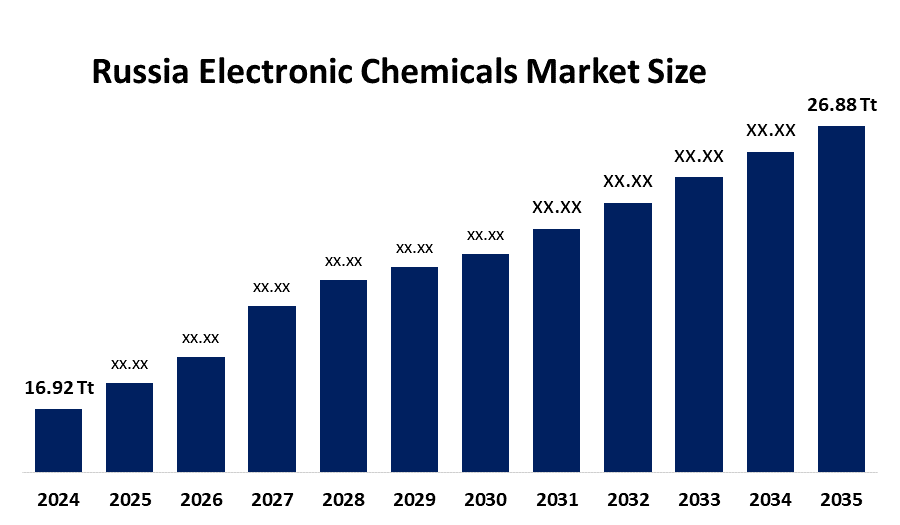
- Russia Electronic Chemicals Market 2024: 16.92 Thousand Tons
- Russia Electronic Chemicals Market Size 2035: 26.88 Thousand Tons
- Russia Electronic Chemicals Market CAGR 2024: 4.3%
- Russia Electronic Chemicals Market Segments: Form and End User
Get more details on this report -
The Russia electronics chemical market comprises the chemical industry's segment that manufactures and supplies specialized chemicals that are used in the creation of electrical devices utilized to manufacture and assemble semiconductor materials or electronic components. All these chemical products are fundamental components within the broader Russian electronics sectors, comprising consumer electronics, automotive electronics, telecommunications infrastructure, and emerging technologies such as 5G and the Internet of Things.
The electronic chemicals in Russia are backed by government support, including the Strategy for the Development of the Electronic Industry of the Russian Federation up to 2030, the federal budget commitment to the electronics and radio-electronic industry over 250 billion rubles has been allocated for the development of domestic electronics manufacturing during 2026–2028, a significant investment aimed at stimulating local production, including materials and chemical inputs critical for semiconductor and electronic parts manufacturing.
As technology advances, Russian electronic chemicals providers are now using advanced methods of photolithography, precise deposition processes and nanometre scale etching techniques, equipment providers have developed ultra-pure photoresist materials, high-quality wet and dry etching media, high-grade cleaning agents and specialised materials for state-of-the-art semiconductor node manufacturing. These advances assist local manufacturers in meeting increasingly high demands for smaller and faster electronic devices with greater energy efficiency, as well as providing support for a worldwide trend toward more sustainable practices by providing less harmful solvent systems and more environmentally-friendly chemical processes.
Market Dynamics of the Russia Electronic Chemicals Market:
The Russia electronic chemicals market is driven by the rising demand for consumer electronics, increases the need for associated chemical inputs, expansion of 5G networks, IoT ecosystems, and automotive electronics, increased demand for high-performance chemicals, strong government support for innovation and domestic manufacturing, reduced reliance on imports, strengthening supply chains, and high preference for sustainability and regulatory compliance drives manufacturers to adopt advanced, compliant chemical formulations further propel the market growth.
The Russia electronic chemicals market is restrained by the high production costs, strict environmental and safety regulations, require significant investment in compliance, slowing production and innovation cycles, rapid pace of technological change may render existing chemical solutions, increase operating costs and risks, and supply chain volatility challenges.
The future of Russia electronic chemicals market is bright and promising, with versatile opportunities emerging from the increased demand for performance-based specialty chemicals, with all the expansion related to Russia's semiconductor fabrication and electronics manufacturing ecosystem. There are also opportunities resulting from the increasing need for environmentally friendly and sustainable chemical products and processes as the new green products must meet the required performance levels of the product and have the minimal impact on the environment.
Russia Electronic Chemicals Market Report Coverage
| Report Coverage | Details |
|---|---|
| Base Year: | 2024 |
| Market Size in 2024: | 16.92 Thousand Tons |
| Forecast Period: | 2025-2035 |
| Forecast Period CAGR 2025-2035 : | CAGR of 4.3% |
| 2035 Value Projection: | 26.88 Thousand Tons |
| Historical Data for: | 2020-2023 |
| No. of Pages: | 210 |
| Tables, Charts & Figures: | 95 |
| Segments covered: | By Form, By End User |
| Companies covered:: | OCSiAI RUSSIA, HaloPolymer, OJSC, Germanium and Applications, LumInnoTech, Uralchimplast, JSC Aviabor, Others, and Key Players |
| Pitfalls & Challenges: | COVID-19 Empact, Challenge, Future, Growth, & Analysis |
Get more details on this report -
Market Segmentation
The Russia electronic chemicals market share is classified into form and end user.
By Form:
The Russia electronic chemicals market is divided by form into liquid chemicals, gaseous chemicals, and solid. Among these, the liquid chemicals segment held the largest revenue market share in 2024 and is predicted to grow at a remarkable CAGR during the forecast period. Essential cleaning agent, high volume use in semiconductor production, and ability to remove microscopic impurities during the water fabrication process all contribute to the liquid chemicals segment's largest share and higher spending on electronic chemicals when compared to other form.
By End User:
The Russia electronic chemicals market is divided by end user into consumer electronics, automotive & EVs, renewable energy, telecommunications, and industrial manufacturing. Among these, the consumer electronics segment dominated the share in 2024 and is anticipated to grow at a remarkable CAGR during the forecast period. The consumer electronics segment dominates because of high penetration of smart devices, constant upgrades and innovation ensuring consumer electronics market, growing tech consumption patterns, and high industrial demand synergy in Russia.
Competitive Analysis:
The report offers the appropriate analysis of the key organisations/companies involved within the Russia electronic chemicals market, along with a comparative evaluation primarily based on their product offering, business overviews, geographic presence, enterprise strategies, segment market share, and SWOT analysis. The report also provides an elaborative analysis focusing on the current news and developments of the companies, which includes product development, innovations, joint ventures, partnerships, mergers & acquisitions, strategic alliances, and others. This allows for the evaluation of the overall competition within the market.
Top Key Companies in Russia Electronic Chemicals Market:
- OCSiAI RUSSIA
- HaloPolymer, OJSC
- Germanium and Applications
- LumInnoTech
- Uralchimplast
- JSC Aviabor
- Others
Recent Developments in Russia Electronic Chemicals Market:
In February 2026, the Rosel holding presented three new models of domestically produced probe stations (OmegaAir-150COAX, Terra-200, and Terra-200T0) for high-precision quality control of microelectronic components.
In November 2025, the Engineering Chemical and Technological Center at Tomsk State University (TSU), experimental production of organic peroxidos (dikumil peroxide and novoperox) in Russia.
Key Target Audience
- Market Players
- Investors
- End-users
- Government Authorities
- Consulting and Research Firm
- Venture capitalists
- Value-Added Resellers (VARs)
Market Segment
This study forecasts revenue at the Russia, regional, and country levels from 2020 to 2035. Spherical Insights has segmented the Russia electronic chemicals market based on the below-mentioned segments:
Russia Electronic Chemicals Market, By Form
- Liquid Chemicals
- Gaseous Chemicals
- Solid
Russia Electronic Chemicals Market, By End User
- Consumer Electronics
- Automotive & EVs
- Renewable Energy
- Telecommunications
- Industrial Manufacturing
Frequently Asked Questions (FAQ)
-
Q: What is the Russia electronic chemicals market size?A: Russia electronic chemicals market is expected to grow from 16.92 thousand tons in 2024 to 26.88 thousand tons by 2035, growing at a CAGR of 4.3% during the forecast period 2025-2035.
-
Q: What are the key growth drivers of the market?A: Market growth is driven by the rising demand for consumer electronics, increases the need for associated chemical inputs, expansion of 5G networks, IoT ecosystems, and automotive electronics, increased demand for high-performance chemicals, strong government support for innovation and domestic manufacturing, reduced reliance on imports, strengthening supply chains, and high preference for sustainability and regulatory compliance drives manufacturers to adopt advanced, compliant chemical formulations further propel the market growth.
-
Q: What factors restrain the Russia electronic chemicals market?A: Constraints include the high production costs, strict environmental and safety regulations, require significant investment in compliance, slowing production and innovation cycles, rapid pace of technological change may render existing chemical solutions, increase operating costs and risks, and supply chain volatility challenges.
-
Q: How is the market segmented by form?A: The market is segmented into liquid chemicals, gaseous chemicals, and solid.
-
Q: Who are the key players in the Russia electronic chemicals market?A: Key companies include OCSiAI RUSSIA, HaloPolymer, OJSC, Germanium and Applications, LumInnoTech, Uralchimplast, JSC Aviabor, and Others.
-
.Q: Who are the target audiences for this market report?A: The report targets market players, investors, end-users, government authorities, consulting and research firms, venture capitalists, and value-added resellers (VARs).
Need help to buy this report?