Global Robotics Laser Welding Market Size, Share, and COVID-19 Impact Analysis, By Component (Hardware, Software, and Services), By Robot Type (Industrial Robots, Collaborative Robots, and Mobile Robots), By End Use (Automotive & Transportation, Metal & Machinery, Electrical & Electronics, Aerospace & Defense, and Others), and By Region (North America, Europe, Asia-Pacific, Latin America, Middle East, and Africa), Analysis and Forecast 2025 - 2035
Industry: Electronics, ICT & Media
Global Robotics Laser Welding Market Size Insights Forecasts to 2035
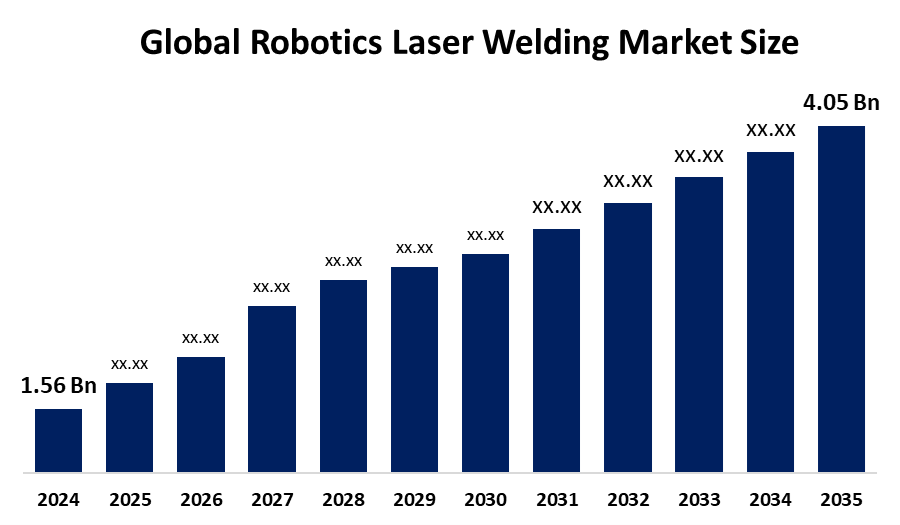
- The Global Robotics Laser Welding Market Size Was Estimated at USD 1.56 Billion in 2024
- The Market Size is Expected to Grow at a CAGR of around 9.06% from 2025 to 2035
- The Worldwide Robotics Laser Welding Market Size is Expected to Reach USD 4.05 Billion by 2035
- North America is expected to grow the fastest during the forecast period.
Get more details on this report -
According to a Research Report Published by Spherical Insights and Consulting, The Global Robotics Laser Welding Market Size was worth around USD 1.56 Billion in 2024 and is predicted to grow to around USD 4.05 Billion by 2035 with a compound annual growth rate (CAGR) of 9.06% from 2025 to 2035. Global integration Artificial Intelligence, Internet of Things, and Industry 4.0 frameworks, continuous technological advancements in laser system and expansion of manufacturing activities are all driving opportunities in the robotics laser welding market.
Market Overview
The global industry segment focused on the development, production, and deployment of robotic systems integrated with laser technologies used for applications such as cutting, welding, marking, engraving, drilling, and surface treatment across industries is known as the robotics laser welding market. These include fiber lasers, high-power laser systems, AI-enabled robotic control, machine vision integration, real-time monitoring, and Industry 4.0 connectivity that improve efficiency, flexibility, and production quality. Government initiatives support smart manufacturing, automation adoption, and advanced manufacturing infrastructure, and promote digital transformation in manufacturing. For example, in March 2025, India’s PLI scheme allocated over USD 165 billion for industrial modernization and advanced manufacturing through 2024, which is expected to increase the adoption of robotic and laser-enabled production equipment.
In February 2024, the U.S. Centers for Disease Control and Prevention, the use of robots in industrial environments is rapidly increasing. The agency reported that the number of industrial robots in U.S. factories increased by about 10% in 2022, reflecting rising adoption of automation technologies in manufacturing industries. This growth directly supports demand for robotic laser systems used in welding, cutting, and material processing.
Report Coverage
This research report categorizes the robotics laser welding market based on various segments and regions, forecasts revenue growth, and analyzes trends in each submarket. The report analyses the key growth drivers, opportunities, and challenges influencing the robotics laser welding market. Recent market developments and competitive strategies, such as expansion, product launch, development, partnership, merger, and acquisition, have been included to draw the competitive landscape in the market. The report strategically identifies and profiles the key market players and analyses their core competencies in each sub-segment of the robotics laser welding market.
Robotics Laser Welding Market Report Coverage
| Report Coverage | Details |
|---|---|
| Base Year: | 2024 |
| Market Size in 2024: | 1.56 Billion |
| Forecast Period: | 2025-2035 |
| Forecast Period CAGR 2025-2035 : | CAGR of 9.06% |
| 2035 Value Projection: | 4.05 Billion |
| Historical Data for: | 2020-2023 |
| No. of Pages: | 225 |
| Tables, Charts & Figures: | 120 |
| Segments covered: | By Component, By Robot Type |
| Companies covered:: | ABB Ltd., FANUC Corporation, Yaskawa Electric Corporation, KUKA AG, Mitsubishi Electric Corporation, Panasonic Corporation, Kawasaki Heavy Industries, Ltd., Daihen Corporation, Trumpf Group, IPG Photonics Corporation, Comau S.p.A., Cloos Robotic Welding, Inc., Jenoptik AG, Han’s Laser Technology Industry Group Co., Ltd., Coherent, Inc., and other key players |
| Pitfalls & Challenges: | COVID-19 Empact, Challenge, Future, Growth, & Analysis |
Get more details on this report -
Driving Factors
Rapid technological innovation is one of the main drivers of the robotics laser market's growth. Increasing adoption of automation and smart manufacturing across industries where robotic laser welding systems are used for high-precision cutting, welding, marking, and surface treatment is the main factor driving the market for robotic laser welding. In this field, innovation and investment are driven by fiber lasers, high-power laser systems, AI-based robotic control, machine vision integration, and Industry 4.0 connectivity, which are enhancing the accuracy, speed, and flexibility of robotic laser operations. Moreover, the government initiatives promote advanced manufacturing, digital transformation, and robotics adoption.
In June 2025, the U.S. NSF announced $25.5 million in funding for new U.S. manufacturing research initiatives, supporting research in next-generation manufacturing technologies, including high-power laser systems, robotics, and advanced automation, which are key enabling technologies for robotic laser processing systems.
Restraining Factors
High development and deployment costs, shortage of skilled professionals, complexity of system customization can slow adoption, high initial investment required, integration challenges with existing manufacturing infrastructure are the main factors restricting the robotics laser welding market.
Market Segmentation
The robotics laser market share is classified into component, robot type, and end use.
- The hardware segment dominated the market in 2024, approximately 67%, and is projected to grow at a substantial CAGR during the forecast period.
Based on the component, the robotics laser welding market is divided into hardware, software, and services. Among these, the hardware segment dominated the market in 2024, approximately 67%, and is projected to grow at a substantial CAGR during the forecast period. The continuous advancements in laser and robotics technology, including laser sources, robotic arms, sensors, and motion controllers, and widely used in automotive, aerospace, and electronics industries, is driving the hardware industry.
- The industrial robots segment accounted for the largest share in 2024, approximately 35%, and is anticipated to grow at a significant CAGR during the forecast period.
Based on the robot type, the robotics laser welding market is divided into industrial robots, collaborative robots, and mobile robots. Among these, the industrial robots segment accounted for the largest share in 2024, approximately 35%, and is anticipated to grow at a significant CAGR during the forecast period. Widely used in high precision, offers high volume manufacturing processes, have higher payload capacity, speed, and durability, and more suitable for intensive laser-based operations is driving the industrial robots industry.
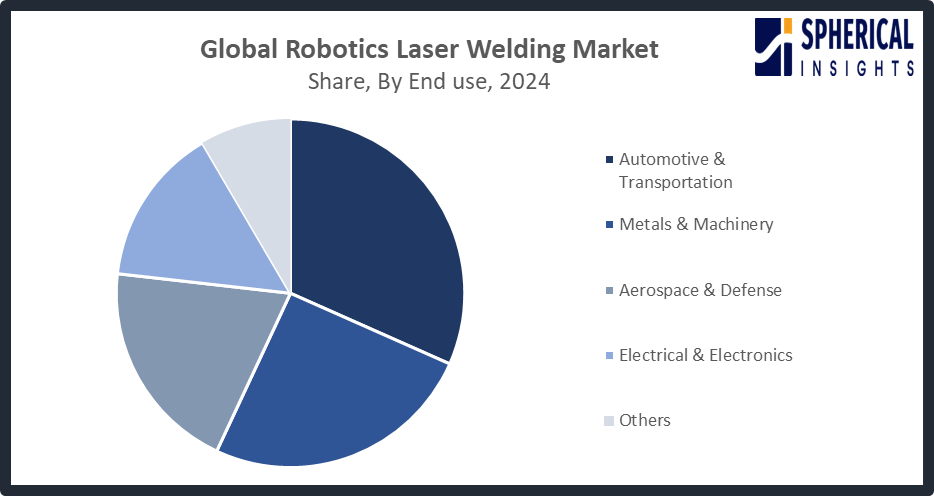
- The automotive & transportation segment accounted for the highest market revenue in 2024, approximately 42%, and is anticipated to grow at a significant CAGR during the forecast period.
Based on the end use, the robotics laser welding market is divided into automotive & transportation, metal & machinery, electrical & electronics, aerospace & defense, and others. Among these, the automotive & transportation segment accounted for the highest market revenue in 2024, approximately 42%, and is anticipated to grow at a significant CAGR during the forecast period. Increased demand for efficient, accurate, and high speed production, heavily relies on laser-based processes, and massive adoption of robotic laser systems making dominating end use is bolstering automotive & transportation market.
Get more details on this report -
Regional Segment Analysis of the Robotics Laser Welding Market
- North America (U.S., Canada, Mexico)
- Europe (Germany, France, U.K., Italy, Spain, Rest of Europe)
- Asia-Pacific (China, Japan, India, Rest of APAC)
- South America (Brazil and the Rest of South America)
- The Middle East and Africa (UAE, South Africa, Rest of MEA)
Asia Pacific is anticipated to hold the largest share of the robotics laser welding market over the predicted timeframe.

Get more details on this report -
Asia Pacific is anticipated to hold the largest share of the robotics laser welding market over the predicted timeframe. China, India, Japan, and South Korea are among the nations making significant investments in automation, smart factories, and Industry 4.0 initiatives. Strong government backing promoting smart manufacturing and advanced industrial infrastructure further enhance the capabilities of robotic laser systems, making them more versatile and reliable create favourable conditions for growth are what propel Asia Pacific. The region's position is further reinforced by government programs promoting deployment of robotic laser solutions across industries such as automotive, aerospace, and electronics, where high precision, speed, and efficiency are critical.
Government initiatives include Japan’s June 2025 Ministry of Economy, Trade and Industry established the RING Project to accelerate regional robot adoption and address labor shortages, India’s September 2023, Ministry of Electronics and Information Technology released the Draft National Strategy on Robotics to position India as a global leader in robotics by 2030, under Make in India 2.0 framework, and Australia’s May 2024 first National Robotics Strategy launched to support robotics and automation in industry and boost competitiveness, productivity & technology adoption.
North America is expected to grow at a rapid CAGR in the robotics laser welding market during the forecast period. United States and Canada are among the nations making significant investments in adoption of AI-enabled robotics, machine vision, and Industry 4.0 integration, combined with a skilled workforce and well-developed industrial infrastructure. Growing demand for high-precision, customized production and shorter product cycles drives manufacturers to invest in flexible, automated robotic laser systems, collectively fueling North America’s rapid market growth.
Government launches include the U.S. NSF, October 2025 focusing on advanced robotics research under the National Robotics Initiative supported by the National Science Foundation, the U.S. December 2025 Advanced Robotics for Manufacturing (ARM) Institute announced project funding to strengthen U.S. manufacturing through robotics and AI, and Canada’s March 2026 provided an Advanced Robotic Material Handling grant under the Industrial Research Assistance Program supporting robotic automation development.
Competitive Analysis:
The report offers the appropriate analysis of the key organizations/companies involved within the robotics laser welding market, along with a comparative evaluation primarily based on their product of offering, business overviews, geographic presence, enterprise strategies, segment market share, and SWOT analysis. The report also provides an elaborative analysis focusing on the current news and developments of the companies, which includes product development, innovations, joint ventures, partnerships, mergers & acquisitions, strategic alliances, and others. This allows for the evaluation of the overall competition within the market.
List of Key Companies
- ABB Ltd.
- FANUC Corporation
- Yaskawa Electric Corporation
- KUKA AG
- Mitsubishi Electric Corporation
- Panasonic Corporation
- Kawasaki Heavy Industries, Ltd.
- Daihen Corporation
- Trumpf Group
- IPG Photonics Corporation
- Comau S.p.A.
- Cloos Robotic Welding, Inc.
- Jenoptik AG
- Han’s Laser Technology Industry Group Co., Ltd.
- Coherent, Inc.
- Others
Key Target Audience
- Market Players
- Investors
- End-users
- Government Authorities
- Consulting and Research Firm
- Venture capitalists
- Value-Added Resellers (VARs)
Recent Developments
• In January 2026, Doosan Robotics unveiled new AI-powered autonomous robotic solutions, including laser-based 3D vision systems, at CES 2026, showcasing its Scan & Go and AI depalletizing systems.
• In January 2026, IMTEX FORMING 2026 (India) featured the latest robotic automation, high-speed laser machines, and digital manufacturing solutions. The event was organized by the Indian Machine Tool Manufacturers’ Association (IMTMA) at the Bangalore International Exhibition Centre, Bengaluru.
• In September 2025, Universal Robots showcased next-generation cobot solutions for laser welding, finishing, and plasma cutting to enhance fabrication automation at FABTECH 2025 in Chicago, Illinois, presenting a range of innovative cobot solutions.
Market Segment
This study forecasts revenue at global, regional, and country levels from 2020 to 2035. Spherical Insights has segmented the robotics laser welding market based on the below-mentioned segments:
Global Robotics Laser Welding Market, By Component
- Hardware
- Software
- Services
Global Robotics Laser Welding Market, By Robot Type
- Industrial Robots
- Collaborative Robots
- Mobile Robots
Global Robotics Laser Welding Market, By End Use
- Automotive & Transportation
- Metals & Machinery
- Electrical & Electronics
- Aerospace & Defense
- Others
Global Robotics Laser Welding Market, By Regional Analysis
- North America
- US
- Canada
- Mexico
- Europe
- Germany
- UK
- France
- Italy
- Spain
- Russia
- Rest of Europe
- Asia Pacific
- China
- Japan
- India
- South Korea
- Australia
- Rest of Asia Pacific
- South America
- Brazil
- Argentina
- Rest of South America
- Middle East & Africa
- UAE
- Saudi Arabia
- Qatar
- South Africa
- Rest of the Middle East & Africa
Frequently Asked Questions (FAQ)
-
1. What technological advancements are shaping the market?Fiber lasers, high-power laser sources, AI-based robotic control, machine vision, and real-time monitoring are driving innovation. Industry 4.0 connectivity enhances flexibility and productivity.
-
2. How do government initiatives affect the market?Governments fund R&D, provide tax incentives, and promote Industry 4.0 adoption. Examples include the U.S. NIST and NSF programs, Japan’s METI robotics funding, and India’s National Robotics Strategy. These accelerate market growth.
-
3. How does robotics laser improve productivity?Robotic lasers reduce human error, operate continuously, and handle complex geometries. They enable faster processing, high repeatability, and consistent quality in manufacturing.
-
4. What trends are shaping the market?Trends include AI-enabled robots, Industry 5.0 adoption, collaborative robots, fiber laser advancements, and integration with IoT and smart factory systems.
-
5. Are laser robotics used in electronics?Yes, applications include PCB cutting, micro-welding, marking, and precision drilling. Robotics lasers provide micron-level accuracy and fast production cycles.
-
6. What is the market outlook for 2035?The market is expected to grow steadily due to industrial automation, demand for high-precision manufacturing, and emerging applications in aerospace, healthcare, and electronics. Technological innovation and government support will continue to drive expansion.
-
1. What technological advancements are shaping the market?Fiber lasers, high-power laser sources, AI-based robotic control, machine vision, and real-time monitoring are driving innovation. Industry 4.0 connectivity enhances flexibility and productivity.
-
2. How do government initiatives affect the market?Governments fund R&D, provide tax incentives, and promote Industry 4.0 adoption. Examples include the U.S. NIST and NSF programs, Japan’s METI robotics funding, and India’s National Robotics Strategy. These accelerate market growth.
-
3. How does robotics laser improve productivity?Robotic lasers reduce human error, operate continuously, and handle complex geometries. They enable faster processing, high repeatability, and consistent quality in manufacturing.
-
4. What trends are shaping the market?Trends include AI-enabled robots, Industry 5.0 adoption, collaborative robots, fiber laser advancements, and integration with IoT and smart factory systems.
-
5. Are laser robotics used in electronics?Yes, applications include PCB cutting, micro-welding, marking, and precision drilling. Robotics lasers provide micron-level accuracy and fast production cycles.
-
6. What is the market outlook for 2035?The market is expected to grow steadily due to industrial automation, demand for high-precision manufacturing, and emerging applications in aerospace, healthcare, and electronics. Technological innovation and government support will continue to drive expansion.
Need help to buy this report?