Global Robotic Welding Market Size, Share, and COVID-19 Impact Analysis, By Type (Arc Welding, Spot Welding, MIG (Metal Inert Gas), TIG (Tungsten Inert Gas), Laser Welding, and Others), By Payload (<50 kg Payload, 50-150 kg Payload, and >150 kg Payload), By End-use (Automotive & Transportation, Metals & Machinery, Electrical & Electronics, Aerospace & Defense, and Others), and By Region (North America, Europe, Asia-Pacific, Latin America, Middle East, and Africa), Analysis and Forecast 2025 - 2035
Industry: Semiconductors & Electronics
Global Robotic Welding Market Insights Forecasts to 2035
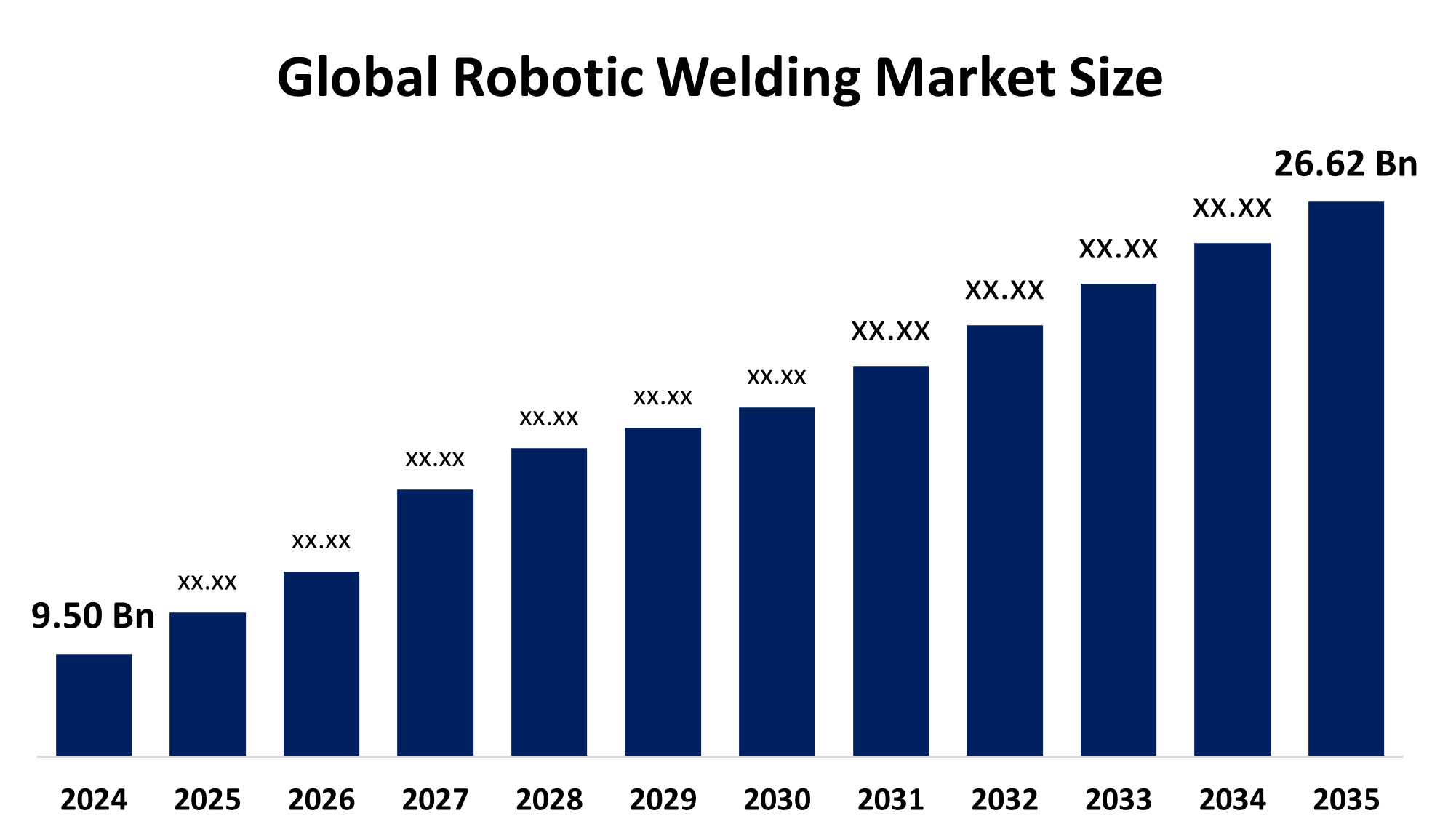
- The Global Robotic Welding Market Size Was Estimated at USD 9.50 Billion in 2024
- The Market Size is Expected to Grow at a CAGR of around 9.82% from 2025 to 2035
- The Worldwide Robotic Welding Market Size is Expected to Reach USD 26.62 Billion by 2035
- North America is expected to grow the fastest during the forecast period.
Get more details on this report -
According to a research report published by Spherical Insights and Consulting, The Global Robotic Welding Market Size was worth around USD 9.50 Billion in 2024 and is Predicted to Grow to around USD 26.62 Billion by 2035 with a Compound Annual Growth Rate (CAGR) of 9.82% from 2025 to 2035. The global robotic welding market is growing due to rising labour shortages, high demand for precision in the automotive and EV sectors, and the adoption of Industry 4.0. Increased productivity, cost efficiency, and the emergence of collaborative robots (cobots) are also driving adoption.
Robotic Welding Market Key Takeaways
- The global robotic welding market was valued at USD 9.50 billion in 2024.
- It is projected to reach USD 26.62 billion by 2035.
- The market is expected to grow at a CAGR of 9.82% from 2024 to 2035.
- Asia Pacific has generated the largest market share of 37% in 2024.
- North America is anticipated to grow at the fastest rate in the market during the forecast period.
- By type, the spot welding segment registered the 36% share of the market in 2024.
- By type, the arc welding segment is expected to grow rapidly in the market during the forecast period of 2024 to 2035.
- By payload, the 50-150 kg segment led the global market in 2024, with an approximate 41% share.
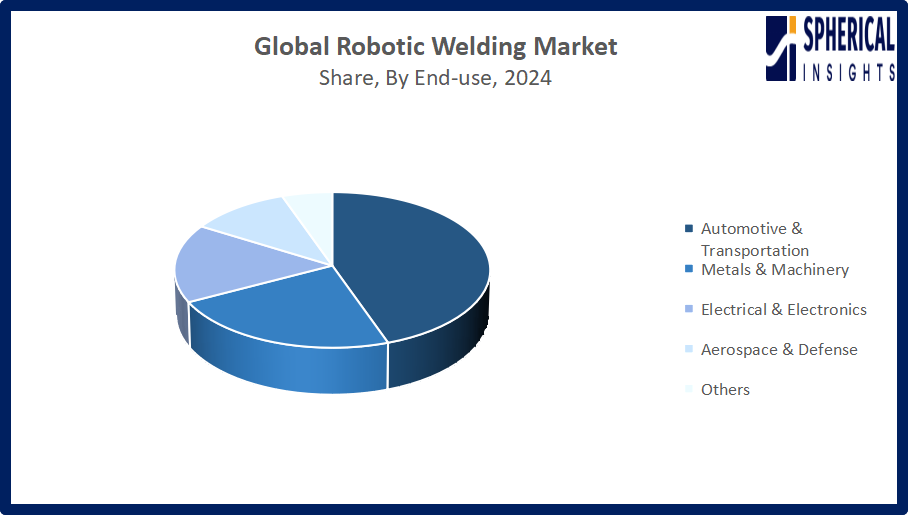
- By end use, the automotive & transportation segment accounted for the highest market share of 45% in 2024.
- By end use, the electrical & electronics segment is expected to expand significantly between the period from 2024 to 2035.
Market Overview
The global robotic welding market refers to programmable automated systems that perform welding tasks with high precision and consistency, reducing human intervention while ensuring superior quality and operational efficiency across manufacturing environments. These systems find extensive applications in automotive manufacturing for chassis assembly and body panel joining, in metal fabrication for structural components, and in aerospace for precise fabrication of aircraft parts. In February 2026, the Australian federal government granted over $17 million to 44 businesses. In South Australia, Global Welding Technologies Group received $226,471 to develop an advanced welding and training centre, supporting manual and robotic welding for national shipbuilding programs, including Hunter-class frigates and future AUKUS submarines.
A primary market driver is the severe labor shortage, with the American Welding Society projecting a deficit of 320,500 welders by 2029, compelling manufacturers to adopt automation solutions. The integration of Industry 4.0 technologies such as AI and IoT enables smart manufacturing with real-time weld defect detection, achieving accuracy with an AUC of 0.92 using multi-sensor systems. Technological advancements such as AI-assisted weld monitoring, machine vision, and IoT-enabled predictive maintenance enhance operational efficiency and reduce downtime, creating significant opportunities. In February 2025, the National Research Council of Canada (NRC) awarded $200,000 to Groupe CFR to develop an intelligent robotic welding process. The system enables complex welding paths without traditional programming, reflecting Canada’s commitment to advancing automation and technological innovation in the welding industry.
Robotic Welding Market Trends
- Increasing adoption of automation in manufacturing is driving the demand for robotic welding systems globally.
- Rising production of electric vehicles is accelerating the use of robotic welding in automotive assembly lines.
- Integration of artificial intelligence, sensors, and machine vision is improving welding precision and efficiency.
- Growing adoption of collaborative robots (cobots) is expanding robotic welding applications in small and medium-sized enterprises.
- Advancements in arc and spot welding technologies are enhancing speed, flexibility, and productivity in automated welding.
Report Coverage
This research report categorizes the robotic welding market based on various segments and regions, forecasts revenue growth, and analyzes trends in each submarket. The report analyses the key growth drivers, opportunities, and challenges influencing the robotic welding market. Recent market developments and competitive strategies, such as expansion, type launch, development, partnership, merger, and acquisition, have been included to draw the competitive landscape in the market. The report strategically identifies and profiles the key market players and analyses their core competencies in each sub-segment of the robotic welding market.
Global Robotic Welding Market Report Coverage
| Report Coverage | Details |
|---|---|
| Base Year: | 2024 |
| Market Size in 2024: | USD 9.50 Billion |
| Forecast Period: | 2025-2035 |
| Forecast Period CAGR 2025-2035 : | 9.82% |
| 2035 Value Projection: | USD 26.62 Billion |
| Historical Data for: | 2020-2023 |
| No. of Pages: | 195 |
| Tables, Charts & Figures: | 102 |
| Segments covered: | By Type, By Payload |
| Companies covered:: | FANUC Corporation, Panasonic Corporation, ABB Ltd., Kuka AG, Daihen Corporation, Fronius International GmbH, Yaskawa Electric Corporation, Comau S.p.A., Kawasaki Heavy Industries, Ltd., Hyundai Robotics, NACHI-FUJIKOSHI Corp., Universal Robots A/S, Kemppi Oy, IGM Robotersysteme AG, and Other Key Players |
| Pitfalls & Challenges: | and COVID-19 Impact Analysis |
Get more details on this report -
Driving Factors
Key driving factors for the global robotic welding market include rapidly rising industrial automation and manufacturing digitalization, especially in automotive and EV production, where precision and throughput are critical, with global robotic welding installations exceeding 67,000 units in 2024 and growing robustly year on year. Adoption is fuelled by labour shortages, with manual welders insufficient to meet demand, prompting manufacturers to automate to boost efficiency and consistency. Industry 4.0 technologies like AI and machine vision enhance weld quality and predictive maintenance, reducing defects by up to 45 to 67 percent and boosting productivity. Additionally, governments’ initiatives to modernize manufacturing and the push for cost reduction in high volume production further boost market growth. In January 2026, Guangxi introduced 17 measures to strengthen its robotics industry. Welding sector incentives include 10% investment subsidies (up to 50 million yuan/6.87 million) and rewards for output milestones. The plan also promotes robot + manufacturing applications in welding, handling, and palletizing to advance industrial automation.
Restraining Factors
The global robotic welding market faces significant restraints, primarily high initial costs and technical complexity. A basic collaborative robot system costs USD250,000 to USD350,000, which is 1.5x higher than traditional equipment, creating barriers for SMEs. Integration complexity extends payback periods, particularly challenging for small manufacturers with limited technical expertise. Additionally, trade tariffs on imported components increase costs by raising prices of robotic arms, sensors, and controllers, affecting return on investment timelines.
Market Segmentation
Type Insights
The spot welding segment registered the largest share of the robotics welding market in 2024. Spot welding is a resistance welding process that joins metal sheets using electric current. Known for its speed and efficiency, it is widely used in automotive mass production. The process consumes less energy and improves productivity. Continuous technological advancements in spot welding are further supporting the growth of the global robotic welding market.
The arc welding segment is expected to grow rapidly in the robotics welding market during the forecast period. Arc welding uses an electric arc to melt and join metals across industries such as automotive, shipbuilding, aerospace, and construction. Its flexibility and compatibility with multiple metals increase adoption, driving technological advancements and automation in robotic welding systems.
Payload Insights
The 50 to 150 kg segment led the global robotics welding market in 2024. This dominance is attributed to their versatility across multiple applications. They are suitable for various tasks in industries such as agriculture, logistics, and manufacturing. The 50 to 150 kg payload robots are gaining popularity due to lower battery consumption, easier maintenance, and operational efficiency. Their manageable size and handling also make them a safer and more practical option for manufacturers and small and medium-sized businesses.
End use Insights
The automotive & transportation segment dominated the robotics welding market in 2024. The growth of this segment is attributed to the high demand for automated, high precision welding in vehicle manufacturing. Increasing production of passenger and electric vehicles, rising adoption of automation in assembly lines, and the need for consistent weld quality and faster production cycles are driving the extensive use of robotic welding systems in automotive manufacturing facilities.
The electrical & electronics segment is expected to expand significantly in the robotics welding market in the period. The segment is gaining popularity due to the growing need for system control in robotic welding. The increasing number of robotic systems drives demand for sensors and microcontrollers, which monitor parameters such as heat, temperature, and other critical components to ensure precision, safety, and efficient welding operations.
Get more details on this report -
Regional Segment Analysis of the Robotic Welding Market
- North America (U.S., Canada, Mexico)
- Europe (Germany, France, U.K., Italy, Spain, Rest of Europe)
- Asia-Pacific (China, Japan, India, Rest of APAC)
- South America (Brazil and the Rest of South America)
- The Middle East and Africa (UAE, South Africa, Rest of MEA)
Asia Pacific Market Trends
Asia Pacific dominated the robotic welding market with the 37% market share. The growth of the region is attributed to rapid industrialization, strong automotive manufacturing, and increasing adoption of industrial automation across major economies such as China, Japan, South Korea, and India. The region hosts some of the world’s largest automotive and electronics production hubs, where robotic welding is widely used for high precision and high volume manufacturing. Government initiatives supporting smart factories and industrial robotics, along with rising investments in Industry 4.0 technologies, are further accelerating the adoption of robotic welding systems across manufacturing sectors in the Asia Pacific. In December 2025, Mangaluru concluded the 10 day Master Trainers Training Programme (MTTP) on industrial automation and robotics. Organized by MVCTMTSD and NITK Surathkal, 30 faculty from Karnataka government institutions enhanced skills in PLCs, industrial sensors, actuators, IoT, control systems, and unmanned vehicles, strengthening industry ready technical competence.
China Robotic Welding Market Trends
The China robotic welding market is expanding rapidly due to strong industrial automation, large scale automotive production, and government support for robotics. Initiatives such as the Made in China 2025 promote smart manufacturing. Rising adoption of collaborative robots, AI based welding systems, and increasing demand from EV, shipbuilding, and heavy machinery industries are accelerating market growth. In November 2025, China’s MIIT launched the Robot+ Action, promoting industrial and humanoid robots in welding, assembly, and spraying. The initiative targets complex, hazardous environments, including mining and emergency rescue, to expand safe and efficient robotic applications nationwide.
North America Market Trends
North America is the fastest growing market for robotic welding, with an approximate 28% share. The region is gaining popularity in the market due to rising automation adoption and strong manufacturing investments in countries such as the United States, Canada, and Mexico. Increasing demand for electric vehicles, aerospace components, and metal fabrication is accelerating robotic welding deployment. In addition, labor shortages and high labor costs are encouraging manufacturers to adopt automated welding systems to improve productivity, ensure consistent weld quality, and support high volume industrial production across the region. In June 2024, the U.S. Economic Development Administration awarded 1.6 million to Minnesota West Community and Technical College for a mobile mechatronics classroom and welding trailer. The initiative aims to train skilled workers for advanced welding and robotics, create/retain 250 jobs, and attract 1 million in private investment.
Europe Robotic Welding Market Trends
Europe’s robotic welding market is growing due to strong industrial automation and advanced manufacturing across countries such as Germany, France, Italy, and the United Kingdom. The region’s well-established automotive, aerospace, and machinery industries are increasing the adoption of robotic welding to improve production efficiency, ensure precision, and address skilled labor shortages while supporting smart factory and Industry 4.0 initiatives.
Competitive Analysis:
The report offers the appropriate analysis of the key organizations/companies involved within the robotic welding market, along with a comparative evaluation primarily based on their type of offering, business overviews, geographic presence, enterprise strategies, segment market share, and SWOT analysis. The report also provides an elaborative analysis focusing on the current news and developments of the companies, which includes type development, innovations, joint ventures, partnerships, mergers & acquisitions, strategic alliances, and others. This allows for the evaluation of the overall competition within the market.
List of Key Companies
- FANUC Corporation
- Panasonic Corporation
- ABB Ltd.
- Kuka AG
- Daihen Corporation
- Fronius International GmbH
- Yaskawa Electric Corporation
- Comau S.p.A.
- Kawasaki Heavy Industries, Ltd.
- Hyundai Robotics
- NACHI-FUJIKOSHI Corp.
- Universal Robots A/S
- Kemppi Oy
- IGM Robotersysteme AG
- Others
Key Target Audience
- Market Players
- Investors
- End-users
- Government Authorities
- Consulting and Research Firm
- Venture capitalists
- Value-Added Resellers (VARs)
Recent Development
- In December 2025, HD Hyundai Heavy Industries deployed compact portable welding robots in South Korean shipyards. Developed with JCT and Rainbow Robotics, the lightweight robotic arm automates complex interior ship welding, improving precision and addressing skilled labour shortages in the shipbuilding industry.
- In December 2025, Fronius expanded its WireSense robot-assisted welding system to construction, agricultural machinery, commercial transport, and metalworking industries. The patented technology uses welding wire as a sensor to detect component positions, improving weld accuracy and significantly reducing rework and defective parts in automated welding processes.
- In September 2025, Panasonic Factory Solutions showcased its TAWERS G4 Welding Robot System at Schweissen & Schneiden 2025 in Essen. The system demonstrated advanced automated welding control, delivering improved precision, reduced spatter, faster cycle times, and simplified programming for high volume industrial manufacturing environments.
Market Segment
This study forecasts revenue at global, regional, and country levels from 2020 to 2035. Spherical Insights has segmented the Robotic Welding Market based on the below mentioned segments:
Global Robotic Welding Market, By Type
- Arc Welding
- Spot Welding
- MIG (Metal Inert Gas)
- TIG (Tungsten Inert Gas)
- Laser Welding
- Others
Global Robotic Welding Market, By Payload
- <50 kg Payload
- 50-150 kg Payload
- >150 kg Payload
Global Robotic Welding Market, By End-use
- Automotive & Transportation
- Metals & Machinery
- Electrical & Electronics
- Aerospace & Defense
- Others
Global Robotic Welding Market, By Regional Analysis
- North America
- US
- Canada
- Mexico
- Europe
- Germany
- UK
- France
- Italy
- Spain
- Russia
- Rest of Europe
- Asia Pacific
- China
- Japan
- India
- South Korea
- Australia
- Rest of Asia Pacific
- South America
- Brazil
- Argentina
- Rest of South America
- Middle East & Africa
- UAE
- Saudi Arabia
- Qatar
- South Africa
- Rest of the Middle East & Africa
Frequently Asked Questions (FAQ)
-
1.How is the adoption of robotic welding impacting productivity and operational efficiency in manufacturing industries?Adoption of robotic welding improves manufacturing productivity by 30-50%, enabling 24/7 operations and reducing cycle times by up to 31%. It also lowers defects and rework, improving overall operational efficiency and reducing labor costs by up to 50%.
-
2.What key technological innovations are transforming robotic welding systems in industries such as automotive and aerospace?Key innovations transforming robotic welding include AI-driven weld monitoring, machine-vision seam tracking, collaborative robots (cobots), and IoT-based predictive maintenance. These technologies reduce welding defects by 31-46% and increase productivity by up to 30% in automotive and aerospace manufacturing.
-
3.How is the global economic environment influencing investments in robotic welding automation?The global economic environment is accelerating investment in robotic welding as manufacturers seek efficiency and cost savings. Global industrial robot installations exceeded 541,000 units annually, while automation investments deliver ROI within 12-18 months, encouraging manufacturers to expand robotics adoption despite economic uncertainty.
-
4.What role does industrial automation play in expanding the size of the robotic welding market worldwide?Industrial automation significantly expands the robotic welding market by improving productivity and consistency. Global industrial robot installations reached about 541,000 units in 2023, with automotive manufacturing using over 30% of robots, accelerating robotic welding adoption worldwide.
-
5.How are advancements in AI, sensors, and collaborative robots shaping the future of robotic welding technology?Advancements in AI, smart sensors, and collaborative robots (cobots) are transforming robotic welding by enabling real-time monitoring and adaptive control. AI systems can reduce welding defects by up to 40% and increase production efficiency by around 20-25%, improving precision and automation in automotive and aerospace manufacturing
-
6.What economic benefits are manufacturers gaining from implementing robotic welding systems in production lines?Manufacturers gain major economic benefits from robotic welding, including 30-50% higher productivity and up to 50% labor-cost savings. Automation also reduces defects and rework, delivering ROI within 12-18 months for many manufacturing facilities.
-
7.How is the increasing demand for electric vehicles impacting the global robotic welding market growth?Rising electric-vehicle demand is boosting robotic welding adoption, as about 14 million EVs were sold globally in 2023, a 35% increase from 2022, requiring automated welding for battery housings, lightweight frames, and chassis assembly.
Need help to buy this report?