Global Restaurant Digitalization Market Size, Share, and COVID-19 Impact Analysis, By Component (Software and Hardware), By Restaurant Type (Cafes, Fast Food, and Dining), By Application (Contactless Payment, Online Ordering Systems & Delivery Apps, Automated Inventory Management Software, Digital Kitchen Boards, Marketing, and Other Applications), and By Region (North America, Europe, Asia-Pacific, Latin America, Middle East, and Africa), Analysis and Forecast 2025 - 2035.
Industry: Information & Technology
Global Restaurant Digitalization Market Insights Forecasts to 2035
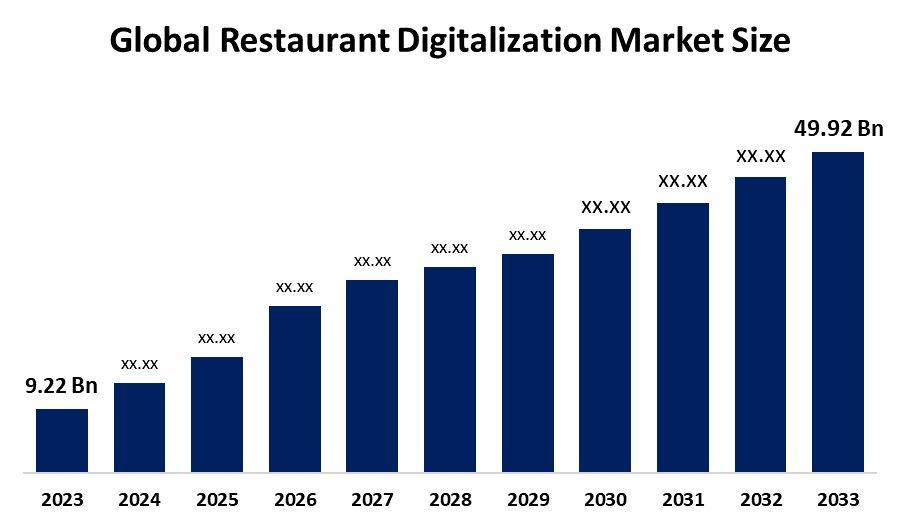
- The Global Restaurant Digitalization Market Size Was Estimated at USD 9.22 Billion in 2024
- The Market Size is Expected to Grow at a CAGR of around 16.6% from 2025 to 2035
- The Worldwide Restaurant Digitalization Market Size is Expected to Reach USD 49.92 Billion by 2035
- North America is expected to grow the fastest during the forecast period.
Get more details on this report -
According to a research report published by Spherical Insights and Consulting, the Global Restaurant Digitalization Market Size was Worth Around USD 9.22 Billion In 2024 And Is Predicted To Grow To Around USD 49.92 Billion By 2035 With A Compound Annual Growth Rate (CAGR) of 16.6% from 2025 to 2035. The restaurant digitalization market is expanding rapidly due to rising consumer demand for convenience, contactless ordering, and personalized experiences. The increased adoption of AI, mobile apps, and self-service kiosks enables restaurants to improve operational efficiency, reduce labour costs, and manage digital orders more effectively.
Market Overview
The Global Restaurant Digitalization Market refers to the adoption of digital technologies, such as POS systems, online ordering platforms, self-service kiosks, mobile apps, contactless payments, inventory management software, digital kitchen displays, and AI-driven analytics, transforming traditional restaurant operations into efficient, customer-centric, software-enhanced ecosystems. These technologies include point-of-sale (POS) systems, online ordering platforms, inventory management tools, AI-driven personalisation engines, and automated kitchen equipment that streamline workflows and enhance the dining experience. In February 2026, Shandong Province implemented measures to promote Digital + Catering and modernise the restaurant industry. The plan encourages digital upgrades for market analysis and customer engagement and introduces the Lu AI Intelligence project, using AI to document Lu cuisine, chefs, dishes, and restaurants on a digital promotion platform.
The market is driven by surging consumer demand for convenience, with digital channels now driving over 40% of transactions for leading restaurant chains. The rapid expansion of online ordering and delivery services is accelerating adoption, as digital orders generate 30% higher value than traditional orders. Additionally, 73% of restaurant operators plan to invest in AI and automation solutions by 2025. Labor pressures with turnover rates reaching 70% annually and the need for cost reduction further compel digitalization. Opportunities lie in AI-powered personalization that increases average order value by 18-26%, predictive analytics improving revenue forecasting accuracy by 22%, and automation reducing material costs by up to 15%. In February 2026, the National Restaurant Association reported that U.S. restaurant sales are projected to reach 1.55 trillion, with over 100,000 jobs added. Despite labor challenges, high costs, and cautious consumer spending, dining out, takeout, and delivery remain culturally significant, supporting steady growth in America’s foodservice industry.
Report Coverage
This research report categorizes the restaurant digitalization market based on various segments and regions, forecasts revenue growth, and analyzes trends in each submarket. The report analyses the key growth drivers, opportunities, and challenges influencing the restaurant digitalization market. Recent market developments and competitive strategies, such as expansion, type launch, development, partnership, merger, and acquisition, have been included to draw the competitive landscape in the market. The report strategically identifies and profiles the key market players and analyses their core competencies in each sub-segment of the restaurant digitalization market.
Global Restaurant Digitalization Market Report Coverage
| Report Coverage | Details |
|---|---|
| Base Year: | 2024 |
| Market Size in 2024: | USD 9.22 Billion |
| Forecast Period: | 2025-2035 |
| Forecast Period CAGR 2025-2035 : | CAGR Of 16.6% |
| 2035 Value Projection: | USD 49.92 Billion |
| Historical Data for: | 2020-2023 |
| No. of Pages: | 240 |
| Tables, Charts & Figures: | 90 |
| Segments covered: | By Component , By Restaurant Type |
| Companies covered:: | Digitory Solutions Pvt. Ltd. Panasonic Corp. Toast, Inc. Cognizant Technology Solutions Corp. Oracle Corporation International Business Machines Corp. Clear Solutions Lightspeed Commerce Inc. Fourth Enterprises LLC TouchBistro Inc. Flipdish Ltd. Snappy Innovation Inc. ParTech Inc. Fiserv, Inc. MustHaveMenus Inc. Others Key Players |
| Pitfalls & Challenges: | COVID-19 Empact, Challenge, Future, Growth, & Analysis |
Get more details on this report -
Driving Factors
Major Global Restaurant Digitalization Market drivers include growing consumer demand for convenience, as online ordering, mobile applications, and digital menus align with evolving preferences and are projected to drive substantial sales growth. Efficiency improvements from POS systems and cloud-based management help reduce labor costs and streamline order processing; for instance, digital kiosks have lowered labor expenses by 15% in quick-service restaurants worldwide. Contactless and mobile payment methods now account for the majority of transactions, with non-cash payments boosting adoption. Integration with delivery platforms and digital loyalty programs enhances repeat visits by up to 35%, supporting market expansion. In July 2025, Enterprise Singapore and IMDA launched an updated Food Services Industry Digital Plan at Restaurant Asia and SIGEP Asia 2025. The refreshed plan adds automation, promoting smart kitchens, cooking robots, AI inventory management, and automated workflows, while enhancing digital skills training and cybersecurity for F&B businesses facing manpower shortages.
Restraining Factors
Key restraining factors in the global restaurant digitalization market include high initial investment in digital infrastructure, cybersecurity concerns, lack of technical expertise among staff, resistance to change in traditional operations, and inconsistent internet connectivity in emerging regions. These challenges slow adoption and limit market penetration, particularly for small restaurants.
Market Segmentation
The restaurant digitalization market share is classified into component, restaurant type, and application.
- The software segment dominated the market in 2024, approximately 58% and is projected to grow at a substantial CAGR during the forecast period.
Based on the component, the restaurant digitalization market is divided into software and hardware. Among these, the software segment dominated the market in 2024 and is projected to grow at a substantial CAGR during the forecast period. The software segment is dominated by streamlining restaurant operations, from reservations and ordering to inventory and staff scheduling. Growing demand for integrated, scalable solutions, especially cloud-based systems, supports efficiency across all restaurant sizes. AI and analytics integration enables data-driven decisions, enhancing customer experience, operational performance, and competitiveness, making software essential for dynamic, modern restaurant management.
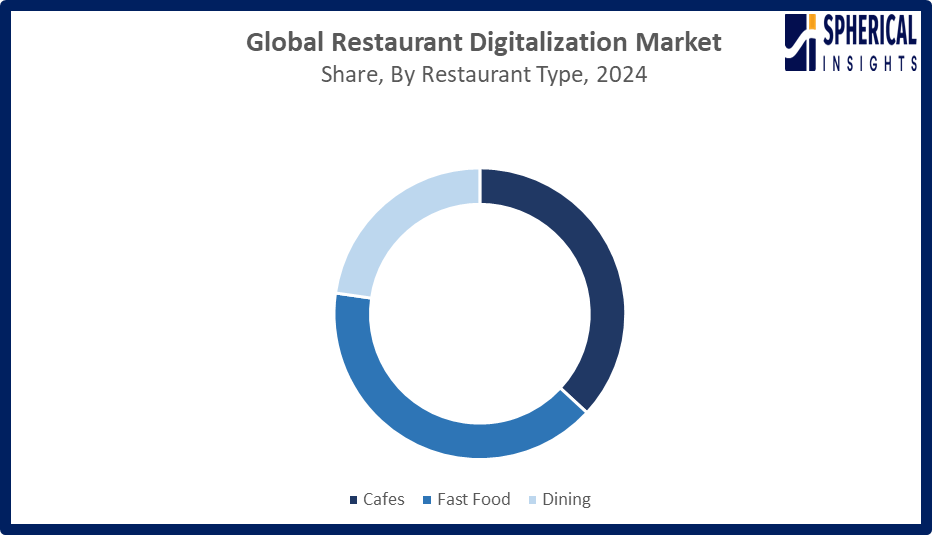
- The fast food segment accounted for the largest share in 2024, approximately 40% and is anticipated to grow at a significant CAGR during the forecast period.
Based on the restaurant type, the restaurant digitalization market is divided into cafes, fast food, and dining. Among these, the fast food segment accounted for the largest share in 2024 and is anticipated to grow at a significant CAGR during the forecast period. This segment growth in digital adoption owing to its need for speed and efficiency. Restaurants use digital ordering systems, self-service kiosks, and mobile apps to reduce wait times and boost customer satisfaction. Advanced analytics help manage inventory, optimize staff scheduling, and respond quickly to consumer preferences, making digital solutions essential in fast-paced operations.
Get more details on this report -
- The online ordering systems & delivery apps segment accounted for the highest market revenue in 2024, approximately 26% and is anticipated to grow at a significant CAGR during the forecast period.
Based on the application, the restaurant digitalization market is divided into contactless payment, online ordering systems & delivery apps, automated inventory management software, digital kitchen boards, marketing, other applications. Among these, the online ordering systems & delivery apps segment accounted for the highest market revenue in 2024 and is anticipated to grow at a significant CAGR during the forecast period. This segment leads due to rising consumer demand for convenience and speed. Online ordering and delivery apps provide seamless, contact-free experiences, especially in fast-paced urban areas. Accelerated by the pandemic, these platforms remain popular, offering valuable data for analyzing preferences, adjusting menus, optimizing pricing, and improving restaurant operations and profitability.
Regional Segment Analysis of the Restaurant Digitalization Market
- North America (U.S., Canada, Mexico)
- Europe (Germany, France, U.K., Italy, Spain, Rest of Europe)
- Asia-Pacific (China, Japan, India, Rest of APAC)
- South America (Brazil and the Rest of South America)
- The Middle East and Africa (UAE, South Africa, Rest of MEA)
North America is anticipated to hold the largest share of the restaurant digitalization market over the predicted timeframe.

Get more details on this report -
North America is anticipated to hold the largest share of the restaurant digitalization market over the predicted timeframe. The region’s growth is driven primarily by the United States and Canada, with an approximate 37% share. High technology adoption in restaurants, advanced digital infrastructure, and widespread use of POS systems, mobile ordering apps, and contactless payments support growth. The U.S., with its mature quick-service and full-service restaurant sectors, accounts for the majority of regional revenue. Consumers’ preference for convenience, along with strong investment in AI, analytics, and cloud-based solutions, further accelerates digitalization adoption across North American foodservice establishments. In January 2026, the Manhattan Chamber of Commerce launched Tech to Table, a six-week AI accelerator supported by Google.org. It trains 80 food entrepreneurs in AI tools, offering 5,000 grants to boost digital adoption and support small restaurant transformation.
Asia Pacific is expected to grow at a rapid CAGR in the restaurant digitalization market during the forecast period. The region is led by China, India, Japan, and South Korea, with an approximate market 25% share. Rapid urbanization, growing smartphone penetration, and increasing demand for convenience are accelerating the adoption of online ordering, mobile payments, and self-service kiosks. Government initiatives supporting digital infrastructure, along with expanding food delivery ecosystems, are driving widespread technology integration. In January 2026, China’s State Administration for Market Regulation issued Order No. 123, updating online catering safety rules. Effective June 1, 2026, the regulation mandates strict digital compliance for platforms and restaurants, replacing the 2017 version and driving widespread technology adoption across China’s food service industry.
Europe’s restaurant digitalization market growth is driven mainly by Germany, the UK, and France. Rising consumer demand for contactless payments, online ordering, and personalized dining experiences is fueling adoption. Additionally, restaurants increasingly implement cloud-based POS systems, AI analytics, and automated workflows to improve operational efficiency, reduce labor costs, and enhance customer engagement, supporting steady digital transformation across European foodservice establishments. On January 14, 2026, the European Commission launched a 15 million Horizon Europe AI funding call to support human-centric generative AI in food services. Funding two projects, it aims to boost sustainability, productivity, SME innovation, data access, and stakeholder collaboration across the entire food system.
Competitive Analysis:
The report offers the appropriate analysis of the key organizations/companies involved within the restaurant digitalization market, along with a comparative evaluation primarily based on their type of offering, business overviews, geographic presence, enterprise strategies, segment market share, and SWOT analysis. The report also provides an elaborative analysis focusing on the current news and developments of the companies, which includes type development, innovations, joint ventures, partnerships, mergers & acquisitions, strategic alliances, and others. This allows for the evaluation of the overall competition within the market.
List of Key Companies
- Digitory Solutions Pvt. Ltd.
- Panasonic Corp.
- Toast, Inc.
- Cognizant Technology Solutions Corp.
- Oracle Corporation
- International Business Machines Corp.
- Clear Solutions
- Lightspeed Commerce Inc.
- Fourth Enterprises LLC
- TouchBistro Inc.
- Flipdish Ltd.
- Snappy Innovation Inc.
- ParTech Inc.
- Fiserv, Inc.
- MustHaveMenus Inc.
- Others
Key Target Audience
- Market Players
- Investors
- End-users
- Government Authorities
- Consulting and Research Firm
- Venture capitalists
- Value-Added Resellers (VARs)
Recent Development
- In February 2026, India-based startup Digitory raised $500,000 in a Pre-Series A round. The company plans expansion and product enhancement. Its cloud-based platform streamlines multi-location restaurant operations, offering inventory, analytics, and automation solutions, supporting over 1.8 million customers across leading restaurant and brewery chains.
- In February 2026, Toast Inc. partnered with Instacart to integrate restaurants with the Instacart Marketplace. The collaboration enables real-time inventory alignment and same-day procurement, allowing restaurants to order fresh supplies quickly through Instacart Business across the U.S. and Canada.
- In July 2025, Panasonic Life Solutions India launched digital hospitality solutions through its SSD division. Innovations like Electronic Smart Labels and eSignCard enable contactless services, real-time updates, and sustainable operations, helping hotels and restaurants enhance efficiency, streamline workflows, and deliver seamless, digital-first guest experiences.
- In April 2025, Fiserv expanded its Clover POS into the premium dining segment, signing a luxury restaurant in Brooklyn. The new Clover Hospitality solution, designed for high-end restaurants, was previewed ahead of its official debut at the National Restaurant Association Show in Chicago.
- In February 2024, MustHaveMenus launched MustHaveMenus Display, a digital display management system integrated with its menu design tool. The solution enables restaurants to instantly update menus, branding, and promotions across multiple screens, enhancing customer engagement through dynamic, multimedia content and streamlined digital operations.
- In May 2024, TouchBistro highlighted its integrated technology solutions to help restaurants tackle rising costs and operational challenges. Its platform offers POS, reservations, loyalty, inventory, and labor management tools, enabling operators to streamline workflows, improve efficiency, and adopt flexible, end-to-end digital solutions across restaurant operations.
Market Segment
This study forecasts revenue at global, regional, and country levels from 2020 to 2035. Spherical Insights has segmented the restaurant digitalization market based on the below-mentioned segments:
Global Restaurant Digitalization Market, By Component
- Software
- Hardware
Global Restaurant Digitalization Market, By Restaurant Type
- Cafes
- Fast Food
- Dining
Global Restaurant Digitalization Market, By Application
- Contactless Payment
- Online Ordering Systems & Delivery Apps
- Automated Inventory Management Software
- Digital Kitchen Boards
- Marketing
- Other Applications
Global Restaurant Digitalization Market, By Regional Analysis
- North America
- US
- Canada
- Mexico
- Europe
- Germany
- UK
- France
- Italy
- Spain
- Russia
- Rest of Europe
- Asia Pacific
- China
- Japan
- India
- South Korea
- Australia
- Rest of Asia Pacific
- South America
- Brazil
- Argentina
- Rest of South America
- Middle East & Africa
- UAE
- Saudi Arabia
- Qatar
- South Africa
- Rest of the Middle East & Africa
Frequently Asked Questions (FAQ)
-
How is digital transformation impacting operational efficiency in the global restaurant digitalization market?Digital transformation significantly improves restaurant efficiency, with 95% of operators reporting better performance. Technologies like POS and kiosks reduce order errors by 25%, cut ticket times by 15%, and lower labor costs by 15%, enhancing overall productivity.
-
What key technology trends are driving adoption in the restaurant digitalization market?Key technology trends include AI, cloud POS, and automation, with 69% of restaurants adopting AI and 78% using POS systems. Mobile ordering (72%) and contactless payments (66%) further accelerate digital adoption
-
How are AI and automation innovations reshaping restaurant operations worldwide?AI and automation are transforming restaurant operations globally, with 35% using AI kiosks and 40% adopting chatbots. These technologies reduce food waste by 20-30%, cut labor costs by 12-8%, and increase revenue by 15-20% through efficiency gains
-
What role do online ordering and delivery platforms play in market expansion?Online ordering and delivery platforms significantly drive market expansion, contributing over 24.5% market share and generating 23% higher order values. They also account for up to 67% of restaurant revenue, expanding customer reach and boosting sales
-
How is the market influencing overall economic growth in the global foodservice industry?The market boosts economic growth by increasing efficiency and revenue, with digital adoption raising sales by 15-20%. Global foodservice revenue is projected to exceed $4.5 trillion, supported by technology-driven productivity and expansion
-
How are cloud-based POS and analytics solutions transforming restaurant management?Cloud-based POS and analytics solutions transform restaurant management by enabling real-time insights (71% adoption), reducing administrative workload by 42%, improving order accuracy by 37%, and lowering IT costs by 20-30%, driving data-driven decisions and efficiency
-
What impact does rising labour costs have on digital adoption in restaurants?Rising labor costs accelerate digital adoption, with 72% of QSRs implementing kiosks to cut labor costs by 15%, while 71% use labor management software, reducing staffing expenses by 15%, improving efficiency.
-
How is digitalization improving customer experience and revenue generation in restaurants?Digitalization enhances customer experience and revenue, with personalized offers increasing spending by 20%, mobile ordering boosting convenience, and digital orders generating 30% higher value, while loyalty programs improve repeat visits by up to 35%.
Need help to buy this report?