Global Resorcinol Market Size, Share, and COVID-19 Impact Analysis, By Production Method (Benzene Disulfonation, Hydroperoxidation of Meta-Diisopropylbenzene, and Hydrolysis of Meta-Phenylenediamine), By Application (Tire and Rubber Products, Wood Adhesives and Binders, UV Products and Dyes, Flame Retardants, and Others), By End-Use (Automotive, Building and Construction, Healthcare, Electrical and Electronics, and Others), and By Region (North America, Europe, Asia-Pacific, Latin America, Middle East, and Africa), Analysis and Forecast 2025 - 2035
Industry: Chemicals & Materials
Global Resorcinol Market Size Insights Forecasts to 2035
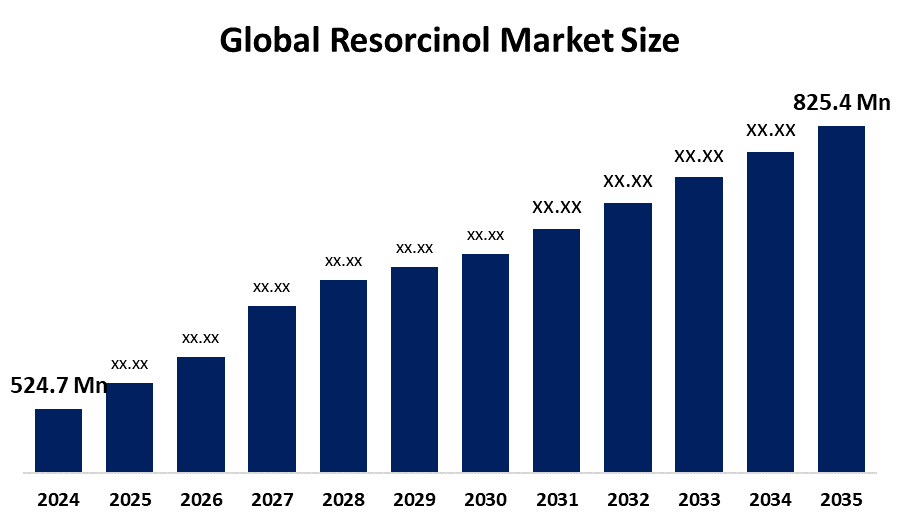
- The Global Resorcinol Market Size Was Estimated at USD 524.7 Million in 2024
- The Market Size is Expected to Grow at a CAGR of around 4.2% from 2025 to 2035
- The Worldwide Resorcinol Market Size is Expected to Reach USD 825.4 Million by 2035
- North America is expected to Grow the fastest during the forecast period.
Get more details on this report -
According to a Research Report Published by Spherical Insights and Consulting, The Global Resorcinol Market Size was worth around USD 524.7 Million in 2024 and is predicted to Grow to around USD 825.4 Million by 2035 with a compound annual growth rate (CAGR) of 4.2% from 2025 to 2035. The main reason for growing demands for resorcinol across various parts of the world, specifically in applications involving automotive, construction, pharmacy, and cosmetics, is related to its application for producing high-performance adhesives.
Market Overview
The global resorcinol market is defined by the production, distribution, and consumption of resorcinol, a versatile organic chemical, used primarily in adhesive, paint, pharmaceutical, and rubber chemicals applications, such as wood adhesives, tire reinforcing chemicals, UV curable coatings, and certain pharmaceuticals because of their excellent bonding, chemical resistance, and curable qualities. Growth in the automotive, construction, and electronics industries, especially for high-performance adhesives, is driving demand for resorcinol worldwide. Resorcinol's advantages are its high reactivity, good bonding properties, and excellent curable qualities, improving durability, strength, and overall performance in end-use products.
Unexplored market areas for resorcinol are in ecologically friendly forms or derivatives, bio-based products, advanced adhesives for emerging sectors such as renewable energies, healthcare, or in electronic devices, developing more efficient, environmentally balanced, more biodegradable, or non-toxic formulas for diversified applications in the growing market. Major market players in the resorcinol market are Arakawa Chemical Industries, SI Group, Lonza Group, Lanxess, and Shikoku Chemicals. France proposed a new harmonized classification of Resorcinol (CAS 108-46-3) to the European Chemicals Agency (ECHA) in January 2025 to create a restriction regarding the hazard statement EUH380 on human health to recognize Resorcinol as an endocrine disruptor. As an antioxidant in cosmetics products acting as a denaturant, hair dyeing agent, or perfuming agent, this is France's second push to ensure a stronger EU restriction under Regulation EC No.1223/2009.
Report Coverage
This research report categorizes the resorcinol market based on various segments and regions, forecasts revenue growth, and analyzes trends in each submarket. The report analyses the key growth drivers, opportunities, and challenges influencing the resorcinol market. Recent market developments and competitive strategies, such as expansion, type launch, development, partnership, merger, and acquisition, have been included to draw the competitive landscape in the market. The report strategically identifies and profiles the key market players and analyses their core competencies in each sub-segment of the resorcinol market.
Global Resorcinol Market Report Coverage
| Report Coverage | Details |
|---|---|
| Base Year: | 2024 |
| Market Size in 2024: | USD 524.7 Million |
| Forecast Period: | 2025-2035 |
| Forecast Period CAGR 2025-2035 : | 4.2% |
| 2035 Value Projection: | USD 825.4 Million |
| Historical Data for: | 2020-2023 |
| No. of Pages: | 164 |
| Tables, Charts & Figures: | 146 |
| Segments covered: | By Production Method, By Application and COVID-19 Impact Analysis |
| Companies covered:: | Arakawa Chemical Industries, Sumitomo Chemical, Lonza Group, Dow Chemical Company, Lanxess AG, SI Group, Evonik Industries AG, Dynea AS, Kraeber and Co. GmbH, Shikoku Chemicals, Mitsui Chemicals, Akrochem Corporation, Amino-Chem Co. Ltd., Sinopec Shanghai Petrochemical, and Others |
| Pitfalls & Challenges: | COVID-19 Empact, Challenges, Future, Growth, & Analysis |
Get more details on this report -
Driving Factors
The primary factors responsible for the growth of the global resorcinol market include the wide usage of resorcinol in adhesives, paints, and rubber goods. Its key properties, such as good chemical stability, strong adhesive strength, and ability to protect from UV light, make it a vital compound for use in tire materials, wood adhesives, and building materials. Growth is informed by rising demand across automotive, construction, and electronics sectors for high-performance tires, laminates, and industrial coatings. Additional awareness of durable, high-strength material solutions, along with the adoption of resorcinol-based solutions in aerospace and renewable energy applications, creates considerable opportunities for this market. Expanding industrialization in emerging economies further accelerates global resorcinol demand.
Restraining Factors
Fluctuating raw material prices, coupled with high production costs and strict environmental regulations on the handling of chemicals and their resultant emissions, act as the major restraints on the global resorcinol market. Besides this, there are a few alternatives in adhesives and bonding agents, and the complex manufacturing process restricts wider adoption and grows the market at a slow pace.
Market Segmentation
The resorcinol market share is classified into production method, application, and end-use.
- The benzene disulfonation segment dominated the market in 2024, approximately 58% and is projected to grow at a substantial CAGR during the forecast period.
Based on the production method, the resorcinol market is divided into benzene disulfonation, hydroperoxidation of meta-diisopropylbenzene, and hydrolysis of meta-phenylenediamine. Among these, the benzene disulfonation segment dominated the market in 2024 and is projected to grow at a substantial CAGR during the forecast period. The benzene disulfonation process was the major growing element in the resorcinol market, being more efficient and scalable for commercial production. The ability to yield resorcinol with high purity for use in the manufacture of adhesives, paints, and rubber further establishes this process as the best. Moreover, its suitability for commercial production further added to its dominance in the resorcinol market.
- The tire and rubber products segment accounted for the largest share in 2024, approximately 50% and is anticipated to grow at a significant CAGR during the forecast period.
Based on the application, the resorcinol market is divided into tire and rubber products, wood adhesives and binders, UV products and dyes, flame retardants, and others. Among these, the tire and rubber products segment accounted for the largest share in 2024 and is anticipated to grow at a significant CAGR during the forecast period. The tire and rubber products industry represented the leading share of the resorcinol industry, which can be attributed to the pivotal role that resorcinol plays in the improvement of the strength, adhesion, and durability of rubber. An increased production rate of automobiles, rising sales of high-performance tires, and the increased use of industrial rubber have been catalysts that influence the growth of the industry.
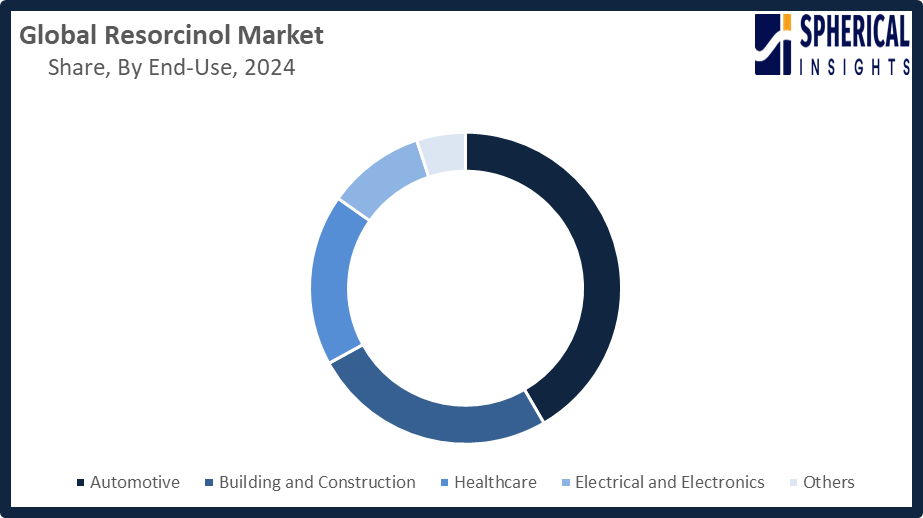
- The automotive segment accounted for the highest market revenue in 2024, approximately 42% and is anticipated to grow at a significant CAGR during the forecast period.
Based on the end-use, the resorcinol market is divided into automotive, building and construction, healthcare, electrical and electronics, and others. Among these, the automotive segment accounted for the highest market revenue in 2024 and is anticipated to grow at a significant CAGR during the forecast period. The automotive sector growth in the resorcinol market is owing to the rising demand for sports vehicles and electric vehicles that demand robust tires, adhesives, and rubber. The strength, chemical resistance, and extended longevity of resorcinol improve automotive manufacturing. The growing number of vehicles manufactured across the world accelerates the demand for resorcinol.
Get more details on this report -
Regional Segment Analysis of the Resorcinol Market
- North America (U.S., Canada, Mexico)
- Europe (Germany, France, U.K., Italy, Spain, Rest of Europe)
- Asia-Pacific (China, Japan, India, Rest of APAC)
- South America (Brazil and the Rest of South America)
- The Middle East and Africa (UAE, South Africa, Rest of MEA)
Asia Pacific is anticipated to hold the largest share of the resorcinol market over the predicted timeframe.

Get more details on this report -
Asia Pacific is anticipated to hold the largest share of the resorcinol market over the predicted timeframe. The Asia Pacific is expected to have a 46% market share, the leading region in the global resorcinol market, with its growth backed by increasing industrialization, urbanization, and the development of automotive, tire, and construction sectors. The prominent countries responsible for the growth of this industry are China, India, Japan, and South Korea, due to the increasing demand for adhesives, paints, rubber materials, and specialized resorcinol. The increasing production base, infrastructure development, and development of the electronics segment are other factors fueling the growth of resorcinol. In 2024, the DGTR of India initiated an investigation against the import of resorcinol from China and Japan, with a potential duty being charged to safeguard local manufacturers.
North America is expected to grow at a rapid CAGR in the resorcinol market during the forecast period. The North American market for resorcinol is expected to have a 20% market share, with growth driven by the increased adoption of resorcinol products, especially resins, specialty chemicals, and rubber compounds, in the automotive, tire, adhesive, and paint sectors, among others, across the US and Canada. The adoption of resorcinol products, especially resins, specialty chemicals, and rubber products, associated with a cleaner environment, also accelerates market growth. The rapid development of the construction and industrial sectors is strongly supported by technological innovation related to adhesives and coatings, further supporting the market expansion. This trend enhances North America's increasing share within the global resorcinol market.
The European market for resorcinol is growing at a steady pace, due to which the demand from the auto, tire, rubber, adhesives, and coatings sectors in the German, French, and UK markets is leading the charge in terms of demand for high-performing, long-lasting materials with low VOCs. In March 2025, France's ANSES proposed the classification of resorcinol as an endocrine disruptor under EU CLP rules. While the ECHA recognized it as an endocrine disruptor back in 2020, it was not classified as a substance of very great concern due to the opposition of experts.
Competitive Analysis:
The report offers the appropriate analysis of the key organizations/companies involved within the resorcinol market, along with a comparative evaluation primarily based on their type of offering, business overviews, geographic presence, enterprise strategies, segment market share, and SWOT analysis. The report also provides an elaborative analysis focusing on the current news and developments of the companies, which includes type development, innovations, joint ventures, partnerships, mergers & acquisitions, strategic alliances, and others. This allows for the evaluation of the overall competition within the market.
List of Key Companies
- Arakawa Chemical Industries
- Sumitomo Chemical
- Lonza Group
- Dow Chemical Company
- Lanxess AG
- SI Group
- Evonik Industries AG
- Dynea AS
- Kraeber and Co. GmbH
- Shikoku Chemicals
- Mitsui Chemicals
- Akrochem Corporation
- Amino-Chem Co. Ltd.
- Sinopec Shanghai Petrochemical
- Others
Key Target Audience
- Market Players
- Investors
- End-users
- Government Authorities
- Consulting and Research Firm
- Venture capitalists
- Value-Added Resellers (VARs)
Recent Development
- In January 2024, India initiated an anti-dumping investigation into Resorcinol imports from China and Japan. The Directorate General of Trade Remedies (DGTR) is assessing whether low-priced imports have caused material injury to domestic manufacturers and whether protective measures are required.
- In August 2021, SI Group announced plans to boost resole resin production capacity by over 25% at its Rotterdam Junction, New York, and Lote, India, facilities. The debottlenecking projects, nearing completion, aim to meet rising global demand from automotive and adhesive markets, while strengthening both sites as leading technology hubs.
- In October 2020, SI Group launched ELAZTOBOND B8-3410, a modified phenol-formaldehyde thermoplastic resin for rubber bonding. The resorcinol-free solution offers improved safety and sustainability while delivering performance equal to or better than traditional resorcinol-based bonding resins in both aged and unaged testing.
Market Segment
This study forecasts revenue at global, regional, and country levels from 2020 to 2035. Spherical Insights has segmented the resorcinol market based on the below-mentioned segments:
Global Resorcinol Market, By Production Method
- Benzene Disulfonation
- Hydroperoxidation of Meta-Diisopropylbenzene
- Hydrolysis of Meta-Phenylenediamine
Global Resorcinol Market, By Application
- Tire and Rubber Products
- Wood Adhesives and Binders
- UV Products and Dyes
- Flame Retardants
- Others
Global Resorcinol Market, By End-Use
- Automotive
- Building and Construction
- Healthcare
- Electrical and Electronics
- Others
Global Resorcinol Market, By Regional Analysis
- North America
- US
- Canada
- Mexico
- Europe
- Germany
- UK
- France
- Italy
- Spain
- Russia
- Rest of Europe
- Asia Pacific
- China
- Japan
- India
- South Korea
- Australia
- Rest of Asia Pacific
- South America
- Brazil
- Argentina
- Rest of South America
- Middle East & Africa
- UAE
- Saudi Arabia
- Qatar
- South Africa
- Rest of the Middle East & Africa
Frequently Asked Questions (FAQ)
-
1. What is the CAGR of the resorcinol market over the forecast period?The global resorcinol market is projected to expand at a CAGR of 4.2% during the forecast period.
-
2. What is the market size of the resorcinol market?The global resorcinol market size is expected to grow from USD 524.7 million in 2024 to USD 825.4 million by 2035, at a CAGR of 4.2% during the forecast period 2025-2035.
-
3. Which region holds the largest share of the resorcinol market?Asia Pacific is anticipated to hold the largest share of the resorcinol market over the predicted timeframe.
-
4. What is the resorcinol market?The resorcinol market involves the production, distribution, and consumption of resorcinol, used in adhesives, rubber, coatings, cosmetics, and pharmaceuticals.
-
5. Who are the top 10 companies operating in the global resorcinol market?Arakawa Chemical Industries, Sumitomo Chemical, Lonza Group, Dow Chemical Company, Lanxess AG, SI Group, Evonik Industries AG, Dynea AS, Kraeber and Co. GmbH, Shikoku Chemicals, and Others.
-
6. What factors are driving the growth of the resorcinol market?The resorcinol market is driven by rising demand in adhesives, rubber, coatings, and cosmetics, growth in the automotive and construction industries, increasing industrialization, and the adoption of high-performance, durable, and specialty chemical products.
-
7. What are the market trends in the resorcinol market?Key trends include demand for high‑performance adhesives, specialty coatings, eco‑friendly derivatives, regulatory scrutiny on chemical safety, and growth in automotive and construction applications.
-
8. What are the main challenges restricting wider adoption of the resorcinol market?The main challenges restricting the wider adoption of the resorcinol market include stringent health and environmental regulations, supply chain volatility regarding key raw materials, and competition from alternative products.
Need help to buy this report?