Global REM Sleep Behavior Disorder Market Size, Share, By Type (Idiopathic and Secondary), By Drug Type (Clonazepam, Melatonin, and Others), By Distribution Channel (Hospital Pharmacy, Retail Pharmacy, and Online Pharmacy), and By Region (North America, Europe, Asia-Pacific, Latin America, Middle East, and Africa), Analysis and Forecast 2026 - 2035
Industry: Healthcare
Global REM Sleep Behavior Disorder Market Insights Forecasts to 207
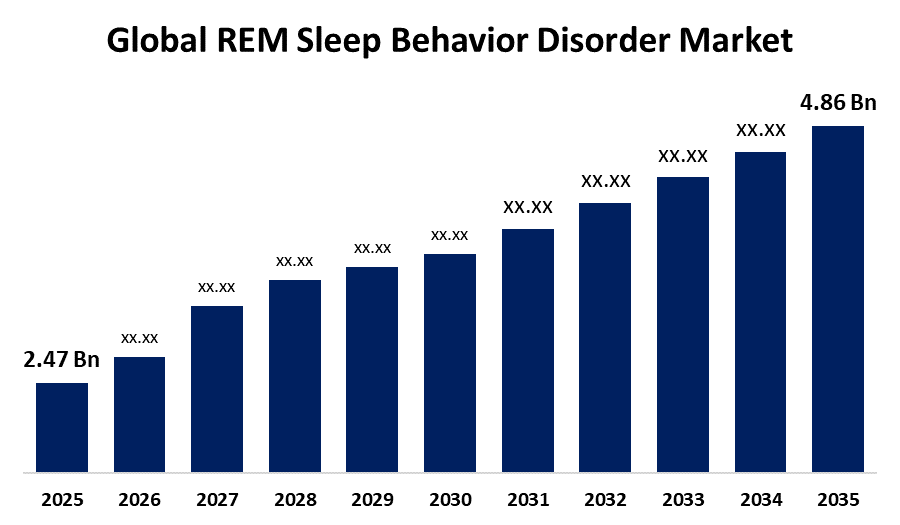
- The Global REM Sleep Behavior Disorder Market Size Was Estimated at USD 2.47 Billion in 2025
- The Market Size is Expected to Grow at a CAGR of around 7% from 2026 to 2035
- The Worldwide REM Sleep Behavior Disorder Market Size is Expected to Reach USD 4.86 Billion by 2035
- Asia Pacific is expected to grow the fastest during the forecast period.
Get more details on this report -
According to a research report published by Spherical Insights and Consulting, the global REM sleep behavior disorder market size was worth around USD 2.47 billion in 2025 and is predicted to grow to around USD 4.86 billion by 2035 with a compound annual growth rate (CAGR) of 7% from 2026 to 2035. The global REM sleep behavior disorder market is driven by rising prevalence of sleep disorders, increasing awareness of early diagnosis, growing geriatric population, expanding adoption of pharmacological therapies like clonazepam and melatonin, and advancements in treatment options globally.
Market Overview
The global REM sleep behavior disorder (RBD) market focuses on the diagnosis, management, and treatment of a sleep disorder where patients physically act out dreams during the REM (Rapid Eye Movement) phase of sleep. REM sleep is a critical stage marked by vivid dreaming and temporary muscle paralysis, which is absent in RBD, leading to movements that can cause injury. The disorder is primarily addressed through diagnostic tools such as video-polysomnography and AI-assisted monitoring, complemented by pharmacological treatments including clonazepam and melatonin. The market scope encompasses hospitals, specialty sleep clinics, and homecare, targeting accurate diagnosis, symptom management, and prevention of progression to neurodegenerative diseases such as Parkinson’s disease and dementia. Future opportunities lie in disease-modifying therapies, biomarker-driven personalized treatments, and AI-enabled remote monitoring solutions. Market growth is further strengthened by government and institutional initiatives, including the North American Prodromal Synucleinopathy (NAPS) Consortium, the Singapore Digital Health Framework, and the WHO Intersectoral Action Plan on neurological disorders, which enhance early detection, standardize care, and drive research and clinical adoption of advanced RBD management strategies across regions.
Report Coverage
This research report categorizes the REM sleep behavior disorder market based on various segments and regions, forecasts revenue growth, and analyzes trends in each submarket. The report analyses the key growth drivers, opportunities, and challenges influencing the REM Sleep Behavior Disorder market. Recent market developments and competitive strategies, such as expansion, product launch, development, partnership, merger, and acquisition, have been included to draw the competitive landscape in the market. The report strategically identifies and profiles the key market players and analyses their core competencies in each sub-segment of the REM sleep behavior disorder market.
Global REM Sleep Behavior Disorder Market Report Coverage
| Report Coverage | Details |
|---|---|
| Base Year: | 2025 |
| Market Size in 2025: | USD 2.47 Billion |
| Forecast Period: | 2026-2035 |
| Forecast Period CAGR 2026-2035 : | 7% |
| 2035 Value Projection: | USD 4.86 Billion |
| Historical Data for: | 2020-2024 |
| No. of Pages: | 240 |
| Tables, Charts & Figures: | 112 |
| Segments covered: | By Type, By Distribution Channel and By Region |
| Pitfalls & Challenges: | Covid 19 Impact Challenges, Future, Growth and Analysis |
Get more details on this report -
Driving Factors
The REM sleep behavior disorder market is primarily driven by the growing prevalence of neurodegenerative diseases, including Parkinson’s disease and dementia, which are closely linked to RBD. Increasing awareness among healthcare professionals and patients is boosting early diagnosis, while advances in video-polysomnography and AI-assisted diagnostic tools are enhancing detection accuracy. Rising investment in clinical research, particularly through initiatives like the North American Prodromal Synucleinopathy (NAPS) Consortium, is facilitating biomarker discovery and development of neuroprotective therapies. Additionally, expanding healthcare infrastructure, especially in hospitals and specialized sleep clinics, along with wider adoption of first-line pharmacological treatments such as clonazepam and melatonin, is supporting broader treatment access and accelerating market growth globally.
Restraining Factors
The REM sleep behavior disorder market is restrained by underdiagnosis, limited awareness, and reliance on expensive polysomnography for accurate detection. Additionally, lack of standardized treatments and limited large-scale clinical evidence hinder therapeutic advancements, slowing adoption and overall market growth globally.
Market Segmentation
The REM sleep behavior disorder market share is classified into type, drug type, and distribution channel.
- The idiopathic segment dominated the market in 2025 and is anticipated to grow at a remarkable CAGR of approximately 60% during the forecast period.
Based on the type, the REM sleep behavior disorder market is divided into idiopathic and secondary. Among these, the idiopathic segment dominated the market in 2025 and is anticipated to grow at a remarkable CAGR during the forecast period. Approximately 60% of RBD cases are idiopathic, driven by a strong association with early-stage neurodegenerative disorders, increasing awareness, rising diagnosis rates, and growing clinical focus on early intervention and long-term monitoring across global healthcare systems.
- The clonazepam segment dominated the market in 2025, approximately 65% and is anticipated to grow at a remarkable CAGR during the forecast period.
Based on the drug type, the REM sleep behavior disorder market is divided into clonazepam, melatonin, and others. Among these, the clonazepam segment dominated the market in 2025 and is anticipated to grow at a remarkable CAGR of approximately 65% during the forecast period. The dominance is driven by its long-standing clinical use, proven effectiveness in reducing symptoms, strong physician preference, established treatment guidelines, and consistent prescription patterns across healthcare systems, supporting its continued adoption in managing REM sleep behavior disorder.
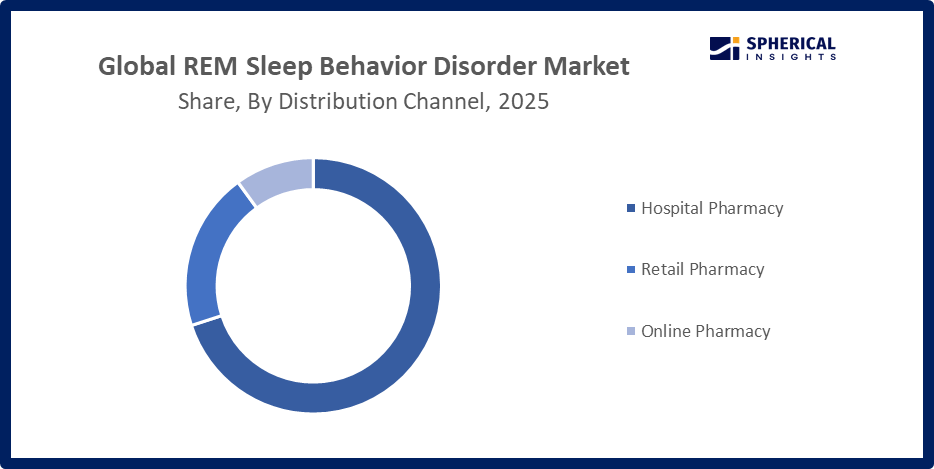
- The hospital pharmacy segment dominated the market in 2025 and is anticipated to grow at a remarkable CAGR of approximately 70% during the forecast period.
Based on the distribution channel, the REM sleep behavior disorder market is divided into hospital pharmacy, retail pharmacy, and online pharmacy. Among these, the hospital pharmacy segment dominated the market in 2025 and is anticipated to grow at a remarkable CAGR of approximately 70% during the forecast period. Growth is driven by increased patient visits for sleep disorder diagnosis, availability of prescription medications in hospital settings, specialist consultations, and integration with clinical treatment pathways, ensuring accurate diagnosis, monitoring, and effective management of RBD cases.
Get more details on this report -
Regional Segment Analysis of the REM Sleep Behaviour Disorder Market
- North America (U.S., Canada, Mexico)
- Europe (Germany, France, U.K., Italy, Spain, Rest of Europe)
- Asia-Pacific (China, Japan, India, Rest of APAC)
- South America (Brazil and the Rest of South America)
- The Middle East and Africa (UAE, South Africa, Rest of MEA)
North America is anticipated to hold the largest share of the REM sleep behaviour disorder market over the predicted timeframe.

Get more details on this report -
North America is anticipated to hold the largest share of the REM sleep behaviour disorder market over the predicted timeframe. Strong clinical research infrastructure, high awareness of sleep disorders, and the presence of leading pharmaceutical and research institutions are key factors driving the region. The market is further strengthened by ongoing advancements in early diagnosis and the growing linkage between RBD and neurodegenerative diseases. Government and institutional support play a critical role in market expansion, particularly through continued research funding by the National Institutes of Health, including the National Heart, Lung, and Blood Institute and the National Institute of Neurological Disorders and Stroke, with active funding programs and research initiatives updated through 2025. These funding efforts are accelerating innovation in diagnostics, biomarker discovery, and therapeutic development, supporting early intervention strategies and reinforcing North America’s leadership in clinical research, treatment advancement, and long-term disease management within the RBD market.
Asia Pacific is expected to grow at a rapid CAGR in the REM sleep behavior disorder market during the forecast period. Rapid expansion of healthcare infrastructure, rising awareness of sleep disorders, and increasing prevalence of neurodegenerative diseases across China, Japan, and South Korea are key factors driving regional growth. The region’s market is further supported by improving access to diagnosis and growing adoption of pharmacological treatments. Government and institutional initiatives are playing a crucial role in market expansion, including Singapore’s Digital Health Framework (2026), which promotes AI-based diagnostics, wearable technologies, and early disease detection, enhancing RBD diagnosis and monitoring. Additionally, the World Health Organization’s Intersectoral Action Plan on neurological disorders, active through 2026, is driving healthcare investment, improving diagnostic capabilities, and strengthening policy alignment for neurological disease management across the region, thereby supporting sustained market growth.
Competitive Analysis:
The report offers the appropriate analysis of the key organizations/companies involved within the REM sleep behaviour disorder market, along with a comparative evaluation primarily based on their product offerings, business overviews, geographic presence, enterprise strategies, segment market share, and SWOT analysis. The report also provides an elaborate analysis focusing on the current news and developments of the companies, which includes product development, innovations, joint ventures, partnerships, mergers & acquisitions, strategic alliances, and others. This allows for the evaluation of the overall competition within the market.
List of Key Companies
- 21st Century HealthCare Inc.
- Aurobindo Pharma USA Inc.
- Bluebonnet Nutrition Corp.
- Cambrex Corp.
- Carlson Laboratories Inc.
- Church & Dwight Co., Inc.
- F. Hoffmann-La Roche Ltd.
- GNC Holdings LLC
- Jarrow Formulas Inc.
- Life Extension Foundation Buyers Club Inc.
- Lupin Ltd.
- Natrol LLC
- NOW Health Group Inc.
- Pharmavite LLC
- Solgar Inc.
- Sun Pharmaceutical Industries Ltd.
- Swanson Health Products Inc.
- Teva Pharmaceutical Industries Ltd.
- Torrent Pharmaceuticals Ltd.
- Zydus Lifesciences Ltd.
Key Target Audience
- Market Players
- Investors
- End-users
- Government Authorities
- Consulting and Research Firm
- Venture capitalists
- Value-Added Resellers (VARs)
Recent Development
- In March 2025, the American Academy of Sleep Medicine (AASM) released updated clinical practice guidelines for REM Sleep Behavior Disorder, recommending clonazepam and melatonin while emphasizing injury prevention strategies and standardized neurological risk assessment in clinical care.
- In March 2025, clinical evidence reaffirmed video-polysomnography as the gold standard for diagnosing REM Sleep Behavior Disorder, strengthening the adoption of sleep laboratory testing and supporting the expansion of standardized diagnostic protocols across healthcare systems.
Market Segment
This study forecasts revenue at global, regional, and country levels from 2020 to 2035. Spherical Insights has segmented the REM sleep behavior disorder market based on the below-mentioned segments:
Global REM Sleep Behavior Disorder Market, By Type
- Idiopathic
- Secondary
Global REM Sleep Behavior Disorder Market, By Drug Type
- Clonazepam
- Melatonin
- Others
Global REM Sleep Behavior Disorder Market, By Distribution Channel
- Hospital Pharmacy
- Retail Pharmacy
- Online Pharmacy
Global REM Sleep Behavior Disorder Market, By Regional Analysis
- North America
- US
- Canada
- Mexico
- Europe
- Germany
- UK
- France
- Italy
- Spain
- Russia
- Rest of Europe
- Asia Pacific
- China
- Japan
- India
- South Korea
- Australia
- Rest of Asia Pacific
- South America
- Brazil
- Argentina
- Rest of South America
- Middle East & Africa
- UAE
- Saudi Arabia
- Qatar
- South Africa
- Rest of the Middle East & Africa
Frequently Asked Questions (FAQ)
-
1. How are wearable devices influencing REM sleep behavior disorder monitoring?Wearable devices enable continuous home-based sleep monitoring, capturing motion, heart rate, and sleep patterns. These insights support personalized care plans, reduce dependency on in-clinic polysomnography, and allow early detection of symptom escalation.
-
2. Can REM Sleep Behavior Disorder management benefit from telemedicine platforms?Telemedicine platforms facilitate remote consultations with sleep specialists, digital prescription management, and integration of patient-reported outcomes, improving treatment adherence and supporting follow-up care without frequent hospital visits.
-
3. Are there non-pharmacological interventions showing promise for RBD?Behavioral interventions such as structured sleep schedules, bedroom safety modifications, and cognitive behavioral therapy for sleep disturbances are emerging to reduce injury risk and improve patient quality of life.
-
4. How is AI being leveraged for long-term RBD care?AI analytics track sleep movement trends, predict progression to neurodegenerative diseases, and alert clinicians to necessary interventions, enabling proactive therapy adjustments and individualized patient management.
-
5. What role do nutrition and lifestyle modifications play in RBD management?Neurologically supportive diets, regular exercise, and avoidance of alcohol or sedatives before sleep can mitigate symptom severity and improve sleep quality, complementing pharmacological treatments.
-
6. How are clinical trial designs evolving for RBD therapies?Adaptive trials now incorporate digital biomarkers, real-time remote monitoring, and patient-reported outcomes, accelerating evaluation of novel therapeutics and optimizing dosage for safety and efficacy.
-
7. Is there potential for RBD prevention strategies in at-risk populations?Research explores early interventions in individuals with prodromal neurodegenerative markers, including lifestyle changes, neuroprotective agents, and cognitive therapies, aiming to delay or prevent symptomatic RBD onset.
Need help to buy this report?