Global Real-Time Spectrum Analysis Market Size, Share, and COVID-19 Impact Analysis, By Product (Handheld Analyzer, Benchtop Analyzer, and Portable Analyzer), By Application (Healthcare, Automotive, Energy & Power, Aerospace & Defense, IT & Telecommunication, Semiconductor & Electronics, Industrial, and Others), and By Region (North America, Europe, Asia-Pacific, Latin America, Middle East, and Africa), Analysis and Forecast 2025 - 2035
Industry: Machinery & Equipment
Global Real-Time Spectrum Analysis Market Insights Forecasts to 2035
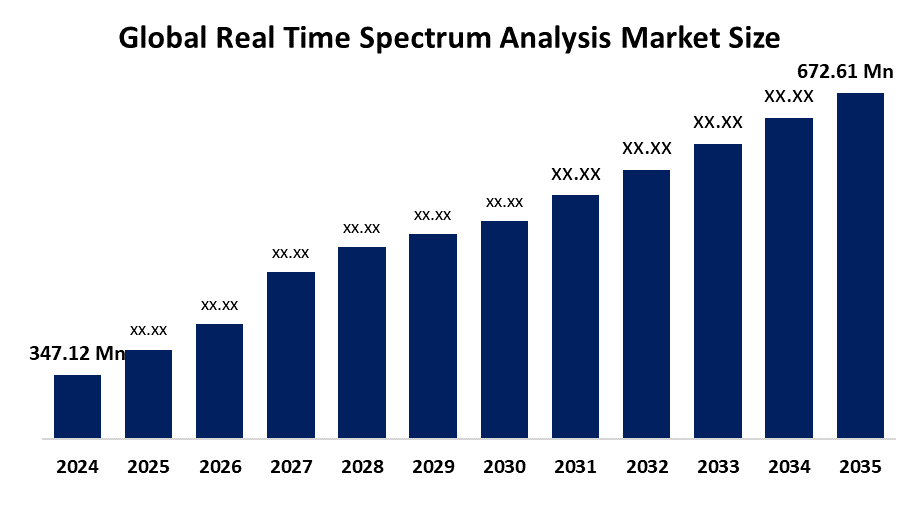
- The Global Real-Time Spectrum Analysis Market Size Was Estimated at USD 347.12 Million in 2024
- The Market Size is Expected to Grow at a CAGR of around 6.2% from 2025 to 2035
- The Worldwide Real-Time Spectrum Analysis Market Size is Expected to Reach USD 672.61 Million by 2035
- Asia Pacific is expected to grow the fastest during the forecast period.
Get more details on this report -
According to a research report published by Spherical Insights and Consulting, the global real-time spectrum analysis market size was worth around USD 347.12 million in 2024 and is predicted to grow to around USD 672.61 million by 2035 with a compound annual growth rate CAGR of 6.2% from 2025 to 2035. Real-time market spectrum analysis is growing rapidly due to the surge in 5G deployment, IoT expansion, and increased demand for advanced signal monitoring in the aerospace, defence, and automotive sectors.
Real-Time Spectrum Analysis Market Key Takeaways
- The global Real-Time Spectrum Analysis market was valued at USD 347.12 million in 2024.
- It is projected to reach USD 672.61 million by 2035.
- The market is expected to grow at a CAGR of 6.2% from 2024 to 2035.
- North America dominated the global real-time spectrum analysis market with the largest market share of 32.23% in 2024.
- Asia Pacific is expected to expand at a solid CAGR during the forecast period.
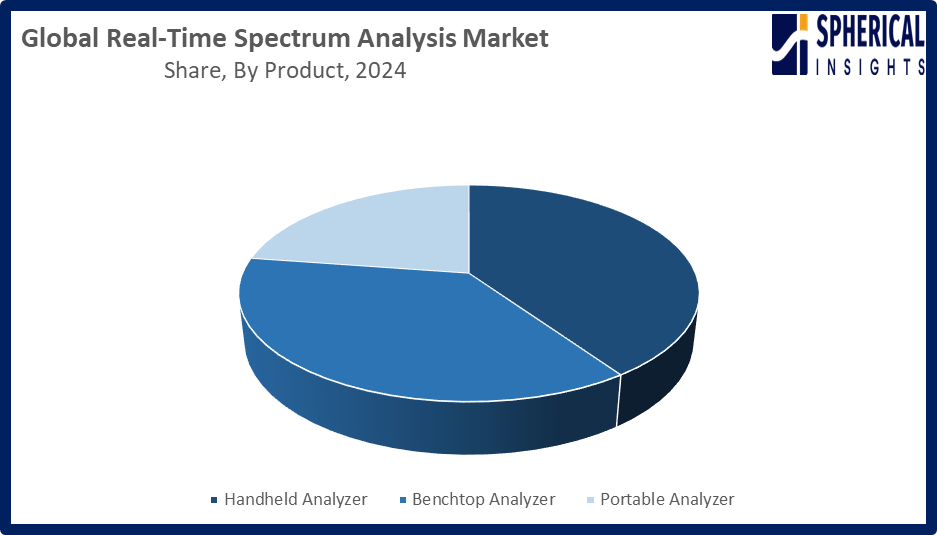
- By product, the handheld analyzer segment contributed the largest market share of 40% in 2024.
- By application, the IT & telecommunication segment has held a major market share of 43% in 2024.
Market Overview
The global real time spectrum analysis market refers to technologies and instruments that capture, process and analyze radio frequency RF signals in real time to detect transient events, interference, and signal anomalies. These analyzers are widely used in telecommunications, aerospace and defense, electronics manufacturing, and research laboratories for applications such as wireless network testing, signal monitoring, electromagnetic interference detection, and spectrum management. In May 2024, the National Telecommunications and Information Administration launched a new funding round from its 1.5 billion Public Wireless Supply Chain Innovation Fund to advance spectrum-sensing and software-defined radio technologies, aiming to improve spectrum sharing, protect government signals, and enable more efficient airwave use for public and commercial wireless networks.
The market is primarily driven by the rapid expansion of 5G communication networks, increasing RF congestion, and the rising number of connected devices. Global 5G subscriptions are projected to surpass 1.5 billion by 2025, significantly increasing demand for advanced spectrum monitoring solutions. Additionally, the number of Internet of Things (IoT) devices is expected to reach around 25 billion by 2030, creating complex wireless environments that require real-time analysis tools. Growing investments in defense communication systems and spectrum surveillance also create strong opportunities for market expansion, particularly in emerging economies adopting advanced wireless technologies. In March 2026, Federal Communications Commission Chairman Brendan Carr launched the Space Spectrum Initiative to allocate additional spectrum for emerging space activities such as orbital laboratories, satellite servicing, and private spacecraft. The proposal could release up to 20,000 MHz to support telemetry, tracking, and command communications for future space missions.
Real-Time Spectrum Analysis Market Trends
- Increasing deployment of IoT devices and connected systems is driving demand for advanced RF monitoring and interference detection solutions.
- Growing investments from the aerospace and defense sectors are boosting the adoption of high-performance real-time spectrum analyzers.
- Integration of AI and machine learning is improving automated spectrum monitoring and signal identification capabilities.
- Rising use of software-defined radios and cloud-based spectrum analysis platforms is transforming spectrum management systems.
- Expanding satellite communication and space technology applications are creating new opportunities for real-time spectrum analysis tools
Report Coverage
This research report categorizes the real-time spectrum analysis market based on various segments and regions, forecasts revenue growth, and analyzes trends in each submarket. The report analyses the key growth drivers, opportunities, and challenges influencing the real-time spectrum analysis market. Recent market developments and competitive strategies, such as expansion, type launch, development, partnership, merger, and acquisition, have been included to draw the competitive landscape in the market. The report strategically identifies and profiles the key market players and analyses their core competencies in each sub-segment of the real-time spectrum analysis market.
Global Real-Time Spectrum Analysis Market Report Coverage
| Report Coverage | Details |
|---|---|
| Base Year: | 2024 |
| Market Size in 2024: | USD 347.12 million |
| Forecast Period: | 2025-2035 |
| Forecast Period CAGR 2025-2035 : | CAGR of 6.2% |
| 2035 Value Projection: | USD 672.61 million |
| Historical Data for: | 2020-2023 |
| No. of Pages: | 240 |
| Tables, Charts & Figures: | 90 |
| Segments covered: | By Product,By Application |
| Companies covered:: | ThinkRF,Anritsu,Teledyne,Signal,Aaronia,Tektronix And Others Players |
| Pitfalls & Challenges: | COVID-19 Empact, Challenges, Future, Growth, & Analysis |
Get more details on this report -
Driving Factors
The global real-time spectrum analysis market is driven primarily by the rapid growth of wireless communication, particularly the global rollout of 5G networks, which demand precise signal testing and optimization. The proliferation of Internet of Things (IoT) devices further congests the radio-frequency spectrum, necessitating advanced tools for real-time monitoring and interference detection. Additionally, increasing technological complexity in defense, aerospace, and telecommunications requires immediate analysis of transient signals. These factors compel industries to adopt real-time spectrum analyzers to support efficient spectrum management, thereby ensuring network reliability and security in an increasingly wireless world. In February 2026, RTX BBN Technologies, in partnership with the National Spectrum Consortium, received a contract from the U.S. Department of War for the Advanced Spectrum Coexistence Demonstration program, developing AI-enabled spectrum management tools to enable secure and efficient sharing of frequencies between national security radars and commercial 5G networks.
Restraining Factors
The global real-time spectrum analysis market faces restraints due to the high cost of advanced spectrum analyzers, often exceeding USD per unit, limiting adoption among small laboratories. Additionally, complex operations, calibration requirements, and a shortage of skilled RF engineers impede widespread implementation, particularly in developing regions with limited technical infrastructure.
Market Segmentation
Product Insights
The handheld analyzer segment registered the largest share of the real-time spectrum analysis market in 2024. This growth dominance is attributed to its portability, ease of field deployment, and ability to perform real time RF signal monitoring in remote locations. Telecom engineers widely use handheld devices for interference detection, network maintenance, and spectrum monitoring. The rapid expansion of wireless infrastructure and 5G networks has further increased demand for compact and efficient testing solutions.
The portable analyzer segment is expected to grow rapidly in the real-time spectrum analysis market during the forecast period. The portable analyzer segment is rapidly growing due to rising demand for flexible, lightweight testing equipment in field operations. Increasing deployment of 5G networks, wireless communication systems, and the growing need for on site RF signal monitoring are driving adoption.
Get more details on this report -
End-use Insights
The IT & telecommunication segment dominated the real-time spectrum analysis market in 2024. The IT & telecommunication segment dominated the market due to the rapid expansion of wireless communication networks and the increasing deployment of technologies. Real time spectrum analyzers are widely used for signal monitoring, interference detection, and network optimization. The growing number of connected devices and rising demand for reliable high-speed connectivity further drive adoption in the telecom sector.
The automotive segment is expected to expand significantly in the real-time spectrum analysis market in the period. The automotive segment is significantly owing to the increasing adoption of connected vehicles, autonomous driving technologies, and advanced driver-assistance systems ADAS. These technologies require accurate RF testing and spectrum monitoring to ensure reliable vehicle to everything communication.
Regional Segment Analysis of the Real-Time Spectrum Analysis Market
- North America U.S., Canada, Mexico
- Europe Germany, France, U.K., Italy, Spain,
- ia-Pacific China, Japan, India, Rest of APAC
- South America Brazil and the Rest of South America
- The Middle East and Africa UAE, South Africa, Rest of MEA
North America Market Trends

Get more details on this report -
North America dominated the real-time spectrum analysis market with the 34 market share, driven by its advanced telecommunications and defense sectors, extensive adoption, and robust capabilities. The region’s stringent spectrum management and interference monitoring regulations fuel the demand for high precision real time analyzers. Substantial investments in aerospace, satellite communications, and military applications, along with the presence of major spectrum analyzer manufacturers in the U.S. and Canada, reinforce its global market leadership and support continued growth. In January 2026, Donald Trump advanced U.S. leadership in 6G through a federal initiative directing agencies to relocate operations from theUpper C Band. The policy aims to free spectrum for commercial deployment, while promoting collaboration among government, industry, and academia to accelerate next-generation wireless innovation.
U.S. Real-Time Spectrum Analysis Market Trends
The U.S. market is expanding due to increasing 5G deployment, IoT proliferation, and advanced defense requirements. Key trends include AI-powered analyzers, automated spectrum monitoring, and integration with cloud platforms, which enhance real-time signal analysis, interference detection, and spectrum utilization across telecom, aerospace, and military domains. In March 2024, the Government of the United States advanced its Spectrum Monitoring Implementation Plan under the national spectrum strategy. Federal agencies began deploying RF sensors and real-time spectrum monitoring systems to enhance spectrum management, reduce interference, and support the development of next-generation wireless communication technologies.
Asia Pacific Market Trends
Asia Pacific is the fastest-growing market for real-time spectrum analysis, with an approximate 25% share, spurred by rapid 5G and IoT expansion, industrial automation, and smart city initiatives in countries like China, India, and Japan. Increased investments in telecom infrastructure, defense modernization, and satellite communications drive demand for advanced spectrum monitoring solutions. Government programs supporting efficient spectrum allocation and compliance further accelerate adoption. In January 2025, the Centre for Development of Telematics signed an agreement with the Indian Institute of Technology Mandi and the Indian Institute of Technology Jammu under the Department of Telecommunications TTDF scheme to develop a wideband spectrum-sensor ASIC chip, improving spectrum utilization and enabling efficient broadband connectivity through advanced cognitive radio technologies.
India Real-Time Spectrum Analysis Market Trends
The India real-time spectrum analysis market is expanding rapidly, driven by growing 5G network deployment, IoT adoption, and telecom infrastructure development. Increasing demand for AI enabled analyzers, automated spectrum monitoring, and interference detection is boosting adoption across telecommunications, defense, aerospace, and industrial sectors, supporting efficient spectrum management and improved network performance. In March 2026, Pemmasani Chandra Sekhar announced that the Government of India released the Bharat Vision Document and a 10 year spectrum roadmap for . Supported by the Department of Telecommunications TTDF scheme, 104 projects worth were approved to advance indigenous research and development.
Europe Real-Time Spectrum Analysis Market Trends
Europe is growing steadily, driven by 5G rollouts, strict spectrum regulations, and increasing aerospace and defense applications. Adoption of AI-driven analyzers, automated monitoring, and cloud-based signal analysis improves accuracy and efficiency. Government initiatives promoting optimal spectrum utilization and interference control further support growth across telecom, research, and industrial sectors.
Germany Real-Time Spectrum Analysis Market Trends
Germany’s market growth is fueled by expanding 5G infrastructure, industrial automation, and defense modernization. AI-powered spectrum analyzers, real-time interference detection, and automated monitoring enhance network efficiency and ensure compliance with strict European spectrum regulations, driving demand in telecom, aerospace, and research industries.
Competitive Analysis:
The report offers the appropriate analysis of the key organizations companies involved within the real-time spectrum analysis market, along with a comparative evaluation primarily based on their type of offering, business overviews, geographic presence, enterprise strategies, segment market share, and SWOT analysis. The report also provides an elaborative analysis focusing on the current news and developments of the companies, which includes type development, innovations, joint ventures, partnerships, mergers & acquisitions, strategic alliances, and others. This allows for the evaluation of the overall competition within the market.
List of Key Companies
- ThinkRF Corp
- Anritsu
- Rohde
- Teledyne
- Keysight
- Aaronia
- Tektronix
- National I
- Advantest
- Standford
- Micronix
- Yokogawa
- Others
Key Target Audience
- Market Players
- Investors
- End-users
- Government Authorities
- Consulting and Research Firm
- Venture capitalists
- Value-Added Resellers (VARs)
Recent Development
- In March 2026, Teledyne LeCroy launched the Frontlin Wireless Protocol Analyzer, offering advanced Bluetooth and Wi Fi 7 MLO analysis across Bluetooth higher-band features and complex RF coexistence testing.
- In February 2026, Rohde Schwarz launched the spectrum analyzer with a new option for the FPL family. Covering , it offers industry first high frequency performance at an affordable price, enabling powerful real time analysis and lowering entry barriers for high frequency testing.
- In December 2025, Keysight Technologies, Inc. launched the Series Field Handheld Designed for complex RF environments addressing interference and transient event challenges.
Market Segment
This study forecasts revenue at global, regional, and country levels from 2020 to 2035. Spherical Insights has segmented the real-time spectrum analysis market based on the below-mentioned segments:
Global Real-Time Spectrum Analysis Market, By Product
- Handheld Analyzer
- Benchtop Analyzer
- Portable Analyzer
Global Real-Time Spectrum Analysis Market, By Application
- Healthcare
- Automotive
- Energy & Power
- Aerospace & Defense
- IT & Telecommunication
- Semiconductor & Electronics
- Industrial
- Others
Global Real-Time Spectrum Analysis Market, By Regional Analysis
- North America
- US
- Canada
- Mexico
- Europe
- Germany
- UK
- France
- Italy
- Spain
- Russia
- Rest of Europe
- Asia Pacific
- China
- Japan
- India
- South Korea
- Australia
- Rest of Asia Pacific
- South America
- Brazil
- Argentina
- Rest of South America
- Middle East & Africa
- UAE
- Saudi Arabia
- Qatar
- South Africa
- Rest of the Middle East & Africa
Frequently Asked Questions (FAQ)
-
1. What are the key innovations driving advancements in spectrum analysis tools?Key innovations advancing spectrum analysis tools include AI/ML‑driven signal classification, cloud‑based real‑time monitoring, and software‑defined radio integration. Adoption of AI‑enabled analyzers is rising 25% annually, enhancing interference detection and automated spectrum management.
-
2. How is AI integration influencing real-time spectrum monitoring efficiency?AI integration is boosting real‑time spectrum monitoring efficiency by automating signal classification and interference detection, reducing analysis time by up to 40%, and enabling predictive adjustments for network optimization in increasingly congested RF environments.
-
3. What role do IoT and connected devices play in market expansion?IoT and connected devices are driving market expansion by increasing RF congestion and monitoring needs. With over 14 billion IoT devices in use globally, demand for real‑time spectrum analysis tools has surged to ensure reliable wireless performance.
-
4. How do regulatory compliance and spectrum management affect market dynamics?Regulatory compliance and spectrum management shape market dynamics by enforcing stringent monitoring standards and efficient spectrum use. With global spectrum allocations increasing 5-7% annually, real‑time analyzers are critical for interference control and regulatory adherence.
-
5. What is the economic impact of real-time spectrum analysis on telecom infrastructure investments?Real‑time spectrum analysis boosts telecom infrastructure investments by improving network reliability and reducing interference costs. With global 5G capex exceeding $600 billion, efficient spectrum tools enhance ROI and support faster, higher‑quality deployments.
-
6. How are software-defined radios and cloud-based solutions shaping market evolution?Software‑defined radios and cloud‑based solutions are transforming the market by enabling flexible, scalable real‑time spectrum monitoring, reducing deployment costs by up to 30%, and supporting remote analytics for modern wireless networks.
-
7. How do government regulations and spectrum management policies influence market adoption?Government regulations and spectrum management policies drive market adoption by mandating efficient spectrum use and interference monitoring, with stricter compliance increasing demand for real-time analyzers by 20-25% annually across telecom, defense, and industrial sectors.
Need help to buy this report?