Global Rapeseed Oil Market Size, Share, and COVID-19 Impact Analysis, By Type (Processed and Virgin), By Application (Food Processing, Bio Fuel, Cosmetics and Personal Care, and Others), and By Region (North America, Europe, Asia-Pacific, Latin America, Middle East, and Africa), Analysis and Forecast 2025 - 2035
Industry: Food & Beverages
Global Rapeseed Oil Market Insights Forecasts to 2035
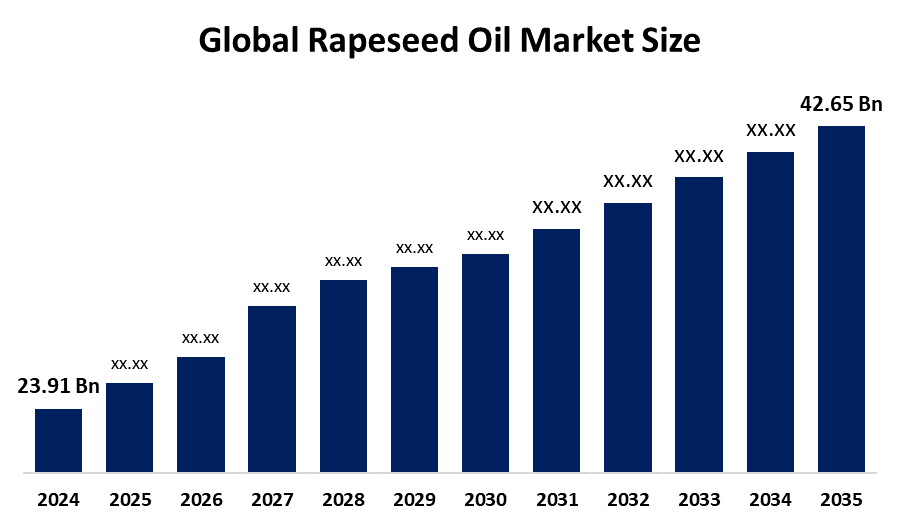
- The Global Rapeseed Oil Market Size Was Estimated at USD 23.91 Billion in 2024
- The Market Size is Expected to Grow at a CAGR of around 5.4% from 2025 to 2035
- The Worldwide Rapeseed Oil Market Size is Expected to Reach USD 42.65 Billion by 2035
- North America is expected to grow the fastest during the forecast period.
Get more details on this report -
According to a research report published by Spherical Insights and Consulting, The Global Rapeseed Oil Market Size Was Valued At Around USD 23.91 Billion In 2024 And Is Predicted To Grow To Around USD 42.65 Billion By 2035 With A Compound Annual Growth Rate (CAGR) Of 5.4% From 2025 To 2035. Growing health consciousness, growing demand for food processing, biofuel applications, sustainable agricultural methods, and growing consumer preference for plant-based, low-saturated-fat edible oils are all factors that create opportunities for the rapeseed oil market.
Market Overview
The global economic system that includes the production, processing, distribution, sale, and consumption of oil made from rapeseed crops is known as the "rapeseed oil market." Cultivation, seed crushing, refining, packaging, marketing, and sales in the commercial, industrial, and residential sectors are all included. Food and beverage, animal feed, biofuel, cosmetics, medicines, and industrial lubricants are just a few of the varied end-use sectors that the industry services. for instance, August 2025, Wilmar International launched a high oleic Rapeseed Oil in the US, offering improved stability and longer frying life, positioning it as an alternative to soybean and palm oils for food industry. The worldwide rapeseed oil market is driven by the European Union's growing use of rapeseed oil in the production of biodiesel. The market is anticipated to be driven by growing health consciousness and knowledge of the advantages rapeseed oil offers.
Report Coverage
This research report categorizes the rapeseed oil market based on various segments and regions, forecasts revenue growth, and analyzes trends in each submarket. The report analyses the key growth drivers, opportunities, and challenges influencing the rapeseed oil market. Recent market developments and competitive strategies, such as expansion, product launch, development, partnership, merger, and acquisition, have been included to draw the competitive landscape in the market. The report strategically identifies and profiles the key market players and analyzes their core competencies in each sub-segment of the rapeseed oil market.
Global Rapeseed Oil Market Report Coverage
| Report Coverage | Details |
|---|---|
| Base Year: | 2024 |
| Market Size in 2024: | USD 23.91 Billion |
| Forecast Period: | 2025-2035 |
| Forecast Period CAGR 2025-2035 : | CAGR Of 5.4% |
| 2035 Value Projection: | USD 42.65 Billion |
| Historical Data for: | 2020-2023 |
| No. of Pages: | 210 |
| Tables, Charts & Figures: | 90 |
| Segments covered: | By Type, By Application |
| Companies covered:: | Archer Daniels Midland Company Cargill Incorporated ConAgra Foods Inc. Cullies Folia Oil Limited SDN Mackintosh of Glendaveny Ola Oils Pacific Coast Canola RISOIL S.A Yorkshire Rapeseed Oil Others Key players |
| Pitfalls & Challenges: | COVID-19 Empact, Challenge, Future, Growth, & Analysis |
Get more details on this report -
Driving Factors
Growing consumer awareness of the importance of eating a balanced diet has led to a preference for edible oils that are high in monounsaturated fatty acids and low in saturated fat, such as rapeseed oil. Due to its neutral flavor and excellent thermal stability, the food processing and foodservice industries' growth further speeds up consumption. Growing consumer demand for sustainable and plant-based foods also helps the rapeseed oil market grow because rapeseed oil supports ecologically friendly farming methods. Furthermore, rapeseed oil is being used more often to produce biofuels, especially biodiesel, which helps meet industrial demand. Supply stability has increased as a result of enhanced yield quality and efficiency brought about by technological developments in oil extraction and seed breeding.
Restraining Factors
Variations in raw material prices, climate-dependent crop yields, competition from other edible oils, regulatory limitations, and supply chain interruptions are some of the challenges facing the rapeseed oil market that may restrict production stability and rapeseed oil market expansion.
Market Segmentation
The rapeseed oil market share is classified into type and application.
- The processed segment accounted for the largest share in 2024 and is anticipated to grow at a significant CAGR during the forecast period.
Based on the type, the rapeseed oil market is divided into processed and virgin. Among these, the processed segment accounted for the largest share in 2024 and is anticipated to grow at a significant CAGR during the forecast period. Manufacturers and customers prefer processed rapeseed oil because it is more stable, has a longer shelf life, and is consistently of higher quality than virgin oil. The expansion of the processed category is mostly driven by the widespread availability of processed rapeseed oil and the growing use of traditional processing methods worldwide.
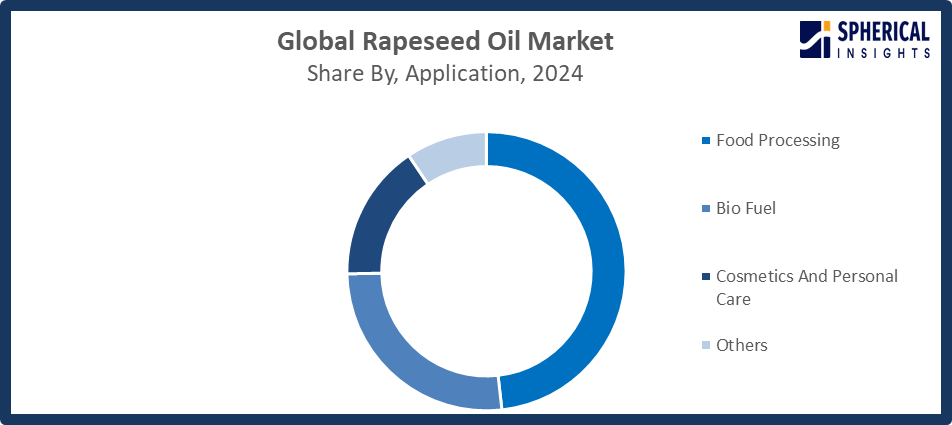
- The food processing segment accounted for the highest market revenue in 2024 and is anticipated to grow at a significant CAGR during the forecast period.
Based on the application, the rapeseed oil market is divided into food processing, bio fuel, cosmetics and personal care, and others. Among these, the food processing segment accounted for the highest market revenue in 2024 and is anticipated to grow at a significant CAGR during the forecast period. Rapeseed oil is perfect for frying, baking, and packaging because of its neutral flavor, high monounsaturated fatty acid concentration, and low saturated fat content. Its growth in the food processing industry is further boosted by consumers' growing preference for wholesome, plant-based food items.
Get more details on this report -
Regional Segment Analysis of the Rapeseed Oil Market
- North America (U.S., Canada, Mexico)
- Europe (Germany, France, U.K., Italy, Spain, Rest of Europe)
- Asia-Pacific (China, Japan, India, Rest of APAC)
- South America (Brazil and the Rest of South America)
- The Middle East and Africa (UAE, South Africa, Rest of MEA)
Asia Pacific is anticipated to hold the largest share of the rapeseed oil market over the predicted timeframe.

Get more details on this report -
Asia Pacific is anticipated to hold the largest share of the rapeseed oil market over the predicted timeframe. Rapid population development, rising disposable incomes, and growing urbanization have all had a significant impact on eating habits, which has led to an increase in edible oil consumption. Large-scale rapeseed production helps the region by guaranteeing a steady supply of raw materials, particularly in countries like China and India. China has the greatest rapeseed growing area in the world because to government-led agricultural modernization programs and mechanized cultivation techniques. India's minimum support price (MSP) for rapeseed and mustard was raised by the government to 6,200 per quintal for 2025–2026 (up 250 from before), encouraging farmers and increasing acreage to record levels in the face of favorable weather and Chinese meal demand.
North America is expected to grow at a rapid CAGR in the rapeseed oil market during the forecast period. Rapeseed oil's use in home and commercial cooking has increased due to growing awareness of its nutritional benefits, such as its high omega-3 fatty acid concentration and low saturated fat content. Recent government initiatives include planned changes to the Clean Fuel Regulations (CFR) for improved feedstock incentives and Canada's Biofuels Production Incentive of C370 million over 2026-2027, which was announced in September 2025 to support domestic production of biodiesel and renewable diesel. These promote lower-carbon fuels while addressing U.S. competition under the 45Z Clean Fuel Production Credit.
Competitive Analysis:
The report offers the appropriate analysis of the key organizations/companies involved within the rapeseed oil market, along with a comparative evaluation primarily based on their product offering, business overviews, geographic presence, enterprise strategies, segment market share, and SWOT analysis. The report also provides an elaborate analysis focusing on the current news and developments of the companies, which includes product development, innovations, joint ventures, partnerships, mergers & acquisitions, strategic alliances, and others. This allows for the evaluation of the overall competition within the market.
List of Key Companies
- Archer Daniels Midland Company
- Cargill Incorporated
- ConAgra Foods Inc.
- Cullies
- Folia Oil Limited SDN
- Mackintosh of Glendaveny
- Ola Oils
- Pacific Coast Canola
- RISOIL S.A
- Yorkshire Rapeseed Oil
- Others
Key Target Audience
- Market Players
- Investors
- End-users
- Government Authorities
- Consulting and Research Firm
- Venture capitalists
- Value-Added Resellers (VARs)
Recent Development
- In March 2024, Cargill and Bunge Limited launched a joint venture to build a rapeseed crushing plant in Russia, with 1.5 million tons annual capacity, operational by 2026, ranking among the world’s largest facilities.
- In January 2024, Archer Daniels Midland Company launched a 50% expansion of its rapeseed crushing capacity in Europe, becoming the continent’s largest crusher to meet rising biodiesel and rapeseed oil demand.
Market Segment
This study forecasts revenue at global, regional, and country levels from 2020 to 2035. Spherical Insights has segmented the rapeseed oil market based on the below-mentioned segments:
Global Rapeseed Oil Market, By Type
- Processed
- Virgin
Global Rapeseed Oil Market, By Application
- Food Processing
- Bio Fuel
- Cosmetics And Personal Care
- Others
Global Rapeseed Oil Market, By Regional Analysis
- North America
- US
- Canada
- Mexico
- Europe
- Germany
- UK
- France
- Italy
- Spain
- Russia
- Rest of Europe
- Asia Pacific
- China
- Japan
- India
- South Korea
- Australia
- Rest of Asia Pacific
- South America
- Brazil
- Argentina
- Rest of South America
- Middle East & Africa
- UAE
- Saudi Arabia
- Qatar
- South Africa
- Rest of the Middle East & Africa
Frequently Asked Questions (FAQ)
-
1. What is the CAGR of the rapeseed oil market over the forecast period?The global rapeseed oil market is projected to expand at a CAGR of 5.4% during the forecast period
-
2. What is the market size of the rapeseed oil market?The global rapeseed oil market size is expected to grow from USD 23.91 billion in 2024 to USD 42.65 billion by 2035, at a CAGR of 5.4% during the forecast period 2025-2035.
-
3. Which region holds the largest share of the rapeseed oil market?Asia Pacific is anticipated to hold the largest share of the rapeseed oil market over the predicted timeframe
-
4. Who are the top companies operating in the global rapeseed oil market?Archer Daniels Midland Company, Cargill Incorporated, ConAgra Foods Inc., Cullise, Folba Oil Limited SDN, Mackintosh of Glendaveny, Ola Oils, Pacific Coast Canola, RISOIL S.A, Yorkshire Rapeseed Oil, and Others.
-
5. What factors are driving the growth of the rapeseed oil market?Rising health awareness, demand for low-saturated-fat oils, growth in food processing, plant-based diets, biofuel applications, technological advancements, and supportive government policies drive the rapeseed oil market
-
6. What are the market trends in the rapeseed oil market?Key market trends include the growing use of high-oleic rapeseed oils, the demand for plant-based, healthier cooking oils, the usage in biodiesel, the expansion of foodservice applications, and sustainable and organic production
-
7. What are the main challenges restricting the wider adoption of the rapeseed oil market?Global adoption of rapeseed oil is hampered by price volatility, climate-dependent crop yields, competition from soybean and palm oils, regulatory limitations, supply chain interruptions, and low consumer knowledge.
Need help to buy this report?