Global Public Cloud Market Size, Share, and COVID-19 Impact Analysis, By Service (Infrastructure As A Service, Platform As A Service, and Software As A Service), By Enterprise Size (SMEs and Large Enterprise), By End Use (BFSI, IT & Telecom, Retail & Consumer Goods, Manufacturing, Healthcare, Energy & Utilities, and Others), and By Region (North America, Europe, Asia-Pacific, Latin America, Middle East, and Africa), Analysis and Forecast 2025 - 2035.
Industry: Information & Technology
Global Public Cloud Market Insights Forecasts to 2035
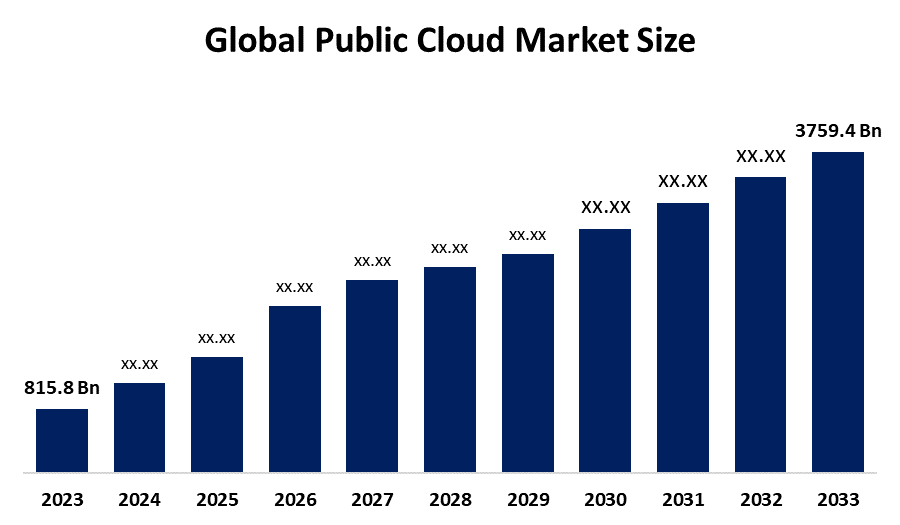
- The Global Public Cloud Market Size Was Estimated at USD 815.8 Billion in 2024
- The Market Size is Expected to Grow at a CAGR of around 14.9% from 2025 to 2035
- The Worldwide Public Cloud Market Size is Expected to Reach USD 3759.4 Billion by 2035
- Asia Pacific is expected to grow the fastest during the forecast period.
Get more details on this report -
According to a research report published by Spherical Insights and Consulting, the global public cloud market size was worth around USD 815.8 billion in 2024 and is predicted to grow to around USD 3759.4 billion by 2035 with a compound annual growth rate (CAGR) of 14.9% from 2025 to 2035. Global expansion of artificial intelligence and machine learning, shift towards cloud-native architectures, managing edge computing and distributed cloud, and adoption of hybrid multi-cloud management are all driving opportunities in the public cloud market.
Market Overview
The global industry segment devoted to a worldwide ecosystem of on-demand computing services, such as infrastructure, platforms, and software delivered over the internet by third-party providers on a pay-as-you-go basis, is known as the public cloud market. These include massive models like Infrastructure as a Service, Platform as a Service, and Software as a Service, covering offerings such as data storage, computing power, networking, databases, analytics, artificial intelligence, and enterprise applications. Governments play a crucial role in this market by establishing regulatory frameworks for data protection, privacy, and cybersecurity, promoting digital infrastructure, and encouraging cloud adoption through public sector initiatives. For example,
In October 2025, the U.S. FedRAMP Standardized cloud security authorization for all federal agencies, with 450+ federal agencies using FedRAMP-authorized cloud services, 62% of government cloud adoption is via FedRAMP platforms, and 114 cloud services were authorized in FY 2025, with rapid supply growth, supporting the public cloud market.
In August 2024, China’s Eastern Data, Western Computing Project builds a nationwide data center & cloud network, shifting data processing to western regions with USD 6.1 billion initial government investment, total investment attracted 200+ billion yuan, and 1.95 million server racks across national hubs, creating a large-scale cloud infrastructure and reducing costs, boosting public cloud adoption nationwide.
Report Coverage
This research report categorizes the public cloud market based on various segments and regions, forecasts revenue growth, and analyzes trends in each submarket. The report analyses the key growth drivers, opportunities, and challenges influencing the public cloud market. Recent market developments and competitive strategies, such as expansion, product launch, development, partnership, merger, and acquisition, have been included to draw the competitive landscape in the market. The report strategically identifies and profiles the key market players and analyses their core competencies in each sub-segment of the public cloud market.
Global Public Cloud Market Report Coverage
| Report Coverage | Details |
|---|---|
| Base Year: | 2024 |
| Market Size in 2024: | USD 815.8 billion |
| Forecast Period: | 2025-2035 |
| Forecast Period CAGR 2025-2035 : | CAGR of 14.9% |
| 2035 Value Projection: | USD 3759.4 billion |
| Historical Data for: | 2020-2023 |
| No. of Pages: | 150 |
| Tables, Charts & Figures: | 121 |
| Segments covered: | By Service,By End Use |
| Companies covered:: | Amazon Web Services, Microsoft Azure, Google Cloud Platform, Alibaba Cloud, Oracle Cloud Infrastructure, IBM Cloud, Salesforce, Tencent Cloud, Huawei Cloud, VMware by Broadcom, DigitalOcean, OVcloud, SAP SE, Others |
| Pitfalls & Challenges: | COVID-19 Empact, Challenge, Future, Growth, & Analysis |
Get more details on this report -
Driving Factors
Rapid technological innovation is one of the main drivers of the public cloud market's growth. Rapid digital transformation across industries, increasing demand for scalable and cost-efficient IT infrastructure, and the widespread adoption of advanced technologies such as AI, big data analytics, and IoT are the main factors driving the market for public cloud. In this field, innovation and investment are driven by the rising cybersecurity requirements, disaster recovery needs, and continuous innovation in cloud services. Government initiatives further accelerate adoption by ensuring security, compliance, and funding support for the public cloud market.
In January 2026, the Government of India launched GI Cloud MeghRaj to accelerate e-governance and optimize IT spending by promoting cloud adoption across ministries. It provides IaaS, PaaS, and SaaS services for public sector workloads.
Restraining Factors
High development and deployment costs, cybersecurity risks and data privacy concerns, vendor lock-in issues, need for skilled professionals, and the requirement for constant upgrades, monitoring, and compliance investments are the main factors restricting the public cloud market.
Market Segmentation
The public cloud market share is classified into service, enterprise size, and end use.
- The software as a service segment dominated the market in 2024, approximately 64%, and is projected to grow at a substantial CAGR during the forecast period.
Based on the service, the public cloud market is divided into infrastructure as a service, platform as a service, and software as a service. Among these, the software as a service segment dominated the market in 2024, approximately 64%, and is projected to grow at a substantial CAGR during the forecast period. High scalability, easy access, advanced software and automatic updates, offer subscription-based pricing, and reduce complex in-house infrastructure, are driving the software as a service industry.
- The large enterprises segment accounted for the largest share in 2024, approximately 63%, and is anticipated to grow at a significant CAGR during the forecast period.
Based on the enterprise size, the public cloud market is divided into SMEs and large enterprises. Among these, the large enterprises segment accounted for the largest share in 2024, approximately 63%, and is anticipated to grow at a significant CAGR during the forecast period. High volume investment in digital transformation, need for scalable infrastructure, advanced data analytics, and providing capital to invest in massive-scale digital initiatives are driving the large enterprises industry.
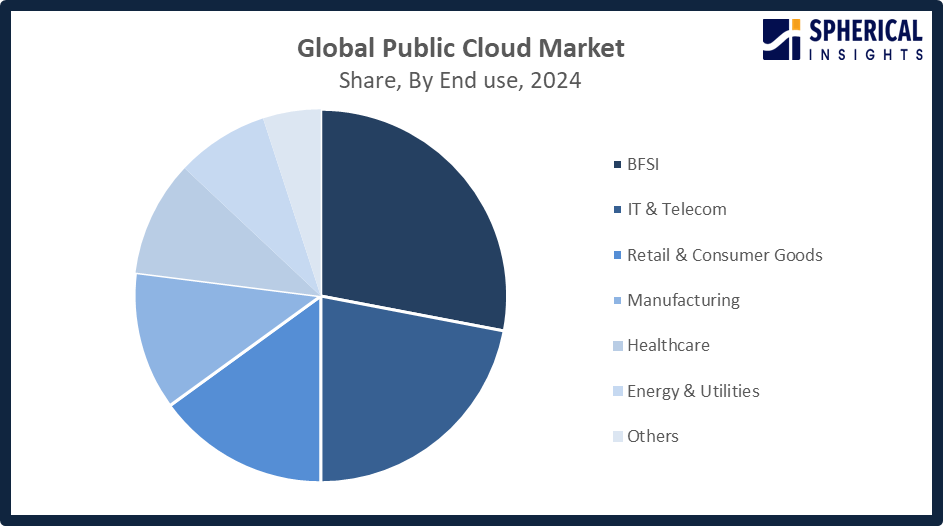
- The BFSI segment accounted for the highest market revenue in 2024, approximately 30%, and is anticipated to grow at a significant CAGR during the forecast period.
Based on the end use, the public cloud market is divided into BFSI, IT & telecom, retail & consumer Goods, manufacturing, energy & utilities, healthcare, and others. Among these, the BFSI segment accounted for the highest market revenue in 2024, approximately 30%, and is anticipated to grow at a significant CAGR during the forecast period. Rapid digital transformation, high demand for secure data, real-time analytics, managing massive data volumes, and the need to scale digital banking and fintech platforms are bolstering the BFSI market.
Get more details on this report -
Regional Segment Analysis of the Public Cloud Market
- North America (U.S., Canada, Mexico)
- Europe (Germany, France, U.K., Italy, Spain, Rest of Europe)
- Asia-Pacific (China, Japan, India, Rest of APAC)
- South America (Brazil and the Rest of South America)
- The Middle East and Africa (UAE, South Africa, Rest of MEA)
North America is anticipated to hold the largest share of the public cloud market over the forecast period. The United States and Canada are key contributors, making the region a global hub for innovation, investment, and cloud adoption. Strong government support, a high concentration of technology-driven industries such as BFSI, IT, and e-commerce, advanced connectivity, robust data center infrastructure, and a skilled workforce are driving growth in North America. The region’s leadership is further strengthened by government initiatives promoting early cloud adoption, ongoing digital transformation efforts, and high IT spending that supports secure and widespread cloud deployment.
Key government initiatives include Canada’s Cloud Adoption Strategy (2023) and the Cloud First / Data Sovereignty White Paper (2018), which prioritize public cloud as the default IT model and promote secure cloud usage. In the United States, the Federal Cloud Computing Strategy (June 2019) and the FedRAMP program have standardized cloud security, modernized procurement processes, and accelerated the migration of government agencies to public cloud platforms.
Asia Pacific is expected to grow at the fastest CAGR in the public cloud market during the forecast period. Countries such as China, Japan, and India are making significant investments in large-scale digital transformation initiatives and cloud services. The presence of major BFSI, retail, and manufacturing hubs further accelerates demand for advanced public cloud solutions. Growth is also driven by increasing internet penetration, rapid mobile adoption, strong enterprise cloud uptake across industries, and substantial government support through cloud-first policies, national cloud infrastructure programs, and data localization frameworks.
Recent government initiatives include Australia’s Whole-of-Government Cloud Computing Policy (December 2025), aimed at unifying secure cloud adoption; Singapore’s Government on Commercial Cloud program (updated September 2025) along with the Artificial Intelligence Government Cloud Cluster (launched May 2023) to support cloud-native AI workloads; and Malaysia’s National Cloud Computing Policy (August 2025), designed to strengthen cloud infrastructure and governance.
Competitive Analysis:
The report offers the appropriate analysis of the key organizations/companies involved within the public cloud market, along with a comparative evaluation primarily based on their product of offering, business overviews, geographic presence, enterprise strategies, segment market share, and SWOT analysis. The report also provides an elaborative analysis focusing on the current news and developments of the companies, which includes product development, innovations, joint ventures, partnerships, mergers & acquisitions, strategic alliances, and others. This allows for the evaluation of the overall competition within the market.
Key Target Audience
- Market Players
- Investors
- End-users
- Government Authorities
- Consulting and Research Firm
- Venture capitalists
- Value-Added Resellers (VARs)
Recent Developments
• March 2026: Microsoft published its 2026 Release Wave 1 plans for Dynamics 365, Microsoft Power Platform, and Copilot Studio, highlighting a wide range of cloud-based AI and automation capabilities scheduled to roll out from April to September 2026, accelerating enterprise cloud adoption.
• January 2026: AWS announced new multicloud tools and enhanced flexibility features to support open standards and reduce switching costs, improving interoperability and customer choice across cloud environments.
• December 2025: AWS unveiled a broad range of infrastructure and AI-oriented cloud innovations at AWS re:Invent 2025, including Graviton5 processors, Trainium3 UltraServers, advanced AI agents, and the Amazon Nova model family to enhance performance, scalability, and AI capabilities on the AWS cloud.
Market Segment
This study forecasts revenue at global, regional, and country levels from 2020 to 2035. Spherical Insights has segmented the public cloud market based on the below-mentioned segments:
Global Public Cloud Market, By Service
- Infrastructure As A Service
- Platform As A Service
- Software As A Service
Global Public Cloud Market, By Enterprise Size
- SMEs
- Large Enterprises
Global Public Cloud Market, By End Use
- BFSI
- IT & Telecom
- Retail & Consumer Goods
- Manufacturing
- Healthcare
- Energy & Utilities
- Others
Global Public Cloud Market, By Regional Analysis
- North America
- US
- Canada
- Mexico
- Europe
- Germany
- UK
- France
- Italy
- Spain
- Russia
- Rest of Europe
- Asia Pacific
- China
- Japan
- India
- South Korea
- Australia
- Rest of Asia Pacific
- South America
- Brazil
- Argentina
- Rest of South America
- Middle East & Africa
- UAE
- Saudi Arabia
- Qatar
- South Africa
- Rest of the Middle East & Africa
Frequently Asked Questions (FAQ)
-
1. What is multi-cloud strategy?A multi-cloud strategy uses multiple cloud providers simultaneously to reduce risk, avoid vendor lock-in, and optimize performance. Enterprises distribute workloads across providers like AWS, Azure, and Google Cloud. It enhances resilience and flexibility.
-
2. How do security concerns affect cloud adoption?Security is a major concern due to data breaches, cyberattacks, and regulatory compliance. Enterprises seek encryption, identity management, and threat detection solutions. FedRAMP and ISO certifications help mitigate risk.
-
3. How does public cloud support remote work?Public cloud enables remote access to applications, collaboration tools, and virtual desktops. Employees can work securely from anywhere. It scales quickly to meet demand spikes.
-
4. How does public cloud support disaster recovery?Public cloud enables replication, backup, and failover services for critical data. Cloud providers maintain geographically distributed data centers. Automated recovery reduces downtime and business risk.
-
5. What is the impact of emerging markets on public cloud?Emerging markets drive growth due to increasing internet penetration, mobile adoption, and digitalization. Governments promote cloud-first policies. SMEs adopt cloud for agility and cost savings. Providers expand infrastructure to meet rising demand.
-
6. What is the future trend of the public cloud market?Trends include AI integration, edge computing, hybrid/multi-cloud, serverless architectures, and enhanced cybersecurity. Adoption in emerging markets and government initiatives continue to fuel growth.
Need help to buy this report?