Global Pseudohypoaldosteronism Type 1 Market Size, Share, and COVID-19 Impact Analysis, By Type (Recessive and Dominant), By Diagnosis (Blood Test, Plasma Test, and Others), By Treatment (Sodium Supplement and Others), By End-Users (Hospitals, Specialty Clinics, and Others), and By Region (North America, Europe, Asia-Pacific, Latin America, Middle East, and Africa), Analysis and Forecast 2025 - 2035
Industry: Healthcare
Global Pseudohypoaldosteronism Type 1 Market Size Insights Forecasts to 2035
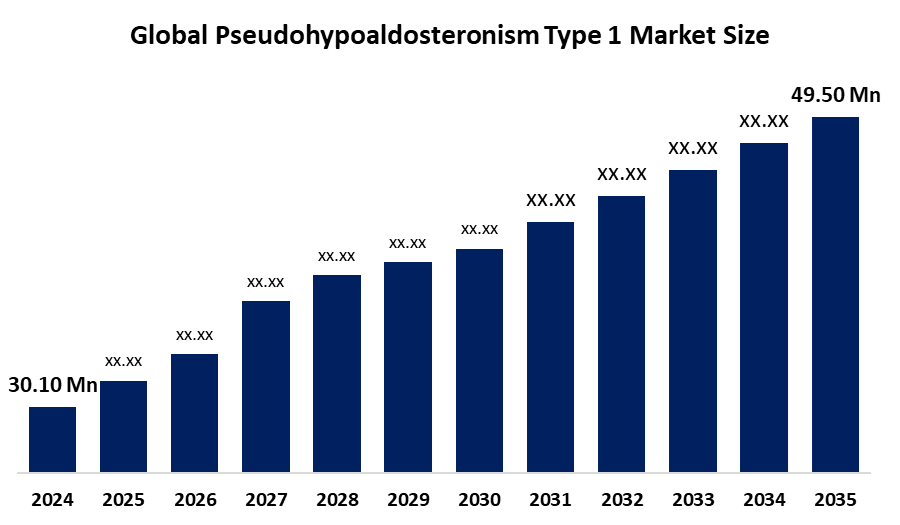
- The Global Pseudohypoaldosteronism Type 1 Market Size Was Estimated at USD 30.10 Million in 2024
- The Market Size is Expected to Grow at a CAGR of around 4.63% from 2025 to 2035
- The Worldwide Pseudohypoaldosteronism Type 1 Market Size is Expected to Reach USD 49.50 Million by 2035
- Asia Pacific is expected to grow the fastest during the forecast period.
Get more details on this report -
According to a Research Report Published by Spherical Insights and Consulting, The Global Pseudohypoaldosteronism Type 1 Market Size was worth around USD 30.10 Million in 2024 and is predicted to grow to around USD 49.50 Million by 2035 with a compound annual growth rate (CAGR) of 4.63% from 2025 and 2035. The market for Pseudohypoaldosteronism Type 1 has a number of opportunities to grow due to the surging focus on managing pseudohypoaldosteronism type 1 primarily through sodium chloride supplementation and, in severe cases, potassium-binding resins. This salt-wasting syndrome requires urgent, often lifelong, intervention for managing severe dehydration.
Market Overview
The Global Pseudohypoaldosteronism Type 1 Market Size focuses on diagnosing and managing a rare, life-threatening genetic salt-wasting disorder, driven by advancements in genetic testing and increasing awareness of pediatric endocrine conditions. Pseudohypoaldosteronism type 1 (PHA1) is a rare inherited disorder condition characterized by problems regulating the amount of sodium in the body. It is characterized by the severe resistance to the hormone aldosterone, which leads to neonatal salt wasting, hyponatremia, hyperkalemia, and metabolic acidosis. Sodium regulation, which is important for blood pressure and fluid balance, primarily occurs in the kidneys. The management include use of high sodium intake as PA1 involves severe resistance to mineralocorticoids. Analyzing the difference in severity and long-term outcomes between the two forms of PHA1, along with an increased emphasis on genetic confirmation for managing the condition, is the key trend in the market.
Innovation and market expansion are anticipated as a result of major players' expanding partnerships between clinical centres for clinical investigation. Advancements in genetic testing, which include the identification of SCNN1A, SCNN1B, and SCNN1G mutations and the development of targeted therapies, are promoting the Pseudohypoaldosteronism Type 1 Market Size.
Report Coverage
This research report categorizes the Pseudohypoaldosteronism Type 1 Market Size based on various segments and regions, forecasts revenue growth, and analyzes trends in each submarket. The report analyses the key growth drivers, opportunities, and challenges influencing the Pseudohypoaldosteronism Type 1 Market Size. Recent market developments and competitive strategies such as expansion, type launch, development, partnership, merger, and acquisition have been included to draw the competitive landscape in the market. The report strategically identifies and profiles the key market players and analyses their core competencies in each sub-segment of the Pseudohypoaldosteronism Type 1 Market Size.
Pseudohypoaldosteronism Type 1 Market Report Coverage
| Report Coverage | Details |
|---|---|
| Base Year: | 2024 |
| Market Size in 2024: | USD 30.10 Million |
| Forecast Period: | 2025-2035 |
| Forecast Period CAGR 2025-2035 : | CAGR of 4.63% |
| 2035 Value Projection: | USD 49.50 Million |
| Historical Data for: | 2020-2023 |
| No. of Pages: | 240 |
| Tables, Charts & Figures: | 120 |
| Segments covered: | By Type, By Diagnosis |
| Companies covered:: | Sandoz AG, Pfizer Inc., Hikma Pharmaceuticals PLC, Merck & Co., Inc., Blueprint Genetics Oy, PreventionGenetics, Breda Genetics, Ultragenyx Pharmaceutical Inc., GeneDx, LLC, Invitae Corporation, Eurofins Scientific, Ambry Genetics, Fulgent Genetics, Quest Diagnostics, Thermo Fisher Scientific, Inc, Illumina, Inc., PerkinElmer, Labcorp, and other key players |
| Pitfalls & Challenges: | COVID-19 Empact, Challenge, Future, Growth, & Analysis |
Get more details on this report -
Driving Factors
The market for pseudohypoaldosteronism type 1 is primarily driven by an increasing prevalence of rare genetic disorders, enhancing inclination towards early diagnosis and targeted treatment approaches. Advancements in genetic testing for providing personalized treatment management are contributing to propel market growth. For instance, identification of mutations in NR3C2, SCNN1A/B/G, KLHL3, and WNK1/4 genes using next-generation sequencing (NGS) and MLPA for large deletions detection. Additionally, increasing awareness among health professionals and increasing focus on rare disease management also contribute to enhancing the market growth.
Restraining Factors
The Pseudohypoaldosteronism Type 1 Market Size is restricted by factors like limited awareness, cost of genetic testing, regulatory hurdles, and low accessibility of specialized healthcare centres, especially in the underdeveloped areas. Further, lack of standardized treatment guidelines also negatively impacts the market growth.
Market Segmentation
The Pseudohypoaldosteronism Type 1 Market Size share is classified into type, diagnosis, treatment, and end-users.
- The recessive segment dominated the market with the largest share of around 50.0% in 2024 and is projected to grow at a substantial CAGR during the forecast period.
Based on the type, the Pseudohypoaldosteronism Type 1 Market Size is divided into recessive and dominant. Among these, the recessive segment dominated the market with the largest share of around 50.0% in 2024 and is projected to grow at a substantial CAGR during the forecast period. The recessive PHA 1 gas severe, life-long, and multi-organ salt-wasting nature, and as per an MDPI study, it was found that in 164 genetically tested cases, 32.9% were recessive ENaC mutation, i.e., PHA1 b, often requiring much higher, intensive, and long-term care, resulting in a higher financial burden per patient. The higher clinical severity, greater diagnostic and treatment needs, and long-term management burden are responsible for driving the segmental market.
- The blood test segment accounted for the dominant share of over 50.0% share in 2024 and is anticipated to grow at a significant CAGR during the forecast period.
Based on the diagnosis, the Pseudohypoaldosteronism Type 1 Market Size is divided into blood test, plasma test, and others. Among these, the blood test segment accounted for the dominant share of over 50.0% share in 2024 and is anticipated to grow at a significant CAGR during the forecast period. Blood test confirming the serum potassium, low serum sodium (hyponatremia), and metabolic acidosis, coupled with elevated plasma renin activity and high aldosterone levels. While genetic testing (e.g., NR3C2, SCNN1A, KLHL3) confirms the specific type.
- The sodium supplement segment accounted for the dominant share of about 45.0% in 2024 and is anticipated to grow at a significant CAGR during the forecast period.
Based on the treatment, the Pseudohypoaldosteronism Type 1 Market Size is divided into sodium supplement and others. Among these, the sodium supplement segment accounted for the dominant share of about 45.0% in 2024 and is anticipated to grow at a significant CAGR during the forecast period. Sodium supplementation is a primary treatment strategy, characterized by resistance to aldosterone, leading to significant renal sodium loss, hypernatremia, and hyperkalemia. Its established efficacy in correcting electrolyte imbalances and preventing severe dehydration episodes in patients, sodium supplementation remains the cornerstone of therapy, often combined with careful dietary management and regular monitoring.
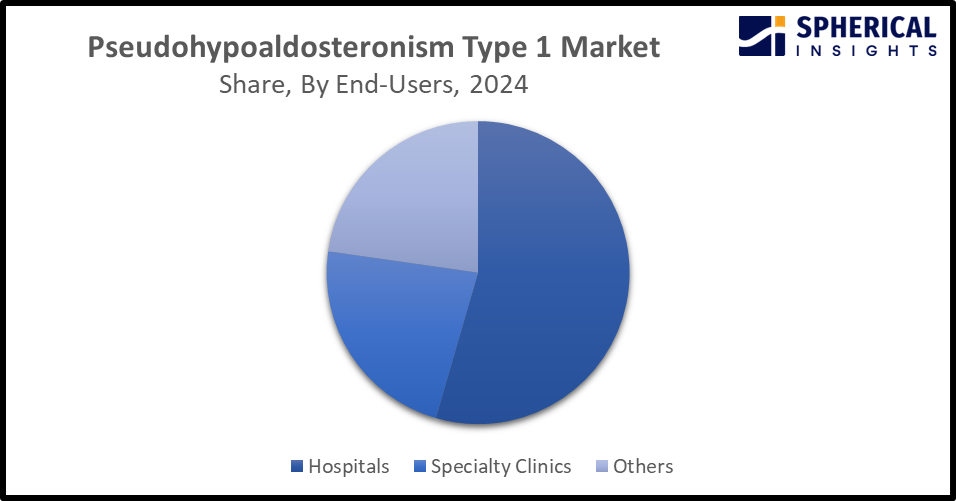
- The hospitals segment dominated the market with the largest share of over 55.1% in 2024 and is projected to grow at a substantial CAGR during the forecast period.
Based on the end-users, the Pseudohypoaldosteronism Type 1 Market Size is divided into hospitals, specialty clinics, and others. Among these, the hospitals segment dominated the market with the largest share of over 55.1% in 2024 and is projected to grow at a substantial CAGR during the forecast period. The segment specifically includes the Neonatal Intensive Care Unit (NICU) and Pediatric Intensive Care Unit (PICU). The upsurging focus on correcting life-threatening electrolyte imbalances and salt loss primarily through high-dose sodium chloride supplementation is driving the segmental market, as acute stabilization often needs IV fluid replacement and, in severe cases, peritoneal dialysis.
Get more details on this report -
Regional Segment Analysis of the Pseudohypoaldosteronism Type 1 Market Size
- North America (U.S., Canada, Mexico)
- Europe (Germany, France, U.K., Italy, Spain, Rest of Europe)
- Asia-Pacific (China, Japan, India, Rest of APAC)
- South America (Brazil and the Rest of South America)
- The Middle East and Africa (UAE, South Africa, Rest of MEA)
North America is anticipated to hold the largest share of the Pseudohypoaldosteronism Type 1 Market Size over the predicted timeframe.

Get more details on this report -
North America is anticipated to hold the largest share of about 41.5% in the Pseudohypoaldosteronism Type 1 Market Size over the predicted timeframe. The market ecosystem in North America is strong, with both increased awareness and advanced healthcare infrastructure. For instance, in April 2025, a case report published entitled ‘Autoimmune hepatitis in a patient with pseudohypoaldosteronism type 1 – insights into a rare co-occurrence’. The market demand for pseudohypoaldosteronism type 1 has been driven by the region's increased healthcare expenditure, strong R&D capabilities, and presence of key pharmaceutical industries that are focusing on rare disease therapies. The United States is leading the North America Pseudohypoaldosteronism Type 1 Market Size, accounting for about 45.0% share in 2024, driven by increased awareness of rare genetic disorders and the presence of advanced healthcare infrastructure.
Asia Pacific is expected to grow at a rapid CAGR of about 6.2% in the Pseudohypoaldosteronism Type 1 Market Size during the forecast period. The Asia Pacific area has a thriving market for Pseudohypoaldosteronism Type 1 due to its rising healthcare infrastructure, awareness program, and government programs for rare disease diagnosis and treatment initiatives. Due to their governments websites that provide details regarding the disorder, as well as an increasing research study on management of PHA 1, are expected to propel market growth. For instance, in August 2022, the MDPI Journal published an article entitled ‘Neonatal Pseudohypoaldosteronism Type-1 in Japan’. India accounts for the dominant share in the Asia Pacific region, due to the country’s expanding healthcare infrastructure, adoption of genetic testing, and government initiatives supporting rare disease management.
Competitive Analysis:
The report offers the appropriate analysis of the key organizations/companies involved within the Pseudohypoaldosteronism Type 1 Market Size, along with a comparative evaluation primarily based on their type of offering, business overviews, geographic presence, enterprise strategies, segment market share, and SWOT analysis. The report also provides an elaborative analysis focusing on the current news and developments of the companies, which includes type development, innovations, joint ventures, partnerships, mergers & acquisitions, strategic alliances, and others. This allows for the evaluation of the overall competition within the market.
List of Key Companies
- Sandoz AG
- Pfizer Inc.
- Hikma Pharmaceuticals PLC
- Merck & Co., Inc.
- Blueprint Genetics Oy
- PreventionGenetics
- Breda Genetics
- Ultragenyx Pharmaceutical Inc.
- GeneDx, LLC
- Invitae Corporation
- Eurofins Scientific
- Ambry Genetics
- Fulgent Genetics
- Quest Diagnostics
- Thermo Fisher Scientific, Inc
- Illumina, Inc.
- PerkinElmer
- Labcorp
- Others
Key Target Audience
- Market Players
- Investors
- End-users
- Government Authorities
- Consulting And Research Firm
- Venture capitalists
- Value-Added Resellers (VARs)
Recent Development
- In September 2025, A case report article was published on the title ‘Functional investigation of the γENaC G532S mutation presenting as mild PHA-1B3’.
- In January 2024, A case study report article was published entitled ‘Early molecular confirmation and sodium polystyrene sulfonate management of systemic pseudohypoaldosteronism type I’.
Market Segment
This study forecasts revenue at global, regional, and country levels from 2020 to 2035. Spherical Insights has segmented the Pseudohypoaldosteronism Type 1 Market Size based on the below-mentioned segments:
Global Pseudohypoaldosteronism Type 1 Market Size, By Type
- Recessive
- Dominant
Global Pseudohypoaldosteronism Type 1 Market Size, By Diagnosis
- Blood Test
- Plasma Test
- Others
Global Pseudohypoaldosteronism Type 1 Market Size, By Treatment
- Sodium Supplement
- Others
Global Pseudohypoaldosteronism Type 1 Market Size, By End-Users
- Hospitals
- Specialty Clinics
- Others
Global Pseudohypoaldosteronism Type 1 Market Size, By Regional Analysis
- North America
- US
- Canada
- Mexico
- Europe
- Germany
- UK
- France
- Italy
- Spain
- Russia
- Rest of Europe
- Asia Pacific
- China
- Japan
- India
- South Korea
- Australia
- Rest of Asia Pacific
- South America
- Brazil
- Argentina
- Rest of South America
- Middle East & Africa
- UAE
- Saudi Arabia
- Qatar
- South Africa
- Rest of the Middle East & Africa
Frequently Asked Questions (FAQ)
-
1. What is the market size of the Pseudohypoaldosteronism Type 1 Market Size?The global Pseudohypoaldosteronism Type 1 Market Size is expected to grow from USD 30.10 Million in 2024 to USD 49.50 Million by 2035, at a CAGR of 4.63% during the forecast period 2025-2035.
-
2. Which region holds the largest share of the Pseudohypoaldosteronism Type 1 Market Size?North America is anticipated to hold the largest share of the Pseudohypoaldosteronism Type 1 Market Size over the predicted timeframe.
-
3. What is the forecasted CAGR of the Global Pseudohypoaldosteronism Type 1 Market Size from 2024 to 2035?The market is expected to grow at a CAGR of around 4.63% during the period 2024–2035.
-
4. Who are the top companies that are involved in the Global Pseudohypoaldosteronism Type 1 Market Size?Key players include Sandoz AG, Pfizer Inc., Hikma Pharmaceuticals PLC, Merck & Co., Inc., Blueprint Genetics Oy, PreventionGenetics, Breda Genetics, Ultragenyx Pharmaceutical Inc., GeneDx, LLC, Invitae Corporation, Eurofins Scientific, Ambry Genetics, Fulgent Genetics, Quest Diagnostics, Thermo Fisher Scientific, Inc, Illumina, Inc., PerkinElmer, and Labcorp.
-
5. What are the main drivers in the Pseudohypoaldosteronism Type 1 Market Size?The increasing prevalence of rare genetic disorders, inclination towards early diagnosis and targeted treatment approaches, and an increased awareness regarding rare genetic disorders are major market growth drivers of the Pseudohypoaldosteronism Type 1 Market Size.
-
6. What challenges are limiting the adoption of pseudohypoaldosteronism type 1 treatment?Limited awareness, cost of genetic testing, regulatory hurdles, and low accessibility of specialized healthcare centres, and lack of standardized treatment guidelines remain key restraints in the Pseudohypoaldosteronism Type 1 Market Size.
-
7. What are the key trends in the Pseudohypoaldosteronism Type 1 Market Size?With the advancements in genetic testing and increasing awareness of pediatric endocrine conditions, clinical investigation on pseudohypoaldosteronism type 1 management is a key trend in the market.
Need help to buy this report?