Global Polysorbate-80 Market Size, Share, and COVID-19 Impact Analysis, By Source (Plant Based, Animal Based, and Synthetic), By Functionality (Emulsifier, Dispersant, Solubilize, Surfactant, and Stabilizer), By Application (Food & Beverage, Pharmaceutical, Nutraceutical, Cosmetics & Personal Care, and Agrochemical), and By Region (North America, Europe, Asia-Pacific, Latin America, Middle East, and Africa), Analysis and Forecast 2025 - 2035
Industry: Chemicals & Materials
Global Polysorbate-80 Market Size Insights Forecasts to 2035
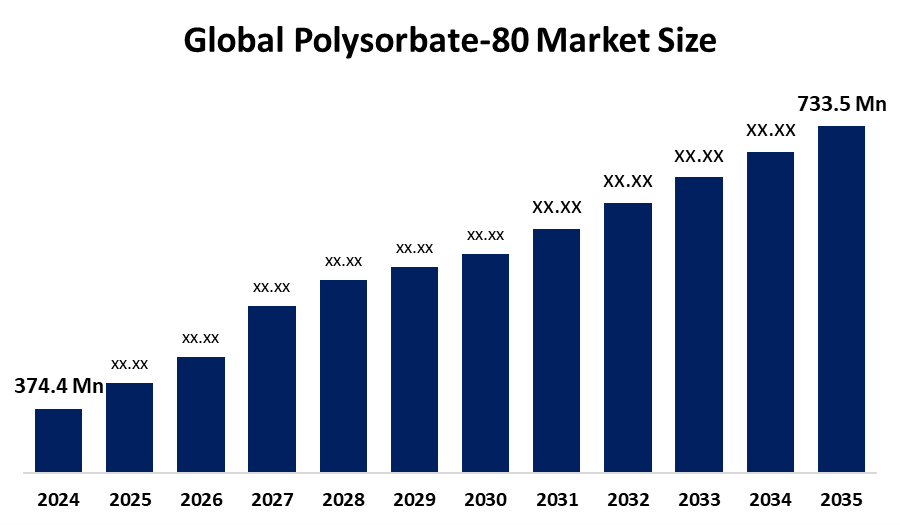
- The Global Polysorbate-80 Market Size Was Estimated at USD 374.4 Million in 2024
- The Market Size is Expected to Grow at a CAGR of around 6.3% from 2025 to 2035
- The Worldwide Polysorbate-80 Market Size is Expected to Reach USD 733.5 Million by 2035
- North America is expected to grow the fastest during the forecast period.
Get more details on this report -
According to a Research Report Published by Spherical Insights and Consulting, The Global Polysorbate-80 Market Size was worth around USD 374.4 Million in 2024 and is predicted to Grow to Around USD 733.5 Million by 2035 with a compound annual growth rate (CAGR) of 6.3% from 2025 to 2035. The Polysorbate-80 Market Size is growing because biopharmaceuticals need vaccine and injectable stabilization, processed food products require emulsifying agents, and personal care products see increasing consumption. Market adoption is accelerating because companies develop bio-based products that have high purity and meet clean-label certification standards.
Market Overview
Polysorbate-80, which is commonly referred to as Tween 80, functions as a non-ionic surfactant that emulsifies, solubilizes and stabilizes products because it results from the ethoxylation process of sorbitan monooleate. The pharmaceutical industry uses this substance to maintain the stability of vaccines and biologic drugs and injectable medicines, which include COVID-19 vaccines. The substance enhances food texture and extends shelf life while it maintains the stability of lotions and creams and hair products in cosmetics. The pharmaceutical industry drives market growth because it demands biologic therapies and vaccines, while the global processed food market and personal care products drive market expansion. The global processed food market, which will exceed USD 3 trillion by 2027, drives consumption because the product finds common usage in ice creams, sauces and baked goods. The worldwide cosmetics industry, which expands at a rate of 5-7% every year, drives the market for creams and lotions.
The market provides opportunities through bio-based and high-purity polysorbate development, which Croda will introduce as bio-based Polysorbate-80 in 2024, while Evonik increases its pharmaceutical-grade capacity. In September 2025Health Canada approved polysorbate 80 for use as an emulsifying agent in unstandardized dips at a maximum level of 0.05% on October 20 2025, which will take effect after its approval. The approval process required a complete premarket submission, which included a scientific safety assessment that followed Division 16 of Canada’s Food and Drug Regulations. The assessment showed the additive was safe according to allergenicity, chemistry, nutrition and toxicology for the specified purpose.
Report Coverage
This research report categorizes the Polysorbate-80 Market Size based on various segments and regions, forecasts revenue growth, and analyzes trends in each submarket. The report analyses the key growth drivers, opportunities, and challenges influencing the Polysorbate-80 Market Size. Recent market developments and competitive strategies, such as expansion, type launch, development, partnership, merger, and acquisition, have been included to draw the competitive landscape in the market. The report strategically identifies and profiles the key market players and analyses their core competencies in each sub-segment of the Polysorbate-80 Market Size.
Polysorbate-80 Market Report Coverage
| Report Coverage | Details |
|---|---|
| Base Year: | 2024 |
| Market Size in 2024: | USD 374.4 Million |
| Forecast Period: | 2025-2035 |
| Forecast Period CAGR 2025-2035 : | CAGR of 6.3% |
| 2035 Value Projection: | USD 733.5 Million |
| Historical Data for: | 2020-2023 |
| No. of Pages: | 230 |
| Tables, Charts & Figures: | 110 |
| Segments covered: | By Source, By Functionality |
| Companies covered:: | Croda International PLC, BASF Corporation, Evonik Industries, Lonza Group Limited, Solenis, Mohini Organics Pvt Ltd., Avril Group, Reachin Chemical Co Ltd., NOF Corporation, Lotion Crafter LLC, Camden-grey Essential Oils, Avantor Inc., Guangzhou Runhua Food Additive Co., Ltd., and other key players |
| Pitfalls & Challenges: | COVID-19 Empact, Challenge, Future, Growth, & Analysis |
Get more details on this report -
Driving Factors
The global Polysorbate-80 Market Size is expanding because industries use the product in pharmaceuticals, food and beverages, and personal care products. The non-ionic surfactant polysorbate-80 functions as an emulsifier, which maintains vaccine, skincare product and processed food product stability. Market growth receives support from rising biopharmaceutical demand, which saw biologics achieve more than 30% of worldwide drug approvals in 2024. The processed food industry will reach a value exceeding USD 3 trillion by 2027, which drives the use of polysorbate-80. The demand for personal care products increases because global cosmetics expenditure rises by 5-7% each year. The industry faces difficulties because regulators examine additives, and budget pressures arise from changes in raw material costs.
Restraining Factors
The global Polysorbate-80 Market Size faces major obstacles because products lose stability from high degradation rates (hydrolysis/oxidation), which are mandated by strict regulatory standards for food and pharmaceutical products and because raw materials experience price fluctuations. The growth of the market faces obstacles because people develop health worries about possible allergic reactions, and they prefer cleaner products that contain natural ingredients.
Market Segmentation
The Polysorbate-80 Market Size share is classified into source, functionality, and application.
- The plant based segment dominated the market in 2024, approximately 52% and is projected to grow at a substantial CAGR during the forecast period.
Based on the source, the Polysorbate-80 Market Size is divided into plant based, animal based, and synthetic. Among these, the plant based segment dominated the market in 2024 and is projected to grow at a substantial CAGR during the forecast period. The segment led the Polysorbate-80 Market Size because consumers increasingly choose natural, sustainable components. The market has experienced increased adoption because manufacturers now prefer renewable materials together with green chemistry solutions to create clean-label products and bio-based cosmetics, and sustainable pharmaceutical excipients. The Good Food Institute reports that 40% of adults in Germany and the UK plan to increase their consumption of plant-based foods.
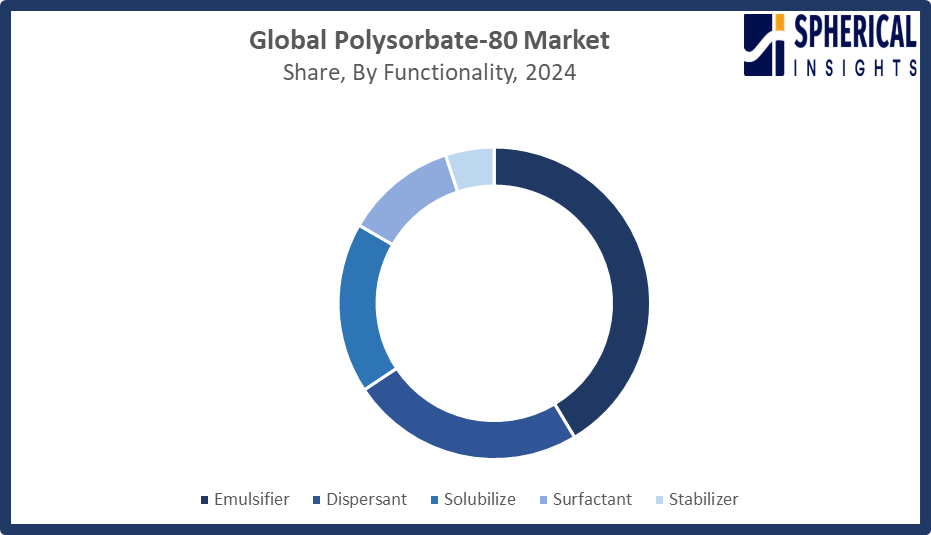
- The emulsifier segment accounted for the largest share in 2024, approximately 41% and is anticipated to grow at a significant CAGR during the forecast period.
Based on the functionality, the Polysorbate-80 Market Size is divided into emulsifier, dispersant, solubilize surfactant, and stabilizer. Among these, the emulsifier segment accounted for the largest share in 2024 and is anticipated to grow at a significant CAGR during the forecast period. The emulsifier segment growth in the Polysorbate-80 Market Size is due to the extensive use of emulsifiers in processed foods, pharmaceuticals and cosmetics. The industrial sectors worldwide consume more emulsifiers because they require stable products that have better textures, longer shelf life and reliable performance.
Get more details on this report -
- The pharmaceutical segment accounted for the highest market revenue in 2024, approximately 37% and is anticipated to grow at a significant CAGR during the forecast period.
Based on the application, the Polysorbate-80 Market Size is divided into food & beverage, pharmaceutical, nutraceutical, cosmetics & personal care, and agrochemical. Among these, the pharmaceutical segment accounted for the highest market revenue in 2024 and is anticipated to grow at a significant CAGR during the forecast period. The pharmaceutical segment market growth is due to the increasing production of biologic vaccines and injectable drugs. The worldwide demand for high-purity polysorbate-80 in pharmaceutical manufacturing has surged because global healthcare expenditures have risen, monoclonal antibody therapies have expanded, and formulation stability requirements have become stricter. The R&D expenditures, which will exceed USD 200 billion in 2024, will support ongoing pharmaceutical research work.
Regional Segment Analysis of the Polysorbate-80 Market
- North America (U.S., Canada, Mexico)
- Europe (Germany, France, U.K., Italy, Spain, Rest of Europe)
- Asia-Pacific (China, Japan, India, Rest of APAC)
- South America (Brazil and the Rest of South America)
- The Middle East and Africa (UAE, South Africa, Rest of MEA)
Asia Pacific is anticipated to hold the largest share of the Polysorbate-80 Market Size over the predicted timeframe.

Get more details on this report -
Asia Pacific is anticipated to hold the largest share of the Polysorbate-80 Market Size over the predicted timeframe. The Asia Pacific region will become the leading segment of the Polysorbate-80 Market Size because its pharmaceutical, food processing and cosmetics industries show strong growth, which will result in 41% of worldwide revenue during 2024. The regional demand in China exceeds all others because the country operates extensive vaccine and biologics production facilities, whereas India's growth is due to its increasing biosimilar production and new regulatory changes. The advanced drug formulation capabilities of Japan and South Korea, together with their high-end cosmetics industry, create value for both nations. The increasing demand for processed foods, together with rising healthcare expenditures in developing Asian nations, creates a higher demand for polysorbate-80 in that region.
North America is expected to grow at a rapid CAGR in the Polysorbate-80 Market Size during the forecast period. The North American market for polysorbate-80 is expected to have 28% share, which will expand quickly because the United States dominates regional demand through its robust biologics and vaccine manufacturing operations. The pharmaceutical-grade market will grow because healthcare costs surpass USD 4.5 trillion annually, and the number of injectable drugs receiving approval continues to increase. Canada supports the region by implementing regulatory improvements that include new food additive permits, which will begin in 2025, to increase the demand for emulsifiers used in processed food and nutraceutical products.
The European Polysorbate-80 Market Size shows steady growth because the pharmaceutical and food markets of Germany, France and the United Kingdom drive market demand. Germany leads regional demand through its advanced biologics manufacturing facilities, while France drives market expansion through its vaccine production capabilities. The UK economy grows because the nutraceutical and processed food industries continue to develop. The European Medicines Agency enforces strict quality control requirements, which increase demand for high-purity bio-based polysorbate-80 products across Europe.
Competitive Analysis:
The report offers the appropriate analysis of the key organizations/companies involved within the Polysorbate-80 Market Size, along with a comparative evaluation primarily based on their type of offering, business overviews, geographic presence, enterprise strategies, segment market share, and SWOT analysis. The report also provides an elaborative analysis focusing on the current news and developments of the companies, which includes type development, innovations, joint ventures, partnerships, mergers & acquisitions, strategic alliances, and others. This allows for the evaluation of the overall competition within the market.
List of Key Companies
- Croda International PLC
- BASF Corporation
- Evonik Industries
- Lonza Group Limited
- Solenis
- Mohini Organics Pvt Ltd.
- Avril Group
- Reachin Chemical Co Ltd.
- NOF Corporation
- Lotion Crafter LLC
- Camden-grey Essential Oils
- Avantor Inc.
- Guangzhou Runhua Food Additive Co., Ltd.
- Others
Key Target Audience
- Market Players
- Investors
- End-users
- Government Authorities
- Consulting and Research Firm
- Venture capitalists
- Value-Added Resellers (VARs)
Recent Development
- In January 2026, the U.S. Food and Drug Administration outlined Human Foods Program priorities, advancing a phase-out of petroleum-based synthetic dyes by end-2026 while reaffirming polysorbate-80’s GRAS status. India continued enforcing excipient disclosure rules, as updated USP standards tightened peroxide limits, favoring high-purity pharmaceutical-grade suppliers.
- In September 2025, Evonik Industries launched MaxiPure Polysorbate 80, an ultra-high purity surfactant for injectable and biopharmaceutical applications. Designed to enhance protein stability and API solubilization, the product strengthens Evonik’s support for growing biologics and biosimilars manufacturing worldwide.
- In July 2024, Amneal Pharmaceuticals, Inc. and Steriscience launched FOCINVEZ, a ready-to-use injectable free of polysorbate 80. The single-dose vial requires no reconstitution and was developed by SPES Pharmaceuticals, offering improved convenience and formulation innovation.
- In January 2024, Croda International launched super-refined Polysorbate 80 variants for biologics and gene therapies. The new line offers ultra-low peroxide and impurity levels, enhancing stability for sensitive APIs and lipid-nanoparticle formulations in advanced pharmaceutical applications.
Market Segment
This study forecasts revenue at global, regional, and country levels from 2020 to 2035. Spherical Insights has segmented the Polysorbate-80 Market Size based on the below-mentioned segments:
Global Polysorbate-80 Market Size, By Source
- Plant Based
- Animal Based
- Synthetic
Global Polysorbate-80 Market Size, By Functionality
- Emulsifier
- Dispersant
- Solubilize
- Surfactant
- Stabilizer
Global Polysorbate-80 Market Size, By Application
- Food & Beverage
- Pharmaceutical
- Nutraceutical
- Cosmetics & Personal Care
- Agrochemical
Global Polysorbate-80 Market Size, By Regional Analysis
- North America
- US
- Canada
- Mexico
- Europe
- Germany
- UK
- France
- Italy
- Spain
- Russia
- Rest of Europe
- Asia Pacific
- China
- Japan
- India
- South Korea
- Australia
- Rest of Asia Pacific
- South America
- Brazil
- Argentina
- Rest of South America
- Middle East & Africa
- UAE
- Saudi Arabia
- Qatar
- South Africa
- Rest of the Middle East & Africa
Frequently Asked Questions (FAQ)
-
1. How are stringent regulatory guidelines from the FDA and EMA impacting the production and usage of pharmaceutical-grade polysorbate-80?Stringent FDA and EMA guidelines now classify polysorbates as high-risk materials, mandating strict contamination testing. This has driven adoption of high-purity grades, with 36% growth in multi-compendial polysorbate 80 for parenteral formulations.
-
2. What role does polysorbate-80 play as a critical stabilizer and emulsifier in COVID-19 vaccines and biologic drug formulations?Polysorbate-80 is a critical stabilizer and emulsifier in COVID-19 vaccines and biologics, preventing protein aggregation and ensuring formulation stability. It was included in several vaccine formulations including AstraZeneca's AZD1222. The pharmaceutical demand for Polysorbate-80 has expanded significantly, driven by biologics growth and vaccine production during the pandemic.
-
3. How is the rising prevalence of chronic diseases, causing 17.9 million annual deaths globally, driving pharmaceutical demand for polysorbate-80?The rising prevalence of chronic diseases, causing 17.9 million annual deaths, drives pharmaceutical demand for Polysorbate-80 as it is essential for stabilizing biologic drugs and chronic disease treatments. The pharmaceutical segment accounts for approximately 38-46% of global Polysorbate-80 demand.
-
4. What impact is the global shift toward plant-based and sustainable surfactants having on polysorbate-80 product development?The shift toward plant-based and sustainable surfactants is boosting Polysorbate-80 development, with 45% of consumers preferring bio-based ingredients, driving manufacturers to launch greener, renewable variants and increase R&D in sustainable emulsifier solutions.
-
5. How do polysorbate-80 degradation and impurity profiles affect stability and safety in parenteral drug formulations?Polysorbate-80 degradation and impurities can reduce parenteral drug stability and increase safety risks; studies show up to 30% loss of surfactant effectiveness over time if degradation isn’t controlled, prompting stricter quality limits and analytical monitoring in formulations.
-
6. What technological advancements are improving high-purity and bio-based polysorbate-80 manufacturing?Technological advancements like enzymatic synthesis and refined bio-based feedstock processing are improving high-purity Polysorbate-80 yields by up to 25-30%, reducing impurities and supporting greener, regulatory-compliant production.
-
7. How does expansion in the cosmetics industry affect global polysorbate-80 sales?Expansion in the cosmetics industry, growing at 5-7% annually worldwide, boosts global Polysorbate-80 sales by increasing demand for stable emulsions in creams, lotions, and hair products, accounting for roughly 25-30% of total market consumption.
-
8. What impact do sustainability initiatives have on raw material sourcing for polysorbate-80?Sustainability initiatives are shifting Polysorbate-80 raw material sourcing toward renewable feedstocks, with 40% of manufacturers adopting bio-based inputs to reduce carbon footprints and meet consumer demand for greener products.
Need help to buy this report?