Global Pigeon Pea Market Size, Share, and COVID-19 Impact Analysis, By Product Type (Organic Pigeon Pea and Conventional Pigeon Pea), By Application (Food and Beverages, Animal Feed, Pharmaceuticals, and Others) and By Region (North America, Europe, Asia-Pacific, Latin America, Middle East, and Africa), Analysis and Forecast 2025 - 2035
Industry: Food & Beverages
Global Pigeon Pea Market Insights Forecasts to 2035
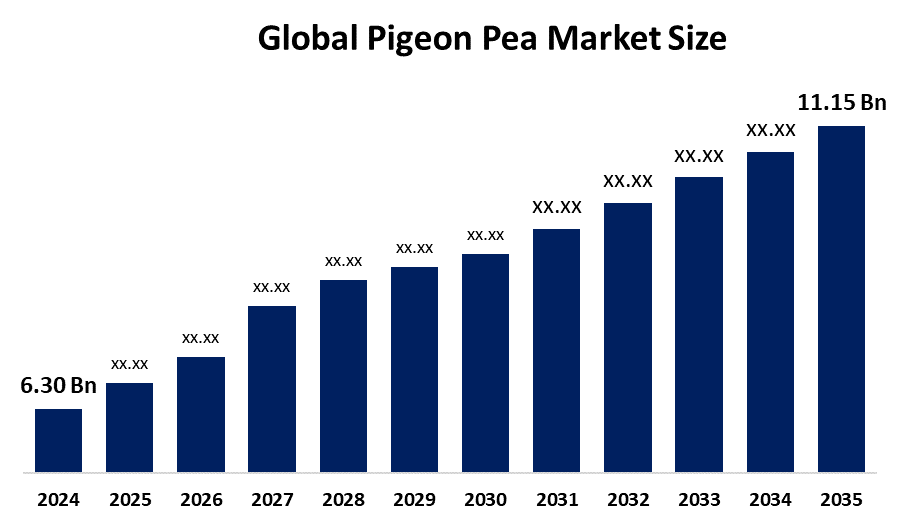
- The Global Pigeon Pea Market Size Was Estimated at USD 6.30 Billion in 2024
- The Market Size is Expected to Grow at a CAGR of around 5.33% from 2025 to 2035
- The Worldwide Pigeon Pea Market Size is Expected to Reach USD 11.15 Billion by 2035
- North America is expected to grow the fastest during the forecast period.
Get more details on this report -
According to a research report published by Spherical Insights and Consulting, The Global Pigeon Pea Market Size was worth around USD 6.30 Billion in 2024 and is predicted to Grow to around USD 11.15 Billion by 2035 with a compound annual growth rate (CAGR) of 5.33% from 2025 to 2035. Global pigeon pea market future opportunities are poised to be driven by numerous factors, such as the increasing demand for plant-based protein, the rise of ready-to-cook and processed foods, growth in exports, adoption of sustainable farming methods, and the successful penetration of emerging vegetarian and health-conscious markets.
Market Overview
The Global Pigeon Pea Market encompasses all the activities related to the production, trade, and consumption of pigeon peas across the world. Pigeon peas are a leguminous plant verging on the rich protein, healthful nutrients, and multifarious application in the kitchen, as livestock feed, and food processing via different methods. Additionally, short-term acreage expansion is supported by policy incentives. For the 2025-26 season, India has increased the minimum support price to Rs 8,000 per quintal, which is equal to USD 96 per quintal, thus providing a margin of 59% over the estimated costs Source: Press Information Bureau, “Cabinet Approves Minimum Support Prices for Kharif Crops 2025-26,” pib.gov.in. Farmers are allowed to enroll in digital procurement portals prior to planting, thus ensuring that their produce is taken by the market and making it easier for them to get credit. Tanzania provides input subsidies for pulses as part of its national food-security strategy, while Kenya connects pigeon pea to school feeding programs. These measures help to reduce the risks associated with the new crops and also speed up the supply of the pigeon pea market's forward pipeline. The success of the strategy depends on the performance of logistics, where public agencies work with private traders, procurement volumes increase quickly, and stockpiles are used to stabilize prices during the off-season.
Report Coverage
This research report categorizes the pigeon pea market based on various segments and regions, forecasts revenue growth, and analyzes trends in each submarket. The report analyses the key growth drivers, opportunities, and challenges influencing the pigeon pea market. Recent market developments and competitive strategies such as expansion, type launch, development, partnership, merger, and acquisition, have been included to draw the competitive landscape in the market. The report strategically identifies and profiles the key market players and analyses their core competencies in each sub-segment of the pigeon pea market.
Driving Factors
The pigeon pea market is full of possibilities due to changing consumer preferences and market dynamics. One main opportunity is the rapid growth of the plant-based protein market, where pigeon peas are progressively recognized as an eco-friendly and nutritious protein source. As consumers are more and more inclined to try not only animal-derived proteins but also pigeon peas, a wide range of cuisines and a healthy option at that are the main attractions. The increased adoption of plant-based diets and the ongoing trend of vegetarianism and veganism are opening up a lot for pigeon pea products. Moreover, this is turning into reality, thanks to food companies' eagerness to experiment with new plant-based products that would have pigeons, like protein-rich snacks and meat substitutes, as their star ingredients.
Restraining Factors
In 2024, the Indian summer monsoons produced numerous one-in-200-year rainfall events that created a flood in both Andhra Pradesh and Telangana, delaying the planting of thousands of hectares of farmland. The same type of irregular precipitation events appears in the Upper Kumaon Himalaya and have had a negative effect on overall water availability. Farmers, who are facing uncertainty due to these patterns, often switch their crops to paddy or abandon pulses altogether, thus decreasing the supply of these crops and increasing the volatility in prices.
Market Segmentation
The pigeon pea market share is classified into product type and application
- The organic pigeon pea segment accounted for the largest share in 2024 and is anticipated to grow at a significant CAGR during the forecast period.
Based on the product type, the pigeon pea market is divided into organic pigeon pea and conventional pigeon pea. Among these, the organic pigeon pea segment accounted for the largest share in 2024 and is anticipated to grow at a significant CAGR during the forecast period. Pigeon peas that are organic, with no artificial chemicals or pesticides used, are in sync with the trend of consumers preferring clean and natural food products. This product category is mostly liked by health seekers and people with diet restrictions as it provides a sustainable and healthy choice. Growth of organic segment is fueled by increasing number of organic farms and also the development of organic food retail channels making organic pigeon peas to be accessed more easily by consumers worldwide.
- The food and beverages segment accounted for the highest market revenue in 2024 and is anticipated to grow at a significant CAGR during the forecast period.
Based on the application, the pigeon pea market is divided into food and beverages, animal feed, pharmaceuticals, and others. Among these, the food and beverages segment accounted for the highest market revenue in 2024 and is anticipated to grow at a significant CAGR during the forecast period. They find their place in numerous culinary dishes, including traditional soups and stews, as well as modern salads and curries. The consumer preference for plant-based proteins and wellness-oriented eating habits are the driving factors for the growth in this segment. Being rich in protein, pigeon peas are acknowledged as a significant food source for vegetarians and vegans.
Regional Segment Analysis of the pigeon pea Market
- North America (U.S., Canada, Mexico)
- Europe (Germany, France, U.K., Italy, Spain, Rest of Europe)
- Asia-Pacific (China, Japan, India, Rest of APAC)
- South America (Brazil and the Rest of South America)
- The Middle East and Africa (UAE, South Africa, Rest of MEA)
Asia Pacific is anticipated to hold the largest share of the pigeon pea market over the predicted timeframe.
Asia Pacific is anticipated to hold the largest share of the pigeon pea market over the predicted timeframe. The major contributors to this trend are the countries of India, Myanmar, and Nepal mainly. In India, pulses have been a part of the people's food for a long time and they are also an important ingredient in meals like dals and curries. The climate of the area is very conducive to the large scale production of pigeon peas and the farmers have also formed their own-practices which enhance the crop yield. Plus, the socio-economic factors such as the presence of a massive consumer market and the cultural importance of pigeon peas are the reasons behind their continued demand in the market. The Asia Pacific region is likely to keep its leadership status because of a CAGR of 4.5% during the forecast period.

Get more details on this report -
North America is expected to grow at a rapid CAGR in the pigeon pea market during the forecast period. In North America, the increasing interest in health-conscious diets and eco-friendly protein sources is the main reason for the demand for pigeon peas. The trend is also propelled by the growing use of international cuisines and the advance of vegan diets. The same is true for Europe where the demand is mainly coming from consumers who are interested in organic and specialty food products. The gradual but consistent rise in market demand for these regions is mainly due to the fact that North America is estimated to grow at a CAGR of 3.8%.
Competitive Analysis:
The report offers the appropriate analysis of the key organizations/companies involved within the pigeon pea market, along with a comparative evaluation primarily based on their type of offering, business overviews, geographic presence, enterprise strategies, segment market share, and SWOT analysis. The report also provides an elaborative analysis focusing on the current news and developments of the companies, which includes type development, innovations, joint ventures, partnerships, mergers & acquisitions, strategic alliances, and others. This allows for the evaluation of the overall competition within the market.
List of Key Companies
- Noble Group Limited
- Olam International Limited
- ETG (Export Trading Group)
- Cargill, Incorporated
- Archer Daniels Midland Company
- Buhler Group
- Louis Dreyfus Company
- Bunge Limited
- Wilmar International Limited
- AGT Food and Ingredients Inc.
- Others
Key Target Audience
- Market Players
- Investors
- End-users
- Government Authorities
- Consulting and Research Firm
- Venture capitalists
- Value-Added Resellers (VARs)
Recent Development
- In January 2025, Cargill and HarvestPlus had launched the USD 3 million NutriHarvest project to supply 119,000 farmers in India, Kenya, Tanzania, and Guatemala with biofortified crops, including pigeon pea.
- In January 2025, [KG1] India had activated a digital portal for the National Agricultural Cooperative Marketing Federation of India Ltd. (NAFED) and the National Cooperative Consumers' Federation of India Limited (NCCF) to procure toor dal directly from farmers at the Minimum Support Price (MSP), thereby advancing the country’s 2027 self-sufficiency target.
Market Segment
This study forecasts revenue at global, regional, and country levels from 2020 to 2035. Spherical Insights has segmented the pigeon pea market based on the below-mentioned segments:
Global Pigeon Pea Market, By Product Type
- Organic Pigeon Pea
- Conventional Pigeon Pea
Global Pigeon Pea Market, By Application
- Food and Beverages
- Animal Feed
- Pharmaceuticals
- Others
Global Pigeon Pea Market, By Regional Analysis
- North America
- US
- Canada
- Mexico
- Europe
- Germany
- UK
- France
- Italy
- Spain
- Russia
- Rest of Europe
- Asia Pacific
- China
- Japan
- India
- South Korea
- Australia
- Rest of Asia Pacific
- South America
- Brazil
- Argentina
- Rest of South America
- Middle East & Africa
- UAE
- Saudi Arabia
- Qatar
- South Africa
- Rest of the Middle East & Africa
Frequently Asked Questions (FAQ)
-
1. What is the CAGR of the pigeon pea market over the forecast period?The global pigeon pea market is projected to expand at a CAGR of 5.33% during the forecast period.
-
2. What is the market size of the pigeon pea market?the global pigeon pea market Size is expected to grow from USD 6.30 billion in 2024 to USD 11.15 billion by 2035, at a CAGR of 5.33% during the forecast period 2025-2035
-
3. Which region holds the largest share of the pigeon pea market?Asia Pacific is anticipated to hold the largest share of the pigeon pea market over the predicted timeframe
-
4. Who are the top 10 companies operating in the global pigeon pea market?Noble Group Limited, Olam International Limited, ETG (Export Trading Group), Cargill, Incorporated, Archer Daniels Midland Company, Buhler Group, Louis Dreyfus Company, Bunge Limited, Wilmar International Limited, AGT Food and Ingredients Inc., and Others.
-
5. What are the market trends in the pigeon pea market?Some major trends in the pigeon pea market are the increasing demand for plant-based protein, the rise of processed and ready-to-cook products, the use of pigeon peas in animal feed, the popularity of eco-friendly farming methods, and the opening up of new markets for legumes targeted at quality-aware and ethnic food consumers.
Need help to buy this report?