Global Osteoarthritis Gene Therapy Market Size, Share, and COVID-19 Impact Analysis, By Therapeutic Approach (Gene Editing, Gene Delivery, Gene Regulation, Gene Silencing, and Gene Replacement), By End-User (Hospitals & Clinics, Orthopedic Centers, Assisted Living Facilities, Nursing Homes, Ambulatory Surgical Centers, and Others), and By Region (North America, Europe, Asia-Pacific, Latin America, Middle East, and Africa), Analysis and Forecast 2025 - 2035
Industry: Healthcare
Global Osteoarthritis Gene Therapy Market Size Insights Forecasts to 2035
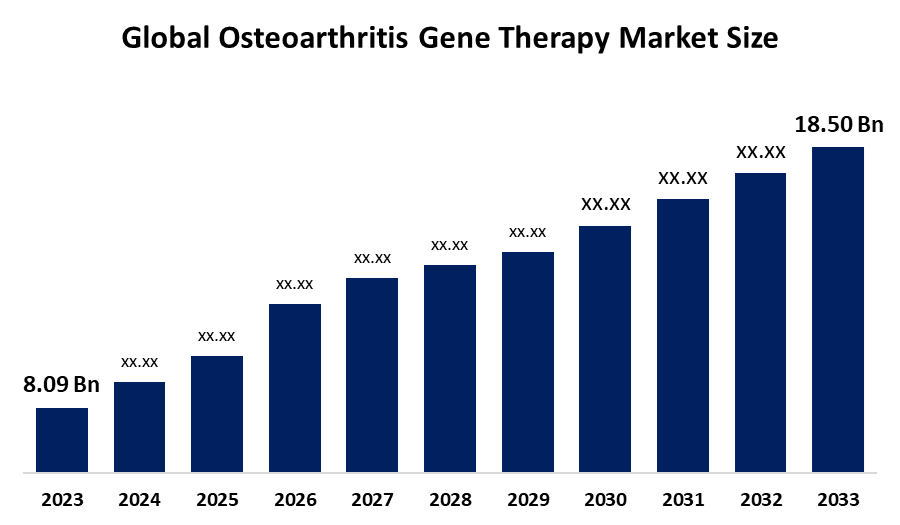
- The Global Osteoarthritis Gene Therapy Market Size Was Estimated at USD 8.09 Billion in 2024
- The Market Size is Expected to Grow at a CAGR of around 7.81% from 2025 to 2035
- The Worldwide Osteoarthritis Gene Therapy Market Size is Expected to Reach USD 18.50 Billion by 2035
- Asia Pacific is expected to grow the fastest during the forecast period.
Get more details on this report -
According to a Research Report Published by Spherical Insights and Consulting, The Global Osteoarthritis Gene Therapy Market Size was worth around USD 8.09 Billion in 2024 and is predicted to grow to around USD 18.50 Billion by 2035 with a compound annual growth rate (CAGR) of 7.81% from 2025 and 2035. The market for osteoarthritis gene therapy has a number of opportunities to grow due to the surging emphasis on stem cell therapy. Further, advancements like CRISPR-Cas9 gene editing, nanotechnology-driven, non-viral delivery systems, and personalized medicine approaches are enhancing precision, safety, and durability.
Market Overview
The global osteoarthritis gene therapy industry is an emerging, high-growth sector focused on disease-modifying, long-term treatments rather than just pain relief, by the use of gene editing (like CRISPR-Cas9) and viral vectors for targeting cartilage degeneration and inflammation, with several candidates (like GNSC-001) in clinical trials showing promising results. Unlike pharmacological treatments, which are administered locally or systemically as a series of interventions, gene therapy aims to establish a sustained therapeutic effect after a single, local injection.
Innovation and market expansion are anticipated as a result of major players' growing R&D expenditures and expanding partnerships. For instance, in December 2025, Pacira Biosciences, Inc., the industry leader in the delivery of innovative, non-opioid pain therapies, announced it has joined the PROBE (Patient Relevant Osteoarthritis endpoints using Big data Evaluation) Consortium, a pioneering initiative to revolutionize osteoarthritis (OA) research and improve patient care and outcomes on a global scale.
Report Coverage
This research report categorizes the Osteoarthritis Gene Therapy Market Size based on various segments and regions, forecasts revenue growth, and analyzes trends in each submarket. The report analyses the key growth drivers, opportunities, and challenges influencing the Osteoarthritis Gene Therapy Market Size. Recent market developments and competitive strategies such as expansion, type launch, development, partnership, merger, and acquisition have been included to draw the competitive landscape in the market. The report strategically identifies and profiles the key market players and analyses their core competencies in each sub-segment of the Osteoarthritis Gene Therapy Market Size.
Osteoarthritis Gene Therapy Market Report Coverage
| Report Coverage | Details |
|---|---|
| Base Year: | 2024 |
| Market Size in 2024: | USD 8.09 Billion |
| Forecast Period: | 2025-2035 |
| Forecast Period CAGR 2025-2035 : | CAGR of 7.81% |
| 2035 Value Projection: | USD 18.50 Billion |
| Historical Data for: | 2020-2023 |
| No. of Pages: | 240 |
| Tables, Charts & Figures: | 120 |
| Segments covered: | By Therapeutic Approach, By End-User |
| Companies covered:: | Flexion, GeneQuine, Novartis, Smith & Nephew, Genascence, Kolon TissueGene, Sanofi, Paraxel, Medipost co ltd, Mundipharma, and other key players |
| Pitfalls & Challenges: | COVID-19 Empact, Challenge, Future, Growth, & Analysis |
Get more details on this report -
Driving Factors
An increasing awareness about gene therapy for osteoarthritis, that focused on providing long-term, disease-modifying treatment rather than just pain relief, is driving the Osteoarthritis Gene Therapy Market Size. The increasing availability of healthcare services and treatment enables the accessibility of gene therapy for osteoarthritis, thereby supporting the market growth. For instance, in July 2025, CMS expanded access to Lifesaving gene therapies through innovative state agreements. Furthermore, the surging trend towards personalized medicine approach, advanced delivery systems, regenerative therapies, and the emergence of advanced solutions in osteoarthritis management are promoting the Osteoarthritis Gene Therapy Market Size.
Restraining Factors
The Osteoarthritis Gene Therapy Market Size is restricted by factors like increased R&D costs, strict regulations, adverse effects and off-target effects. Further, uncertain cost, efficacy, and targeted delivery are challenging the market growth.
Market Segmentation
The Osteoarthritis Gene Therapy Market Size share is classified into therapeutic approach and end-user.
- The gene editing segment dominated the market with over 50.0% share in 2024 and is projected to grow at a substantial CAGR during the forecast period.
Based on the therapeutic approach, the Osteoarthritis Gene Therapy Market Size is divided into gene editing, gene delivery, gene regulation, gene silencing, and gene replacement. Among these, the gene editing segment dominated the market with over 50.0% share in 2024 and is projected to grow at a substantial CAGR during the forecast period. The segment includes gene editing technology CRISPR/Cas9 in osteoarthritis, that modify joint cells, for long-term, localized treatment of cartilage degeneration and inflammation, rather than temporary pain relief. With an increasing prevalence of disease (single-gene-related genetic diseases like cystic fibrosis, certain types of sickle cell anemia and other rare diseases), advancement in gene editing is driving the segmental market growth.
Get more details on this report -
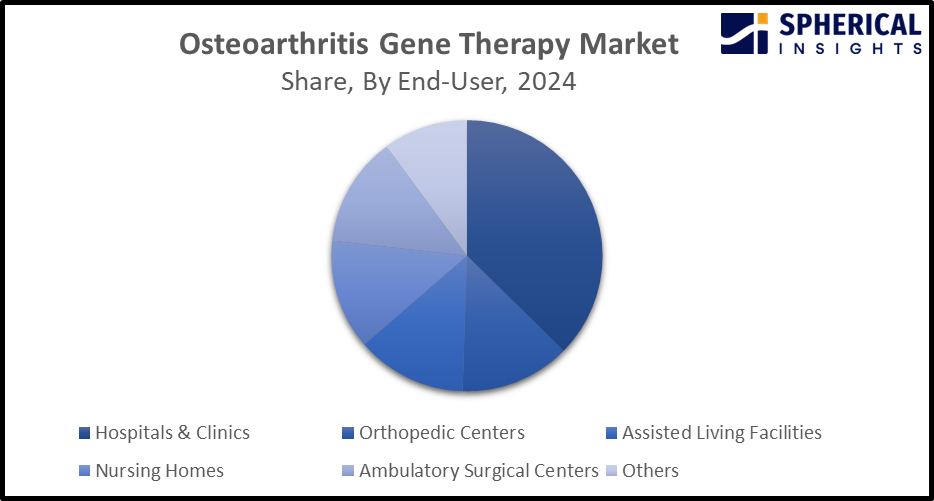
- The hospitals & clinics segment accounted for the major share of around 40.1% in 2024 and is anticipated to grow at a significant CAGR during the forecast period.
Based on the end-user, the Osteoarthritis Gene Therapy Market Size is divided into hospitals & clinics, orthopedic centers, assisted living facilities, nursing homes, ambulatory surgical centers, and others. Among these, the hospitals & clinics segment accounted for the major share of around 40.1% in 2024 and is anticipated to grow at a significant CAGR during the forecast period. Gene therapy is research based approach delivering therapeutic genes directly into joint tissues, mainly aiming at repairing cartilage and managing symptoms. Hospitals and clinics are providing advanced, specialized treatments or modifying genes.
Regional Segment Analysis of the Osteoarthritis Gene Therapy Market Size
- North America (U.S., Canada, Mexico)
- Europe (Germany, France, U.K., Italy, Spain, Rest of Europe)
- Asia-Pacific (China, Japan, India, Rest of APAC)
- South America (Brazil and the Rest of South America)
- The Middle East and Africa (UAE, South Africa, Rest of MEA)
Europe is anticipated to hold the largest share of the Osteoarthritis Gene Therapy Market Size over the predicted timeframe.

Get more details on this report -
Europe is anticipated to hold the largest share of around 33.5% in the Osteoarthritis Gene Therapy Market Size over the predicted timeframe. The market ecosystem in Europe is strong, due to the advanced research in gene-based and regenerative therapies, as well as the presence of key companies like Bone Therapeutics, GeneQuine Biotherapeutics, and Swedish biopharma Sobi. The demand for osteoarthritis gene therapy has been driven by the region's increased prevalence of knee OA, ageing population, and significant amount of investment in regenerative medicine. Due to ongoing research initiatives on innovative osteoarthritis diagnosis and treatment, and partnerships with other industry players, the market is expanding. For instance, in December 2025, Helmholtz Munich launched a pioneering osteoarthritis research project with EU partners. Germany is the region’s leading country in the Osteoarthritis Gene Therapy Market Size, driven by the personalized treatment approaches and expanding R&D portfolio in the biopharmaceutical sector.
Asia Pacific is expected to grow at a rapid CAGR of around 12.5% in the Osteoarthritis Gene Therapy Market Size during the forecast period. The Asia Pacific area has a thriving market for osteoarthritis gene therapy due to its increasing prevalence of chronic joint diseases, significant biotechnological advancements, and government support for healthcare infrastructure. For instance, in January 2019, Mundipharma expanded osteoarthritis gene therapy (Invossa-K) to APAC countries from Kolon Life Sciences. Further, a partnership between biopharmaceutical industries for promoting the development of gene therapy for knee osteoarthritis. For instance, in April 2022, Jupiter Biologics acquired cell-mediated gene therapy for the treatment of knee osteoarthritis. China holds the largest market base in the region’s Osteoarthritis Gene Therapy Market Size, owing to the expanding gene/advanced therapy initiatives and an increase in clinical research programs.
Competitive Analysis:
The report offers the appropriate analysis of the key organizations/companies involved within the Osteoarthritis Gene Therapy Market Size, along with a comparative evaluation primarily based on their type of offering, business overviews, geographic presence, enterprise strategies, segment market share, and SWOT analysis. The report also provides an elaborative analysis focusing on the current news and developments of the companies, which includes type development, innovations, joint ventures, partnerships, mergers & acquisitions, strategic alliances, and others. This allows for the evaluation of the overall competition within the market.
List of Key Companies
- Flexion
- GeneQuine
- Novartis
- Smith & Nephew
- Genascence
- Kolon TissueGene
- Sanofi
- Paraxel
- Medipost co ltd
- Mundipharma
- Others
Key Target Audience
- Market Players
- Investors
- End-users
- Government Authorities
- Consulting And Research Firm
- Venture capitalists
- Value-Added Resellers (VARs)
Recent Development
- In April 2025, Pacira BioSciences, Inc., started a Phase 2 trial of PCRX-201 for knee osteoarthritis. PCRX-201 features an innovative design based on the company's proprietary high-capacity adenovirus, or HCAd, gene therapy vector platform.
- In July 2025, Genascence Corporation, a clinical-stage biotechnology company, announced that the U.S. Food and Drug Administration (FDA) had granted the Regenerative Medicine Advanced Therapy (RMAT) designation to GNSC-001, a potential first-in-class gene therapy blocking interleukin 1 (IL-1) for the treatment of knee osteoarthritis (OA).
- In March 2025, Belief BioMed (BBM), an innovative biotechnology company focused on developing cutting-edge gene therapies, announced that it had received National Medical Products Administration (NMPA) clearance of an Investigational New Drug (IND) application for BBM-A101, a gene therapy drug for knee osteoarthritis (KOA).
- In February 2024, BioSenic shared data on its late-clinical asset JTA-004 for the treatment of knee osteoarthritis at the Osteoarthritis Research Society International (OARSI) World Congress 2024.
- In June 2023, ScienceAdvances published a research article on ‘Urchin-like ceria nanoparticle for enhanced gene therapy of osteoarthritis’.
Market Segment
This study forecasts revenue at global, regional, and country levels from 2020 to 2035. Spherical Insights has segmented the Osteoarthritis Gene Therapy Market Size based on the below-mentioned segments:
Global Osteoarthritis Gene Therapy Market Size, By Therapeutic Approach
- Gene Editing
- Gene Delivery
- Gene Regulation
- Gene Silencing
- Gene Replacement
Global Osteoarthritis Gene Therapy Market Size, By End-User
- Hospitals & Clinics
- Orthopedic Centers
- Assisted Living Facilities
- Nursing Homes
- Ambulatory Surgical Centers
- Others
Global Osteoarthritis Gene Therapy Market Size, By Regional Analysis
- North America
- US
- Canada
- Mexico
- Europe
- Germany
- UK
- France
- Italy
- Spain
- Russia
- Rest of Europe
- Asia Pacific
- China
- Japan
- India
- South Korea
- Australia
- Rest of Asia Pacific
- South America
- Brazil
- Argentina
- Rest of South America
- Middle East & Africa
- UAE
- Saudi Arabia
- Qatar
- South Africa
- Rest of the Middle East & Africa
Frequently Asked Questions (FAQ)
-
1. What is the market size of the Osteoarthritis Gene Therapy Market Size?The global Osteoarthritis Gene Therapy Market Size is expected to grow from USD 8.09 Billion in 2024 to USD 18.50 Billion by 2035, at a CAGR of 7.81% during the forecast period 2025-2035.
-
2. Which region holds the largest share of the Osteoarthritis Gene Therapy Market Size?Europe is anticipated to hold the largest share of the Osteoarthritis Gene Therapy Market Size over the predicted timeframe.
-
3. What is the forecasted CAGR of the Global Osteoarthritis Gene Therapy Market Size from 2024 to 2035?The market is expected to grow at a CAGR of around 7.81% during the period 2024–2035.
-
4. Who are the top companies that are involved in the Global Osteoarthritis Gene Therapy Market Size?Key players include Flexion, GeneQuine, Novartis, Smith & Nephew, Genascence, Kolon TissueGene, Sanofi, Paraxel, Medipost co ltd, and Mundipharma.
-
5. What are the main drivers in the Osteoarthritis Gene Therapy Market Size?Increased focus on providing long-term, disease-modifying treatment, availability of healthcare services and treatment, trend towards personalized medicine approach are major market growth drivers of the Osteoarthritis Gene Therapy Market Size.
-
6. What challenges are limiting the adoption of osteoarthritis gene therapy treatment?The increased R&D costs, strict regulations, adverse effects and off-target effects remain key restraints in the Osteoarthritis Gene Therapy Market Size.
-
7. What are the key trends in the Osteoarthritis Gene Therapy Market Size?Advancements like CRISPR-Cas9 gene editing, nanotechnology-driven, non-viral delivery systems, and personalized medicine approaches are key trends in the Osteoarthritis Gene Therapy Market Size.
Need help to buy this report?