Global Ophthalmic Anti-VEGF Therapeutics Market Size, Share, and COVID-19 Impact Analysis, By Drug Type (Biologics and Biosimilars), By Indication (Age-related macular degeneration, Diabetic retinopathy, Macular edema, Retinal vein occlusion, and Myopic choroidal neovascularization), and By Region (North America, Europe, Asia-Pacific, Latin America, Middle East, and Africa), Analysis and
Industry: Healthcare
Key Market Trends & Opportunities
The ophthalmic anti-VEGF therapeutics market has a number of opportunities to grow, due to the ongoing emphasis on developing novel agents with longer half-lives, sustained release delivery systems, and gene therapies.
- Longer acting agents (Faricimab, Brolucizumab) for reducing treatment burden
- Adoption of personalized/AI-driven treatment
- Use of Biosimilars for lowering costs
- Adoption of Dual-pathway inhibition
Global Ophthalmic Anti-VEGF Therapeutics Market Insights Forecasts to 2035
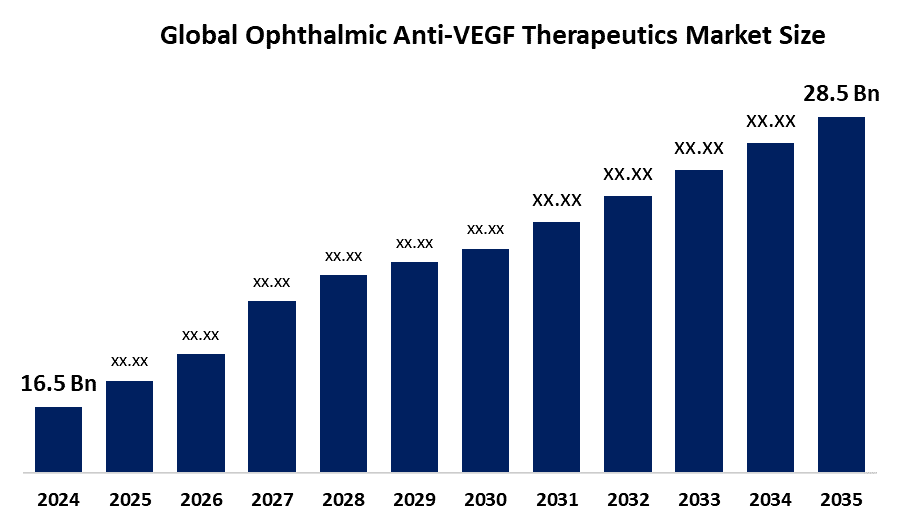
- The Global Ophthalmic Anti-VEGF Therapeutics Market Size Was Estimated at USD 16.5 Billion in 2024
- The Market Size is Expected to Grow at a CAGR of around 5.09% from 2025 to 2035
- The Worldwide Ophthalmic Anti-VEGF Therapeutics Market Size is Expected to Reach USD 28.5 Billion by 2035
Get more details on this report -
Major Players
AMGEN, Astellas, Biocon Biologics, Biogen, CELLTRION, Intas Pharmaceuticals, KANGHONG PHARMACEUTICALS, LUPIN, NOVARTIS, REGENERON, Reliance Life Sciences, Roche, SANDOZ, STADA, and teva
Market Overview
The global industry of ophthalmic anti-VEGF therapeutics encompasses drugs designed for blocking vascular endothelial growth factor (VEGF), reducing abnormal blood vessel growth and leakage that cause vision loss in diseases such as neovascular AMD and diabetic macular edema. Due to increasing ageing populations, high prevalence of retinal diseases, and adoption of intravitreal injection, the market is expected to grow. Anti-VEGF medications minimize leaky aberrant blood vessels in the retina by blocking VEGF, which reduces or eliminates the damage caused by the aberrant blood vessels and slows down the loss of eyesight. It may even enhance vision on occasion. Anti-VEGF medications are used by ophthalmologists to treat the eye conditions, including wet AMD, macular edema, diabetic retinopathy, and retinal vein occlusion.
Innovation and market expansion are anticipated as a result of major players' growing R&D expenditures and expanding partnerships. For instance, in September 2025, ExSight Ventures, a venture capital firm dedicated to investing in transformative ophthalmology innovations, announced its investment in RevOpsis Therapeutics, a biotechnology company pioneering next-generation therapies for retinal diseases.
Report Coverage
This research report categorizes the ophthalmic anti-VEGF therapeutics market based on various segments and regions, forecasts revenue growth, and analyzes trends in each submarket. The report analyses the key growth drivers, opportunities, and challenges influencing the ophthalmic anti-VEGF therapeutics market. Recent market developments and competitive strategies such as expansion, type launch, development, partnership, merger, and acquisition have been included to draw the competitive landscape in the market. The report strategically identifies and profiles the key market players and analyses their core competencies in each sub-segment of the ophthalmic anti-VEGF therapeutics market.
Ophthalmic Anti-VEGF Therapeutics Market Report Coverage
| Report Coverage | Details |
|---|---|
| Base Year: | 2024 |
| Market Size in 2024: | USD 16.5 Billion |
| Forecast Period: | 2025-2035 |
| Forecast Period CAGR 2025-2035 : | 5.09% |
| 2035 Value Projection: | USD 28.5 Billion |
| Historical Data for: | 2020-2023 |
| No. of Pages: | 198 |
| Tables, Charts & Figures: | 110 |
| Segments covered: | By Drug Type, By Indication |
| Companies covered:: | AMGEN, Astellas, Biocon Biologics, Biogen, CELLTRION, Intas Pharmaceuticals, KANGHONG PHARMACEUTICALS, LUPIN, NOVARTIS, REGENERON, Reliance Life Sciences, Roche, SANDOZ, STADA, teva, Others |
| Pitfalls & Challenges: | COVID-19 Empact, Challenge, Future, Growth, & Analysis |
Get more details on this report -
Driving Factors
Prevalence of eye diseases and an ageing population
An increasing global ageing population leads to age-related eye diseases, resulting in a propelling the market demand for ophthalmic anti-VEGF therapeutics. Age-related macular degeneration (AMD), diabetic retinopathy (DR), and other retinal diseases are well-known causes of visual disability. For more than a decade, intravitreal agents have been available for the treatment of these diseases.
Technological advancements in drug development
This includes the development of multi-target agents, extending treatment intervals, through the integration of smarter and more sustainable drug delivery systems. Further, developing next-generation anti-VEGF agents, sustained release delivery technologies, as well as gene therapy molecular approaches, personalized medicine, and biosimilars are anticipated to drive the market expansion.
Awareness towards the timely treatment of ophthalmic disorders
Timely initiation is crucial as it significantly aids in improving long-term visual outcomes and preventing irreversible vision. Administration of intravitreal injections, which work by inhibiting VEGF, stimulates abnormal blood vessel growth (angiogenesis) and fluid leakage in the retina.
Restraining Factors
Increased treatment cost, as well as side effects and safety concerns
The high anti-VEGF therapy costs for ophthalmic disorders in which drugs used range from injection for off-label Bevacizumab (Avastin) to branded options such as Lucentis (Ranibizumab) or Eylea. Further, the side effects of drugs and safety concerns associated with it is challenging the market growth.
Market Segment Insights
By Drug Type: Biologics (Dominant) versus Biosimilars (Emerging)
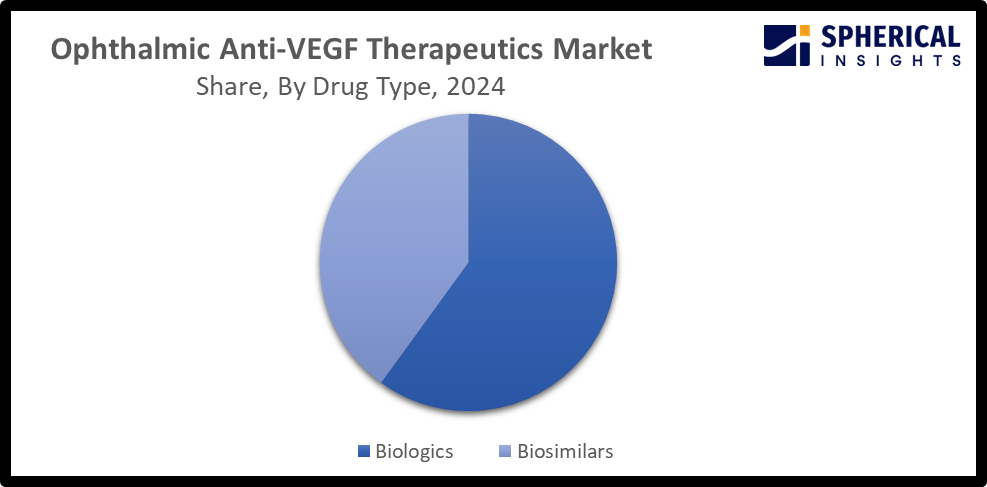
The biologics segment held the dominant market share in 2024 and is expected to grow at about 4.8% CAGR, owing to its strong clinical outcomes and established usage in wet AMD, DME, and DR support. Biologics against VEGF are important for treating many retinal diseases, typically imposing a high financial burden. Approved anti-VEGF biosimilars are clinically equivalent to reference products, bringing substantial benefits to patients and healthcare systems by reducing costs. Realization of biosimilar benefits depends, in part, on their successful uptake
Get more details on this report -
By Indication: Age-related macular degeneration (Dominant) versus Macular Edema (Emerging)
The age-related macular degeneration segment held the dominant share of about 47.0% in the ophthalmic anti-VEGF therapeutics market, owing to an increasing ageing population along with the prevalence of AMD, which is expected to increase from 170 million to 288 million by the year 2040. However, the macular edema segment held a significant revenue share, with an anticipated CAGR growth of about 6.0% during the forecast period. This is driven by an increasing emphasis on providing combination therapies and extending the treatment duration.
Regional Segment Analysis of the Ophthalmic Anti-VEGF Therapeutics Market
- North America (U.S., Canada, Mexico)
- Europe (Germany, France, U.K., Italy, Spain, Rest of Europe)
- Asia-Pacific (China, Japan, India, Rest of APAC)
- South America (Brazil and the Rest of South America)
- The Middle East and Africa (UAE, South Africa, Rest of MEA)
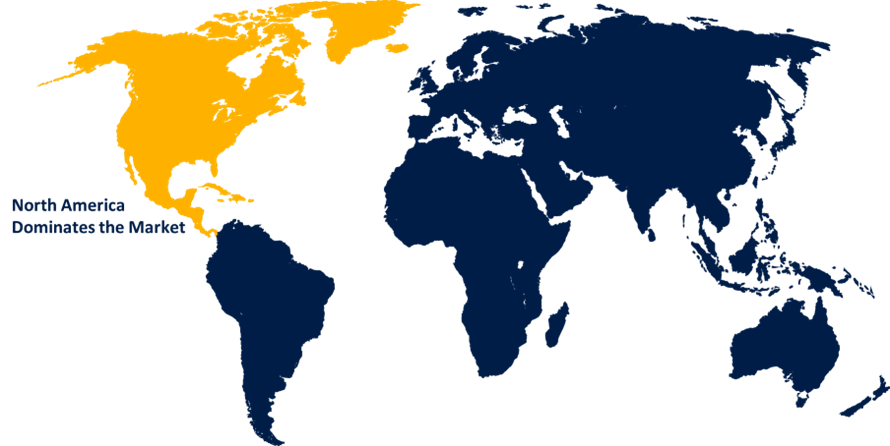
North America is anticipated to hold the largest share of the ophthalmic anti-VEGF therapeutics market over the predicted timeframe.
Get more details on this report -
North America is anticipated to hold the largest share of around 64.2% in the ophthalmic anti-VEGF therapeutics market over the predicted timeframe. The market ecosystem in North America is strong, due to the region’s well-established retina specialty centres, ambulatory surgical centres, and ophthalmology clinics. The United States is the dominant country in the North America ophthalmic anti-VEGF therapeutics market, owing to the growing disease prevalence and approval & commercialization of new products.
Asia Pacific is expected to grow at a rapid CAGR of about 7.0% in the ophthalmic anti-VEGF therapeutics market during the forecast period. The Asia Pacific area has a thriving market for ophthalmic anti-VEGF therapeutics due to factors like sedentary lifestyles, high-calorie diets, and increased obesity that are responsible for the increased prevalence of retinal vascular disorders. Japan is the leading country in the Asia Pacific market, holding the dominant share of over 27.8%, owing to an increased ageing population.
Competitive Analysis:
The report offers the appropriate analysis of the key organizations/companies involved within the ophthalmic anti-VEGF therapeutics market, along with a comparative evaluation primarily based on their type of offering, business overviews, geographic presence, enterprise strategies, segment market share, and SWOT analysis. The report also provides an elaborative analysis focusing on the current news and developments of the companies, which includes type development, innovations, joint ventures, partnerships, mergers & acquisitions, strategic alliances, and others. This allows for the evaluation of the overall competition within the market.
List of Key Companies
- AMGEN
- Astellas
- Biocon Biologics
- Biogen
- CELLTRION
- Intas Pharmaceuticals
- KANGHONG PHARMACEUTICALS
- LUPIN
- NOVARTIS
- REGENERON
- Reliance Life Sciences
- Roche
- SANDOZ
- STADA
- teva
- Others
Key Target Audience
- Market Players
- Investors
- End-users
- Government Authorities
- Consulting And Research Firm
- Venture capitalists
- Value-Added Resellers (VARs)
Industry Development
- In September 2025, Ollin Biosciences, Inc., a clinical-stage biopharmaceutical company, announced its launch with an initial $100 million in financing led by ARCH Venture Partners, Mubadala Capital and Monograph Capital.
- In July 2025, Harrow, a leading North American eyecare pharmaceutical company, announced that it had entered into a definitive agreement with Samsung Bioepis Co. Ltd. to secure the exclusive US commercial rights to the ophthalmology biosimilar portfolio of Samsung Bioepis, BYOOVIZ (ranibizumab-nuna), an FDA-approved biosimilar referencing LUCENTIS (ranibizumab), and OPUVIZ (aflibercept-yszy), an FDA-approved biosimilar referencing EYLEAii (aflibercept), two of the most widely used anti-VEGF therapies for retinal diseases.
- In October 2024, Bevacizumab-vikg for ophthalmic use has been submitted for FDA approval. A positive decision from the agency would trigger a provision of the Drug Quality and Security Act (DQSA) prohibiting repackaging of the oncologic formulation of bevacizumab (Avastin) for off-label use.
Market Segment
This study forecasts revenue at global, regional, and country levels from 2020 to 2035. Spherical Insights has segmented the ophthalmic anti-VEGF therapeutics market based on the below-mentioned segments:
Global Ophthalmic Anti-VEGF Therapeutics Market, By Drug Type
- Biologics
- Biosimilars
Global Ophthalmic Anti-VEGF Therapeutics Market, By Indication
- Age-related macular degeneration
- Diabetic retinopathy
- Macular edema
- Retinal vein occlusion
- Myopic choroidal neovascularization
Global Ophthalmic Anti-VEGF Therapeutics Market, By Regional Analysis
- North America
- US
- Canada
- Mexico
- Europe
- Germany
- UK
- France
- Italy
- Spain
- Russia
- Rest of Europe
- Asia Pacific
- China
- Japan
- India
- South Korea
- Australia
- Rest of Asia Pacific
- South America
- Brazil
- Argentina
- Rest of South America
- Middle East & Africa
- UAE
- Saudi Arabia
- Qatar
- South Africa
- Rest of the Middle East & Africa
Frequently Asked Questions (FAQ)
-
1. What is the market size of the Ophthalmic Anti-VEGF Therapeutics Market?The Global Ophthalmic Anti-VEGF Therapeutics Market size is expected to grow from USD 16.5 Billion in 2024 to USD 28.5 Billion by 2035, at a CAGR of 5.09% during the forecast period 2025-2035.
-
2. Which region holds the largest share of the Ophthalmic Anti-VEGF Therapeutics Market?North America is anticipated to hold the largest share of the Ophthalmic Anti-VEGF Therapeutics Market over the predicted timeframe.
-
3. What is the forecasted CAGR of the Global Ophthalmic Anti-VEGF Therapeutics Market from 2024 to 2035?The market is expected to grow at a CAGR of around 5.09% during the period 2024–2035.
-
4. Who are the top companies that are involved in the Global Ophthalmic Anti-VEGF Therapeutics Market?Key players include AMGEN, Astellas, Biocon Biologics, Biogen, CELLTRION, Intas Pharmaceuticals, KANGHONG PHARMACEUTICALS, LUPIN, NOVARTIS, REGENERON, Reliance Life Sciences, Roche, SANDOZ, STADA, and teva.
-
5. What are the main drivers in the Ophthalmic Anti-VEGF Therapeutics Market?An increasing prevalence of eye disorder & ageing population, advancement in drug development, and awareness towards timely treatment of disorder, are major market growth drivers of the ophthalmic anti-VEGF therapeutics market.
-
6. What challenges are limiting the adoption of Ophthalmic Anti-VEGF Therapeutics?Factors like the increased treatment cost, as well as side effects and safety concerns, remain key restraints in the ophthalmic anti-VEGF therapeutics market.
-
7. What are the key trends in the Ophthalmic Anti-VEGF Therapeutics Market?The emergence of longer-acting agents like Faricimab, Brolucizumab, the adoption of personalized/AI-driven treatment, use of biosimilars for lowering costs are major key trends in the Ophthalmic Anti-VEGF Therapeutics market.
Need help to buy this report?