Global Nuclear Bombs and Missiles Market Size, Share, and COVID-19 Impact Analysis, By Type (Aircraft Bomber and Land Based Missiles, Inter-Continental Ballistic Missile (ICBM), Submarine-Launched Ballistic Missile (SLBM), and Others), By Range (Less Than 1,000km, 1,000Km to 5,000km, and Greater Than 5,000km), By Region (North America, Europe, Asia-Pacific, Latin America, Middle East, and Africa), Analysis and Forecast 2025 - 2035
Industry: Aerospace & Defense
Global Nuclear Bombs and Missiles Market Insights Forecasts to 2035
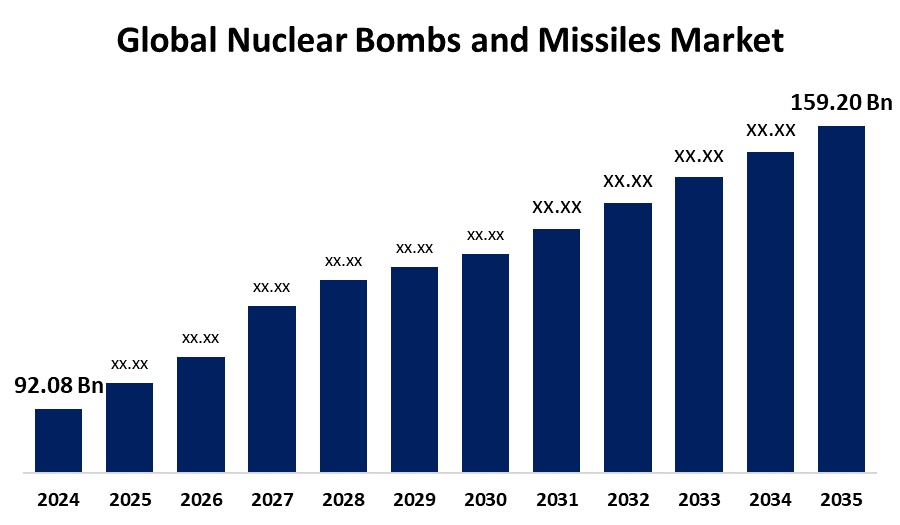
- The Global Nuclear Bombs and Missiles Market Size Was Estimated at USD 92.08 Billion in 2024
- The Market Size is Expected to Grow at a CAGR of around 5.1% from 2025 to 2035
- The Worldwide Nuclear Bombs and Missiles Market Size is Expected to Reach USD 159.20 Billion by 2035
- Asia Pacific is expected to grow the fastest during the forecast period.
Get more details on this report -
According to a research report published by Spherical Insights and Consulting, The Global Nuclear Bombs And Missiles Market Size Was Worth Around USD 92.08 Billion In 2024 And Is Predicted To Grow To Around USD 159.20 Billion By 2035 With A Compound Annual Growth Rate (CAGR) Of 5.1% From 2025 To 2035. The market for nuclear bombs and missiles offers opportunities for the development of cutting-edge defense technologies, strategic deterrent solutions, military arsenal modernization, export potential, government contracts, research partnerships, and the integration of developing defense systems.
Market Overview
The worldwide industry devoted to the development, production, acquisition, upkeep, and strategic deployment of nuclear weapons linked with cutting-edge delivery systems is known as the nuclear bombs and missiles market. These include aircraft bombers with nuclear weapons, submarine-launched ballistic missiles (SLBMs), intercontinental ballistic missiles (ICBMs), and new models in the short-, medium-, and long-range ranges. The market includes all defense organizations operated by the government, private defense companies, and international partnerships that work on national security and deterrence capabilities and military strategic readiness.
In January 2026, India launched its first long-range hypersonic missile, LR-AShM, developed by DRDO, during the 77th Republic Day parade, strengthening naval defense capabilities and countering growing regional maritime threats from China and Pakistan. The primary factors expected to propel the market's expansion are rising military spending, increased threats to different countries from border security problems and terrorism, and developments in hypersonic missile technology.
Nuclear Bombs and Missiles Market Trends
- Improvements in stealth, propulsion, and missile guidance
- Hypersonic missile technology is developing quickly to enable quicker strikes.
- Precision-strike and low-collateral damage weapons are receiving more attention.
- Increasing nuclear and defense spending worldwide to improve strategic deterrence
- Nuclear arsenals are constantly being updated, and outdated systems are being replaced.
- Growing geopolitical tensions and the dynamics of the weapons race are propelling industry expansion.
Report Coverage
This research report categorizes the nuclear bombs and missiles market based on various segments and regions, forecasts revenue growth, and analyzes trends in each submarket. The report analyzes the key growth drivers, opportunities, and challenges influencing the nuclear bombs and missiles market. Recent market developments and competitive strategies, such as expansion, product launch, development, partnership, merger, and acquisition, have been included to draw the competitive landscape in the market. The report strategically identifies and profiles the key market players and analyzes their core competencies in each sub-segment of the nuclear bombs and missiles market.
Global Nuclear Bombs and Missiles Market Report Coverage
| Report Coverage | Details |
|---|---|
| Base Year: | 2024 |
| Market Size in 2024: | USD 92.08 Billion |
| Forecast Period: | 2025-2035 |
| Forecast Period CAGR 2025-2035 : | 5.1% |
| 2035 Value Projection: | USD 159.20 Billion |
| Historical Data for: | 2020-2023 |
| No. of Pages: | 250 |
| Tables, Charts & Figures: | 113 |
| Segments covered: | By Type, By Range, By Region |
| Companies covered:: | Airbus, ArianeGroup SAS, BAE Systems, Boeing, BrahMos Aerospace, Lockheed Martin Corporation, MBDA, Northrop Grumman Corporation, Rafael Advanced Defense Systems Ltd., RTX Corporation, THALES, Others |
| Pitfalls & Challenges: | Covid 19 Impact Challanges, Future, Growth and Analysis |
Get more details on this report -
Driving factors
The increasing focus on national security and border protection, together with military superiority, drives ongoing research and development efforts. The market for nuclear bombs and missiles exists due to countries facing growing geopolitical tensions, and their nuclear powers require strategic deterrence. Governments allocate significant funds to modernize their aging nuclear arsenals, together with advanced missile delivery systems and warhead technologies. The market experiences rapid expansion due to the fact that emerging economies and developed markets are both increasing their defense spending. The nuclear bombs and missiles market growth receives support from technological advancements, which include hypersonic missiles and precision-guided systems with better surveillance and reconnaissance capabilities.
Restraining Factor
The market for nuclear bombs and missiles is constrained by several factors, including strict international regulations, nuclear non-proliferation treaties, high development and maintenance costs, ethical concerns, pressure from geopolitical diplomacy, and growing global advocacy for disarmament.
Market Segmentation
The global nuclear bombs and missiles market is divided into type and range.
Global Nuclear Bombs and Missiles Market, By Type:
- The ICBM segment dominated the market in 2024, approximately 40%, and is projected to grow at a substantial CAGR during the forecast period.
Based on the type, the nuclear bombs and missiles market is divided into aircraft bomber and land-based missiles, inter-continental ballistic missile (ICBM), submarine-launched ballistic missile (SLBM), and others. Among these, the ICBM segment dominated the market in 2024, approximately 40%, and is projected to grow at a substantial CAGR during the forecast period. ICBMs are a vital component of contemporary military arsenals since they can transport nuclear weapons across continents with great speed, accuracy, and dependability. Major nuclear countries are still making significant investments in modernizing and improving their ICBM systems, including advancements in guidance, propulsion, and multiple independently targetable re-entry vehicle (MIRV) capabilities.
The submarine-launched ballistic missile (SLBM) segment in the nuclear bombs and missiles market is expected to grow at the fastest CAGR over the forecast period. The growing focus on second-strike capabilities, stealth deployment, and naval defense modernization is driving the submarine-launched ballistic missile (SLBM) market.
Global Nuclear Bombs and Missiles Market, By Range:
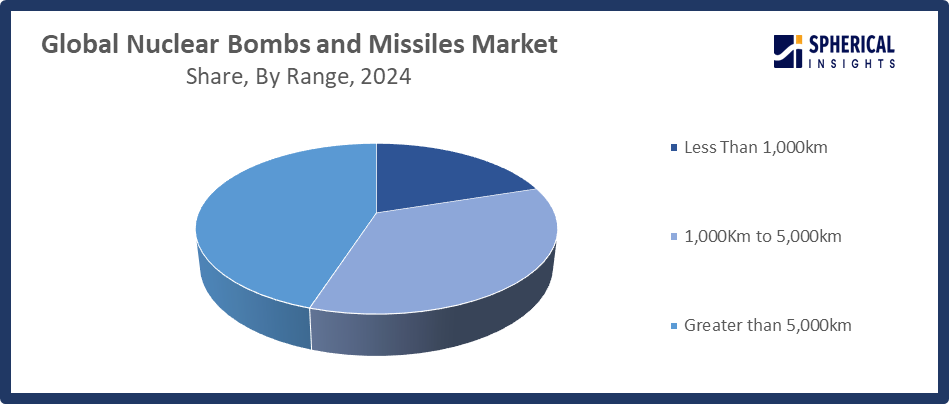
- The greater than 5,000 km segment accounted for the highest market revenue in 2024, approximately 45%, and is anticipated to grow at a significant CAGR during the forecast period.
Based on the range, the nuclear bombs and missiles market is divided into less than 1,000 km, 1,000 km to 5,000 km, and greater than 5,000 km. Among these, the greater than 5,000 km segment accounted for the highest market revenue in 2024, approximately 45%, and is anticipated to grow at a significant CAGR during the forecast period. Its crucial importance in long-range strategic deterrent and worldwide strike capability accounts for the more than 5,000 km length. These missiles, especially intercontinental ballistic missiles (ICBMs), are crucial to the national security plans of major nuclear countries since they can carry payloads across continents.
Get more details on this report -
The 1,000–5,000 km segment in the nuclear bombs and missiles market is expected to grow at the fastest CAGR over the forecast period. The growing need for medium-range missile weapons in tactical and regional defense operations is the reason for the 1,000–5,000 km segment.
Regional Segment Analysis of the Global Nuclear Bombs and Missiles Market
- North America (U.S., Canada, Mexico)
- Europe (Germany, France, U.K., Italy, Spain, Rest of Europe)
- Asia-Pacific (China, Japan, India, Rest of APAC)
- South America (Brazil and the Rest of South America)
- The Middle East and Africa (UAE, South Africa, Rest of MEA)
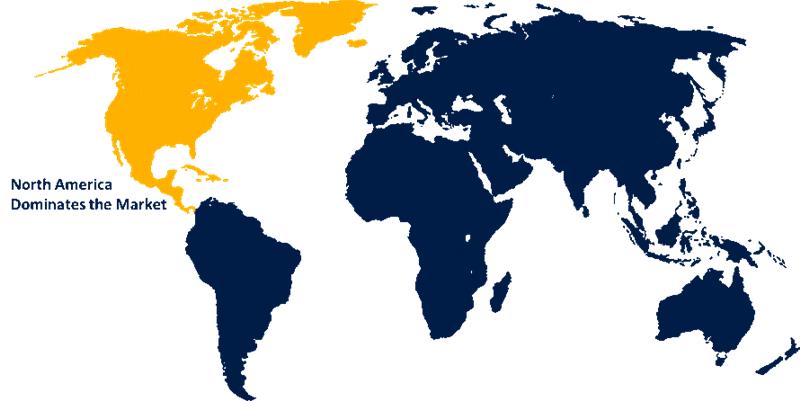
North America is expected to hold the largest share of the global nuclear bombs and missiles market over the forecast period.
Get more details on this report -
North America is expected to hold the largest share of the global nuclear bombs and missiles market over the forecast period. The United States operates the world's most advanced nuclear weapons system because it maintains its nuclear arsenal and missile systems as its top international defense priority. The ongoing development of next-generation intercontinental ballistic missiles ICBMs and submarine-launched ballistic missiles SLBMs and strategic bombers through modernization programs brings important benefits to the region.
The U.S. government has conducted multiple operational tests and launches of Minuteman III ICBMs in the 2025 to 2026 period, which aimed to test their operational reliability and functional capabilities. The United States maintained around 30000 nuclear weapons during the 1960s, whereas the Soviet Union built up its stockpile to more than 40000 weapons during the 1980s.
Asia Pacific is expected to grow at the fastest CAGR in the nuclear bombs and missiles market during the forecast period. To improve regional security and deterrence, nations like China, India, and Pakistan are actively bolstering their nuclear and missile capacities. Investments in cutting-edge technology like precision-guided systems and hypersonic missiles, along with swift military modernization initiatives, are driving market expansion.
In December 2025, Kim Jong-un's order to increase missile and munitions production through 2026, along with pledges made at the Workers' Party Congress for an accelerated nuclear build-up, are among the recent statements. India also enhanced Agni-V MIRV capabilities.
Competitive Analysis:
The report offers the appropriate analysis of the key organizations/companies involved within the global nuclear bombs and missiles market, along with a comparative evaluation primarily based on their Type of offering, business overviews, geographic presence, enterprise strategies, segment market share, and SWOT analysis. The report also provides an elaborate analysis focusing on the current news and developments of the companies, which includes Type development, innovations, joint ventures, partnerships, mergers & acquisitions, strategic alliances, and others. This allows for the evaluation of the overall competition within the market.
Worldwide Top Key Players In The Nuclear Bombs and Missiles Market Include
- Airbus
- ArianeGroup SAS
- BAE Systems
- Boeing
- BrahMos Aerospace
- Lockheed Martin Corporation
- MBDA
- Northrop Grumman Corporation
- Rafael Advanced Defense Systems Ltd.
- RTX Corporation
- THALES
- Others
Key Target Audience
- Market Players
- Investors
- End-users
- Government Authorities
- Consulting And Research Firm
- Venture capitalists
- Value-Added Resellers (VARs)
Recent Development
- In November 2025, Vladimir Putin stated that Russia launched and successfully tested the nuclear-powered Burevestnik missile, a unique weapon with near-unlimited range, flying over 14,000 kilometers in 15 hours from Novaya Zemlya, as confirmed by Norwegian authorities.
- In September 2025, the Defence Research and Development Organisation launched and successfully test-fired the Agni-Prime missile from a rail-based mobile launcher on in collaboration with the Strategic Forces Command under a full operational scenario.
Market Segment
This study forecasts revenue at the global, regional, and country levels from 2020 to 2035. Spherical Insights has segmented the nuclear bombs and missiles market based on the following segments:
Global Nuclear Bombs and Missiles Market, By Type
- Aircraft Bomber and Land based missiles
- Inter-Continental Ballistic Missile (ICBM)
- Submarine-Launched Ballistic Missile (SLBM)
- Others
Global Nuclear Bombs and Missiles Market, By Range
- Less Than 1,000km
- 1,000Km to 5,000km
- Greater than 5,000km
Global Nuclear Bombs and Missiles Market, By Regional Analysis
- North America
- US
- Canada
- Mexico
- Europe
- Germany
- UK
- France
- Italy
- Spain
- Russia
- Rest of Europe
- Asia Pacific
- China
- Japan
- India
- South Korea
- Australia
- Rest of Asia Pacific
- South America
- Brazil
- Argentina
- Rest of South America
- Middle East & Africa
- UAE
- Saudi Arabia
- Qatar
- South Africa
- Rest of the Middle East & Africa
Frequently Asked Questions (FAQ)
-
1. What is the CAGR of the nuclear bombs and missiles market over the forecast period?The global nuclear bombs and missiles market is projected to expand at a CAGR of 5.1% during the forecast period.
-
2. Which region holds the largest share of the nuclear bombs and missiles market?North America is anticipated to hold the largest share of the Nuclear Bombs and Missiles market over the predicted timeframe.
-
3. Who are the top companies operating in the global Nuclear Bombs and Missiles market?Airbus, ArianeGroup SAS, BAE Systems, Boeing, BrahMos Aerospace, Lockheed Martin Corporation, MBDA, Northrop Grumman Corporation, Rafael Advanced Defense Systems Ltd., RTX Corporation, THALES, and Others.
-
4. What factors are driving the growth of the Nuclear Bombs and Missiles market?Growth is driven by rising geopolitical tensions, increasing defense budgets, nuclear arsenal modernization, technological advancements in missile systems, strategic deterrence needs, and expanding military capabilities among major and emerging economies.
-
5. What are market trends in the Nuclear Bombs and Missiles market?Key trends include development of hypersonic missiles, modernization of nuclear arsenals, integration of advanced guidance systems, increased R&D investments, expansion of MIRV capabilities, and strengthening command and control infrastructures.
-
6. What are the main challenges restricting wider adoption of the Nuclear Bombs and Missiles market?Market growth is restricted by strict international regulations, non-proliferation treaties, high development and maintenance costs, ethical concerns, disarmament initiatives, and geopolitical diplomacy pressures limiting deployment and expansion.
Need help to buy this report?