Global Non-Invasive Minimally Invasive Medical Imaging Visualization System Market Size, Share, and COVID-19 Impact Analysis, By Imaging Technique (Ultrasound, Magnetic Resonance Imaging, Computed Tomography, and Optical Imaging), By Application (Orthopedics, Cardiology, Oncology, and Others), and By Region (North America, Europe, Asia-Pacific, Latin America, Middle East, and Africa), Analysis and Forecast 2025 - 2035
Industry: Healthcare
Key Market Trends & Opportunities
The non-invasive minimally invasive medical imaging visualization system market has a number of opportunities to grow, due to the inclination towards AI-driven, real-time, and 3D guided procedures for enhancing surgical precision, since AI-powered robotic surgery, smart, flexible endoscopes, and integrated molecular imaging provide better contrast.
- Rise of portable devices, hybrid imaging (PET/CT), and cloud-based systems
- Inclination towards green, energy-efficient, and sustainable imaging infrastructure
- Artificial Intelligence in Imaging, as well as 3D and 4D imaging for sophisticated monitoring
- Increased accessibility of portable ultrasound and handheld devices like Butterfly iQ
Global Non-Invasive Minimally Invasive Medical Imaging Visualization System Market Insights Forecasts to 2035
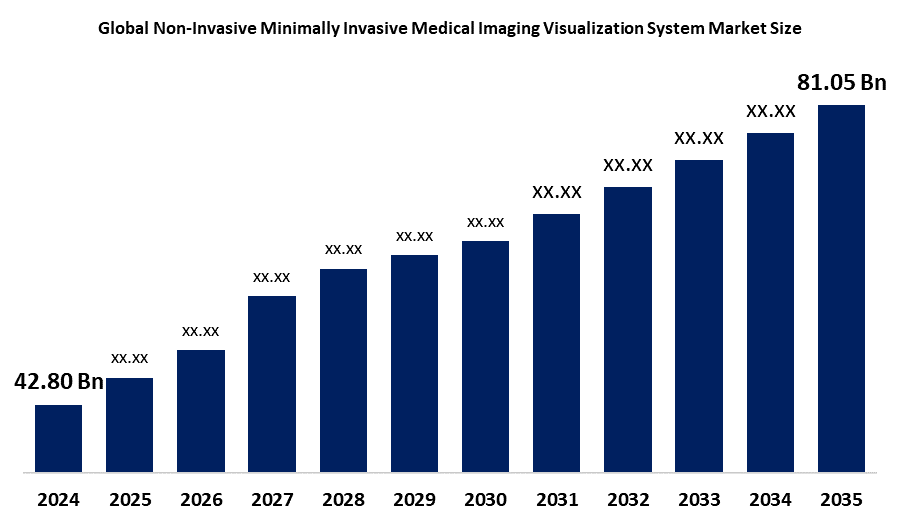
- The Global Non-Invasive Minimally Invasive Medical Imaging Visualization System Market Size Was Estimated at USD 42.80 Billion in 2024
- The Market Size is Expected to Grow at a CAGR of around 5.98% from 2025 to 2035
- The Worldwide Non-Invasive Minimally Invasive Medical Imaging Visualization System Market Size is Expected to Reach USD 81.05 Billion by 2035
Get more details on this report -
According to Spherical Insights, The Global Non-Invasive Minimally Invasive Medical Imaging Visualization System Market Size is expected to Grow from USD 42.80 Billion in 2024 to USD 81.05 Billion by 2035, at a CAGR of 5.98% during the forecast period 2025-2035.
Major Players
Abbott Laboratories, Advanced Brain Monitoring, Boston Scientific Corporation, Canon Medical Systems Corporation, CAS Medical Systems, Inc., CNSystems Medizintechnik GmbH, Fujifilm Holdings Corporation, GE Healthcare, Koninklijke Philips N. V., Medtronic plc, Siemens Healthineers AG, and Smith & Nephew plc
Market Overview
The global industry for non-invasive & minimally invasive medical imaging visualization system is the market that provides technologies for diagnosing and treating diseases through small incisions or no-incision, high-definition visualization. Some of the key technologies, like endoscopy, MRI, CT scans, and robotic systems, offer real-time 3D visualization. Non-invasive and minimally invasive medical invasive visualization systems are diagnostic tools creating internal body images without (or with minimal) surgical intervention, reducing risks, pain, and recovery time.
Currently, there is an upsurging demand for non-invasive high-resolution imaging of peripheral olfactory targets, a need for non-invasive imaging providing cellular specificity, and a need for non-invasive high-resolution imaging of olfactory targets beyond the periphery.
Innovation and market expansion are anticipated as a result of major players' growing R&D expenditures and expanding partnerships. For instance, in May 2025, Philips and Polarean, a medical imaging technology leader in advanced MRI of lung function, announced the next phase of their strategic partnership to increase access to advanced, radiation-free lung MRI for patients with obstructive lung diseases.
Report Coverage
This research report categorizes the non-invasive minimally invasive medical imaging visualization system market based on various segments and regions, forecasts revenue growth, and analyzes trends in each submarket. The report analyses the key growth drivers, opportunities, and challenges influencing the non-invasive minimally invasive medical imaging visualization system market. Recent market developments and competitive strategies such as expansion, type launch, development, partnership, merger, and acquisition have been included to draw the competitive landscape in the market. The report strategically identifies and profiles the key market players and analyses their core competencies in each sub-segment of the non-invasive minimally invasive medical imaging visualization System market.
Global Non-Invasive & Minimally Invasive Medical Imaging and Visualization System Market Report Coverage
| Report Coverage | Details |
|---|---|
| Base Year: | 2024 |
| Market Size in 2024 : | USD 42.80 Billion |
| Forecast Period: | 2025-2035 |
| Forecast Period CAGR 2025-2035 : | 5.98% |
| 2035 Value Projection: | USD 81.05 Billion |
| Historical Data for: | 2020-2023 |
| No. of Pages: | 248 |
| Tables, Charts & Figures: | 85 |
| Segments covered: | By Imaging Technique, By Application and COVID-19 Impact Analysis |
| Companies covered:: | Abbott Laboratories, Advanced Brain Monitoring, Boston Scientific Corporation, Canon Medical Systems Corporation, CAS Medical Systems, Inc., CNSystems Medizintechnik GmbH, Fujifilm Holdings Corporation, GE Healthcare, Koninklijke Philips N. V., Medtronic plc, Siemens Healthineers AG, Smith & Nephew plc, and Others |
| Pitfalls & Challenges: | Covid 19 Impact Challenges, Future, Growth and Analysis |
Get more details on this report -
Driving Factors
Demand for non-invasive procedures with increased emphasis on preventive healthcare
The increasing awareness regarding the benefits of non-invasive imaging, like reduced hospital stay, is driving the demand for non-invasive procedures with an increased emphasis on preventive healthcare. These solutions can assist in lowering the total healthcare expenses related to managing late-stage diseases by facilitating prompt diagnosis.
Growing prevalence of chronic diseases
Chronic disease conditions like cardiovascular diseases, diabetes, and cancer are driving the need for advanced imaging solutions for effective management. With an increasing older people population, there is an increasing prevalence of chronic disease and disability. For instance, it is estimated that 2.1 billion people will be aged 60 years and over by 2050.
Policymakers and academic groups are using modelling due to the importance of changes in the prevalence of chronic diseases. According to estimates from The Health Foundation, dementia (45%), chronic obstructive lung disease (37%), heart failure (92%), chronic renal disease (34%), cancer (31%), and diabetes (49%) would all increase in England between the year 2019 and 2040.
Technological advancements in imaging systems
There is increasing adoption of artificial intelligence, virtual reality, and wearable computers for improving healthcare. Computers simulate real-world situations, providing humans with new insights and diverse perspectives, going beyond human sensory perception. In order to prevent and treat the diseases that endanger health and well-being, prompt and precise diagnosis is important. Thus, medical imaging technology is becoming increasingly crucial for identifying and treating almost every disease that people run the risk of acquiring or developing. It is a major responsibility of medical imaging specialists.
Restraining Factors
Increased cost of imaging devices and reimbursement issues
The increased prices vary for each new system, depending on magnetic strength, brand, features, plus installation and construction costs, hindering its adoption, especially in the underdeveloped and developing regions, is a challenging factor in the market growth.
Market Segment Insights
By Imaging Technique: Ultrasound (Largest) versus Optical Imaging (Fastest-Growing)
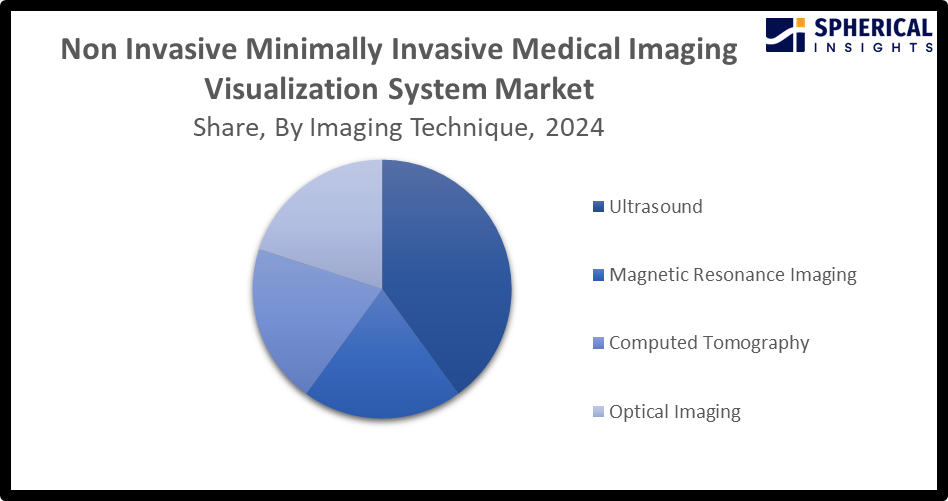
The ultrasound segment held the largest market share of over 50.0% in 2024, owing to its widespread application in prenatal imaging, cardiology, and diagnostics. Ultrasound imaging, also known as sonography, uses high-frequency sound waves to produce real-time images inside the body. Common ultrasound imaging procedures include abdominal ultrasound, bone sonometry, breast ultrasound, and others. Whereas optical imaging is anticipated to grow at the fastest rate, due to its innovative applications and an increased demand for non-invasive procedures. Use of non-ionizing light ranging from visible to near infrared for visualizing, measuring, and analyzing human tissue at the cellular level in real time.
Get more details on this report -
By Application: Cardiology (Largest) versus Oncology (Fastest-Growing)
The cardiology segment held the dominant share in the non-invasive minimally invasive medical imaging visualization system market, owing to the growing prevalence of cardiovascular disorders and the need for advanced imaging solutions for accurate diagnosis and treatment. Non-invasive cardiac imaging devices, like cardiac MRI, CT Angiography (CCTA), and Echocardiography are important for diagnosing heart disorders without catheters, assessing heart structure, function, and coronary blockade. In the oncology segment, advancements in imaging techniques such as PET and MRI provide enhanced visualization for tumor detection and treatment planning.
Regional Segment Analysis of the Non-Invasive Minimally Invasive Medical Imaging Visualization System Market
- North America (U.S., Canada, Mexico)
- Europe (Germany, France, U.K., Italy, Spain, Rest of Europe)
- Asia-Pacific (China, Japan, India, Rest of APAC)
- South America (Brazil and the Rest of South America)
- The Middle East and Africa (UAE, South Africa, Rest of MEA)
North America is anticipated to hold the largest share of the non-invasive minimally invasive medical imaging visualization system market over the predicted timeframe.

Get more details on this report -
North America is anticipated to hold the largest share of over 35.0% in the non-invasive minimally invasive medical imaging visualization system market over the predicted timeframe. The market ecosystem in North America is strong, with a rapidly expanding, high-value sector and increasing technological advancements in AI, 3D imaging, and robotics. The United States is the dominant country in the North America non invasive minimally invasive medical imaging visualization system market, owing to the increasing emphasis on reducing patient risk and improving procedural precision.
Asia Pacific is expected to grow at a rapid CAGR in the non invasive minimally invasive medical imaging visualization system market during the forecast period. The Asia Pacific area has a thriving market for non invasive minimally invasive medical imaging visualization system due to its increasing need for advanced diagnostic technologies. Further, rapid healthcare modernization, a massive aging population, and strategic shift towards precision diagnostics are contributing factors in regional market growth. China is the leading country in the Asia Pacific market, holding the dominant share, owing to the increased need for diagnostics and a robust manufacturing base.
Competitive Analysis:
The report offers the appropriate analysis of the key organizations/companies involved within the non invasive minimally invasive medical imaging visualization system market, along with a comparative evaluation primarily based on their type of offering, business overviews, geographic presence, enterprise strategies, segment market share, and SWOT analysis. The report also provides an elaborative analysis focusing on the current news and developments of the companies, which includes type development, innovations, joint ventures, partnerships, mergers & acquisitions, strategic alliances, and others. This allows for the evaluation of the overall competition within the market.
List of Key Companies
- Abbott Laboratories
- Advanced Brain Monitoring
- Boston Scientific Corporation
- Canon Medical Systems Corporation
- CAS Medical Systems, Inc.
- CNSystems Medizintechnik GmbH
- Fujifilm Holdings Corporation
- GE Healthcare
- Koninklijke Philips N. V.
- Medtronic plc
- Siemens Healthineers AG
- Smith & Nephew plc
- Others
Key Target Audience
- Market Players
- Investors
- End-users
- Government Authorities
- Consulting And Research Firm
- Venture capitalists
- Value-Added Resellers (VARs)
Industry Development
- In May 2025, Philips and Polarean, a medical imaging technology leader in advanced MRI of lung function, today announced the next phase of their strategic partnership to increase access to advanced, radiation-free lung MRI for patients with obstructive lung diseases.
- In February 2024, Siemens unveils Magnetom Flow MRI scanner at ECR 2024. Siemens Healthineers launched its Magnetom Flow, 1.5 tesla (T) platform in Vienna for MRI with a closed helium circuit and no quench pipe.
- In January 2024, Canon Medical Systems Corporation (Canon Medical) and Olympus Corporation (Olympus), announced that we have reached an agreement to collaborate on Endoscopic Ultrasound Systems.
- In January 2024, South Korean medical AI provider Lunit signed a three-year supply contract with Samsung Electronics. The deal is for the integration of Lunit's two chest X-ray AI solutions, Lunit INSIGHT CXR and Lunit INSIGHT CXR Triage, into Samsung's line of premium X-ray devices.
Market Segment
This study forecasts revenue at global, regional, and country levels from 2020 to 2035. Spherical Insights has segmented the non-invasive minimally invasive medical imaging visualization system market based on the below-mentioned segments:
Global Non-Invasive Minimally Invasive Medical Imaging Visualization System Market, By Imaging Technique
- Ultrasound
- Magnetic Resonance Imaging
- Computed Tomography
- Optical Imaging
Global Non-Invasive Minimally Invasive Medical Imaging Visualization System Market, By Application
- Orthopedics
- Cardiology
- Oncology
- Others
Global Non-Invasive Minimally Invasive Medical Imaging Visualization System Market, By Regional Analysis
- North America
- US
- Canada
- Mexico
- Europe
- Germany
- UK
- France
- Italy
- Spain
- Russia
- Rest of Europe
- Asia Pacific
- China
- Japan
- India
- South Korea
- Australia
- Rest of Asia Pacific
- South America
- Brazil
- Argentina
- Rest of South America
- Middle East & Africa
- UAE
- Saudi Arabia
- Qatar
- South Africa
- Rest of the Middle East & Africa
Frequently Asked Questions (FAQ)
-
1. What is the market size of the Non-Invasive Minimally Invasive Medical Imaging Visualization System market?The Global Non-Invasive Minimally Invasive Medical Imaging Visualization System Market size is expected to grow from USD 42.80 Billion in 2024 to USD 81.05 Billion by 2035, at a CAGR of 5.98% during the forecast period 2025-2035.
-
2. Which region holds the largest share of the Non-Invasive Minimally Invasive Medical Imaging Visualization System market?North America is anticipated to hold the largest share of the Non-Invasive Minimally Invasive Medical Imaging Visualization System market over the predicted timeframe.
-
3. What is the forecasted CAGR of the Global Non-Invasive Minimally Invasive Medical Imaging Visualization System Market from 2024 to 2035?The market is expected to grow at a CAGR of around 5.98% during the period 2024–2035.
-
4. Who are the top companies that are involved in the Global Non-Invasive Minimally Invasive Medical Imaging Visualization System Market?Key players include Abbott Laboratories, Advanced Brain Monitoring, Boston Scientific Corporation, Canon Medical Systems Corporation, CAS Medical Systems, Inc., CNSystems Medizintechnik GmbH, Fujifilm Holdings Corporation, GE Healthcare, Koninklijke Philips N. V., Medtronic plc, Siemens Healthineers AG, and Smith & Nephew plc.
-
5. What are the main drivers in the non-invasive minimally invasive medical imaging visualization system market?An increased emphasis on preventive healthcare, chronic disease prevalence, and technological advancement in imaging system are major market growth drivers of the non-invasive minimally invasive medical imaging visualization system market.
-
6. What challenges are limiting the adoption of non-invasive minimally invasive medical imaging visualization system?Factors like the increased cost of imaging devices and reimbursement issues remain key restraints in the non-invasive minimally invasive medical imaging visualization system market.
-
7. What are the key trends in the non-invasive minimally invasive medical imaging visualization system market?The rise of portable devices, hybrid imaging, cloud-based systems, sustainable imaging & green energy-efficient infrastructure, AI in imaging, and 3D and 4D imaging for sophisticated monitoring, are major key trends in the non-invasive minimally invasive medical imaging visualization system market.
Need help to buy this report?