Global NGS-based AMR Detection Market Size, Share, and COVID-19 Impact Analysis, By Product Type (Instruments & Platforms, Reagents & Consumables, and Bioinformatics & Software Solutions), By Technology (Whole-Genome Sequencing (WGS) and Targeted NGS), By Application (Clinical Diagnostics, Public Health & Surveillance, Pharma/R&D and Academic & Research Use), By End User (Hospitals & Clinical Laboratories, Public Health Agencies & Reference Labs, Pharmaceutical & Biotechnology Companies, and Academic & Research Institutes), and By Region (North America, Europe, Asia-Pacific, Latin America, Middle East, and Africa), Analysis and Forecast 2025 - 2035
Industry: Healthcare
Global NGS-based AMR Detection Market Size Insights Forecasts to 2035
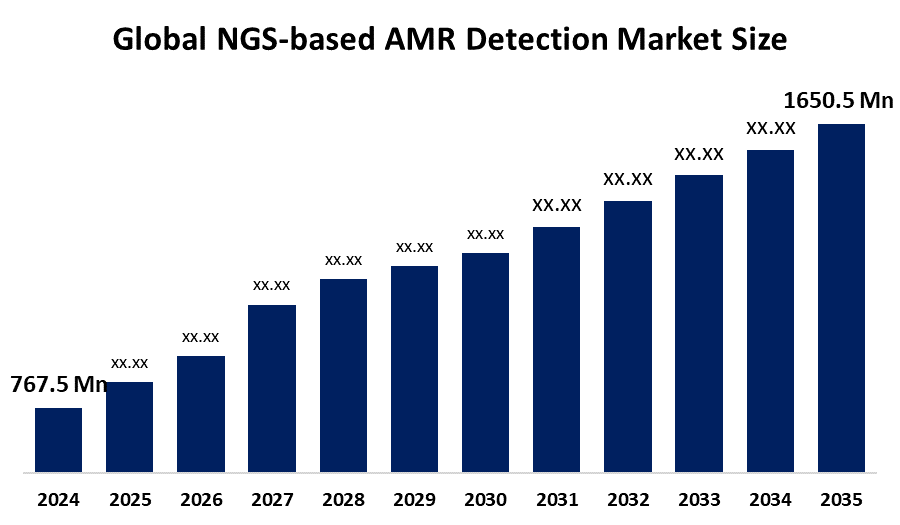
- The Global NGS-based AMR Detection Market Size Was Estimated at USD 767.5 Million in 2024
- The Market Size is Expected to Grow at a CAGR of around 7.21% from 2025 to 2035
- The Worldwide NGS-based AMR Detection Market Size is Expected to Reach USD 1650.5 Million by 2035
- Asia Pacific is expected to Grow the fastest during the forecast period.
Get more details on this report -
According to a Research Report Published by Spherical Insights and Consulting, The Global NGS-based AMR Detection Market Size was worth around USD 767.5 Million in 2024 and is predicted to Grow to around USD 1650.5 Million by 2035 with a compound annual growth rate (CAGR) of 7.21% from 2025 and 2035. The market for NGS-based AMR detection has a number of opportunities to grow due to the surging need for faster, more accurate, and detailed molecular insights than conventional phenotypic methods.
Market Overview
The global industry for NGS-based antimicrobial resistance detection encompasses the use of high-throughput sequencing technologies (WGS, tNGS, mNGS) to rapidly identify resistance genes and mutations in pathogens. NGS-based antimicrobial resistance detection is an advanced and culture-independent molecular technique that use Next-Generation Sequencing (NGS) to identify antibiotic resistance genes, mutations, and resistant bacteria directly from clinical or environmental samples, enabling rapid, precise identification of resistance mechanisms (including novel ones) within days, rather than weeks, by providing comprehensive genetic data, allowing for faster targeted treatment.
Innovation and market expansion are anticipated as a result of major players' growing R&D expenditures and the expanding partnerships. For instance, in February 2026, Researchers in Imperial’s Fleming Initiative have been awarded new funding through a global programme to help transform the discovery of new antibiotics and tackle the growing threat of antimicrobial resistance (AMR).
Report Coverage
This research report categorizes the NGS-based AMR Detection market based on various segments and regions, forecasts revenue growth, and analyzes trends in each submarket. The report analyses the key growth drivers, opportunities, and challenges influencing the NGS-based AMR Detection market. Recent market developments and competitive strategies such as expansion, type launch, development, partnership, merger, and acquisition have been included to draw the competitive landscape in the market. The report strategically identifies and profiles the key market players and analyses their core competencies in each sub-segment of the NGS-based AMR Detection market.
Global NGS-based AMR Detection Market Report Coverage
| Report Coverage | Details |
|---|---|
| Base Year: | 2024 |
| Market Size in 2024 : | USD 767.5 Million |
| Forecast Period: | 2025-2035 |
| Forecast Period CAGR 2025-2035 : | 7.21% |
| 2035 Value Projection: | USD 1650.5 Million |
| Historical Data for: | 2020-2023 |
| No. of Pages: | 295 |
| Tables, Charts & Figures: | 91 |
| Segments covered: | By Product Type, By Technology and COVID-19 Impact Analysis |
| Companies covered:: | Illumina, QIAGEN, Thermo Fisher Scientific, BIOMÉRIEUX, Abbott, ACRO Biosystems, CD Genomics., Diagnostics Longwood SL, Credence Genomics, Fraunhofer IGB, and Others |
| Pitfalls & Challenges: | Covid 19 Impact Challenges, Future, Growth and Analysis |
Get more details on this report -
Driving Factors
NGS-based AMR detection market is driven by an increasing prevalence of antimicrobial resistance (AMR) via prompting action from global health bodies like the WHO’s Global Action Plan on AMR. Furthermore, the need for rapid, high-throughput surveillance, advancements in bioinformatics/AI for data analysis, and increasing government funding for infection control are contributing to propel the NGS-based AMR detection market. The integration of AI-driven bioinformatics and cloud-based analytics for accelerating and improving the accuracy of NGS-based AMR detection is escalating the market growth.
Restraining Factors
The NGS-based AMR detection market is restricted by factors like limited standardization and data interpretation complexity. Further, the increased price, technical limitations, and need for trained workforce are challenging the market growth.
Market Segmentation
The NGS-based AMR detection market share is classified into product type, technology, application, and end user.
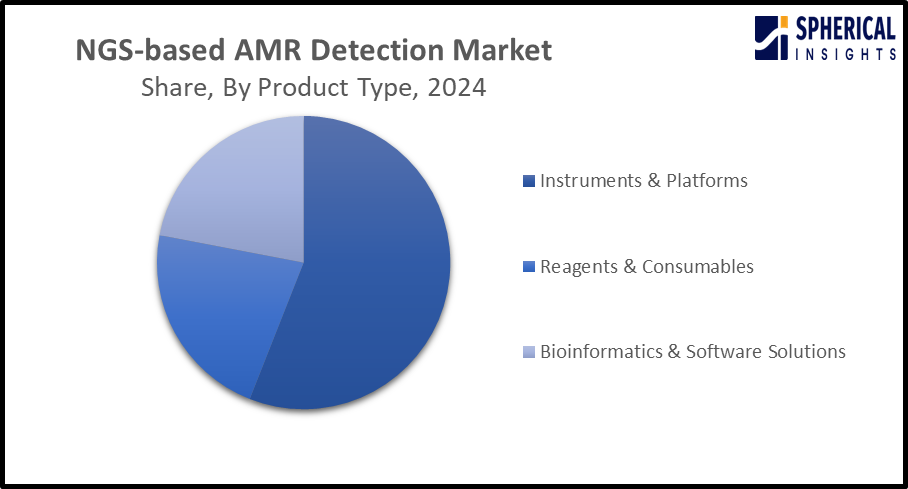
- The instruments & platforms segment dominated the market with approximately 55.7% share in 2024 and is projected to grow at a substantial CAGR during the forecast period.
Based on the product type, the NGS-based AMR detection market is divided into instruments & platforms, reagents & consumables, and bioinformatics & software solutions. Among these, the instruments & platforms segment dominated the market with approximately 55.7% share in 2024 and is projected to grow at a substantial CAGR during the forecast period. The surging demand for high-throughput, accurate sequencing systems, along with ongoing advancements in sequencing technology supporting precise identification of resistance genes and mutations is driving the market in the instruments & platforms segment. For instance, AmrProfiler is a comprehensive tools with specialized modules identifying acquired AMR genes, resistance-associated mutations, and rRNA gene mutations across nearly 18 000 bacterial species.
Get more details on this report -
- The whole-genome sequencing (WGS) segment accounted for the largest share of about 72.0% in 2024 and is anticipated to grow at a significant CAGR during the forecast period.
Based on the technology, the NGS-based AMR detection market is divided into whole-genome sequencing (WGS) and targeted NGS. Among these, the whole-genome sequencing (WGS) segment accounted for the largest share of about 72.0% in 2024 and is anticipated to grow at a significant CAGR during the forecast period. Whole-genome sequencing relies on NGS technologies, commonly employed for analyzing the genomes of single bacterial isolates, with its application extending to difficult to culture microorganisms like Mycobacterium tuberculosis. An increasing need for comprehensive and high-resolution profiling of antimicrobial resistance gene across diverse pathogens is responsible for driving the market demand.
- The clinical diagnostics segment held the dominant market share of about 55.0% in 2024 and is anticipated to grow at a significant CAGR during the projected period.
Based on the application, the NGS-based AMR detection market is divided into clinical diagnostics, public health & surveillance, pharma/R&D and academic & research use. Among these, the clinical diagnostics segment held the dominant market share of about 55.0% in 2024 and is anticipated to grow at a significant CAGR during the projected period. Key applications of NGS-based AMR detection in clinical diagnostics include rapid identification, metagenomic next-generation sequencing (mNGS), whole genome sequencing, genomic prediction, and infection control. Use of next-generation sequencing technologies in hospitals and clinical laboratories for precise identification of antimicrobial resistance profiles, with an increasing prevalence of MDR, anticipated to propel market demand.
- The hospitals & clinical laboratories segment held the dominant market share of about 52.0% in 2024 and is anticipated to grow at a significant CAGR during the projected period.
Based on the end user, the NGS-based AMR detection market is divided into hospitals & clinical laboratories, public health agencies & reference labs, pharmaceutical & biotechnology companies, and academic & research institutes. Among these, the hospitals & clinical laboratories segment held the dominant market share of about 52.0% in 2024 and is anticipated to grow at a significant CAGR during the projected period. Clinical and public health microbiology labs are using next generation sequencing (NGS) technology into their current diagnostic cycles more frequently as a result of the technology’s quick advancements. An increasing investments in advanced NGS platforms and associated consumables by the healthcare facilities contributing to propel segmental market growth.
Regional Segment Analysis of the NGS-based AMR Detection Market
- North America (U.S., Canada, Mexico)
- Europe (Germany, France, U.K., Italy, Spain, Rest of Europe)
- Asia-Pacific (China, Japan, India, Rest of APAC)
- South America (Brazil and the Rest of South America)
- The Middle East and Africa (UAE, South Africa, Rest of MEA)
North America is anticipated to hold the largest share of the NGS-based AMR Detection market over the predicted timeframe.
North America is anticipated to hold the largest share of over 30.0% in the NGS-based AMR detection market over the predicted timeframe. The market ecosystem in North America is strong, with both cutting-edge startups and major industrial heavyweights well-represented. For instance, in November 2020, PathoQuest SAS, a genomic expert company dedicated to quality control testing of biologics, and its strategic partner Charles River Laboratories International, Inc., announced that it has established a U.S. subsidiary, PathoQuest, Inc., and would construct a state-of-the-art next generation sequencing (NGS)-based testing laboratory at Charles River’s site in Wayne, PA. The demand for NGS-based AMR detection has been driven by the region's increasing prevalence of MDR infections, increased infrastructure investment, and need for rapid, precise diagnostic tools. The United States is dominating the North America region in the NGS-based AMR detection market, driven by aggressive national efforts for combating antimicrobial resistance and collaborations under the National Action Plan for Combating Antibiotic-Resistant Bacteria.
Asia Pacific is expected to grow at a rapid CAGR of around 7.2% in the NGS-based AMR detection market during the forecast period. The Asia Pacific area has a thriving market for NGS-based AMR detection due to the rising investment in genomic infrastructure, along with the adoption of molecular diagnostics in emerging economic countries of north America region. Initiatives such as Asia Pathogen Genomics Initiatives and India’s National Action Plan focuses on using NGS for rapid pathogen detection and evidence based policy are promoting the market growth. India is the fastest growing country in the Asia Pacific NGS-based AMR detection market, with a CAGR of about 7.8% during the forecast period, due to the expanding genomic surveillance programs and an increasing adoption of next-generation sequencing in clinical and public health laboratories.
Competitive Analysis:
The report offers the appropriate analysis of the key organizations/companies involved within the NGS-based AMR detection market, along with a comparative evaluation primarily based on their type of offering, business overviews, geographic presence, enterprise strategies, segment market share, and SWOT analysis. The report also provides an elaborative analysis focusing on the current news and developments of the companies, which includes type development, innovations, joint ventures, partnerships, mergers & acquisitions, strategic alliances, and others. This allows for the evaluation of the overall competition within the market.
List of Key Companies
- Illumina
- QIAGEN
- Thermo Fisher Scientific
- BIOMÉRIEUX
- Abbott
- ACRO Biosystems
- CD Genomics.
- Diagnostics Longwood SL
- Credence Genomics
- Fraunhofer IGB
- Others
Key Target Audience
- Market Players
- Investors
- End-users
- Government Authorities
- Consulting And Research Firm
- Venture capitalists
- Value-Added Resellers (VARs)
Recent Development
- In February 2026, Genient, a Noida-based genomics and molecular diagnostics company, is strengthening India’s precision healthcare ecosystem by delivering platform agonistic, India-relevant molecular and next-generation sequencing (NGS) solutions tailored to the country’s real disease burden, including antimicrobial resistance (AMR).
- In September 2024, Cepheid announced an important partnership with the Fleming Initiative, a global collaboration established by Imperial College Healthcare NHS Trust and Imperial College London to combat antimicrobial resistance.
- In April 2022, OpGen, Inc., a precision medicine company harnessing the power of molecular diagnostics and informatics to help combat infectious disease, announced that its subsidiary, Ares Genetics, which strives to become a leader in bacterial genomics and AI-powered prediction of antimicrobial resistance (AMR), is commercially launching a series of new genome sequencing and analysis services globally.
- In August 2019, Curetis N.V. announced that its wholly-owned subsidiary Ares Genetics GmbH has opened a specialized service laboratory offering next-generation molecular antimicrobial resistance (AMR) testing services with an initial focus on infection control, AMR epidemiology and surveillance, clinical research and pharmaceutical anti-infectives R&D.
Market Segment
This study forecasts revenue at global, regional, and country levels from 2020 to 2035. Spherical Insights has segmented the NGS-based AMR detection market based on the below-mentioned segments:
Global NGS-based AMR Detection Market, By Product Type
- Instruments & Platforms
- Reagents & Consumables
- Bioinformatics & Software Solutions
Global NGS-based AMR Detection Market, By Technology
- Whole-Genome Sequencing (WGS)
- Targeted NGS
Global NGS-based AMR Detection Market, By Application
- Clinical Diagnostics
- Public Health & Surveillance
- Pharma/R&D
- Academic & Research Use
Global NGS-based AMR Detection Market, By End User
- Hospitals & Clinical Laboratories
- Public Health Agencies & Reference Labs
- Pharmaceutical & Biotechnology Companies
- Academic & Research Institutes
Global NGS-based AMR Detection Market, By Regional Analysis
- North America
- US
- Canada
- Mexico
- Europe
- Germany
- UK
- France
- Italy
- Spain
- Russia
- Rest of Europe
- Asia Pacific
- China
- Japan
- India
- South Korea
- Australia
- Rest of Asia Pacific
- South America
- Brazil
- Argentina
- Rest of South America
- Middle East & Africa
- UAE
- Saudi Arabia
- Qatar
- South Africa
- Rest of the Middle East & Africa
Frequently Asked Questions (FAQ)
-
1. What is the market size of the NGS-based AMR detection market?The global NGS-based AMR detection market size is expected to grow from USD 767.5 Million in 2024 to USD 1650.5 Million by 2035, at a CAGR of 7.21% during the forecast period 2025-2035.
-
2. Which region holds the largest share of the NGS-based AMR detection market?North America is anticipated to hold the largest share of the NGS-based AMR detection market over the predicted timeframe.
-
3. What is the forecasted CAGR of the Global NGS-based AMR detection Market from 2024 to 2035?The market is expected to grow at a CAGR of around 7.21% during the period 2024–2035.
-
4. Who are the top companies that are involved in the Global NGS-based AMR detection Market?Key players include Illumina, QIAGEN, Thermo Fisher Scientific, BIOMÉRIEUX, Abbott, ACRO Biosystems, CD Genomics., Diagnostics Longwood SL, Credence Genomics, and Fraunhofer IGB.
-
5. What are the main drivers in the NGS-based AMR detection market?An increasing prevalence of antimicrobial resistance (AMR) and integration of AI-driven bioinformatics and cloud-based analytics, are major market growth drivers of the NGS-based AMR detection market.
-
6. What challenges are limiting the adoption of NGS-based AMR detection treatment?Factors like limited standardization and data interpretation complexity remain key restraints in the NGS-based AMR detection market.
-
7. What are the key trends in the NGS-based AMR detection market?The upsurging need for rapid, high-throughput surveillance, advancements in bioinformatics/AI for data analysis, and increasing government funding for infection control, are key trends in the NGS-based AMR detection market.
Need help to buy this report?