Global Nano Urea Market Size, Share, and COVID-19 Impact Analysis, By Product Type (Liquid Nano Urea and Granular Nano Urea), By Application (Cereals & Grains, Fruits & Vegetables, Oilseeds & Pulses, and Others), By End-User (Agriculture, Horticulture, Floriculture, and Others), and By Region (North America, Europe, Asia-Pacific, Latin America, Middle East, and Africa), Analysis and Forecast 2025 - 2035
Industry: Agriculture
Global Nano Urea Market Insights Forecasts to 2035
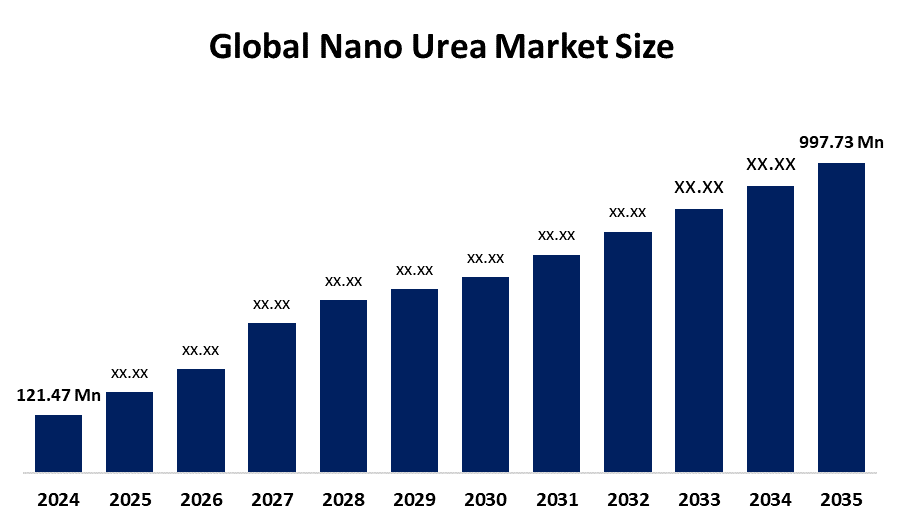
- The Global Nano Urea Market Size Was Estimated at USD 121.47 Million in 2024
- The Market Size is Expected to Grow at a CAGR of around 21.1% from 2025 to 2035
- The Worldwide Nano Urea Market Size is Anticipated to Reach USD 997.73 Million by 2035
- North America is expected to grow the fastest during the forecast period.
Get more details on this report -
According to a research report published by Spherical Insights and Consulting, The Global Nano Urea Market Size was Worth Around USD 121.47 Million in 2024 and is Predicted to Grow to Around USD 997.73 Million by 2035 with a Compound Annual Growth rate (CAGR) of 21.1% from 2025 to 2035. The demand for the global nano urea market is rising owing to the growing need for sustainable agriculture and crop yields. It provides better efficiency and does not cause any pollution compared to urea fertilizers in agriculture.
Market Overview
The international Global Nano Urea Market Size is based on the manufacturing and usage of nano-scale urea fertilizers, which aim at improving nutrient efficiency and reducing damaging effects on the environment. Nano urea acts as a targeted nutrient delivery option, which helps improve plant growth and yields, along with curtailing the unnecessary usage of chemical fertilizers. It has vast applications in cereals, vegetables, and commercial crops, which help sustain agriculture. The market is boosted by increasing demands for environmentally supportive farming methods, surging pressures from the rising population that call for increased agricultural output, and increased focus from the government on using environmentally positive fertilizers.
The Global Nano Urea Market Size has areas of growth that include increasing adoption among small and medium-scale farmers, integration with precision farming methods, and increasing the number of developing nations that expand agricultural lands. Major players, IFFCO, Krishak Bharati Cooperative, among others, work consistently on research and development and distribution to tap this increased market. With growing awareness of environmental sustainability and cost-effective farming, the global nano urea market is set to see major growth in the next few years. In December 2025, India signed a five-year MoU with the ICAR for a Rs 21.20 crore nano urea project across different agricultural institutes, including CRRI, Cuttack. Earlier, a study supported by ICFFTR in 2024 analysed the effect of nano fertilizers on the growth of crops as well as soil health, while IFFCO conducted field tests in drought-affected areas such as Balangir.
Report Coverage
This research report categorizes the Global Nano Urea Market Size based on various segments and regions, forecasts revenue growth, and analyzes trends in each submarket. The report analyses the key growth drivers, opportunities, and challenges influencing the nano urea market. Recent market developments and competitive strategies, such as expansion, type launch, development, partnership, merger, and acquisition, have been included to draw the competitive landscape in the market. The report strategically identifies and profiles the key market players and analyses their core competencies in each sub-segment of the nano urea market.
Nano Urea Market Report Coverage
| Report Coverage | Details |
|---|---|
| Base Year: | 2024 |
| Market Size in 2024: | USD 121.47 Million |
| Forecast Period: | 2024-2035 |
| Forecast Period CAGR 2024-2035 : | CAGR of 21.1% |
| 2035 Value Projection: | USD 997.73 Million |
| Historical Data for: | 2020-2023 |
| No. of Pages: | 245 |
| Tables, Charts & Figures: | 106 |
| Segments covered: | By Product Type, By End-User |
| Companies covered:: | IFFFO, National Fertilizers Limited (NFL), Yara International ASA, BASF SE, Coromandel International Ltd., OCI N.V., CF Industries Holdings, Inc., Syngenta AG, EuroChem Group, Nutrien Limited, Koch Fertilizer, LLC, SABIC Agri-Nutrients, ICL Group, The Mosaic Company, and Other Key Players |
| Pitfalls & Challenges: | COVID-19 Empact, Challenges, Future, Growth, & Analysis |
Get more details on this report -
Driving Factors
The international market for nano urea is on the rise, owing to an increasing demand for eco-friendly and resource-effective means of agriculture. The application of nano urea increases the growth of crops by delivering nutrients effectively. Moreover, it reduces the environmental pollution caused by the usage of chemical fertilizers. The increasing awareness among people regarding the need to take care of the soil, precision farming, and efficient resource farming methods has led to the adoption of nano urea. The subsidized schemes by the governments for using eco-friendly fertilizers have also contributed to the growth of the international market for nano urea. The growing population and need for food security are other notable reasons that contribute to the growth of the international market for nano urea.
Restraining Factors
Restraints in the Global Nano Urea Market Size come from factors such as high production costs, unawareness about nano urea among small-scale farmers, and the absence of proper distribution networks in rural areas. Government policies, a lack of standard application procedures, and doubts about the effectiveness of nano fertilisers compared to conventional fertilisers are some factors that hinder this market.
Market Segmentation
The Nano Urea Market share is classified into product type, application, and end-user.
- The liquid nano urea segment dominated the market in 2024, approximately 58% and is projected to grow at a substantial CAGR during the forecast period.
Based on the product type, the Global Nano Urea Market Size is divided into liquid nano urea and granular nano urea. Among these, the liquid nano urea segment dominated the market in 2024 and is projected to grow at a substantial CAGR during the forecast period. The liquid nano urea segment has had the leading role in fueling market growth owing to its easy use, quicker nutrient assimilation, and compatibility with present spray and irrigation channels. Its efficacy in foliar spray, use in precision agriculture, and capacity for enhancing nutrient use efficiency and preventing fertilizer losses added to its adoption among farmers.
- The cereals & grains segment accounted for the largest share in 2024, approximately 45% and is anticipated to grow at a significant CAGR during the forecast period.
Based on the application, the Global Nano Urea Market Size is divided into cereals & grains, fruits & vegetables, oilseeds & pulses, and others. Among these, the cereals & grains segment accounted for the largest share in 2024 and is anticipated to grow at a significant CAGR during the forecast period. The cereals and grains category contributed the largest market share, owing to the larger cultivation areas and being major food crops. Increased demand for increased yields, efficient nitrogen, and an economical mode of fertilization provided impetus to the adoption of nano urea among rice, wheat, and corn crops.
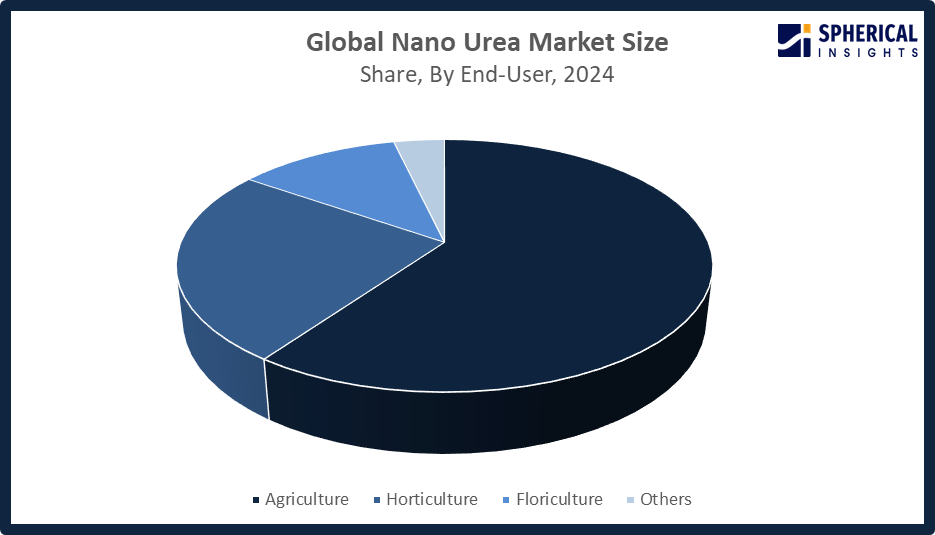
- The agriculture segment accounted for the highest market revenue in 2024, approximately 60% and is anticipated to grow at a significant CAGR during the forecast period.
Based on the end-user, the Global Nano Urea Market Size is divided into agriculture, horticulture, floriculture, and others. Among these, the agriculture segment accounted for the highest market revenue in 2024 and is anticipated to grow at a significant CAGR during the forecast period. The agriculture industry market growth in the overall market is due to widespread farming, growing food demands, and demands for sustainable methods of fertilization. Use of nano urea increased the efficiency of nutrients, lowered the costs of use, and improved yield, making it highly appropriate for commercial farming.
Get more details on this report -
Regional Segment Analysis of the Nano Urea Market
- North America (U.S., Canada, Mexico)
- Europe (Germany, France, U.K., Italy, Spain, Rest of Europe)
- Asia-Pacific (China, Japan, India, Rest of APAC)
- South America (Brazil and the Rest of South America)
- The Middle East and Africa (UAE, South Africa, Rest of MEA)
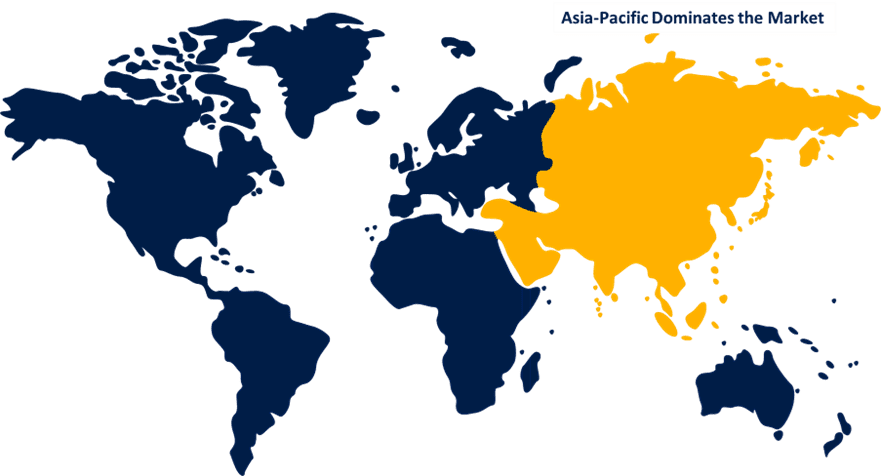
Asia Pacific is anticipated to hold the largest share of the nano urea market over the predicted timeframe.
Asia Pacific is anticipated to hold the largest share of the nano urea market over the predicted timeframe. Asia Pacific is projected to encompass the 55% market share for the Global Nano Urea Market Size due to large agricultural activity, growing demand for food, and increased government encouragement for eco-friendly fertilizers. The Indian market is leading the adoption of large-scale promotion of nano-urea to minimise the utilisation of conventional fertiliser imports. China is leading this market through enhanced agricultural technologies. In addition, Japan is supporting this market through the efficient utilisation of nutrients. Furthermore, Australia is encouraging this market through innovation. In this regard, the Indian Government plans to increase the number of production plants of nano liquid urea to 13 production plants by 2025 to produce 44 crore 500 ml bottles of nano-urea & DAP.
Get more details on this report -
North America is expected to grow at a rapid CAGR in the Global Nano Urea Market Size during the forecast period. North America is expected to have a 20% in the market share in nano urea as there has been an increasing adoption of precision farming practices and advancements in the technology of farming. The United States will contribute to the growth of the market as there has been an increasing demand for efficient nitrogen fertiliser that has little environmental impact. Additionally, there has been an increased emphasis on efficient soil management practices. Ranked No. 2724 in the Inc. 5000 in August 2025, Nano-Yield was identified among the fastest-growing private companies in America, thus recognising its innovation in the area of agricultural input delivery.
Europe’s market growth in the use of nano urea is promoted by strict environmental norms, the increasing demand for sustainable agriculture, and the decrease in the use of chemical fertilizers. Germany and France are at the forefront in the use of advanced agricultural practices and precise nutrient management. This is supplemented by the increased interest in soil care and eco-friendly fertilizers in the United Kingdom, while the rest of Europe follows suit to address climate and sustainability commitments through the use of nano fertilizers.
Competitive Analysis:
The report offers the appropriate analysis of the key organizations/companies involved within theGlobal Nano Urea Market Size , along with a comparative evaluation primarily based on their type of offering, business overviews, geographic presence, enterprise strategies, segment market share, and SWOT analysis. The report also provides an elaborative analysis focusing on the current news and developments of the companies, which includes type development, innovations, joint ventures, partnerships, mergers & acquisitions, strategic alliances, and others. This allows for the evaluation of the overall competition within the market.
List of Key Companies
- IFFFO
- National Fertilizers Limited (NFL)
- Yara International ASA
- BASF SE
- Coromandel International Ltd.
- OCI N.V.
- CF Industries Holdings, Inc.
- Syngenta AG
- EuroChem Group
- Nutrien Limited
- Koch Fertilizer, LLC
- SABIC Agri-Nutrients
- ICL Group
- The Mosaic Company
- Others
Key Target Audience
- Market Players
- Investors
- End-users
- Government Authorities
- Consulting and Research Firm
- Venture capitalists
- Value-Added Resellers (VARs)
Recent Development
- In August 2025, India saw a surge in demand for nano fertilizers such as Nano Urea and Nano DAP, as farmers adopt sustainable alternatives. Government support, research institutions, and fertilizer companies are driving nationwide adoption, promoting eco-friendly farming practices.
- In December 2024, National Fertilizers Ltd. (NFL) announced its entry into the nano urea market with a new high-performance variant at its Nangal plant, producing 1.5 lakh 500 ml bottles daily. The NFL is also conducting field research to evaluate the effectiveness and farmer acceptance of existing nano urea products.
- In July 2024, IFFCO launched the Nano Fertiliser Usage Promotion Mahaabhiyan to boost nano-fertiliser adoption. The initiative targets 200 model nano village clusters, offering farmers in 800 villages a 25% subsidy on Nano Urea Plus, Nano DAP, and Sagarika fertilisers, encouraging wider use in agricultural fields.
- In April 2023, Union Home Minister Amit Shah launched IFFCO Nano DAP (Liquid) in New Delhi, aiming to boost India’s self-reliance in fertilizers. The initiative, praised for inspiring national cooperatives, is expected to transform agriculture, enhance farmer prosperity, and strengthen domestic fertilizer production under PM Modi’s leadership.
- In June 2021, IFFCO dispatched its first Nano Urea Liquid consignment to Uttar Pradesh on World Environment Day. Developed using patented technology at Kalol, Gujarat, it was introduced by MD Dr U.S. Awasthi on 31 May 2021. A green flag-off ceremony marked its launch for farmer use.
Market Segment
This study forecasts revenue at global, regional, and country levels from 2020 to 2035. Spherical Insights has segmented the nano urea market based on the below-mentioned segments:
Global Nano Urea Market, By Product Type
- Liquid Nano Urea
- Granular Nano Urea
Global Nano Urea Market, By Application
- Cereals & Grains
- Fruits & Vegetables
- Oilseeds & Pulses
- Others
Global Nano Urea Market, By End-User
- Agriculture
- Horticulture
- Floriculture
- Others
Global Nano Urea Market, By Regional Analysis
- North America
- US
- Canada
- Mexico
- Europe
- Germany
- UK
- France
- Italy
- Spain
- Russia
- Rest of Europe
- Asia Pacific
- China
- Japan
- India
- South Korea
- Australia
- Rest of Asia Pacific
- South America
- Brazil
- Argentina
- Rest of South America
- Middle East & Africa
- UAE
- Saudi Arabia
- Qatar
- South Africa
- Rest of the Middle East & Africa
Frequently Asked Questions (FAQ)
-
1. What is the CAGR of the nano urea market over the forecast period?The global nano urea market is projected to expand at a CAGR of 21.1% during the forecast period.
-
2. What is the market size of the nano urea market?The global nano urea market size is expected to grow from USD 121.47 million in 2024 to USD 997.73 million by 2035, at a CAGR of 21.1% during the forecast period 2025-2035.
-
3. What is the nano urea market?The nano urea market involves the production and sale of nano-sized urea fertilizers that enhance crop yield and nutrient efficiency.
-
4. Which region holds the largest share of the nano urea market?Asia Pacific is anticipated to hold the largest share of the nano urea market over the predicted timeframe.
-
5. Who are the top 10 companies operating in the global nano urea market?IFFFO, National Fertilizers Limited (NFL), Yara International ASA, BASF SE, Coromandel International Ltd., OCI N.V., CF Industries Holdings, Inc., Syngenta AG, EuroChem Group, Nutrien Limited, and Others
-
6. What factors are driving the growth of the nano urea market?The nano urea market is driven by rising demand for sustainable agriculture, higher crop yields, efficient nutrient delivery, government support, environmental concerns, and growing adoption of precision farming practices globally.
-
7. What are the market trends in the nano urea market?Key market trends include rising precision agriculture adoption, sustainable fertilizer demand, technological innovation, increased government support, and expanding use in major crop segments worldwide.
-
8. What are the main challenges restricting wider adoption of the nano urea market?The main challenges restricting the wider adoption of the nano urea market include high production and application costs, limited long-term research on safety and efficacy, the need for farmer education and acceptance, and regulatory uncertainties.
Need help to buy this report?