Global Muscle Wasting Disorders Market Size, Share, By Disease Type (Muscular Dystrophy, Spinal Muscular Atrophy, Amyotrophic Lateral Sclerosis, and Others), By Treatment Modality (Drug Therapies, Gene Therapy, Physical Therapy and Rehabilitation, Supplements and Nutrition, and Others), By Mechanism of Action (Anti-inflammatory Agents, Muscle Growth Stimulators, Gene Editing Therapies, Immunomodulatory, and Others), and By Region (North America, Europe, Asia-Pacific, Latin America, Middle East, and Africa), Analysis and Forecast 2025 - 2035
Industry: Healthcare
Global Muscle Wasting Disorders Market Size Insights Forecasts to 2035
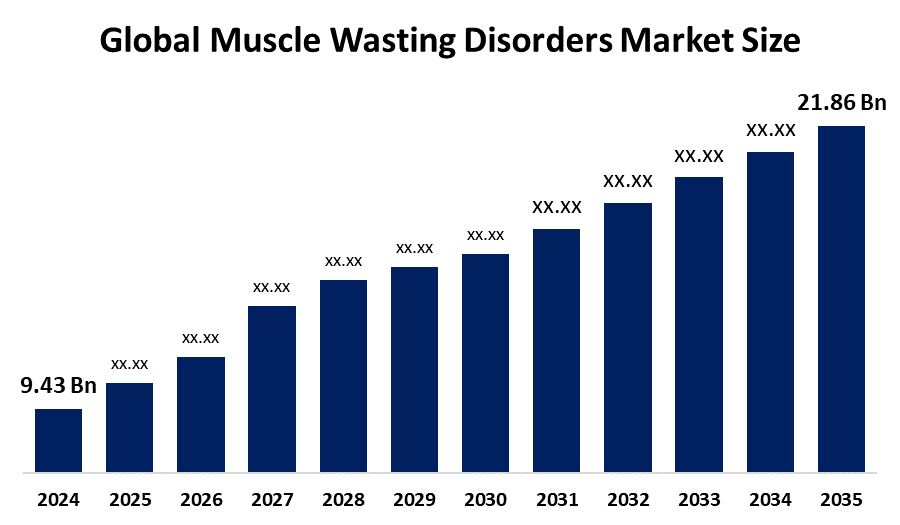
- The Global Muscle Wasting Disorders Market Size Was Estimated at USD 9.43 Billion in 2024
- The Market Size is Expected to Grow at a CAGR of around 7.94 % from 2025 to 2035
- The Worldwide Muscle Wasting Disorders Market Size is Expected to Reach USD 21.86 Billion by 2035
- Asia-Pacific region is expected to Grow the fastest during the forecast period.
Get more details on this report -
According to a Research Report Published by Spherical Insights, The Global Muscle Wasting Disorders Market Size was worth around USD 9.43 Billion in 2024 and is predicted to Grow to around USD 21.86 Billion by 2035 with a compound annual growth rate (CAGR) of 7.94% from 2025 to 2035. The global muscle wasting disorders market is expanding due to the rising prevalence of neuromuscular diseases, growing aging population, increasing healthcare awareness, advancements in gene and drug therapies, and higher investment in rare disease research and treatment development worldwide.
Market Overview
The worldwide muscle wasting disorders market represents the medical field which develops, creates, and sells therapeutic aids for managing diseases that lead to continuous muscular degeneration and strength loss, including muscular dystrophy, cachexia, and sarcopenia. The system includes the components, which are pharmaceuticals and biologics and supportive care products that help patients gain mobility while decreasing disease advancement and improving their overall health. The market experiences growth because muscular dystrophy and sarcopenia cases decrease with the rising elderly population and better diagnostic capabilities and increased research work on precise treatment methods. Muscle wasting disorder treatments receive development support from government programs through National Institutes of Health and European Medicines Agency which finance rare disease studies while giving orphan drug benefits, which speeds up drug development for muscle wasting disorders. In September 2023, the Muscular Dystrophy Association announced $8.4 million in research grants supporting neuromuscular disease studies, while the National Institutes of Health continues funding multiple muscular dystrophy research programs and clinical studies, supporting development of treatments for muscle wasting disorders.
The global muscle wasting disorders market shows a current trend which involves developing new gene therapies and biologics and targeted therapies while conducting more clinical studies and using precision medicine to enhance treatment results and disease advancement control. The global muscle wasting disorders market presents business opportunities because more resources are being allocated to rare disease studies and researchers are developing gene and cell therapies and clinical trials are expanding and more people want personalized medicine and emerging markets are enhancing their healthcare delivery systems.
Report Coverage
This research report categorizes the global muscle wasting disorders market based on various segments and regions, forecasts revenue growth, and analyzes trends in each submarket. The report analyses the key growth drivers, opportunities, and challenges influencing the global muscle wasting disorders market. Recent market developments and competitive strategies, such as expansion, product launch, development, partnership, merger, and acquisition, have been included to draw the competitive landscape in the market. The report strategically identifies and profiles the key market players and analyzes their core competencies in each sub-segment of the global muscle wasting disorders market.
Global Muscle Wasting Disorders Market Report Coverage
| Report Coverage | Details |
|---|---|
| Base Year: | 2024 |
| Market Size in 2024 : | USD 9.43 Billion |
| Forecast Period: | 2025-2035 |
| Forecast Period CAGR 2025-2035 : | 7.94% |
| 2035 Value Projection: | USD 21.86 Billion |
| Historical Data for: | 2020-2023 |
| No. of Pages: | 283 |
| Tables, Charts & Figures: | 86 |
| Segments covered: | By Disease Type, By Treatment Modality |
| Companies covered:: | Pfizer Inc, F. Hoffmann La Roche Ltd, Novartis AG, Sanofi, GlaxoSmithKline, Eli Lilly and Company, Teva Pharmaceutical Industries, Regeneron Pharmaceuticals, Biogen Inc, Santhera Pharmaceuticals, Sarepta Therapeutics, PTC Therapeutics, Ionis Pharmaceuticals, Cytokinetics Incorporated, Italfarmaco S.p.A., and Others |
| Pitfalls & Challenges: | COVID-19 Empact, Challenge, Future, Growth, & Analysis |
Get more details on this report -
Driving Factors
The global muscle wasting disorders market shows growth because more people develop muscular dystrophy, cachexia, and sarcopenia. The combination of increased awareness about rare neuromuscular diseases and better diagnostic tools and higher healthcare spending helps establish earlier disease detection and treatment methods. The expansion of research programs and government funding for rare disease treatments and progress in gene therapy and biologics research combine to speed up the development of new patient treatment methods. According to the World Health Organization, the global population aged 60 years and above is expected to reach about 2.1 billion by 2050, highlighting the growing aging population and associated risk of age-related disorders such as muscle wasting conditions.
Restraining Factors
The global muscle wasting disorders market faces restraints due to high treatment costs, limited availability of effective therapies, complex clinical trials for rare diseases, and low awareness in developing regions, which can delay diagnosis, reduce treatment accessibility, and slow the adoption of advanced therapeutic options.
Market Segmentation
The global muscle wasting disorders market share is classified into disease type, treatment modality, and mechanism of action.
- The muscular dystrophy segment accounted for the largest share in 2024, approximately 45%, and is anticipated to grow at a significant CAGR during the forecast period.
Based on the disease type, the global muscle wasting disorders market is divided into muscular dystrophy, spinal muscular atrophy, amyotrophic lateral sclerosis, and others. Among these, the muscular dystrophy segment accounted for the largest share in 2024, approximately 45%, and is anticipated to grow at a significant CAGR during the forecast period. This is because muscular dystrophy is highly prevalent worldwide, necessitates long-term management, and creates continuous demand for specialized therapies, supportive care, and advanced treatment solutions to improve patient quality of life and slow disease progression.
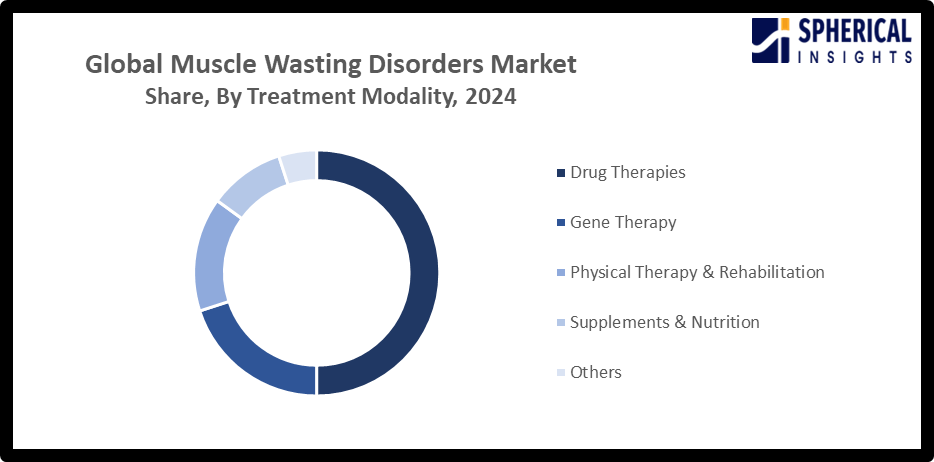
- The drug therapies segment accounted for the highest market revenue in 2024, approximately 50%, and is anticipated to grow at a significant CAGR during the forecast period.
Based on the treatment modality, the global muscle wasting disorders market is divided into drug therapies, gene therapy, physical therapy and rehabilitation, supplements and nutrition, and others. Among these, the drug therapies segment accounted for the highest market revenue in 2024, approximately 50%, and is anticipated to grow at a significant CAGR during the forecast period. This is because drug therapies are the most widely used treatment for muscle wasting disorders, effectively managing symptoms, slowing disease progression, improving muscle function, and enhancing patient quality of life, making them the primary choice across healthcare settings worldwide.
Get more details on this report -
- The muscle growth stimulators segment dominated the market in 2024, approximately 42%, and is projected to grow at a substantial CAGR during the forecast period.
Based on the mechanism of action, the global muscle wasting disorders market is divided into anti-inflammatory agents, muscle growth stimulators, gene editing therapies, immunomodulatory, and others. Among these, the muscle growth stimulators segment dominated the market in 2024, approximately 42%, and is projected to grow at a substantial CAGR during the forecast period. The market dominates due to their ability to effectively increase muscle mass, enhance strength, and improve functional outcomes in patients with muscle wasting disorders.
Regional Segment Analysis of the Global Muscle Wasting Disorders Market
- North America (U.S., Canada, Mexico)
- Europe (Germany, France, U.K., Italy, Spain, Rest of Europe)
- Asia-Pacific (China, Japan, India, Rest of APAC)
- South America (Brazil and the Rest of South America)
- The Middle East and Africa (UAE, South Africa, Rest of MEA)
North America is anticipated to hold the largest share of the global muscle wasting disorders market over the predicted timeframe.

Get more details on this report -
North America is anticipated to hold the largest share of global muscle wasting disorders market over the predicted timeframe. This is mainly due to well-established healthcare infrastructure, high healthcare expenditure, the presence of key market players, advanced diagnostic facilities, and stringent regulatory support for rare disease treatments. The U.S. is the leading country in the region’s muscle wasting disorders market, holding the largest regional share, owing to increased diagnostic rates of conditions such as Spinal Muscular Atrophy.
The Asia-Pacific region is expected to grow at the fastest rate during the forecast period, driven by rapid healthcare infrastructure expansion, increasing geriatric population, rising prevalence of muscle wasting disorders, growing awareness, and improving access to advanced therapies in emerging economies such as China and India. Japan is the leading country in the Asia Pacific muscle wasting disorders market, driven by the increasing healthcare expenditure and the adoption of innovative treatments.
Competitive Analysis:
The report offers the appropriate analysis of the key organizations/companies involved within the global muscle wasting disorders market, along with a comparative evaluation primarily based on their product offering, business overviews, geographic presence, enterprise strategies, segment market share, and SWOT analysis. The report also provides an elaborative analysis focusing on the current news and developments of the companies, which includes product development, innovations, joint ventures, partnerships, mergers & acquisitions, strategic alliances, and others. This allows for the evaluation of the overall competition within the market.
List of Key Companies
- Pfizer Inc
- F. Hoffmann-La Roche Ltd
- Novartis AG
- Sanofi
- GlaxoSmithKline
- Eli Lilly and Company
- Teva Pharmaceutical Industries
- Regeneron Pharmaceuticals
- Biogen Inc
- Santhera Pharmaceuticals
- Sarepta Therapeutics
- PTC Therapeutics
- Ionis Pharmaceuticals
- Cytokinetics Incorporated
- Italfarmaco S.p.A.
- Others
Key Target Audience
- Market Players
- Investors
- End-users
- Government Authorities
- Consulting and Research Firm
- Venture capitalists
- Value-Added Resellers (VARs)
Recent Development
- In March 2026, Biogen reported additional Phase 1b clinical trial data for its investigational antisense oligonucleotide therapy salanersen, for spinal muscular atrophy (SMA). The study showed about 75% reduction in neurofilament light chain (NfL) levels, a biomarker of neurodegeneration, and the company initiated a global Phase 3 clinical development program following these promising results.
- In April 2025, ProFuse Technology launched a new drug discovery platform focused on identifying therapies that prevent muscle loss. The platform targets conditions such as GLP-1 drug–associated muscle loss, cancer cachexia, and age-related sarcopenia, supporting development of treatments for muscle wasting disorders.
- In June 2023, the U.S. Food and Drug Administration approved Elevidys (delandistrogene moxeparvovec) as the first gene therapy for Duchenne muscular dystrophy (DMD) for ambulatory pediatric patients aged 4–5 years with confirmed DMD gene mutations. Later, in May 2024, the therapy was submitted for regulatory review in the European Union to expand its availability.
Market Segment
This study forecasts revenue at global, regional, and country levels from 2020 to 2035. Spherical Insights has segmented the global muscle wasting disorders market based on the below-mentioned segments:
Global Muscle Wasting Disorders Market, By Disease Type
- Muscular Dystrophy
- Spinal Muscular Atrophy
- Amyotrophic Lateral Sclerosis
- Others
Global Muscle Wasting Disorders Market, By Treatment Modality
- Drug Therapies
- Gene Therapy
- Physical Therapy and Rehabilitation
- Supplements and Nutrition
- Others
Global Muscle Wasting Disorders Market, By Mechanism of Action
- Anti-Inflammatory Agents
- Muscle Growth Stimulators
- Gene Editing Therapies
- Immunomodulatory
- Others
Global Muscle Wasting Disorders Market, By Regional Analysis
- North America
- US
- Canada
- Mexico
- Europe
- Germany
- UK
- France
- Italy
- Spain
- Russia
- Rest of Europe
- Asia Pacific
- China
- Japan
- India
- South Korea
- Australia
- Rest of Asia Pacific
- South America
- Brazil
- Argentina
- Rest of South America
- Middle East & Africa
- UAE
- Saudi Arabia
- Qatar
- South Africa
- Rest of the Middle East & Africa
Frequently Asked Questions (FAQ)
-
1. What are muscle wasting disorders?A: Muscle wasting disorders are medical conditions that cause progressive loss of muscle mass, strength, and function. Examples include muscular dystrophy, spinal muscular atrophy, sarcopenia, and cachexia.
-
2. What factors are increasing the prevalence of muscle wasting disorders globally?A: Aging populations, rising chronic diseases, cancer-related cachexia, genetic disorders, and sedentary lifestyles are major factors contributing to the growing number of muscle wasting cases worldwide.
-
3. What types of therapies are commonly used to manage muscle wasting disorders?A: Common treatments include drug therapies, gene therapies, physical rehabilitation programs, nutritional supplements, and supportive care approaches to help maintain muscle strength and mobility.
-
4. How is biotechnology influencing treatment development for muscle wasting disorders?A: Advances in biotechnology, including gene editing, RNA-based therapies, and regenerative medicine, are enabling development of targeted treatments designed to slow disease progression and improve muscle function.
-
5. Why is early diagnosis important for muscle wasting disorders?A: Early diagnosis allows timely treatment, helps slow disease progression, improves patient outcomes, and enables healthcare providers to implement more effective and personalized treatment strategies.
-
6. Which healthcare sectors are most involved in treating muscle wasting disorders?A: Hospitals, neurology clinics, rehabilitation centers, research institutes, and biotechnology companies are key sectors involved in diagnosis, treatment, and research of muscle wasting disorders.
-
7. What role do clinical trials play in the muscle wasting disorders market?A: Clinical trials help evaluate the safety and effectiveness of new therapies, particularly gene therapies and biologics, supporting the development of innovative treatments for muscle wasting diseases.
Need help to buy this report?