Middle East & Africa Methanol Market Size, Share, and COVID-19 Impact Analysis, By Feedstock (Natural Gas, Coal, and Others), By Application (Traditional Chemical and Energy-Related), and Middle East & Africa Methanol Market Insights, Industry Trends, Forecast to 2035.
Industry: Chemicals & Materials
Middle East & Africa Methanol Market Insights Forecasts to 2035
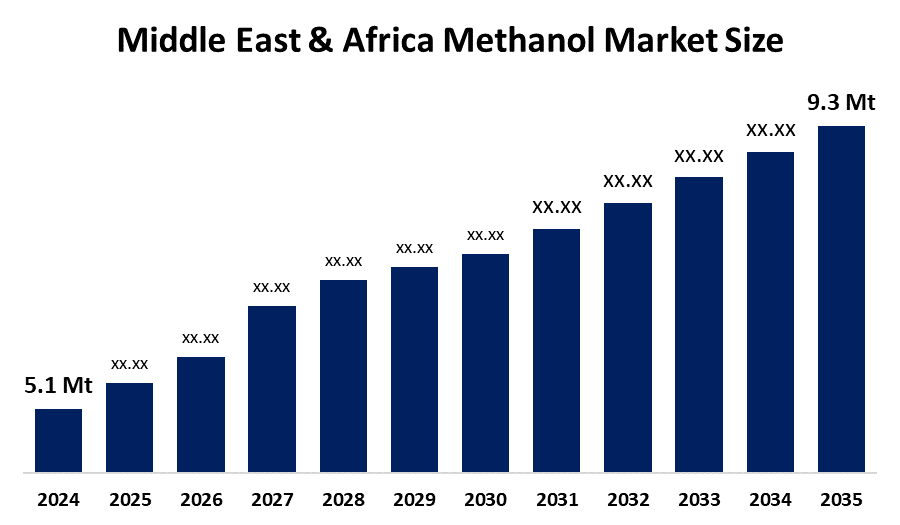
- The Middle East & Africa Methanol Market Size Was Estimated at 5.1 Million Tonnes in 2024
- The Market Size is Expected to Grow at a CAGR of Around 5.61% from 2025 to 2035
- The Middle East & Africa Methanol Market Size is Expected to Reach 9.3 Million Tonnes by 2035
Get more details on this report -
According to a research report published by Spherical Insights & Consulting, the Middle East & Africa Methanol Market size is anticipated to reach 9.3 million tonnes by 2035, growing at a CAGR of 5.61% from 2025 to 2035. The market is driven by the increasingly supports the market demand for Middle East methanol, as methanol is extensively used in industrial applications.
Market Overview
The MEA market which includes methanol production and distribution and consumption activities in the Middle East and Africa, operates from its main production facilities located in Saudi Arabia, Iran and Oman. The Middle East and Africa (MEA) methanol market serves as an essential component of the worldwide industry because the region possesses extensive natural gas resources and functions as an economical site for production and export activities. SABIC provides methanol together with its derived products through an extensive product range that meets the needs of various industrial and specialized application requirements.
Mitsubishi Gas Chemical Company Incorporated announced the beginning of construction work for a methanol production demonstration facility, which they call the Demonstration Facility at their Mizushima Plant site in March 2025. The facility will use various gases as raw materials, which include CO2 and industrial by-product gases.
The Ministry of New and Renewable Energy (MNRE) published official Green Methanol standards, which set a maximum lifecycle emissions limit of 0.44 kilograms of CO2 equivalent emissions per kilogram of product for National Green Hydrogen Mission certification. SABIC introduced certified low-carbon methanol, which is produced through carbon capture and utilization (CCU) technology.
Report Coverage
This research report categorises the Middle East & Africa methanol market based on various segments and regions, and forecasts revenue growth and analyses trends in each submarket. The report analyses the key growth drivers, opportunities, and challenges influencing the Middle East & Africa methanol market. Recent market developments and competitive strategies, such as expansion, product launch, development, partnership, merger, and acquisition have been included to draw the competitive landscape in the market. The report strategically identifies and profiles the key market players and analyses their core competencies in each sub-segment of the Middle East & Africa methanol market.
Middle East & Africa Methanol Market Report Coverage
| Report Coverage | Details |
|---|---|
| Base Year: | 2024 |
| Market Size in 2024: | 5.1 Million Tonnes |
| Forecast Period: | 2025-2035 |
| Forecast Period CAGR 2025-2035 : | 5.61% |
| 2035 Value Projection: | 9.3 Million Tonnes |
| Historical Data for: | 2020-2023 |
| No. of Pages: | 210 |
| Tables, Charts & Figures: | 89 |
| Segments covered: | By Feedstock, By Application |
| Companies covered:: | SABIC, Zagros Petrochemical Company, QAFAC, Methanol Chemicals Company, OQ SAOC, Sasol, and Industries Qatar. |
| Pitfalls & Challenges: | COVID-19 Impact Analysis and Forecast 2023 - 2033 |
Get more details on this report -
Driving Factors
The methanol market in the Middle East & Africa is driven by the petrochemical hub investments are increasing particularly for the Methanol-to-Olefins and Formaldehyde production facilities. The technology produces ethylene and propylene through a process that decreases reliance on crude oil-derived naphtha. The automotive and marine industries are showing increased interest in methanol because it serves as a cleaner alternative to conventional fossil fuels.
Restraining Factors
The methanol market in the Middle East & Africa is restrained by increased production output in Saudi Arabia, with decreased demand from Asian markets, which include China and Japan, resulting in an excess supply that has caused prices to decline during the recent three months. The storage and transportation of methanol requires specially built facilities, which need to be 2.5 times bigger than the facilities used for oil storage and transportation.
Market Segmentation
The Middle East & Africa methanol market share is categorised into feedstock and application.
- The natural gas segment accounted for the largest share in 2024 and is expected to grow at a significant CAGR during the forecast period.
The Middle East & Africa methanol market is segmented by feedstock into natural gas, coal, and others. Among these, the natural gas segment accounted for the largest share in 2024 and is expected to grow at a significant CAGR during the forecast period. The segment growth is driven by the region, which contains multiple natural gas reserves that provide inexpensive feedstock for methanol production, while advanced reforming technology operates at high efficiency. The process of natural gas reforming exists as a well-established method that achieves high production rates through its operation at lower temperature and pressure settings when compared to coal-based methods.
- The energy-related segment dominated the market in 2024 and is projected to grow at a substantial CAGR during the forecast period.
Based on application, the Middle East & Africa Methanol market is segmented into traditional chemical and energy-related. Among these, the energy-related segment dominated the market in 2024 and is projected to grow at a substantial CAGR during the forecast period. The segmental growth is driven by pilots with Dimethyl Ether in Indonesia and Vietnam, having promise as a diesel substitute, are also extending the trial in addition to the extension of the energy horizon.
Competitive Analysis:
The report offers the appropriate analysis of the key organizations/companies involved within the Middle East & Africa methanol market, along with a comparative evaluation primarily based on their product offering, business overviews, geographic presence, enterprise strategies, segment market share, and SWOT analysis. The report also provides an elaborate analysis focusing on the current news and developments of the companies, which includes product development, innovations, joint ventures, partnerships, mergers & acquisitions, strategic alliances, and others. This allows for the evaluation of the overall competition within the market.
List of Key Companies
- SABIC
- Zagros Petrochemical Company
- QAFAC
- Methanol Chemicals Company
- OQ SAOC
- Sasol
- Industries Qatar
- Others
Key Target Audience
- Market Players
- Investors
- End-users
- Government Authorities
- Consulting and Research Firm
- Venture capitalists
- Value-Added Resellers (VARs)
Market Segment
This study forecasts revenue at the Middle East & Africa, regional, and country levels from 2020 to 2035. Spherical Insights has segmented the Middle East & Africa methanol market based on the below-mentioned segments:
Middle East & Africa Methanol Market, By Feedstock
- Natural Gas
- Coal
- Others
Middle East & Africa Methanol Market, By Application
- Traditional Chemical
- Energy-Related
Frequently Asked Questions (FAQ)
-
What is the projected growth of the Middle East & Africa methanol Market?The Middle East & Africa methanol market size is expected to grow from 5.1 million tonnes in 2024 to 9.3 million tonnes by 2035, growing at a CAGR of 5.61% during the forecast period 2025-2035.
-
What factors are driving the growth of the MEA methanol market?Growth is driven by increasing investments in petrochemical hubs, especially for Methanol-to-Olefins (MTO) and formaldehyde production. Rising interest in methanol as a cleaner alternative fuel in the automotive and marine industries also supports demand.
-
Why is the Middle East an important region for methanol production?The region has abundant natural gas reserves, making methanol production more cost-effective. Countries such as Saudi Arabia, Iran, and Oman host major production facilities and export significant volumes globally.
-
Which feedstock segment holds the largest share in the MEA methanol market?The natural gas feedstock segment held the largest market share in 2024. This is due to the availability of low-cost natural gas and the efficiency of natural gas reforming technologies for methanol production.
-
Which application segment dominates the MEA methanol market?The energy-related application segment dominated the market in 2024. Methanol is increasingly used as an alternative fuel and in products like Dimethyl Ether (DME), which can substitute diesel.
-
What are the key restraints affecting the MEA methanol market?The market faces challenges such as oversupply due to increased production in Saudi Arabia and declining demand from Asian markets like China and Japan. Additionally, methanol storage and transportation require larger specialized infrastructure, increasing costs.
-
What recent technological developments are influencing the methanol market?Companies are investing in low-carbon and green methanol technologies. For example, new facilities are being developed to produce methanol using CO₂ and industrial by-product gases, and carbon capture technologies are also being adopted
-
Who are the major companies operating in the MEA methanol market?Key companies include SABIC, Zagros Petrochemical Company, QAFAC, Methanol Chemicals Company, OQ SAOC, Sasol, and Industries Qatar.
-
Who are the key target audiences for this market report?The report targets market players, investors, government authorities, consulting firms, and venture capitalists. It is also useful for end-users and value-added resellers (VARs) interested in methanol industry trends.
Need help to buy this report?