Middle East & Africa Biodegradable Polymers Market Size, Share, and COVID-19 Impact Analysis, By Type (Starch-Based Plastics, Polylactic Acid, Polyhydroxy Alkanoates, Polyesters and Cellulose Derivatives), By End User (Agriculture, Textile, Consumer Goods, Packaging, and Healthcare), and Middle East & Africa Biodegradable Polymers Market Insights, Industry Trends, Forecast to 2035.
Industry: Chemicals & Materials
Middle East & Africa Biodegradable Polymers Market Insights Forecasts to 2035
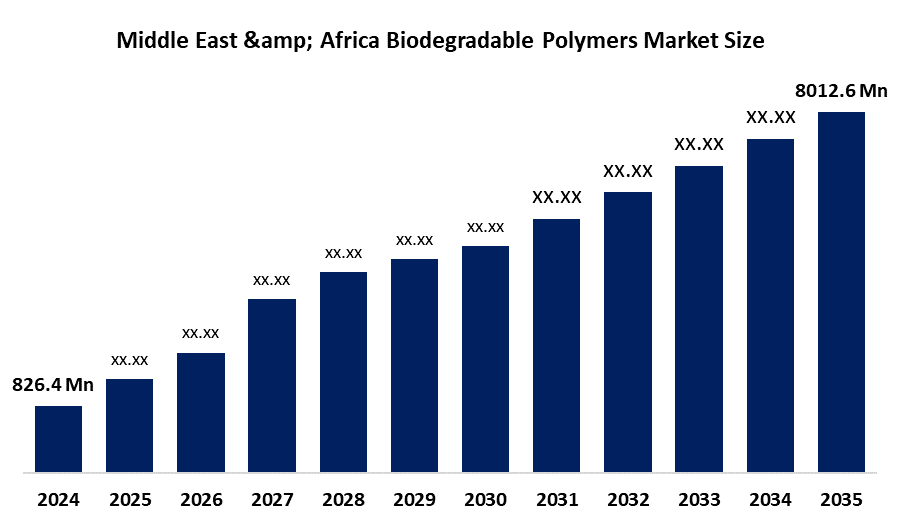
- The Middle East & Africa Biodegradable Polymers Market Size Was Estimated at USD 826.4 Million in 2024
- The Market Size is Expected to Grow at a CAGR of Around 22.94% from 2025 to 2035
- The Middle East & Africa Biodegradable Polymers Market Size is Expected to Reach USD 8012.6 Million by 2035
Get more details on this report -
According to a research report published by Spherical Insights & Consulting, the Middle East & Africa Biodegradable Polymers Market Size is anticipated to reach USD 8012.6 Million by 2035, Growing at a CAGR of 22.94% from 2025 to 2035. The market is driven by the growing awareness among consumers and rising initiatives towards a safer environment. Consumers are becoming aware of the harmful effects of conventional plastics on people and the environment.
Market Overview
The biodegradable polymers market in the Middle East and Africa develops, produces, and uses earth-friendly polymers that decompose through microbial processes. The polymers are experiencing major growth because of rising regulatory demands and increased consumer knowledge and sustainability programs that various industries are implementing. The performance and scalability of biodegradable polymers are being improved through advancements in polymer synthesis and blending techniques, microbial fermentation methods.
Emirates Biotech, which is a joint venture between SS Royal Kit, Emirates Investment from the UAE and Global Biopolymers Industries from Hong Kong, revealed its intention to build the world's biggest Polylactic Acid production plant in the United Arab Emirates in 2024.
The governments and industries in this area are slowly adopting environmentally friendly solutions to address plastic pollution while decreasing their use of materials that do not decompose. The region experiences growing partnerships between private enterprises and research organizations which enable knowledge exchange and speed up the development of biodegradable polymer products.
Report Coverage
This research report categorises the Middle East & Africa biodegradable polymers market based on various segments and regions, and forecasts revenue growth and analyses trends in each submarket. The report analyses the key growth drivers, opportunities, and challenges influencing the Middle East & Africa biodegradable polymers market. Recent market developments and competitive strategies, such as expansion, product launch, development, partnership, merger, and acquisition have been included to draw the competitive landscape in the market. The report strategically identifies and profiles the key market players and analyses their core competencies in each sub-segment of the Middle East & Africa biodegradable polymers market.
Middle East & Africa Biodegradable Polymers Market Report Coverage
| Report Coverage | Details |
|---|---|
| Base Year: | 2024 |
| Market Size in 2024: | USD 826.4 Million |
| Forecast Period: | 2024-2035 |
| Forecast Period CAGR 2024-2035 : | CAGR of 22.94% |
| 2035 Value Projection: | USD 8012.6 Million |
| Historical Data for: | 2020-2023 |
| No. of Pages: | 240 |
| Tables, Charts & Figures: | 105 |
| Segments covered: | By Type, By Application |
| Companies covered:: | BASF SE, Total Energies Corbion, Braskem SA, NatureWorks LLC, Novamont S.p.A., Danimer Scientific, Avani Eco Middle East, Al Bayader International, Cargill Incorporated, Eastman Chemical Company, Others, and |
| Pitfalls & Challenges: | COVID-19 Empact, Challenge, Future, Growth, & Analysis |
Get more details on this report -
Driving Factors
The biodegradable polymers market in Middle East & Africa is driven by the rising public understanding of biodegradable polymers' environmental advantages, which they represent as sustainable products. The growing market demand for eco-friendly products forces businesses to allocate funding towards research and development efforts, which will produce superior biodegradable polymers at lower costs. Consumers are increasingly choosing biodegradable alternatives to conventional plastics, boosting market adoption
Restraining Factors
The biodegradable polymers market in Middle East & Africa is restrained by the cost of biodegradable polymers exceeds the expense of traditional petroleum-based plastics because their raw material and processing costs remain higher. Some biodegradable polymers have lower mechanical strength and shorter shelf life compared to synthetic plastics, which restricts their use in various applications.
Market Segmentation
The Middle East & Africa biodegradable polymers market share is categorised into type and end user.
- The polylactic acid segment accounted for the largest share in 2024 and is expected to grow at a significant CAGR during the forecast period.
The Middle East & Africa biodegradable polymers market is segmented by type into starch-based plastics, polylactic acid, polyhydroxy alkanoates, polyesters and cellulose derivatives. Among these, the polylactic acid segment accounted for the largest share in 2024 and is expected to grow at a significant CAGR during the forecast period. The segmental growth is driven by the development of applications through their enhanced food containers and packaging solutions, and their disposable cutlery products have resulted in market expansion. The segment experiences growth because various industries and consumers increasingly prefer sustainable practices, which generate low carbon emissions. The packaging, textiles and biomedical industries use PLA because of its flexible applications and its ability to be biocompatible.
- The packaging segment dominated the market in 2024 and is projected to grow at a substantial CAGR during the forecast period.
Based on end user, the Middle East & Africa biodegradable polymers market is segmented into agriculture, textile, consumer goods, packaging, and healthcare. Among these, the packaging segment dominated the market in 2024 and is projected to grow at a substantial CAGR during the forecast period. The growth of the segment is driven by the growing demand for biodegradable solutions, which results from increasing environmental concerns driving market growth. The increasing public understanding of environmental issues, with business initiatives for carbon footprint reduction, has created a growing need for biodegradable bags, containers and films.
Competitive Analysis:
The report offers the appropriate analysis of the key organizations/companies involved within the Middle East & Africa biodegradable polymers market, along with a comparative evaluation primarily based on their product offering, business overviews, geographic presence, enterprise strategies, segment market share, and SWOT analysis. The report also provides an elaborate analysis focusing on the current news and developments of the companies, which includes product development, innovations, joint ventures, partnerships, mergers & acquisitions, strategic alliances, and others. This allows for the evaluation of the overall competition within the market.
List of Key Companies
- BASF SE
- Total Energies Corbion
- Braskem SA
- NatureWorks LLC
- Novamont S.p.A.
- Danimer Scientific
- Avani Eco Middle East
- Al Bayader International
- Cargill Incorporated
- Eastman Chemical Company
- Others
Key Target Audience
- Market Players
- Investors
- End-users
- Government Authorities
- Consulting and Research Firm
- Venture capitalists
- Value-Added Resellers (VARs)
Recent Development
In February 2024, Khalifa Economic Zones Abu Dhabi (KEZAD Group), the largest operator of integrated and purpose-built economic zones, announced that it had welcomed Gulf Biopolymers Industries Ltd. (GBI) to the KEZAD ecosystem.
Market Segment
This study forecasts revenue at the Middle East & Africa, regional, and country levels from 2020 to 2035. Spherical Insights has segmented the Middle East & Africa biodegradable polymers market based on the below-mentioned segments:
Middle East & Africa Biodegradable Polymers Market, By Type
- Starch-Based Plastics
- Polylactic Acid
- Polyhydroxy Alkanoates
- Polyesters
- Cellulose Derivatives
Middle East & Africa Biodegradable Polymers Market, By End User
- Agriculture
- Textile
- Consumer Goods
- Packaging
- Healthcare
Frequently Asked Questions (FAQ)
-
Q: What is the Middle East & Africa biodegradable polymers market size?A: The Middle East & Africa biodegradable polymers market size is expected to grow from USD 826.4 million in 2024 to USD 8012.6 Million by 2035, growing at a CAGR of 22.94% during the forecast period 2025-2035
-
Q: What are biodegradable polymers, and their primary use?A: The biodegradable polymers market in the Middle East and Africa develops, produces, and uses earth-friendly polymers that decompose through microbial processes. The polymers are experiencing major growth because of rising regulatory demands and increased consumer knowledge and sustainability programs that various industries are implementing.
-
Q: What are the key growth drivers of the market?A: Market growth is driven by the rising public understanding of biodegradable polymers' environmental advantages, which they represent as sustainable products.
-
Q: What factors restrain the Middle East & Africa biodegradable polymers market?A: The market is restrained by the cost of biodegradable polymers exceeding the expense of traditional petroleum-based plastics because their raw material and processing costs remain higher.
-
Q: How is the market segmented by type?A: The market is segmented into starch-based plastics, polylactic acid, polyhydroxy alkanoates, polyesters and cellulose derivatives.
-
Q: Who are the key players in the Middle East & Africa biodegradable polymers market?A: Key companies include BASF SE, Total Energies Corbion, Braskem SA, NatureWorks LLC, Novamont S.p.A., Danimer Scientific, Avani Eco Middle East, Al Bayader International, Cargill Incorporated, and Eastman Chemical Company.
Need help to buy this report?