Global Malic Acid Market Size, Share, By Type (L-Malic Acid and DL-Malic Acid), By Grade (Food Grade and Pharmaceutical Grade), By Application (Food and Beverages, Personal Care and Cosmetics, Pharmaceuticals, and Animal Feed), and By Region (North America, Europe, Asia-Pacific, Latin America, Middle East, and Africa), Analysis and Forecast 2025 - 2035
Industry: Chemicals & Materials
Global Malic Acid Market Insights Forecasts to 2035
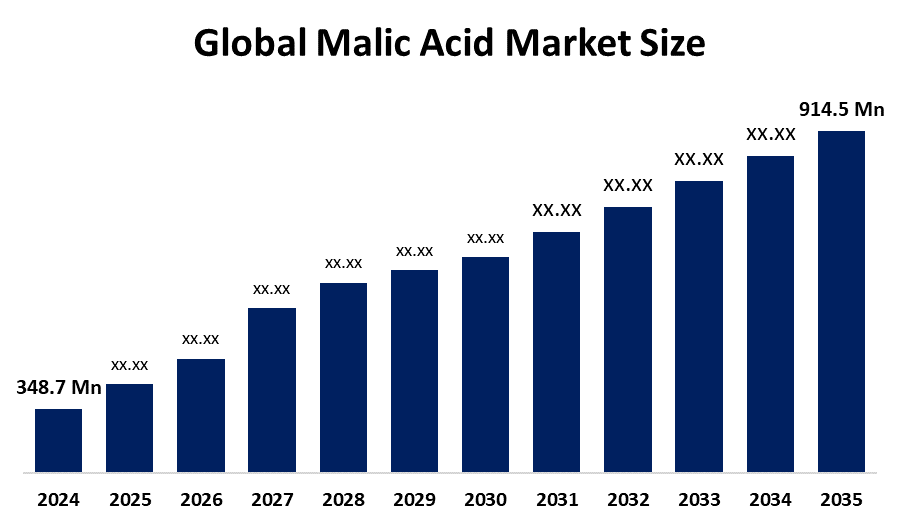
- The Global Malic Acid Market Size Was Estimated at USD 348.7 Million in 2024
- The Market Size is Expected to Grow at a CAGR of around 9.16 % from 2025 to 2035
- The Worldwide Malic Acid Market Size is Expected to Reach USD 914.5 Million by 2035
- Asia Pacific is expected to grow the fastest during the forecast period.
Get more details on this report -
According to a Research Report Published by Spherical Insights, The Global Malic Acid market Size was Worth Around USD 348.7 Million in 2024 and is Predicted to Grow to Around USD 914.5 Million by 2035 with a Compound Annual Growth rate (CAGR) of 9.16% from 2025 to 2035. The global malic acid market is driven by increasing demand for bio-based food additives, rising consumption of functional beverages, expanding use in pharmaceuticals and cosmetics, and growing emphasis on sustainable and environmentally friendly production.
Market Overview
The Global Malic Acid Market Size is driven by the production and consumption of malic acid, a naturally occurring organic acid widely used as a flavor enhancer and acidity regulator across food and beverages, pharmaceuticals, and cosmetic products.Market growth is primarily fueled by increasing consumer demand for natural additives, rising consumption of processed food and beverages, and expanding pharmaceutical applications. Additionally, the growing preference for clean-label products and transparent ingredient lists is encouraging manufacturers to adopt malic acid as a safer and more health-conscious alternative.Supportive government regulations and food safety standards are further strengthening market expansion. Regulatory frameworks, particularly those established by the Gulf Cooperation Council (GCC), play a key role in controlling ingredient purity and defining permissible usage levels, ensuring product quality and consumer safety.
Technological advancements in production processes—including improved fermentation techniques, enzyme innovation, and biocatalysis—are enhancing efficiency, reducing costs, and enabling more sustainable and eco-friendly manufacturing practices.Current market trends strongly emphasize clean-label solutions and natural flavor alternatives, aligning with evolving consumer preferences for healthier and minimally processed products.In December 2025, Bartek Ingredients, headquartered in Ontario, Canada, continued to strengthen its global presence by supplying maleic anhydride and food-grade malic and fumaric acids to over 40 countries. The company operates the only vertically integrated production facility for these acidulants in North America and generates approximately USD 65 million in annual revenue. It is also developing a new production facility, expected to be completed in 2026, which will significantly expand its production capacity and reinforce its position in the global food ingredients market.
The rising usage of malic acid in functional foods and beverages, cosmetics, and nutritional supplements creates business opportunities that will help companies grow and enter new markets across different international markets.
Report Coverage
This research report categorizes the Global Malic Acid Market Size based on various segments and regions, forecasts revenue growth, and analyzes trends in each submarket. The report analyses the key growth drivers, opportunities, and challenges influencing the global malic acid market. Recent market developments and competitive strategies, such as expansion, product launch, development, partnership, merger, and acquisition, have been included to draw the competitive landscape in the market. The report strategically identifies and profiles the key market players and analyzes their core competencies in each sub-segment of the malic acid market.
Global Malic Acid Market Report Coverage
| Report Coverage | Details |
|---|---|
| Base Year: | 2024 |
| Market Size in 2024: | USD 348.7 Million |
| Forecast Period: | 2024-2035 |
| Forecast Period CAGR 2024-2035 : | 9.16% |
| 2035 Value Projection: | USD 914.5 Million |
| Historical Data for: | 2020-2023 |
| No. of Pages: | 245 |
| Tables, Charts & Figures: | 100 |
| Segments covered: | By Type, By Application |
| Companies covered:: | Bartek Ingredients Inc, Fuso Chemical Co Ltd, ISEGEN South Africa Pty Ltd, Polynt S p A, Thirumalai Chemicals Ltd, Anhui Sealong Biotechnology Co Ltd, Changmao Biochemical Engineering Co Ltd, Yongsan Chemicals, Tate & Lyle PLC, Lonza Group Ltd, Prinova Group LLC, Nacalai Tesque Inc, Merck KGaA, Akzo Nobel N V, Jungbunzlauer Suisse AG, and Others Key Players |
| Pitfalls & Challenges: | COVID-19 Empact, Challenge, Future, Growth, & Analysi |
Get more details on this report -
Driving Factors
The Global Malic Acid Market Size shows its main growth because of higher demand from the food and beverage industry, which uses malic acid as a flavor enhancer, acidulant, and pH regulator. Market growth receives major support from the rising consumption of processed foods, confectionery, and carbonated beverages. The growing consumer demand for natural and clean-label ingredients leads manufacturers to incorporate malic acid into their product designs. The demand for the product has increased because of its new uses in the pharmaceutical, cosmetic, and personal care product industries. The market expansion receives additional support from three factors, which include urban growth, changing food preferences, and the expansion of the worldwide food processing sector.
Restraining Factors
The Global Malic Acid Market Size faces restraints because raw material price changes and high production expenses create obstacles for the industry. The market will experience growth limitations because multiple countries enforce strict food safety standards and additive regulations. The market experiences a decrease in demand because consumers prefer alternative acidulants such as citric acid and tartaric acid over other products.
Market Segmentation
The Global Malic Acid Market share is classified into filter type, grade, and application.
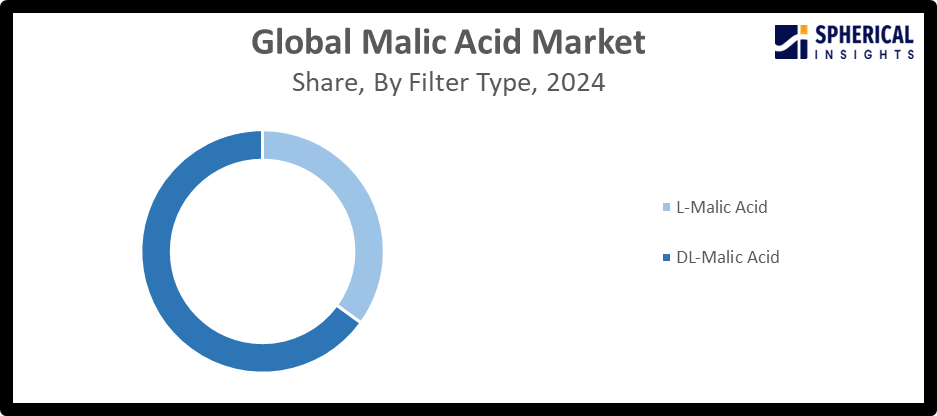
- The DL-malic acid segment accounted for the largest share in 2024, approximately 65%, and is anticipated to grow at a significant CAGR during the forecast period.
Based on the filter type, the Global Malic Acid Market Size is divided into L-malic acid and DL-malic acid. Among these, the DL-malic acid segment accounted for the largest share in 2024, approximately 65%, and is anticipated to grow at a significant CAGR during the forecast period. This is because DL-malic acid is widely used in food and beverage applications due to its strong sour taste, cost-effective production, and broad use as an acidulant and flavor enhancer in confectionery, beverages, and processed foods.
Get more details on this report -
- The food-grade segment accounted for the highest market revenue in 2024, approximately 70%, and is anticipated to grow at a significant CAGR during the forecast period.
Based on the grade, the Global Malic Acid Market Size is divided into food grade and pharmaceutical grade. Among these, the food-grade segment accounted for the highest market revenue in 2024, approximately 70%, and is anticipated to grow at a significant CAGR during the forecast period. This is because food-grade malic acid is extensively used in beverages, confectionery, bakery, and processed foods as an acidulant and flavor enhancer. Rising consumption of packaged foods and flavored drinks globally continues to increase their demand.
- The food and beverages segment dominated the market in 2024, approximately 68%, and is projected to grow at a substantial CAGR during the forecast period.
Based on the application, the Global Malic Acid Market Size is divided into food and beverages, personal care and cosmetics, pharmaceuticals, and animal feed. Among these, the food and beverages segment dominated the market in 2024, approximately 68%, and is projected to grow at a substantial CAGR during the forecast period. The market dominance is driven by the increasing use of malic acid as an acidulant and flavor enhancer in beverages, confectionery, and processed foods. Growing global demand for packaged food, flavored drinks, and convenience products continues to support strong consumption across the food and beverage industry.
Analysis of the Global Malic Acid Market
- North America (U.S., Canada, Mexico)
- Europe (Germany, France, U.K., Italy, Spain, Rest of Europe)
- Asia-Pacific (China, Japan, India, Rest of APAC)
- South America (Brazil and the Rest of South America)
- The Middle East and Africa (UAE, South Africa, Rest of MEA)
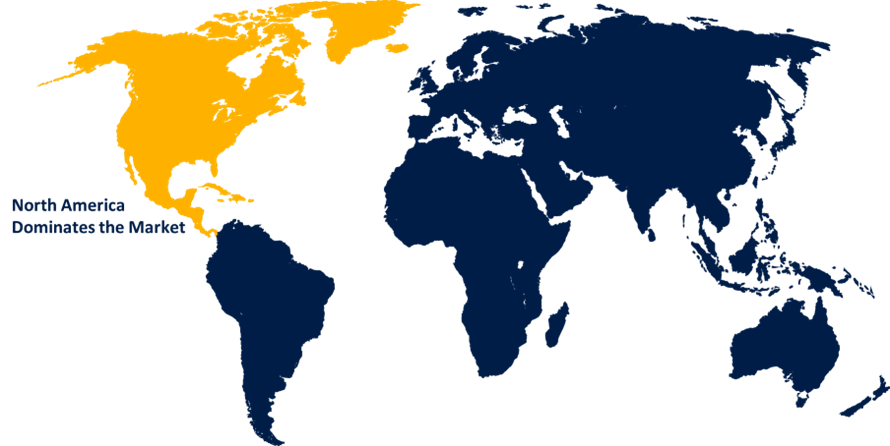
North America is anticipated to hold the largest share of the global malic acid market over the predicted timeframe.
North America is anticipated to hold the largest share of the global malic acid market over the predicted timeframe, approximately 40% market share. This is due to high demand from food and beverage industries, extensive use as a flavor enhancer and acidulant, strong manufacturing infrastructure, well-established supply chains, and growing consumption of processed foods and beverages across the region, making North America the leading market globally.
Get more details on this report -
The Asia Pacific region is expected to grow at the fastest rate during the forecast period, approximately 35% market share, due to rapid urbanization, increasing processed food and beverage consumption, expanding pharmaceutical and personal care industries, rising adoption of natural and clean-label additives, strong population growth, improving economic conditions, and growing health awareness, positioning Asia Pacific as a key emerging market for malic acid worldwide.
Competitive Analysis:
The report offers the appropriate analysis of the key organizations/companies involved within the Global Malic Acid Market Size, along with a comparative evaluation primarily based on their product offering, business overviews, geographic presence, enterprise strategies, segment market share, and SWOT analysis. The report also provides an elaborative analysis focusing on the current news and developments of the companies, which includes product development, innovations, joint ventures, partnerships, mergers & acquisitions, strategic alliances, and others. This allows for the evaluation of the overall competition within the market.
List of Key Companies
- Bartek Ingredients Inc
- Fuso Chemical Co Ltd
- ISEGEN South Africa Pty Ltd
- Polynt S p A
- Thirumalai Chemicals Ltd
- Anhui Sealong Biotechnology Co Ltd
- Changmao Biochemical Engineering Co Ltd
- Yongsan Chemicals
- Tate & Lyle PLC
- Lonza Group Ltd
- Prinova Group LLC
- Nacalai Tesque Inc
- Merck KGaA
- Akzo Nobel N V
- Jungbunzlauer Suisse AG
- Others
Key Target Audience
- Market Players
- Investors
- End-users
- Government Authorities
- Consulting and Research Firm
- Venture capitalists
- Value-Added Resellers (VARs)
Recent Development
- In December 2025, Thirumalai Chemicals Ltd. (TCL) subsidiary, TCL Specialities LLC, an operating company in the US, is moving to pre-commissioning & startup activities of its new manufacturing facility and is progressing to startup operations. The facility would be involved in the manufacturing and sales of derivatives, including Malic Acid, in the United States and other growing markets.
- In December 2025, ICL entered an agreement to acquire Bartek Ingredients, a global supplier of food-grade malic and fumaric acid to industries like food, beverage, confectionery and baked foods.
- In September 2023, Dialog Group Bhd revealed plans to invest around USD 88.1 million to build a specialty chemical plant in Pahang, Malaysia, where malic acid will be a key product with an annual production capacity of 12,000 metric tons.
- In July 2023, pH Plex launched malic acid-based shampoo and conditioner designed to protect and repair hair. The sulfate- and paraben-free formula is suitable for all hair types.
- In July 2023, Corbion expanded its acid powder production capacity at its Montmeló, Spain, facility by adding a new production line, expected to be operational in the second half of 2025, to meet rising demand from sour gummy and confectionery applications.
Market Segment
This study forecasts revenue at global, regional, and country levels from 2020 to 2035. Spherical Insights has segmented the Global Malic Acid Market Size based on the below-mentioned segments:
Global Malic Acid Market, By Type
- L-Malic Acid
- DL-Malic Acid
Global Malic Acid Market, By Grade
- Food Grade
- Pharmaceutical Grade
Global Malic Acid Market, By Application
- Food and Beverages
- Personal Care and Cosmetics
- Pharmaceuticals
- Animal Feed
Global Malic Acid Market, By Regional Analysis
- North America
- US
- Canada
- Mexico
- Europe
- Germany
- UK
- France
- Italy
- Spain
- Russia
- Rest of Europe
- Asia Pacific
- China
- Japan
- India
- South Korea
- Australia
- Rest of Asia Pacific
- South America
- Brazil
- Argentina
- Rest of South America
- Middle East & Africa
- UAE
- Saudi Arabia
- Qatar
- South Africa
- Rest of the Middle East & Africa
Frequently Asked Questions (FAQ)
-
1. What is malic acid, and where is it used?A: Malic acid is a naturally occurring organic acid most commonly used as an acidulant and flavor enhancer in foods and beverages. It is also used in pharmaceuticals, personal care products, and as an intermediate in chemical manufacturing.
-
2. What are the main types of malic acid available commercially?A: The two primary commercial types are L malic acid, the naturally occurring form, and DL malic acid, a synthetic form. Both are used in food and beverage applications, but DL malic acid is often preferred for cost effective sour flavoring.
-
3. Which applications drive the demand for malic acid?A: The food and beverage sector is the largest driver, especially in products like confectionery, carbonated drinks, and snacks. Other important applications include personal care and cosmetics, pharmaceutical formulations, and animal feed.
-
4. What factors are influencing market growth?A: Growth is driven by rising consumer demand for natural ingredients, increasing consumption of processed and functional foods, wider use in pharmaceutical and cosmetic products, and technological advancements in production methods.
-
5. Are there any regulatory or safety considerations for malic acid use?A: Yes. Food safety authorities in major markets (like the U.S. FDA and the EU’s EFSA) regulate additive usage and purity standards. Manufacturers must comply with guidelines for allowable concentrations in different food and beverage categories.
-
6. What are the main challenges facing the malic acid industry?A: Challenges include raw material price volatility, production cost pressures, and competition from alternative acidulants such as citric acid or tartaric acid. Regulatory restrictions in some regions can also affect market access.
-
7. How are manufacturers responding to sustainability trends?A: Producers are increasingly exploring bio based production methods, fermentation technologies, and energy efficient manufacturing processes. There is growing interest in developing cleaner, more eco friendly products that meet consumer demand for sustainable ingredients.
Need help to buy this report?