Global Liquid Applied Membrane Market Size, Share, and COVID-19 Impact Analysis, By Type (Cementitious, Bituminous, Acrylic, and Others), By Application (Roofing, Walls, Underground and Tunnels, and Other Applications), By End-User Sector (Residential, Commercial, Industrial, and Institutional & Infrastructure), and By Region (North America, Europe, Asia-Pacific, Latin America, Middle East, and Africa), Analysis and Forecast 2025 - 2035
Industry: Chemicals & Materials
Global Liquid Applied Membrane Market Size Insights Forecasts to 2035
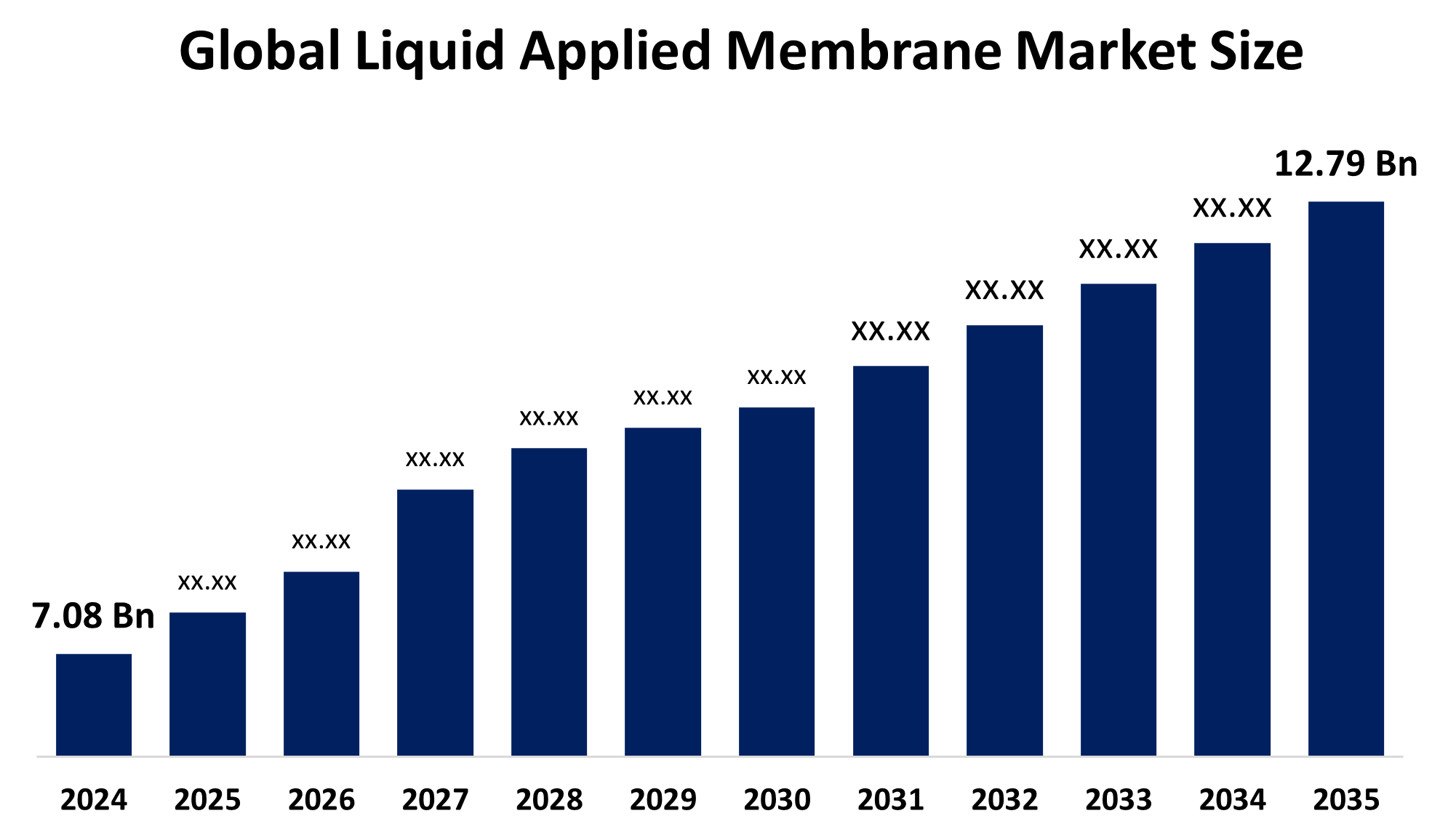
- The Global Liquid Applied Membrane Market Size Was Estimated at USD 7.08 Billion in 2024
- The Market Size is Expected to Grow at a CAGR of around 5.52% from 2025 to 2035
- The Worldwide Liquid Applied Membrane Market Size is Expected to Reach USD 12.79 Billion by 2035
- North America is expected to grow the fastest during the forecast period.
Get more details on this report -
According to a research report published by Spherical Insights and Consulting, the Global Liquid Applied Membrane Market Size was worth around USD 7.08 Billion in 2024 and is Predicted to Grow to around USD 12.79 Billion by 2035 with a Compound Annual Growth Rate (CAGR) of 5.52% from 2025 to 2035. The liquid applied membrane market is growing due to increasing construction activities, stringent waterproofing regulations, rising demand for sustainable, eco-friendly materials, urbanization, infrastructure development, and technological innovations enhancing durability, seamless application, and energy efficiency across residential and commercial projects.
Market Overview
The worldwide market for liquid-applied membrane refers to liquid polymeric and cementitious coatings, which include polyurethane and acrylic and bituminous and elastomeric types, which construction workers apply as liquids and which turn into solid waterproofing barriers that maintain flexibility and protect against cracks while sticking to various surfaces. These membranes are widely used for roofing, basements, foundations, exterior walls, balconies, terraces, tunnels, bridges, and water-retaining structures across residential, commercial, and infrastructure sectors. The market experiences growth because worldwide construction activities and infrastructure development projects are increasing, which includes the infrastructure investments of India and China that exceed $1.2 trillion. The adoption of eco-friendly low-VOC membranes has increased because of strict building codes and green building certifications (LEED/BREEAM), as green project usage throughout North America and Europe has grown by 32% during 2023.
The market presents new opportunities because companies develop new technologies, which include self-healing polymers and smart membranes that include IoT sensors for structural health monitoring, that will generate a $3.8 billion business opportunity by the year 2030. The adoption of cold climate applications and energy-efficient retrofits for established markets creates new growth opportunities. The DOE Office of Clean Energy Demonstrations awarded Nippon Dynawave Packaging a $46.6 million grant in January 2025 to create advanced membrane technology which will concentrate black liquor without using energy-consuming thermal methods. The initiative promotes energy-efficient industrial applications and underscores U.S. government support for innovative membrane-based solutions.
Report Coverage
This research report categorizes the Global Liquid Applied Membrane Market based on various segments and regions, forecasts revenue growth, and analyzes trends in each submarket. The report analyses the key growth drivers, opportunities, and challenges influencing the liquid applied membrane market. Recent market developments and competitive strategies, such as expansion, type launch, development, partnership, merger, and acquisition, have been included to draw the competitive landscape in the market. The report strategically identifies and profiles the key market players and analyses their core competencies in each sub-segment of the liquid applied membrane market.
Global Liquid Applied Membrane Market Report Coverage
| Report Coverage | Details |
|---|---|
| Base Year: | 2024 |
| Market Size in 2024: | USD 7.08 Billion |
| Forecast Period: | 2025-2035 |
| Forecast Period CAGR 2025-2035 : | 5.52% |
| 2035 Value Projection: | USD 12.79 Billion |
| Historical Data for: | 2020-2023 |
| No. of Pages: | 195 |
| Tables, Charts & Figures: | 102 |
| Segments covered: | By Type, By Application |
| Companies covered:: | Sika AG, GCP Applied Technologies, RPM International Inc., Carlisle Companies, Mapei S.p.A., BASF, Soprema Group, Saint-Gobain Weber, Fosroc, Inc, Dow, Inc., H.B. Fuller, GAF Materials LLC, Pidilite Industries, Kemeper Systems America and Other Key Players |
| Pitfalls & Challenges: | and COVID-19 Impact Analysis |
Get more details on this report -
Driving Factors
The Global Liquid Applied Membrane Market is experiencing robust growth because of increasing urbanization and infrastructural development, which is happening in emerging economies. The demand for waterproofing solutions that provide seamless, durable and highly flexible protection is growing because building owners need to stop water from entering their buildings to extend the life of their structures. The adoption of water-based systems and low-VOC systems has increased because VOC regulations have become stricter, and people are now using sustainable, eco-friendly building materials. The growth of renovation projects, together with the demand for UV-resistant materials that perform well in tropical environments, drives market expansion.
Restraining Factors
The Global Liquid Applied Membrane Market encounters obstacles because of expensive material and installation expenses, and insufficient knowledge in developing areas and technical difficulties, which include surface preparation and curing time requirements. The traditional waterproofing methods compete with the current market because they depend on environmental conditions, and different countries have various rules, which slow down market expansion.
Market Segmentation
The liquid applied membrane market share is classified into type, application, and end-user sector.
- The bituminous segment dominated the market in 2024, approximately 36% and is projected to grow at a substantial CAGR during the forecast period.
Based on the type, the Global Liquid Applied Membrane Market is divided into cementitious, bituminous, acrylic, and others. Among these, the bituminous segment dominated the market in 2024 and is projected to grow at a substantial CAGR during the forecast period. The segment demonstrated market dominance because of its affordable price, proven product durability, and ability to function as both a roofing material and a below-grade waterproofing solution. The product demonstrates excellent adhesion and weather resistance, which makes it suitable for use in various infrastructure applications. The established supply chain system, together with a simple application process, makes it the ideal solution for international commercial and industrial construction projects.
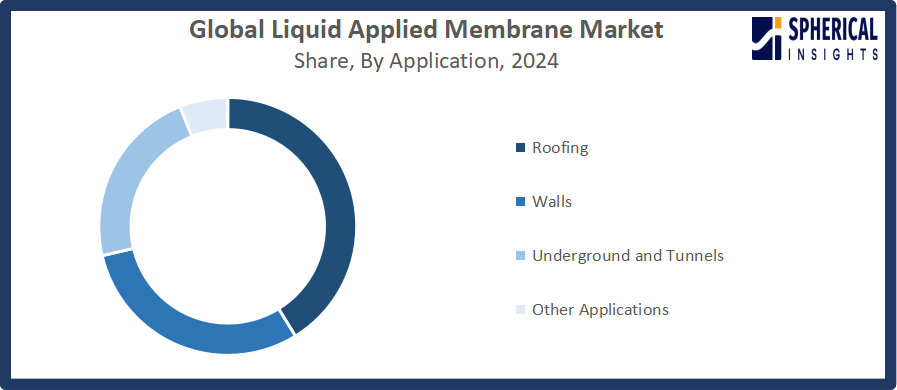
- The roofing segment accounted for the largest share in 2024, approximately 41% and is anticipated to grow at a significant CAGR during the forecast period.
Based on the application, the Global Liquid Applied Membrane Market is divided into roofing, walls, underground and tunnels, and other applications. Among these, the roofing segment accounted for the largest share in 2024 and is anticipated to grow at a significant CAGR during the forecast period. The roofing segment growth is due to surging global construction and infrastructure spending. Liquid-applied membranes are the preferred choice for concrete roofing systems because they create seamless, durable barriers that prevent leaks while enabling buildings to withstand structural movement throughout their operational lifespan. Their ability to be easily applied to complicated roofing shapes makes them more popular among users.
Get more details on this report -
- The residential segment accounted for the highest market revenue in 2024, approximately 31% and is anticipated to grow at a significant CAGR during the forecast period.
Based on the end-user sector, the Global Liquid Applied Membrane Market is divided into residential, commercial, industrial, and institutional & infrastructure. Among these, the residential segment accounted for the highest market revenue in 2024 and is anticipated to grow at a significant CAGR during the forecast period. The residential segment market growth is due to rapid urbanization, rising housing construction, and increasing home renovation activities. Homeowners increasingly prefer liquid-applied membranes for balconies, terraces, and basements because they offer seamless waterproofing, easy application, and long-term protection against moisture damage and leaks.
Regional Segment Analysis of the Liquid Applied Membrane Market
- North America (U.S., Canada, Mexico)
- Europe (Germany, France, U.K., Italy, Spain, Rest of Europe)
- Asia-Pacific (China, Japan, India, Rest of APAC)
- South America (Brazil and the Rest of South America)
- The Middle East and Africa (UAE, South Africa, Rest of MEA)
Asia Pacific is anticipated to hold the largest share of the liquid applied membrane market over the predicted timeframe.

Get more details on this report -
Asia Pacific is anticipated to hold the largest share of the Global Liquid Applied Membrane Market over the predicted timeframe. The Asia Pacific region dominates the global liquid applied membrane market because it supplies 43% of worldwide market needs, which results from fast-growing urban areas, infrastructure development and extensive construction projects. China leads the region with more than 35% market share, while India and Japan, together with Southeast Asian countries, drive demand for roofing, foundation and infrastructure projects. Government development programs, together with public funding for residential and commercial construction projects, create increased market demand. The Asia Pacific region leads market growth because construction projects require sustainable waterproofing solutions that deliver high performance.
North America is expected to grow at a rapid CAGR in the liquid applied membrane market during the forecast period. The Liquid Applied Membrane Market of North America is expected to experience a 28% share of fast expansion because commercial construction activities, infrastructure upgrades, and green building projects increase throughout the United States and Canada. The United States construction industry reached a spending total of $1.98 trillion during 2023, which created a need for waterproofing systems that provide long-lasting and continuous protection. California regulations on low-VOC emissions and federal environmental protection standards promote the use of sustainable membrane materials. The market experiences growth because companies need to upgrade their outdated systems while implementing energy-saving solutions that provide extended operational life. In March 2025, the Canadian government showed support for small and medium-sized enterprises by funding Thetis Environmental Inc. with $150,000 through NRC-IRAP to develop advanced 3D UF membrane technology for improved wastewater treatment solutions.
The Liquid Applied Membrane Market in Europe shows continuous expansion because building codes and environmental regulations, as well as sustainable construction practices, mandate compliance in Germany, the UK, and France. Germany leads the world with a 23% share of the global market for high-performance systems. The combination of EU energy efficiency standards and low-VOC requirements enables increased adoption of advanced liquid applied membranes, which enhance durability and compliance and long-term operational efficiency.
Competitive Analysis:
The report offers the appropriate analysis of the key organizations/companies involved within the Global Liquid Applied Membrane Market, along with a comparative evaluation primarily based on their type of offering, business overviews, geographic presence, enterprise strategies, segment market share, and SWOT analysis. The report also provides an elaborative analysis focusing on the current news and developments of the companies, which includes type development, innovations, joint ventures, partnerships, mergers & acquisitions, strategic alliances, and others. This allows for the evaluation of the overall competition within the market.
List of Key Companies
- Sika AG
- GCP Applied Technologies
- RPM International Inc.
- Carlisle Companies
- Mapei S.p.A.
- BASF
- Soprema Group
- Saint-Gobain Weber
- Fosroc, Inc
- Dow, Inc.
- H.B. Fuller
- GAF Materials LLC
- Pidilite Industries
- Kemeper Systems America
- Others
Key Target Audience
- Market Players
- Investors
- End-users
- Government Authorities
- Consulting and Research Firm
- Venture capitalists
- Value-Added Resellers (VARs)
Recent Development
- In January 2026, RPM International Inc. announced that Tremco Construction Products Group will acquire Kalzip GmbH, a global leader in metal roofs and facades. The acquisition strengthens Tremco CPG’s building envelope capabilities, enhancing architectural innovation and high-performance solutions for demanding construction specifications worldwide.
- In October 2025, Ghana’s Environmental Protection Agency (EPA) proposed a $200,000 pilot for copper-based “nano liquid” technology to purify rivers. Laboratory tests are complete with international validation from Greece, highlighting government interest in advanced membrane-based purification systems and innovative liquid treatment solutions for environmental cleanup.
- In September 2025, the El Dorado Irrigation District, California, issued RFP P25-011 for liquid emulsion polymer to condition and dewater municipal wastewater sludge using belt filter presses. The one-year contract, with optional extensions up to five years, highlights municipal demand for liquid-based treatment solutions, supporting applications in the liquid applied membrane market.
- In October 2024, the NIH/National Institute of Environmental Health Sciences awarded a grant R43ES036050 (completed May 2025) to develop Microwave Induced Membrane Distillation with Carbon Nanotube Membranes for hazardous waste solvent recovery. The project advances environmental remediation and circular economy applications, boosting opportunities for liquid membrane innovations in waste treatment.
- In June 2023, Fosroc launched Polyurea WH 100, a hand-applied, seamless waterproofing solution ideal for flat roofs. Offering long-lasting protection, quick return-to-service times, and easy installation without spray equipment, the product enhances Fosroc’s Polyurea portfolio, addressing diverse market-sector waterproofing needs and helping reduce construction time and labor.
Market Segment
This study forecasts revenue at global, regional, and country levels from 2020 to 2035. Spherical Insights has segmented the Global Liquid Applied Membrane Market based on the below-mentioned segments:
Global Liquid Applied Membrane Market, By Type
- Cementitious
- Bituminous
- Acrylic
- Others
Global Liquid Applied Membrane Market, By Application
- Roofing
- Walls
- Underground and Tunnels
- Other Applications
Global Liquid Applied Membrane Market, By End-User Sector
- Residential
- Commercial
- Industrial
- Institutional & Infrastructure
Global Liquid Applied Membrane Market, By Regional Analysis
- North America
- US
- Canada
- Mexico
- Europe
- Germany
- UK
- France
- Italy
- Spain
- Russia
- Rest of Europe
- Asia Pacific
- China
- Japan
- India
- South Korea
- Australia
- Rest of Asia Pacific
- South America
- Brazil
- Argentina
- Rest of South America
- Middle East & Africa
- UAE
- Saudi Arabia
- Qatar
- South Africa
- Rest of the Middle East & Africa
Frequently Asked Questions (FAQ)
-
1.How are innovations in polymer and polyurethane technologies impacting the performance and adoption of liquid applied membranes?Innovations in polymer and polyurethane technologies are enhancing liquid applied membranes’ elasticity, UV resistance and durability, boosting adoption; polyurethane systems held 36 % market share in 2024.
-
2.What impact are green building certifications like LEED and BREEAM having on membrane adoption?Green building certifications like LEED and BREEAM significantly boost membrane adoption by prioritizing low‑VOC, eco‑friendly waterproofing; over 500 million m² of membranes were used in certified green projects in 2023, increasing adoption and sustainable specifications.
-
3.How are smart coatings and multifunctional membranes transforming the liquid applied membrane industry?Smart coatings and multifunctional membranes are transforming the liquid applied membrane industry by introducing self‑healing, sensing, and adaptive functionalities, accelerating innovation; smart waterproofing solutions now represent around 18% of new liquid membrane trends.
-
4.What role do sustainability and low-VOC regulation play in shaping product innovations in the LAM market?Sustainability and low‑VOC regulations drive LAM innovation, with low‑VOC products comprising 28% of new launches in 2024 and green building codes prioritizing eco‑friendly, water‑based membranes, accelerating market shift from solvent‑based systems.
-
5.How do government initiatives and public infrastructure projects affect the adoption of liquid applied membranes?Government initiatives and public infrastructure projects significantly boost liquid applied membrane (LAM) adoption by driving construction demand and specifying durable waterproofing solutions; for example, infrastructure projects account for 20-30% of membrane demand and affordable housing/urban development schemes accelerate LAM use globally.
-
6.What are the emerging technological innovations in application methods and curing processes for LAM products?Emerging innovations in application methods and curing processes for liquid applied membranes include rapid‑curing systems that reduce cure time by 75%, increased use of spray and automated applicators, self‑healing microcapsule membranes in 42% of new products, and smart sensor integration for real‑time performance monitoring, enhancing efficiency and durability.
Need help to buy this report?