Global Limbal Stem Cells Deficiency Market Size, Share, and COVID-19 Impact Analysis, By Treatment Types (Autologous Stem Cell Transplantation, Allogeneic Stem Cell Transplantation, and Cultured Limbal Epithelial Cells), By End User (Hospitals, Ophthalmology Clinics, Research Institutions, and Others), and By Region (North America, Europe, Asia-Pacific, Latin America, Middle East, and Africa), Analysis and Forecast 2025 - 2035
Industry: Healthcare
Global Limbal Stem Cells Deficiency Market Size Insights Forecasts to 2035
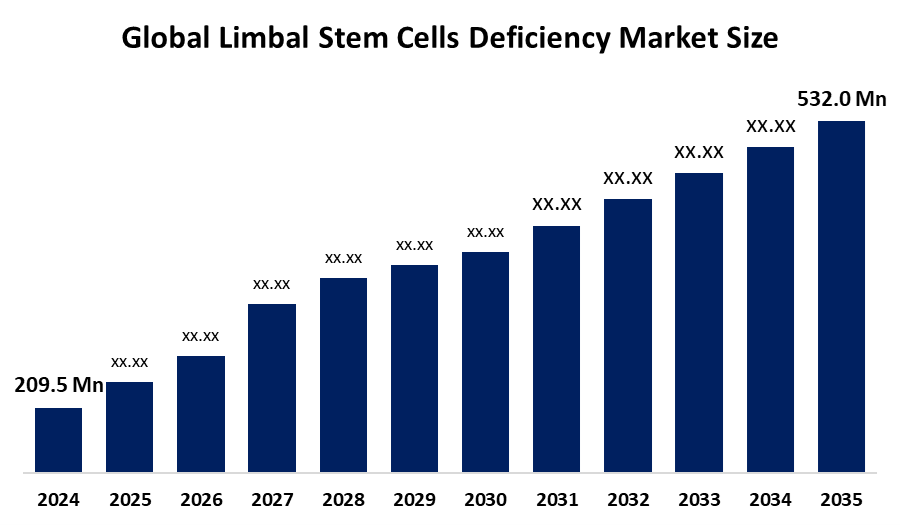
- The Global Limbal Stem Cells Deficiency Market Size Was Estimated at USD 209.5 Million in 2024
- The Market Size is Expected to Grow at a CAGR of around 8.84% from 2025 to 2035
- The Worldwide Limbal Stem Cells Deficiency Market Size is Expected to Reach USD 532.0 Million by 2035
- Asia Pacific is expected to grow the fastest during the forecast period.
Get more details on this report -
According to a Research Report Published by Spherical Insights and Consulting, The Global Limbal Stem Cells Deficiency Market Size was worth around USD 209.5 Million in 2024 and is predicted to grow to around USD 532.0 Million by 2035 with a compound annual growth rate (CAGR) of 8.84% from 2025 and 2035. The market for limbal stem cells deficiency has a number of opportunities to grow due to the expanding stem cell and regenerative medicine platforms, increased funding for ocular rare disease research, and development of gene therapy & iPSC based solutions.
Market Overview
The global industry for limbal stem cells deficiency focused on diagnosing and treating a rare, blinding eye condition caused by damage to corneal stem cells, leading to severe pain and vision loss from corneal scarring. Regenerative, cell-based therapies such as cultured limbal epithelial transplantation (CLET) and other surgical innovations are driving the limbal stem cells deficiency market. Limbal stem cell deficiency (LSCD) is a condition caused by the loss or dysfunction of stem cells at the corneal limbus, preventing proper corneal surface regeneration.
Innovation and market expansion are anticipated as a result of major players' growing R&D expenditures and the expanding partnerships. For instance, in September 2025, Mytos advances automated iPSC manufacturing through a strategic partnership with StemSight, Rinri Therapeutics, and Novadip.
Report Coverage
This research report categorizes the limbal stem cells deficiency market based on various segments and regions, forecasts revenue growth, and analyzes trends in each submarket. The report analyses the key growth drivers, opportunities, and challenges influencing the limbal stem cells deficiency market. Recent market developments and competitive strategies such as expansion, type launch, development, partnership, merger, and acquisition have been included to draw the competitive landscape in the market. The report strategically identifies and profiles the key market players and analyses their core competencies in each sub-segment of the limbal stem cells deficiency market.
Limbal Stem Cells Deficiency Market Report Coverage
| Report Coverage | Details |
|---|---|
| Base Year: | 2024 |
| Market Size in 2024: | USD 209.5 Million |
| Forecast Period: | 2025-2035 |
| Forecast Period CAGR 2025-2035 : | CAGR of 8.84% |
| 2035 Value Projection: | USD 532.0 Million |
| Historical Data for: | 2020-2023 |
| No. of Pages: | 240 |
| Tables, Charts & Figures: | 120 |
| Segments covered: | By Treatment Types, By End User |
| Companies covered:: | Cheisi USA Inc., Holostem Terapie Avanzate S.r.l., Kala Pharmaceuticals, Sandoz Group AG, Xenon Pharmaceuticals Inc., Bausch + Lomb Corp, Rayner Group, AdvaCare Pharma, Eyeris Vision Care Pvt. Ltd., AbbVie Inc., and other key players |
| Pitfalls & Challenges: | COVID-19 Empact, Challenge, Future, Growth, & Analysis |
Get more details on this report -
Driving Factors
The market for limbal stem cells deficiency is primarily driven by the rising prevalence of corneal blindness and complications associated with the treatment. It was estimated that over 6 million people are affected by corneal blindness at a global pace. Limbal stem cell deficiency (LSCD) is a devastating condition that significantly contributes to corneal blindness, especially in certain regions, accounting for approximately 15-20% of these cases. With the growing awareness, inclination towards less therapeutic innovative approaches is anticipated to propel the market of limbal stem cells deficiency.
Restraining Factors
The limbal stem cells deficiency market is restricted by the treatment complications. Further, increased treatment costs, limited donor availability for autologous/allogenic transplants, and complex, non-standardized manufacturing of cultivated cell sheets are restraining the market growth.
Market Segmentation
The limbal stem cells deficiency market share is classified into treatment types and end user.
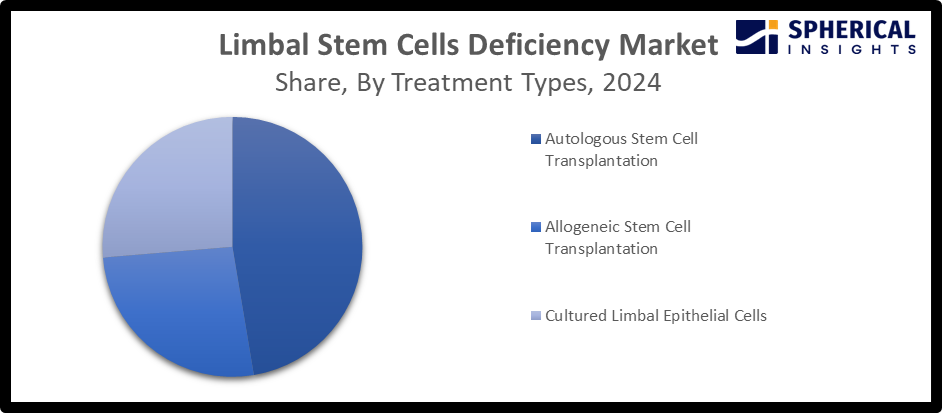
- The autologous stem cell transplantation segment dominated the market with about 45.0% share in 2024 and is projected to grow at a substantial CAGR during the forecast period.
Based on the treatment types, the limbal stem cells deficiency market is divided into autologous stem cell transplantation, allogeneic stem cell transplantation, and cultured limbal epithelial cells. Among these, the autologous stem cell transplantation segment dominated the market with about 45.0% share in 2024 and is projected to grow at a substantial CAGR during the forecast period. Three different techniques of autologous limbal stem cell transplantation (LSCT): conjunctival-limbal autografting (CLAu), cultivated limbal epithelial transplantation (CLET), and simple limbal epithelial transplantation (SLET), in unilateral limbal stem cell deficiency (LSCD). It utilizes patient’s own cells for minimizing the risks of rejection and complications.
Get more details on this report -
- The hospitals segment accounted for the largest share of around 50.0% in 2024 and is anticipated to grow at a significant CAGR during the forecast period.
Based on the end user, the limbal stem cells deficiency market is divided into hospitals, ophthalmology clinics, research institutions, and others. Among these, the hospitals segment accounted for the largest share of around 50.0% in 2024 and is anticipated to grow at a significant CAGR during the forecast period. For instance, in February 2023, the UCI Health Gavin Herbet Eye Institute offered sight-saving ocular stem cell transplants for severe eye surface damage, becoming only the second medical institution in the nation to treat this blinding condition. An increasing patient population and accessibility of advanced healthcare technologies for LSD management are contributing to propel the segmental market.
Regional Segment Analysis of the Limbal Stem Cells Deficiency Market
- North America (U.S., Canada, Mexico)
- Europe (Germany, France, U.K., Italy, Spain, Rest of Europe)
- Asia-Pacific (China, Japan, India, Rest of APAC)
- South America (Brazil and the Rest of South America)
- The Middle East and Africa (UAE, South Africa, Rest of MEA)
North America is anticipated to hold the largest share of the limbal stem cells deficiency market over the predicted timeframe.
North America is anticipated to hold the largest share of around 40.0% in the limbal stem cells deficiency market over the predicted timeframe. The market ecosystem in North America is strong, with both cutting-edge industrial and research efforts such as advanced cell-based therapy (CALEC), simple limbal epithelial transplantation (SLET), bioengineered scaffolds and biomaterials, cultivated oral mucosal epithelial transplantation (COMET), and other approaches. The demand for limbal stem cell deficiency has been driven by the region's growing prevalence of ocular surface injuries, an ageing population, and innovations like KPI-012. The United States is dominating the North America limbal stem cells deficiency market, with over 55% regional share, owing to increased disease prevalence and FDA-designated treatments.
Asia Pacific is expected to grow at a rapid CAGR of 8.0% in the limbal stem cells deficiency market during the forecast period. The Asia Pacific area has a thriving market for limbal stem cells deficiency due to an increasing prevalence of corneal blindness, cases of chemical/thermal ocular burns, and advancements in regenerative medicines such as stem cell therapy. China is the dominating country in the Asia Pacific region for limbal stem cells deficiency market, accounting for about 10.1% CAGR, driven by an increasing stem-cell research, ocular trauma cases, and expanding regenerative medicine programs.
Competitive Analysis:
The report offers the appropriate analysis of the key organizations/companies involved within the limbal stem cells deficiency market, along with a comparative evaluation primarily based on their type of offering, business overviews, geographic presence, enterprise strategies, segment market share, and SWOT analysis. The report also provides an elaborative analysis focusing on the current news and developments of the companies, which includes type development, innovations, joint ventures, partnerships, mergers & acquisitions, strategic alliances, and others. This allows for the evaluation of the overall competition within the market.
List of Key Companies
- Cheisi USA Inc.
- Holostem Terapie Avanzate S.r.l.
- Kala Pharmaceuticals
- Sandoz Group AG
- Xenon Pharmaceuticals Inc.
- Bausch + Lomb Corp
- Rayner Group
- AdvaCare Pharma
- Eyeris Vision Care Pvt. Ltd.
- AbbVie Inc.
- Others
Key Target Audience
- Market Players
- Investors
- End-users
- Government Authorities
- Consulting And Research Firm
- Venture capitalists
- Value-Added Resellers (VARs)
Recent Development
- In September 2025, Mytos, a biotechnology company automating cell manufacturing, announced new manufacturing collaborations with three innovative biotech companies, StemSight, Rinri Therapeutics, and Novadip.
- In March 2025, a scientific report on ‘Autologous glueless simple oral mucosal transplantation for the repair of limbal stem cell deficiency ocular surface in a rabbit model’.
- In April 2023, Kala Pharmaceuticals, Inc. announced the California Institute for Regenerative Medicine (CIRM) had awarded Combangio, Inc., a wholly owned subsidiary of Kala, a $15-million grant to support its ongoing KPI-012 program for the treatment of persistent corneal epithelial defect (PCED).
- In March 2021, Dovepress Taylor & Francis Group published a paper on ‘Dupilumab Induced Limbal Stem Cell Deficiency’.
Market Segment
This study forecasts revenue at global, regional, and country levels from 2020 to 2035. Spherical Insights has segmented the limbal stem cells deficiency market based on the below-mentioned segments:
Global Limbal Stem Cells Deficiency Market, By Treatment Types
- Autologous Stem Cell Transplantation
- Allogeneic Stem Cell Transplantation
- Cultured Limbal Epithelial Cells
Global Limbal Stem Cells Deficiency Market, By End User
- Hospitals
- Ophthalmology Clinics
- Research Institutions
- Others
Global Limbal Stem Cells Deficiency Market, By Regional Analysis
- North America
- US
- Canada
- Mexico
- Europe
- Germany
- UK
- France
- Italy
- Spain
- Russia
- Rest of Europe
- Asia Pacific
- China
- Japan
- India
- South Korea
- Australia
- Rest of Asia Pacific
- South America
- Brazil
- Argentina
- Rest of South America
- Middle East & Africa
- UAE
- Saudi Arabia
- Qatar
- South Africa
- Rest of the Middle East & Africa
Frequently Asked Questions (FAQ)
-
1. What is the market size of the limbal stem cells deficiency market?The global limbal stem cells deficiency market size is expected to grow from USD 209.5 Million in 2024 to USD 532.0 Million by 2035, at a CAGR of 8.84% during the forecast period 2025-2035.
-
2. Which region holds the largest share of the limbal stem cells deficiency market?North America is anticipated to hold the largest share of the limbal stem cells deficiency market over the predicted timeframe.
-
3. What is the forecasted CAGR of the Global Limbal Stem Cells Deficiency Market from 2024 to 2035?The market is expected to grow at a CAGR of around 8.84% during the period 2024–2035.
-
4. Who are the top companies that are involved in the Global Limbal Stem Cells Deficiency Market?Key players include Cheisi USA Inc., Holostem Terapie Avanzate S.r.l., Kala Pharmaceuticals, Sandoz Group AG, Xenon Pharmaceuticals Inc., Bausch + Lomb Corp, Rayner Group, AdvaCare Pharma, Eyeris Vision Care Pvt. Ltd., and AbbVie Inc.
-
5. What are the main drivers in the limbal stem cells deficiency market?A rising prevalence of corneal blindness, treatment complications, growing awareness, and inclination towards less therapeutic innovative approaches are major market growth drivers of the limbal stem cells deficiency market.
-
6. What challenges are limiting the adoption of limbal stem cells deficiency treatment?Factors like increased treatment costs, limited donor availability for autologous/allogenic transplants, and complex, non-standardized manufacturing of cultivated cell sheets remain key restraints in the limbal stem cells deficiency market.
-
7. What are the key trends in the limbal stem cells deficiency market?The emergence of regenerative medicine, such as induced pluripotent stem cells (iPSCs), HOLOCAR as specialized therapy, and the development of topical agents for corneal repair are key trends in the limbal stem cells deficiency market.
Need help to buy this report?