Japan Vibration Control System Market Size, Share, By System Type (Vibration Control and Motion Control), By Application (Automotive, Aerospace & Defense, Manufacturing, Electrical & Electronics, Healthcare, Oil & Gas, and Others), Japan Vibration Control System Market Insights, Industry Trend, Forecasts to 2035.
Industry: Semiconductors & Electronics
Japan Vibration Control System Market Insights Forecasts to 2035
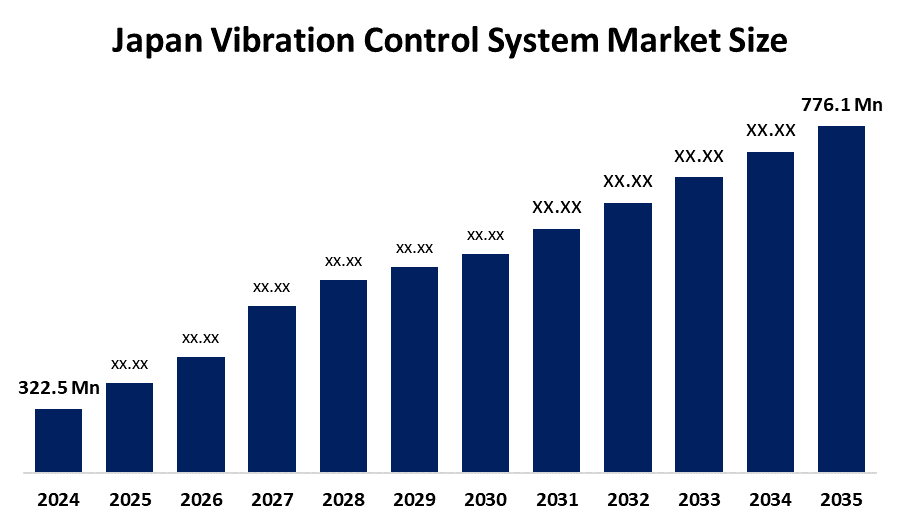
- Japan Vibration Control System Market Size 2024: USD 322.5 Mn
- Japan Vibration Control System Market Size 2035: USD 776.1 Mn
- Japan Vibration Control System Market CAGR 2024: 8.31%
- Japan Vibration Control System Market Segments: System Type and Application.
Get more details on this report -
In Japan, vibration control systems protect from unwanted vibrations typically associated with the operation of the equipment in many different industries, including industrial machinery, vehicles, and structures. Vibration control systems play an important role in assuring the appropriate operation of machinery and equipment, and also provide additional protection to the operators and their workplace, especially in the semiconductor fab and nuclear power plant industries, while also extending the life of the equipment. The growing trend within the vibration control system market in Japan is that of moving away from traditional or passive damping material toward smart and active vibration control solutions that offer real-time adaptability to the dynamic nature of the operating environment.
Both the Government of Japan and private investments have played an important role in allowing the vibration control system market to grow in Japan. Japan's regulatory framework on workplace safety and noise control, combined with the rapid growth of private sector investments in the electronics and automotive sectors, has promoted the adoption of advanced vibration control solutions by the industrial operators to meet the needs of their employees and the surrounding communities, as well as encouraging the automotive and manufacturing industries to invest in next-generation electric vehicles and high-precision manufacturing lines to provide them with a competitive advantage in the marketplace.
Technological advancements are shaping the vibration control system landscape in Japan, particularly with the implementation of Industry 4.0 technologies. The rise of IoT and AI technologies has facilitated the implementation of vibration data-based predictive maintenance solutions that enable early identification of mechanical imbalances before equipment failures. Additionally, advances in pneumatic active isolation and high-end viscoelastic polymer materials have allowed Japanese companies to achieve extraordinary levels of control over micro-vibrations, which are critical for the development of the country's advanced nanotechnology and semiconductor R&D centers.
Japan Vibration Control System Market Report Coverage
| Report Coverage | Details |
|---|---|
| Base Year: | 2024 |
| Market Size in 2024: | USD 322.5 Million |
| Forecast Period: | 2025-2035 |
| Forecast Period CAGR 2025-2035 : | CAGR Of 8.31% |
| 2035 Value Projection: | USD 776.1 Million |
| Historical Data for: | 2020-2023 |
| No. of Pages: | 221 |
| Tables, Charts & Figures: | 153 |
| Segments covered: | By Application, By System Type, |
| Companies covered:: | Mitsubishi Heavy Industries, Ltd., Sumitomo Riko Company Limited, Tokkyokiki Corporation, Shinkawa Electric Co., Ltd., Bridgestone Corporation, KYB Corporation, Azbil Corporation, Yokogawa Electric Corporation,and Other key players |
| Pitfalls & Challenges: | COVID-19 Empact, Challenge, Future, Growth, & Analysis |
Get more details on this report -
Market Dynamics of the Japan Vibration Control System Market:
The Japanese vibration control system market is driven by the increased demand for high-precision manufacturing processes in Japan's semiconductor and electronics industries, while even the slightest vibrations may result in significant product defects. The rapid growth in electric vehicle adoption has led to a need for advanced vibration and noise control systems, ensuring that passengers are comfortable. Government regulations to strengthen structural safety and the fact that much of Japan's industrial infrastructure is reaching the end of its useful life have increased the demand for effective monitoring and damping systems. Lastly, AI-driven predictive maintenance approaches have become common practice in Japanese smart factory environments.
The primary barrier to the adoption of Japanese vibration control systems by small and mid-sized businesses is the initial expense involved in acquiring and having these systems professionally installed. In addition, retrofitting existing machinery with up-to-date sensor technology is often complex. The shortage of qualified vibration analysts also presents another obstacle to widespread adoption of complicated monitoring systems.
In addition, there are considerable opportunities with the development of smart vibration isolators in conjunction with 5G-enabled IoT Sensors for real-time remote monitoring. The expansion of renewable energy technology, especially offshore wind farms, is leading to demands for advanced structural stabilization methods. In addition, urban developers are focusing on developing earthquake-resistant infrastructures, creating opportunities to use innovative damping technologies.
Market Segmentation
The Japan vibration control system market share is classified into system type and application.
By System Type:
The Japanese vibration control system market is divided by system type into vibration control and motion control. Among these, the vibration control segment dominated the market in 2024 and is anticipated to grow at a significant CAGR during the forecast period. This is due to their increasing demand for improved mechanical stability and vibration isolation in critical industries such as industrial, automotive, aerospace, and infrastructure.
By Application:
The Japan vibration control system market is divided by application into automotive, aerospace & defense, manufacturing, electrical & electronics, healthcare, oil & gas, and others. Among these, the manufacturing segment dominated the market in 2024 and is anticipated to grow at a remarkable CAGR during the forecast period. Manufacturing businesses rely heavily on machinery and equipment that generate vibrations while in operation. This increased the requirement for vibration control systems to assure operating stability, safety, and machinery longevity.
Competitive Analysis:
The report offers the appropriate analysis of the key organisations/companies involved within the Japan vibration control system market, along with a comparative evaluation primarily based on their product offering, business overviews, geographic presence, enterprise strategies, segment market share, and SWOT analysis. The report also provides an elaborative analysis focusing on the current news and developments of the companies, which includes product development, innovations, joint ventures, partnerships, mergers & acquisitions, strategic alliances, and others. This allows for the evaluation of the overall competition within the market.
Top Key Companies in Japan Vibration Control System Market:
- Mitsubishi Heavy Industries, Ltd.
- Sumitomo Riko Company Limited
- Tokkyokiki Corporation
- Shinkawa Electric Co., Ltd.
- Bridgestone Corporation
- KYB Corporation
- Azbil Corporation
- Yokogawa Electric Corporation
- Others
Key Target Audience
- Market Players
- Investors
- End-users
- Government Authorities
- Consulting and Research Firm
- Venture capitalists
- Value-Added Resellers (VARs)
Market Segment
This study forecasts revenue at the Japan, regional, and country levels from 2020 to 2035. Spherical Insights has segmented the Japan vibration control system market based on the below-mentioned segments:
Japan Vibration Control System Market, By System Type
- Vibration Control
- Motion Control
Japan Vibration Control System Market, By Application
- Automotive
- Aerospace & Defense
- Manufacturing
- Electrical & Electronics
- Healthcare
- Oil & Gas
- Others
Frequently Asked Questions (FAQ)
-
Q: What is the market size and growth outlook of the Japan vibration control system market?A: The market was valued at USD 322.5 million in 2024 and is projected to reach USD 776.1 million by 2035, growing at a CAGR of 8.31% during the forecast period 2025–2035.
-
Q: Which system type dominates the Japan vibration control system market?A: The vibration control system segment dominated the market in 2024 due to its widespread use in stabilizing machinery and isolating vibrations in critical sectors such as manufacturing, automotive, aerospace, and infrastructure.
-
Q: Which application segment holds the largest share in the Japan vibration control system market?A: The manufacturing segment held the largest market share in 2024, driven by the extensive use of vibration-generating machinery and the need to ensure equipment stability, worker safety, and production quality.
-
Q: What are the key drivers of the Japan vibration control system market?A: Major drivers include rising demand for high-precision manufacturing in the semiconductor and electronics industries, growth in electric vehicles, strict workplace safety regulations, aging industrial infrastructure, and adoption of AI-based predictive maintenance.
-
Q: What challenges are faced by the Japan vibration control system market?A: High initial investment costs, complexity of retrofitting existing machinery, and a shortage of skilled vibration analysis professionals are key challenges limiting widespread adoption, especially among small and mid-sized enterprises.
-
Q: What future opportunities exist in the Japan vibration control system market?A: Opportunities include the development of smart vibration control systems integrated with IoT and 5G technologies, growth in renewable energy projects such as offshore wind farms, and increasing focus on earthquake-resistant and smart infrastructure development.
-
Q: Who are the target audiences for the Japan vibration control system market report?A: The report targets market players, investors, end-users, government authorities, consulting and research firms, venture capitalists, and value-added resellers (VARs).
Need help to buy this report?