Japan Smart Trash Bin Market Size, Share, By Capacity (8-13 Gallon, 14-23 Gallon, and Above 24 Gallon), By Sales Channel (Online and Offline), By End Use (Residential and Commercial), By Operation (Automatic and Semi-Automatic), By Compartment (Single Compartment and Multi-Compartment), Japan Smart Trash Bin Market Insights, Industry Trend, Forecasts to 2035.
Industry: Consumer Goods
Japan Smart Trash Bin Market Insights Forecasts to 2035
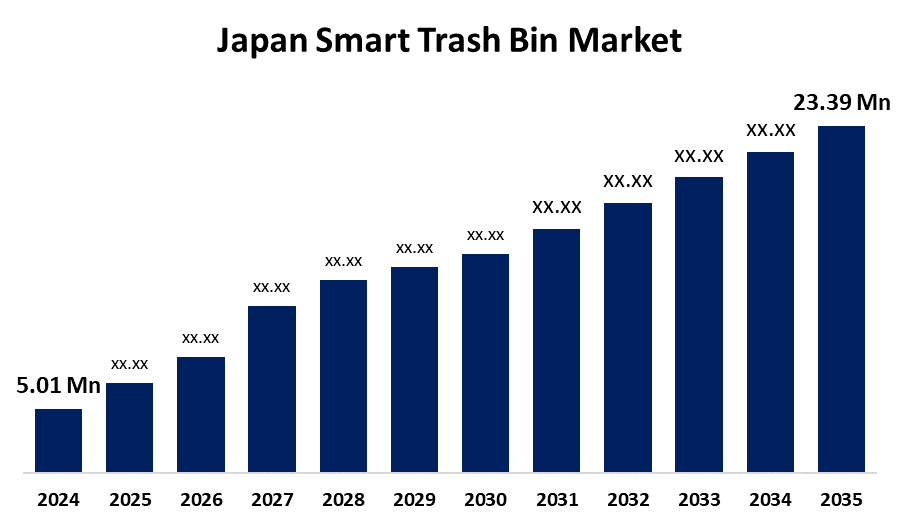
- Japan Smart Trash Bin Market Size 2024: USD 5.01 Mn
- Japan Smart Trash Bin Market Size 2035: USD 23.39 Mn
- Japan Smart Trash Bin Market CAGR 2024: 15.04%
- Japan Smart Trash Bin Market Segments: Capacity, Sales Channel, End Use, Operation, and Compartment
Get more details on this report -
Smart trash bins function as waste containers which use sensors to monitor their fill levels while operating automated lid systems and compacting waste materials and sending live waste data to their collection systems. The waste management system relies on these bins to improve its operational performance while maintaining better cleanliness and using its resources in a more efficient manner. Japanese commercial areas and transportation stations and public parks and tourist attractions and residential communities use smart trash bins to manage their waste collection process while preventing overflow problems. The increasing municipal solid waste volume leads to increased demand for waste management systems according to Japan's Ministry of the Environment because the country produces 42 million tonnes of municipal waste each year which needs effective technological waste management solutions.
Organizations develop new technology through their work with IoT sensors and solar-powered waste compaction systems and cloud-based monitoring platforms and artificial intelligence systems that forecast waste levels and vehicle routing software that minimizes expenses. Japanese government-supported smart city projects use digital infrastructure development programs to promote information-based urban service delivery systems which include advanced waste management technologies. AI-based waste separation systems will create new possibilities for waste management through their connection with intelligent street systems and their application in busy tourist areas and their implementation in mid-sized cities which need economical waste management solutions.
Market Dynamics of the Japan Smart Trash Bin Market:
Japan smart trash bin market growth is primarily driven by increasing hygiene awareness, strong cultural emphasis on cleanliness, and rapid adoption of smart home appliances across urban households. Strict municipal waste segregation regulations and limited living spaces encourage consumers to adopt automated, space-efficient, multi-compartment bins. Technological advancements such as motion sensors, odor control systems, and rechargeable battery integration further accelerate product penetration in both residential and commercial sectors.
Japan smart trash bin market expansion is restrained by high product costs compared to conventional bins, limited price sensitivity among mass consumers, and battery maintenance concerns. Dependence on electronic components increases replacement and repair expenses, while smaller households may perceive smart bins as non-essential appliances. Additionally, competition from low-cost imports can pressure margins for domestic manufacturers.
Japan smart trash bin market presents significant future opportunities through IoT-enabled waste monitoring, integration with smart building ecosystems, and AI-assisted waste sorting solutions. Growing demand from commercial offices, healthcare facilities, and hospitality sectors for touchless infrastructure will expand application scope. Sustainable product innovation, recyclable materials, and energy-efficient designs are expected to unlock premiumization opportunities.
Japan Smart Trash Bin Market Report Coverage
| Report Coverage | Details |
|---|---|
| Base Year: | 2024 |
| Market Size in 2024: | USD 5.01 Million |
| Forecast Period: | 2025-2035 |
| Forecast Period CAGR 2025-2035 : | 15.04% |
| 2035 Value Projection: | USD 23.39 Million |
| Historical Data for: | 2020-2023 |
| No. of Pages: | 210 |
| Tables, Charts & Figures: | 89 |
| Segments covered: | By Capacity, By Sales Channel, By End Use, By Operation, By Compartment |
| Companies covered:: | Ecube Labs, Bigbelly, iTouchless, Simplehuman, EKO, Nine Stars Group, and others. |
| Pitfalls & Challenges: | COVID-19 Impact, Challenges, Future, Growth, & Analysis |
Get more details on this report -
Market Segmentation
The Japan smart trash bin market share is classified into capacity, sales channel, end use, operation, and compartment.
By Capacity:
The Japan smart trash bin market is divided by capacity into 8-13 Gallon, 14-23 Gallon, and Above 24 Gallon. Among these, the 14-23 Gallon segment dominated the share in 2024 and is anticipated to grow at a remarkable CAGR during the forecast period. The 14-23 Gallon segment dominates due to its suitability for compact Japanese households, optimal balance between storage volume and space efficiency, compatibility with standardized municipal waste bag sizes, and strong preference among urban apartment residents seeking practical daily waste management solutions.
By Sales Channel:
The Japan smart trash bin market is divided by sales channel into online and offline. Among these, the online segment dominated the share in 2024 and is anticipated to grow at a remarkable CAGR during the forecast period. The online segment dominates because Japanese consumers actively compare smart features, pricing, and reviews on e-commerce platforms, benefit from doorstep delivery for bulky products, access wider brand availability, and prefer digital purchasing for home appliances integrated with advanced sensor technologies.
By End Use:
The Japan smart trash bin market is divided by end use into residential and commercial. Among these, the residential segment dominated the share in 2024 and is anticipated to grow at a remarkable CAGR during the forecast period. The residential segment dominates due to rising smart home adoption, increasing hygiene awareness, limited kitchen space requiring automated lid mechanisms, growing elderly population seeking touchless convenience, and higher replacement demand from urban households upgrading to sensor-enabled waste management solutions.
By Operation:
The Japan smart trash bin market is divided by operation into automatic and semi-automatic. Among these, the automatic segment dominated the share in 2024 and is anticipated to grow at a remarkable CAGR during the forecast period. The automatic segment dominates because motion-sensor lid activation supports Japan’s strong hygiene culture, minimizes physical contact in kitchens and offices, aligns with smart home ecosystems, enhances user convenience, and delivers superior technological appeal compared to foot-pedal or manually assisted alternatives.
By Compartment:
The Japan smart trash bin market is divided by compartment into single compartment and multi-compartment. Among these, the multi-compartment segment dominated the share in 2024 and is anticipated to grow at a remarkable CAGR during the forecast period. The multi-compartment segment dominates due to Japan’s strict waste segregation regulations, household-level recycling compliance requirements, space-efficient dual sorting designs, and increasing consumer preference for organized disposal systems separating burnable, non-burnable, and recyclable waste streams.
Competitive Analysis:
The report offers the appropriate analysis of the key organisations/companies involved within the Japan smart trash bin market, along with a comparative evaluation primarily based on their product offering, business overviews, geographic presence, enterprise strategies, segment market share, and SWOT analysis. The report also provides an elaborative analysis focusing on the current news and developments of the companies, which includes product development, innovations, joint ventures, partnerships, mergers & acquisitions, strategic alliances, and others. This allows for the evaluation of the overall competition within the market.
Top Key Companies in Japan Smart Trash Bin Market:
- Ecube Labs
- Bigbelly
- iTouchless
- Simplehuman
- EKO
- Nine Stars Group
- Others
Key Target Audience
- Market Players
- Investors
- End-users
- Government Authorities
- Consulting and Research Firm
- Venture capitalists
- Value-Added Resellers (VARs)
Market Segment
This study forecasts revenue at the Japan, regional, and country levels from 2020 to 2035. Decisions Advisors has segmented the Japan smart trash bin market based on the below-mentioned segments:
Japan Smart Trash Bin Market, By Capacity
- 8-13 Gallon
- 14-23 Gallon
- Above 24 Gallon
Japan Smart Trash Bin Market, By Sales Channel
- Online
- Offline
Japan Smart Trash Bin Market, By End Use
- Residential
- Commercial
Japan Smart Trash Bin Market, By Operation
- Automatic
- Semi-Automatic
Japan Smart Trash Bin Market, By Compartment
- Single Compartment
- Multi-Compartment
Frequently Asked Questions (FAQ)
-
What is the Japan smart trash bin market size?Japan smart trash bin market is expected to grow from USD 5.01 million in 2024 to USD 23.39 million by 2035, growing at a CAGR of 15.04% during the forecast period 2025-2035.
-
What are the key growth drivers of the market?Market growth is driven by rising hygiene awareness, strong cultural emphasis on cleanliness, increasing smart home adoption, strict municipal waste segregation regulations, limited residential space encouraging compact automated solutions, and growing demand for touchless and sensor-enabled home appliances.
-
What factors restrain the Japan smart trash bin market?Constraints include high product costs compared to conventional bins, battery maintenance concerns, dependence on electronic components, price sensitivity among mass consumers, and competition from low-cost imports that may impact margins and adoption rates.
-
Who are the key players in the Japan smart trash bin market?Key companies include Ecube Labs, Bigbelly, iTouchless, Simplehuman, EKO, Nine Stars Group, and others.
-
Who are the target audiences for this market report?The report targets market players, investors, end-users, government authorities, consulting and research firms, venture capitalists, and value-added resellers (VARs).
Need help to buy this report?