Japan Smart Healthcare Products Market Size, Share By Product (Telemedicine, Medical Imaging, Wearable Devices, Mobile Health (mHealth) Apps, and Electronic Health Records (EHRs)), By Application (Chronic Disease Management, Storage and Inventory Management, Wellness and Fitness, and Remote Patient Monitoring), By End Use (Home Care Settings, Hospitals, and Clinics), Japan Smart Healthcare Products Market Industry Trend, Forecasts to 2035
Industry: Healthcare
Japan Smart Healthcare Products Market Insights Forecasts to 2035
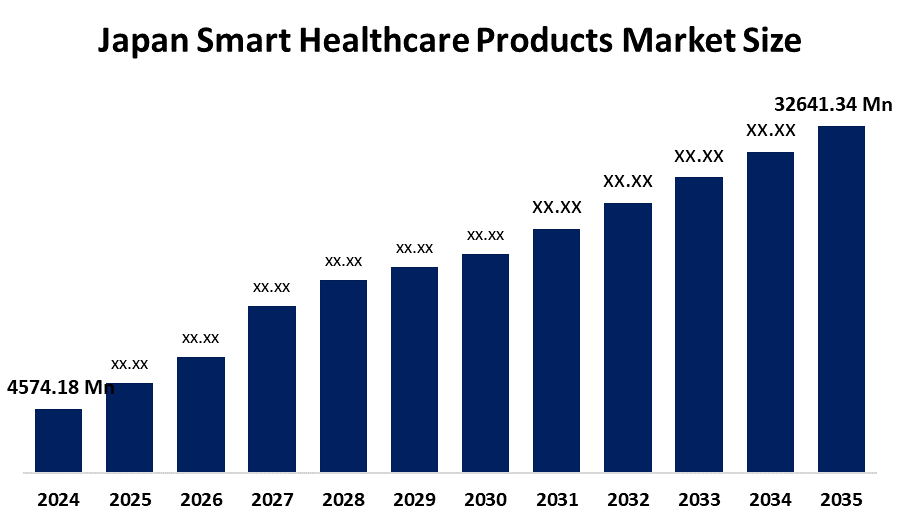
- Japan Smart Healthcare Products Market Size 2024: USD 4574.18 million
- Japan Smart Healthcare Products Market Size 2035: USD 32641.34 million
- Japan Smart Healthcare Products Market CAGR 2024: 19.56%
- Japan Smart Healthcare Products Market Segments, Product, Application and End Use.
Get more details on this report -
The Japan smart healthcare products market includes connected digital health devices and technologies used to monitor, manage, and improve health. These include wearable sensors, remote patient monitoring tools, mobile health apps, smart medical devices, and telehealth solutions. They collect and analyse health data to help healthcare providers and individuals track vital signs, prevent disease, and deliver personalised, efficient care. Furthermore, the Japan smart healthcare products market is growing due to an increasing elderly population, higher incidence of chronic diseases, and rising demand for remote healthcare solutions. Adoption of wearable devices, IoT enabled monitoring tools, and AI assisted diagnostics boosts efficiency. Government initiatives promoting digital health, growing consumer awareness of preventive care, and integration of telemedicine also contribute to continuous market growth.
Japan government actively supports smart healthcare through digital transformation policies that encourage remote care, data interoperability, and integration of AI and IoT in health services. Regulations aim to improve healthcare efficiency, patient access, and safety while ensuring data privacy and security. Government initiatives fund telehealth adoption and smart device integration in public health programs to better manage chronic diseases and aging population.
Japan smart healthcare products market trends include widespread adoption of remote patient monitoring systems, IoT enabled wearable devices for health tracking, and integration of AI for diagnostics and personalised care. Telehealth and mobile health apps are increasingly used for chronic disease management. Smart home healthcare devices that connect with clinical platforms are also gaining traction, creating an interconnected digital healthcare ecosystem.
Market Dynamics of the Japan Smart Healthcare Products Market:
The Japan Smart Healthcare Products Market is driven by Japans ageing society, increasing prevalence of chronic diseases, and rising demand for convenient healthcare access. Adoption of IoT, AI, and mobile technologies encourages smart health product use. Healthcare providers and patients seek better monitoring, early diagnosis, and cost effective care. Increasing consumer awareness of wellness and preventive health also boosts demand for smart healthcare devices and services.
The Japan smart healthcare products market restraints include high costs of advanced devices, concerns about data security and privacy, and complex regulatory approval processes. Integration with existing healthcare systems is challenging, requiring interoperability standards and infrastructure upgrades. Limited digital literacy among some patient groups and clinician resistance to new technologies slow adoption. Strict healthcare regulations also delay product approvals and deployment.
The Opportunities include the development of advanced wearable health monitors, AI assisted diagnostics, and smart home health systems. Growth in telemedicine and remote patient monitoring opens new market segments. Partnerships between tech firms, device makers, and healthcare providers can accelerate innovation. Preventive health solutions and personalised care services also present potential, especially for managing chronic conditions and supporting Japans high elderly population.
Japan Smart Healthcare Products Market Report Coverage
| Report Coverage | Details |
|---|---|
| Base Year: | 2024 |
| Market Size in 2024: | USD 4574.18 Million |
| Forecast Period: | 2025-2035 |
| Forecast Period CAGR 2025-2035 : | CAGR of 19.56 % |
| 2035 Value Projection: | USD 32641.34 Million |
| Historical Data for: | 2020-2023 |
| No. of Pages: | 210 |
| Tables, Charts & Figures: | 90 |
| Segments covered: | By Product,By Application |
| Companies covered:: | OMRON Healthcare,Fujitsu,Hitachi,NEC,Sony ,Terumo And Others Players |
| Pitfalls & Challenges: | COVID-19 Empact, Challenge, Future, Growth, & Analysis Pitfalls & Challenges |
Get more details on this report -
Market Segmentation
The Japan smart healthcare products market share is classified into products, applications, and end users.
By Product:
The Japan smart healthcare products market is divided by product into telemedicine, medical imaging, wearable devices, mobile health apps, and electronic health records. Among these, the wearable devices segment dominated the share in 2024 and is anticipated to grow at a remarkable CAGR during the forecast period. The wearable devices segment dominates due to widespread consumer adoption for continuous monitoring of vital signs, fitness, and chronic conditions. Integration with mobile health apps and telemedicine platforms enhances usability. Ease of use, real-time health tracking, and growing preventive healthcare awareness make wearables the most demanded product in Japan’s smart healthcare market.
By Application:
The Japan smart healthcare products market is divided by application into chronic disease management, storage and inventory management, wellness and fitness, and remote patient monitoring. Among these, the chronic disease management segment dominated the share in 2024 and is anticipated to grow at a remarkable CAGR during the forecast period. The chronic disease management segment dominates because Japans ageing population has a high prevalence of diabetes, hypertension, and cardiovascular conditions. Smart healthcare products like wearables, mobile apps, and remote monitoring tools help track health, manage treatment, and prevent complications, driving widespread adoption in chronic disease care over other applications.
By End Use:
The Japan smart healthcare products market is divided by end use into home care settings, hospitals, and clinics. Among these, the home care segment dominated the share in 2024 and is anticipated to grow at a remarkable CAGR during the forecast period. The home care segment dominates because Japans ageing population and rising chronic disease prevalence increase demand for remote health monitoring. Smart healthcare products like wearable devices, mobile health apps, and connected monitoring tools allow patients to track vital signs, manage conditions, and receive preventive care conveniently at home, reducing the need for frequent hospital or clinic visits.
Competitive Analysis:
The report offers the appropriate analysis of the key organisations/companies involved within the Japan smart healthcare products market, along with a comparative evaluation primarily based on their product offering, business overviews, geographic presence, enterprise strategies, segment market share, and SWOT analysis. The report also provides an elaborate analysis focusing on the current news and developments of the companies, which includes product development, innovations, joint ventures, partnerships, mergers & acquisitions, strategic alliances, and others. This allows for the evaluation of the overall competition within the market.
Top Key Companies in Japan Smart Healthcare Products Market:
- OMRON Healthcare
- Fujitsu
- HitachI
- NEC
- Sony Group Corp.
- Terumo
- Nihon Kohden
- Sysmex
- Other
Key Target Audience
- Market Players
- Investors
- End-users
- Government Authorities
- Consulting and Research Firm
- Venture capitalists
- Value-Added Resellers (VARs)
Market Segment
This study forecasts revenue at the Japan, regional, and country levels from 2020 to 2035. Spherical Insights has segmented the Japan smart healthcare products market based on the below-mentioned segments:
Japan Smart Healthcare Products Market, By Product.
- Telemedicine
- Medical Imaging
- Wearable Devices
- Mobile Health (mHealth) Apps
- Electronic Health Records
Japan Smart Healthcare Products Market, By Application
- Chronic Disease Management
- Storage and Inventory Management
- Wellness and Fitness
- Remote Patient Monitoring
Japan Smart Healthcare Products Market, by End Use.
- Home Care Settings
- Hospitals
- Clinics
Frequently Asked Questions (FAQ)
-
Q 1: What is the Japan smart healthcare products market size?Japan smart healthcare products market is expected to grow from USD 4574.18 million in 2024 to USD 32641.34 million by 2035, growing at a CAGR of 19.56 % during the forecast period 2025-2035.
-
Q 2: What are the key growth drivers of the Japan smart healthcare products market?The Japan smart healthcare products market includes a growing elderly population, increasing chronic diseases, growing demand for remote monitoring, adoption of IoT and AI, government support, and consumer awareness.
-
Q 3: What factors restrain the Japan smart healthcare products market?The Japan smart healthcare products market is restrained by High device costs, strict regulations, data privacy concerns, limited digital literacy among users, integration challenges with existing healthcare systems, and slow adoption in some regions.
-
Q 4: How is the Japan smart healthcare products market segmented by application?The Japan smart healthcare products market is segmented into chronic disease management, storage and inventory management, wellness and fitness, and remote patient monitoring
-
Q 5: Who are the key players in the Japan Smart Healthcare Products Market?Key companies in the Japan Smart Healthcare Products Market include OMRON Healthcare, Fujitsu, Hitachi, Medley, Inc., Panasonic Corporation, NEC Corporation, Sony Group Corp., Terumo Corporation, Nihon Kohden Corporation, Sysmex Corporation, and other
Need help to buy this report?