Japan Research Antibodies Market Size, Share, By Type (Monoclonal Antibodies, Polyclonal Antibodies), By Technology (Immunochemistry, Immunofluorescence, Western Blotting, Flow Cytometry, Immunoprecipitation, ELISA, and Others), By Source (Mouse Antibodies, Rabbit Antibodies, Goat Antibodies, and Others), By Application (Infectious Diseases, Immunology, Oncology, Stem Cells, Neurobiology, and Others), Japan Research Antibodies Market Insights, Industry Trend, Forecasts to 2035.
Industry: Healthcare
Japan Research Antibodies Market Insights Forecasts to 2035
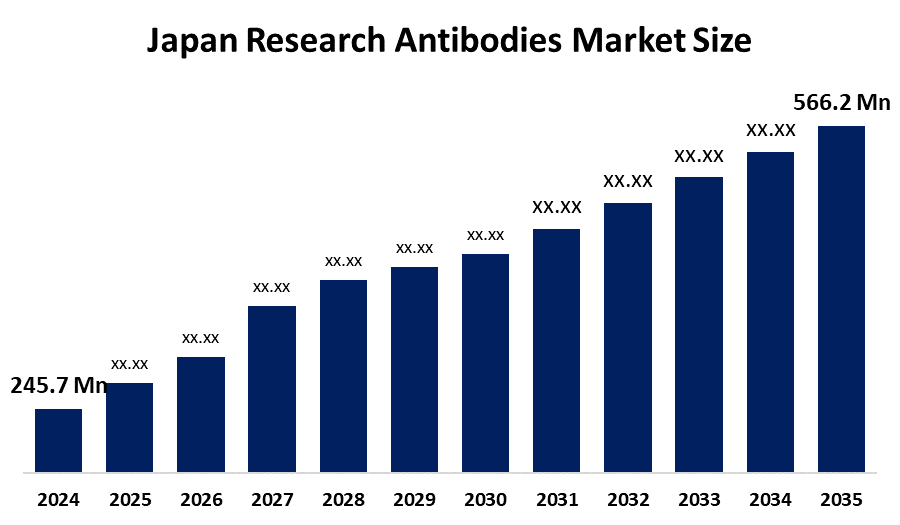
- Japan Research Antibodies Market Size 2024: USD 245.7 Million
- Japan Research Antibodies Market Size 2035: USD 566.2 Million
- Japan Research Antibodies Market CAGR 2024: 7.88%
- Japan Research Antibodies Market Segments: Type, Technology, Source, and Application.
Get more details on this report -
The Japan research antibodies market refers to the market for laboratory antibodies used in scientific research across Japan. These antibodies are essential tools used by research institutes, universities, pharmaceutical companies, and biotechnology firms to study proteins, understand diseases, and support drug discovery, diagnostics development, and life-science research. Furthermore, the growth factors for the Japan research antibodies market are the increase in investments in biotechnology, research, and medicine, growing demand for quality antibodies for cancer and immunology research, advancements in the techniques of antibody preparation and analysis, and the developing trends of precision medicine.
The Japan research antibody market, according to the government, will benefit from public policies aimed at fostering the bio economy strategy in the country. The strategy includes the promotion of biotechnology research and development, along with the commercialisation of biological products such as antibodies. The government will facilitate more public-private partnerships, fund research, streamline regulations, and increase production capabilities in biotechnology in order to make the biotech industry in Japan more competitive.
Japan Research Antibodies market trends include the significant rise in monoclonal antibodies, the biggest and fastest-growing market segment, an increased focus on innovation and the use of advanced biotechnology methodologies such as genetic engineering and antibody recombinants; growth in the use of customized and high affinity antibodies, particularly in sophisticated biotech research; and collaboration with international biotech companies to support personalised and diagnostic biotech research.
Market Dynamics of the Japan Research Antibodies Market:
Japan research antibodies market is driven by increasing investment in biotechnology and life science R&D, rising demand for monoclonal and recombinant antibodies in studies related to cancer, immunology, and molecular biology, and a focus on personalised medicine and precision diagnostics. Technological advancements, collaborations between academia and industry, and growing research to address an ageing population further fuel market growth.
Japan research antibodies market faces restraints from tough quality standards and regulations, which work as a slower adopter. The high cost of antibodies and reagents can be a limiting factor in research work. Moreover, difficulties in cold-chain logistics can contribute to higher operational costs in various institutions. Furthermore, small laboratories and institutions with tight budgets can face restrictions in accessing such platforms.
Japan research antibodies market presents significant opportunities through the growing demand for monoclonal and recombinant antibodies in cancer, immunology, and molecular biology research. expansion in personalised medicine and precision diagnostics, increased biotech R&D investment, and government support for life science innovation create avenues for new product development, academic-industry collaborations, and market expansion, especially in high affinity and custom antibody segments.
Japan Research Antibodies Market Report Coverage
| Report Coverage | Details |
|---|---|
| Base Year: | 2024 |
| Market Size in 2024: | USD 245.7 Million |
| Forecast Period: | 2025-2035 |
| Forecast Period CAGR 2025-2035 : | CAGR of 7.88% |
| 2035 Value Projection: | USD 566.2 Million |
| Historical Data for: | 2020-2023 |
| No. of Pages: | 210 |
| Tables, Charts & Figures: | 90 |
| Segments covered: | By Type, By Technology |
| Companies covered:: | Abcam plc, Cell Signalling Technology, Inc,Thermo Fisher Scientific Inc,Merck KGaA |
| Pitfalls & Challenges: | COVID-19 Empact, Challenge, Future, Growth, & Analysis |
Get more details on this report -
Market Segmentation
The Japan research antibodies market share is classified into type, technology, source, and application
By Type:
The Japan research antibodies market is divided by type into monoclonal antibodies and polyclonal antibodies. Among these, the monoclonal antibodies segment dominated the share in 2024 and is anticipated to grow at a remarkable CAGR during the forecast period. The monoclonal antibodies segment is due to their high specificity, consistent quality, and reproducibility, making them ideal for precise diagnostics, therapeutic research, and molecular biology studies. Their suitability for advanced applications and large-scale experiments gives them a clear advantage over polyclonal antibodies.
By Technology:
The Japan research antibodies market is divided by technology into immunochemistry, immunofluorescence, western blotting, flow cytometry, immunoprecipitation, ELISA, and others. Among these, the ELISA segment dominated the share in 2024 and is anticipated to grow at a remarkable CAGR during the forecast period. The ELISA segment dominates because it provides high sensitivity, specificity, and reproducibility for detecting proteins and antibodies. Its quantitative capabilities, ease of use, and suitability for high-throughput screening make it essential in diagnostics, immunology, and cancer research. These advantages make ELISA more widely adopted than technologies like western blotting or immunofluorescence.
By sources:
The Japan research antibodies market is divided by sources into mouse antibodies, rabbit antibodies, goat antibodies, and others. Among these, the mouse antibodies segment dominated the share in 2024 and is anticipated to grow at a remarkable CAGR during the forecast period. The mouse antibodies segment dominates because they offer high specificity, consistent quality, and reliable reproducibility, making them ideal for monoclonal antibody production. Their long-standing use in immunology, molecular biology, and diagnostic research, combined with well-established production methods, ensures widespread adoption over rabbit, goat, or other host species antibodies.
By Application:
The Japan research antibodies market is divided by application into infectious diseases, immunology, oncology, stem cells, neurobiology, and others. Among these, the oncology segment dominated the share in 2024 and is anticipated to grow at a remarkable CAGR during the forecast period. The oncology segment dominates because of increasing cancer prevalence and intensive research in Japan. Antibodies are crucial for tumour biomarker detection, targeted therapies, and cancer diagnostics, offering high specificity and reproducibility. Strong government and private funding in oncology research further drives antibody usage, making it the leading application in the market.
Competitive Analysis:
The report offers the appropriate analysis of the key organisations/companies involved within the Japan research antibodies market, along with a comparative evaluation primarily based on their product offering, business overviews, geographic presence, enterprise strategies, segment market share, and SWOT analysis. The report also provides an elaborate analysis focusing on the current news and developments of the companies, which includes product development, innovations, joint ventures, partnerships, mergers & acquisitions, strategic alliances, and others. This allows for the evaluation of the overall competition within the market.
Top Key Companies in Japan Research Antibodies Market:
- Abcam plc
- Cell Signalling Technology, Inc.
- Thermo Fisher Scientific Inc.
- Merck KGaA
- Bio Techne Proteintech Group
- Takeda Pharmaceutical Company.
- Chugai Pharmaceutical Roche subsidiary
- Daiichi Sankyo
- Astellas Pharma
- Others
Key Target Audience
- Market Players
- Investors
- End-users
- Government Authorities
- Consulting and Research Firm
- Venture capitalists
- Value-Added Resellers (VARs)
Market Segment
This study forecasts revenue at the Japan, regional, and country levels from 2020 to 2035. Spherical Insights has segmented the Japan research antibodies market based on the below-mentioned segments:
Japan research antibodies market, By Type
- Monoclonal Antibodies
- Polyclonal Antibodies
Japan research antibodies market, By Technology
- Immunochemistry
- Immunofluorescence
- Western Blotting
- Flow Cytometry
- Immunoprecipitation
- ELISA
- Others
Japan research antibodies market, By Source
- Mouse Antibodies
- Rabbit Antibodies
- Goat Antibodies
- Others
Japan Research Antibodies Market, By Application
- Infectious Diseases
- Immunology
- Oncology
- Stem Cells
- Neurobiology
- Others
Frequently Asked Questions (FAQ)
-
Q 1: What is the Japan research antibodies market size? Japan research antibodies market is expected to grow from USD 245.7 million in 2024 to USD 566.2 million by 2035, growing at a CAGR of 7.88% during the forecast period 2025-2035.
-
Q 2: What are the key drivers of Japan research antibodies market growth? Major factors fueling growth include the expansion of life science and biotechnology R&D in Japan. Increasing academic and pharmaceutical research activities rely on advanced antibody tools. Demand for high-quality antibodies in areas like immunology, oncology, and stem cell research.
-
Q3: What factors restrain the Japan research antibodies market? Restraining factors in Japan’s research antibodies market include high antibody costs, stringent quality and validation standards, batch-to-batch variability, limited research budgets, and strong competition among established global suppliers.
-
Q 4: How is the japan research antibodies market segmented by sources The Japan research antibodies market is segmented into mouse antibodies, rabbit antibodies, goat antibodies, and others.
-
Q 5: Who are the key players in the Japan research antibodies market? Key players in the Japan research antibodies market include global research antibody suppliers such as Cell Signalling Technology, Abcam, Invitrogen Antibodies, and Millipore Sigma, alongside prominent japan firms like Fujifilm Wako Pure Chemical, Funakoshi, Cosmo Bio, Proteintec Group, and Medical & Biological Laboratories (mbl) supporting domestic research and reagent demand.
Need help to buy this report?