Japan Refinery Catalyst Market Size, Share, By Type (Fluid Catalytic Cracking Catalysts, Hydro-Processing Catalysts, Catalytic Reforming Catalysts, And Others), By Material (Zeolites, Metals, And Chemical Compounds), And Japan Refinery Catalyst Market Insights, Industry Trend, Forecasts to 2035
Industry: Chemicals & Materials
Japan Refinery Catalyst Market Insights Forecasts to 2035
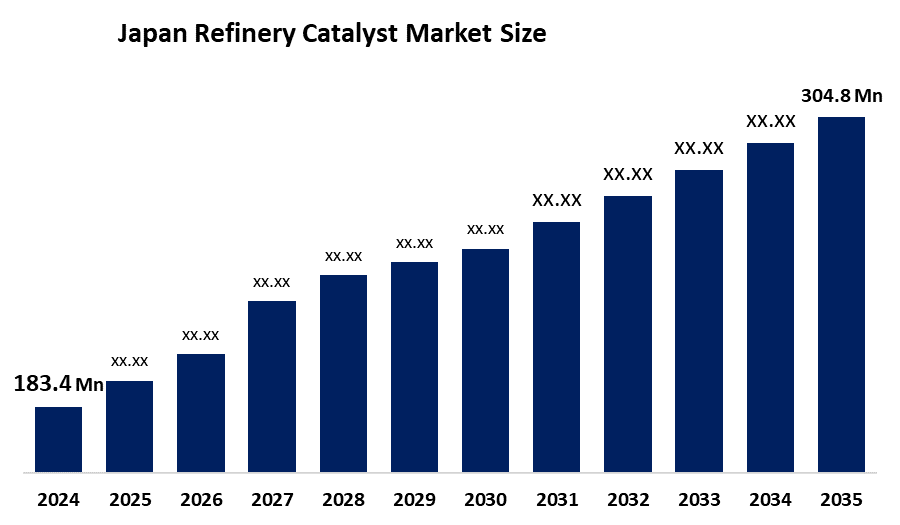
- Japan Refinery Catalyst Market Size 2024: USD 183.4 Mn
- Japan Refinery Catalyst Market Size 2035: USD 304.8 Mn
- Japan Refinery Catalyst Market CAGR 2024: 4.73%
- Japan Refinery Catalyst Market Segments: Type and Material
Get more details on this report -
The Japan refinery catalyst market includes the entire economic and industrial environment for producing, supplying and using refinery catalysts in the oil refinery industry in Japan. Refinery catalysts are special chemicals used to enhance process efficiency and reduce emissions by optimising critical chemical reactions within crude oil refineries, such as hydrocracking, catalytic reforming, and hydrotreating fluid catalytic cracking. In Japan, where all refineries are technologically advanced, and designed to produce clean and high-quality fuels and specialty petrochemicals catalysts play an important role in improving the process efficiencies of refineries and reducing emissions.
The refining catalyst in Japan are backed by government support, including the Green Innovation Fund, established by the Ministry of Economy, Trade and Industry (METI) under the New Energy and Industrial Technology Development Organization (NEDO) to accelerate decarbonization technologies and innovation across sectors as part of the country’s 2030 and 2050 carbon neutrality goals.
As technology advances, Japanese refining catalyst providers are now using next generation catalysis materials specifically designed for more stringent fuel standards and tougher feed stocks. They have been developed to provide improved hydroprocessing capabilities through the utilization of superior performing catalysts. These catalysts will increase refinery throughput, minimize energy consumption and provide improved performance from an operational standpoint with better predictive maintenance capabilities, thus increasing overall refinery efficiency and lowering operating expenses.
Market Dynamics of the Japan Refinery Catalyst Market:
The Japan refinery catalyst market is driven by the stringent environmental regulations and fuel quality standards, ongoing demand for high-value refined products, rise in technologically advanced refining industry, Japan’s strategic focus on energy efficiency and reducing greenhouse gas emissions, high investment in catalyst technologies support sustainability goals, the expansion of petrochemical production, and growing interest in renewable feedstock such as biofuels present additional demand drivers for specialized catalysts.
The Japan refinery catalyst market is restrained by the high development and implementation costs for advanced catalysts, complex manufacturing, long catalyst replacement cycles issues, challenges related to deactivation and performance degradation over time, fluctuating prices adds supply chain vulnerabilities that can constrain market growth.
The future of Japan refinery catalyst market is bright and promising, with versatile opportunities emerging from continuous shift to sustainability and the principles of a circular economy, the potential for catalyst recycling and regeneration services to convert spent catalysts into valuable commodities increases. In addition, there is an increasing opportunity for refining technologies that facilitate the development of renewable and low-carbon fuel blends. Digital tools and ongoing advancements in refining catalysts sector provide additional opportunities to improve the performance of catalysts that can simultaneously meet the growing requirements for environmental compliance and performance at competitive cost within the constantly changing energy landscape of Japan.
Japan Refinery Catalyst Market Report Coverage
| Report Coverage | Details |
|---|---|
| Base Year: | 2024 |
| Market Size in 2024: | USD 183.4 Million |
| Forecast Period: | 2024-2035 |
| Forecast Period CAGR 2024-2035 : | 4.73% |
| 2035 Value Projection: | USD 304.8 Million |
| Historical Data for: | 2020-2023 |
| No. of Pages: | 240 |
| Tables, Charts & Figures: | 105 |
| Segments covered: | By Type, By Application |
| Companies covered:: | Mitsui Chemicals, Inc., JGC Catalysts and Chemicals Ltd., Tosoh Corporation, Sumitomo Chemicals Co., Ltd., Kuraray Co., Ltd., Showa Denko K.K., Hitachi Chemical Co., Ltd., Nippon Ketjen Co. Ltd., Albemarle Corporation, BASF SE, Johnson Matthey PLC, Clariant AG, Evonik Industries AG, W.R. Grace & Co., Haldor Topsoe A/S, Others, and Key Players |
| Pitfalls & Challenges: | COVID-19 Empact, Challenge, Future, Growth, & Analysis |
Get more details on this report -
Market Segmentation
The Japan Refinery Catalyst Market share is classified into type and material.
By Type:
The Japan refinery catalyst market is divided by type into fluid catalytic cracking catalysts, hydro-processing catalysts, catalytic reforming catalysts, and others. Among these, the fluid catalytic cracking catalysts segment held the largest revenue market share in 2024 and is predicted to grow at a remarkable CAGR during the forecast period. High demand for gasoline and petrochemicals, conversion of heavy feedstock, technological advancement, and stricter environmental regulations all contribute to the fluid catalytic cracking catalysts segment's largest share and higher spending on refinery catalysts when compared to other type.
By Material:
The Japan refinery catalyst market is divided by material into zeolites, metals, chemical compounds, and others. Among these, the zeolites segment dominated the share in 2024 and is anticipated to grow at a remarkable CAGR during the forecast period. The zeolites segment dominates because of high-octane gasoline production, stringent environmental regulation, technological advancements, improve refinery efficiency, and shift to petrochemicals in Japan.
Competitive Analysis:
The report offers the appropriate analysis of the key organisations/companies involved within the Japan refinery catalyst market, along with a comparative evaluation primarily based on their product offering, business overviews, geographic presence, enterprise strategies, segment market share, and SWOT analysis. The report also provides an elaborative analysis focusing on the current news and developments of the companies, which includes product development, innovations, joint ventures, partnerships, mergers & acquisitions, strategic alliances, and others. This allows for the evaluation of the overall competition within the market.
Top Key Companies in Japan Refinery Catalyst Market:
- Mitsui Chemicals, Inc.
- JGC Catalysts and Chemicals Ltd.
- Tosoh Corporation
- Sumitomo Chemicals Co., Ltd.
- Kuraray Co., Ltd.
- Showa Denko K.K.
- Hitachi Chemical Co., Ltd.
- Nippon Ketjen Co. Ltd.
- Albemarle Corporation
- BASF SE
- Johnson Matthey PLC
- Clariant AG
- Evonik Industries AG
- W.R. Grace & Co.
- Haldor Topsoe A/S
- Others
Recent Developments in Japan Refinery Catalyst Market:
In December 2025, Mitsui O.S.K. Lines & JERA announced the launch of Japan’s first large-scale low-carbon ammonia transportation project to establish a commercial-scale value chain, which serves as a key raw material and hydrogen carrier in downstream refining.
In May 2025, Nippon Shokubai Co., Ltd. developed the V/TSM catalyst, which maintains high performance in industrial applications even at temperature below 200 Celsius, addressing efficiency needs in refining processes.
Key Target Audience
- Market Players
- Investors
- End-users
- Government Authorities
- Consulting and Research Firm
- Venture capitalists
- Value-Added Resellers (VARs)
Market Segment
This study forecasts revenue at the Japan, regional, and country levels from 2020 to 2035. Decisions Advisors has segmented the Japan refinery catalyst market based on the below-mentioned segments:
Japan Refinery Catalyst Market, By Type
- Fluid Catalytic Cracking Catalysts
- Hydro Processing Catalysts
- Catalytic Reforming Catalysts
- Others
Japan Refinery Catalyst Market, By Material
- Zeolites
- Metals
- Chemical Compounds
Frequently Asked Questions (FAQ)
-
Q: What is the Japan refinery catalyst market size?A: Japan refinery catalyst market is expected to grow from USD 183.4 million in 2024 to USD 304.8 million by 2035, growing at a CAGR of 4.73% during the forecast period 2025-2035.
-
Q: What are the key growth drivers of the market?A: Market growth is driven by the stringent environmental regulations and fuel quality standards, ongoing demand for high-value refined products, rise in technologically advanced refining industry, Japan’s strategic focus on energy efficiency and reducing greenhouse gas emissions, high investment in catalyst technologies support sustainability goals, the expansion of petrochemical production, and growing interest in renewable feedstock such as biofuels present additional demand drivers for specialized catalysts.
-
Q: What factors restrain the Japan refinery catalyst market?A: Constraints include the high development and implementation costs for advanced catalysts, complex manufacturing, long catalyst replacement cycles issues, challenges related to deactivation and performance degradation over time, fluctuating prices adds supply chain vulnerabilities that can constrain market growth.
-
Q: How is the market segmented by material?A: The market is segmented into zeolites, metals, and chemical compounds.
-
Q: Who are the key players in the Japan refinery catalyst market?A: Key companies include Mitsui Chemicals, Inc., JGC Catalysts and Chemicals Ltd., Tosoh Corporation, Sumitomo Chemicals Co., Ltd., Kuraray Co., Ltd., Showa Denko K.K., Hitachi Chemical Co., Ltd., Nippon Ketjen Co. Ltd., Albemarle Corporation, BASF SE, Johnson Matthey PLC, Clariant AG, Evonik Industries AG, W.R. Grace & Co., Haldor Topsoe A/S, and Others.
-
Q: Who are the target audiences for this market report?A: The report targets market players, investors, end-users, government authorities, consulting and research firms, venture capitalists, and value-added resellers (VARs).
Need help to buy this report?