Japan predictive maintenance market Size, Share, By Technology (IoT, AI & Machine Learning, Digital Twin, and Advanced Analytics), By Application (Condition Monitoring, Predictive Analytics, Remote Monitoring, Asset Tracking, and Maintenance Scheduling), By End-Use (Military & Defence, Energy & Utilities, Manufacturing, Healthcare, IT and Telecom, Logistics & Transportation), Japan Predictive Maintenance Market Industry Trend, Forecasts to 2035.
Industry: Information & Technology
Japan Predictive Maintenance Market Insights Forecasts to 2035
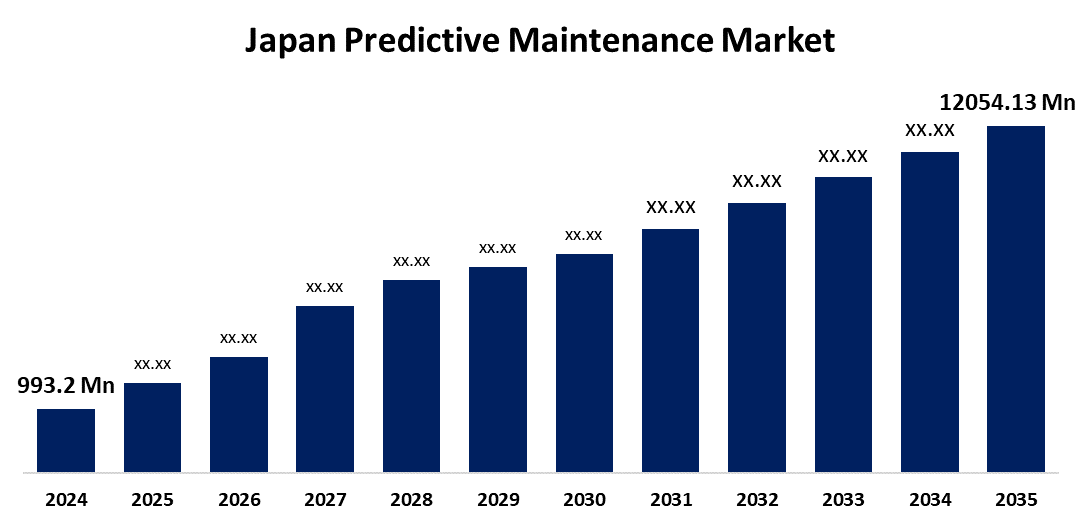
- Japan Predictive Maintenance Market Size 2024: USD 993.2 Million
- Japan Predictive Maintenance Market Size 2035: USD 12054.13 Million
- Japan Predictive Maintenance Market CAGR 2024: 25.47%
- Japan Predictive Maintenance Market Segments: Technology, Application, and End Use.
Get more details on this report -
Japan’s predictive maintenance market refers to technologies and services that use data, sensors, and software to predict when machines or equipment may fail. Companies use tools such as artificial intelligence, IoT sensors, and data analytics to monitor equipment health. This helps businesses repair machines before breakdowns happen, reducing downtime, saving maintenance costs, and improving productivity in industries like manufacturing, energy, and transportation. Furthermore, the Japan predictive maintenance market is growing due to Japan’s strong manufacturing industry and increasing use of smart technologies. Companies are adopting artificial intelligence, machine learning, and IoT sensors to monitor machines in real time. These tools help predict failures and improve operational efficiency. The shift toward smart factories and automation is also increasing demand for predictive maintenance solutions.
The Japan government supports predictive maintenance through digital transformation and smart manufacturing initiatives. Policies promoting Industry 4.0 technologies, automation, and smart infrastructure encourage companies to adopt advanced monitoring systems. Investments in smart cities and digital industrial development also promote predictive maintenance technologies that improve efficiency, safety, and sustainability in industrial operations.
Japan’s predictive maintenance market trends include increasing use of artificial intelligence, machine learning, and IoT-based sensors to monitor equipment performance. Cloud-based predictive maintenance platforms are also becoming popular because they allow companies to store and analyse large data sets. Real-time monitoring, digital twins, and advanced analytics are helping organisations detect machine problems earlier and improve maintenance planning.
Market Dynamics of the Japan Predictive Maintenance Market:
The Japan predictive maintenance market is driven by factors such as the need to reduce machine downtime, improve productivity, and lower maintenance costs. Many industries rely on complex equipment, making predictive maintenance essential for avoiding unexpected failures. Japan’s advanced industrial base, high automation levels, and growing adoption of AI-driven monitoring systems are pushing companies to implement predictive maintenance solutions.
The Japan predictive maintenance market faces several restraints that may slow adoption. High upfront costs for installing IoT sensors, analytics platforms, and monitoring systems can be difficult for small and medium-sized companies. Integration with older industrial equipment is also complex and time-consuming. In addition, concerns about data security, system reliability, and a shortage of skilled professionals who can analyse maintenance data may limit wider implementation across industries.
The opportunities as industries continue digital transformation and smart manufacturing adoption. Expanding use of IoT devices, cloud platforms, and AI analytics will create demand for predictive maintenance services. Growth in sectors such as energy, transportation, and manufacturing will further increase adoption. Companies that develop advanced analytics and automated maintenance solutions can benefit significantly.
Market Segmentation
Japan Predictive Maintenance Market Report Coverage
| Report Coverage | Details |
|---|---|
| Base Year: | 2024 |
| Market Size in 2024: | USD 993.2 Million |
| Forecast Period: | 2025-2035 |
| Forecast Period CAGR 2025-2035 : | 25.47 % |
| 2035 Value Projection: | USD 12054.13 Million |
| Historical Data for: | 2020-2023 |
| No. of Pages: | 210 |
| Tables, Charts & Figures: | 89 |
| Segments covered: | By Technology, By Application, By End Use |
| Companies covered:: | Sony AI, Toshiba Digital Solutions Corporation, Hitachi Vantara, NEC Corporation, Mitsubishi Electric Corporation, Fujitsu Limited, Omron Corporation, Yokogawa Electric Corporation, NTT Data, Panasonic Corporation, and others. |
| Pitfalls & Challenges: | COVID-19 Impact, Challenges, Future, Growth, & Analysis |
Get more details on this report -
The Japan predictive maintenance market share is classified into technology, applications, and end users.
By Technology:
The Japan predictive maintenance market is divided by technology into IoT, AI & machine learning, digital twin, and advanced analytics. Among these, the IoT segment dominated the share in 2024 and is anticipated to grow at a remarkable CAGR during the forecast period. The IoT segment dominates due to IoT sensors, enable real-time monitoring of industrial equipment. These sensors collect data such as temperature, vibration, and pressure, helping companies detect issues early. Japan’s strong manufacturing base and growing smart factory adoption increase IoT use, as it provides the essential data needed for predictive maintenance systems and analytics.
By Application:
The Japan predictive maintenance market is divided by application into condition monitoring, predictive analytics, remote monitoring, asset tracking, and maintenance scheduling. Among these, the condition monitoring segment dominated the share in 2024 and is anticipated to grow at a remarkable CAGR during the forecast period. The Condition Monitoring segment dominates because industries need continuous tracking of machine health. Sensors collect real-time data like vibration, temperature, and pressure to detect early faults. This helps companies prevent equipment failure, reduce downtime, lower repair costs, and maintain high productivity in Japan’s advanced manufacturing sector.
By End Users:
The Japan predictive maintenance market is divided by end use into military & defence, energy & utilities, manufacturing, healthcare, it and telecom, logistics & transportation. Among these, the manufacturing segment dominated the share in 2024 and is anticipated to grow at a remarkable CAGR during the forecast period. The manufacturing segment dominated because Japan’s industrial sector is highly advanced, with industries like automotive, electronics, and heavy machinery relying on complex equipment. Continuous monitoring prevents unexpected breakdowns, reduces downtime, lowers maintenance costs, and ensures high productivity, making predictive maintenance essential in manufacturing compared to other end-use sectors.
Competitive Analysis:
The report offers the appropriate analysis of the key organisations/companies involved within the Japan Predictive Maintenance Market, along with a comparative evaluation primarily based on their product offering, business overviews, geographic presence, enterprise strategies, segment market share, and SWOT analysis. The report also provides an elaborate analysis focusing on the current news and developments of the companies, which includes product development, innovations, joint ventures, partnerships, mergers & acquisitions, strategic alliances, and others. This allows for the evaluation of the overall competition within the market.
Top Key Companies in Japan Predictive Maintenance Market:
- Sony AI
- Toshiba Digital Solutions Corporation
- Hitachi Vantara
- NEC Corporation
- Mitsubishi Electric Corporation
- Fujitsu Limited
- Omron Corporation
- Yokogawa Electric Corporation
- NTT Data
- Panasonic Corporation
- Others
Key Target Audience
- Market Players
- Investors
- End-users
- Government Authorities
- Consulting and Research Firm
- Venture capitalists
- Value-Added Resellers (VARs)
Market Segment
This study forecasts revenue at the Japan, regional, and country levels from 2020 to 2035. Decisions advisors has segmented the Japan predictive maintenance market based on the below-mentioned segments:
Japan Predictive Maintenance Market, By Technology.
- IoT
- AI & Machine Learning
- Digital Twin
- Advanced Analytics
Japan Predictive Maintenance Market, By Application
- Condition Monitoring
- Predictive Analytics
- Remote Monitoring
- Asset Tracking
- Maintenance Scheduling
Japan Predictive Maintenance Market, By End Use.
- Military & Defence
- Energy & Utilities
- Manufacturing
- Healthcare
- IT and Telecom
- Logistics & Transportation
Frequently Asked Questions (FAQ)
-
What is the Japan predictive maintenance market size?Japan predictive maintenance market is expected to grow from USD 993.2 million in 2024 to USD 12054.13 million by 2035, growing at a CAGR of 25.47 % during the forecast period 2025-2035.
-
What are the key growth drivers of the Japan predictive maintenance market?The Japan predictive maintenance market includes Rising automation, smart factory adoption, IoT and AI integration, and the need to reduce downtime.
-
What factors restrain the Japan predictive maintenance market?The Japan predictive maintenance market is restrained by High installation costs, data integration challenges, cybersecurity concerns, and a shortage of skilled professionals.
-
How is the Japan predictive maintenance market segmented by application?The Japan predictive maintenance market is segmented into condition monitoring, predictive analytics, remote monitoring, asset tracking, and maintenance scheduling
-
Who are the key players in the Japan Predictive Maintenance Market?The Japan predictive maintenance market is led by companies such as Sony AI, Toshiba Digital Solutions Corporation, Hitachi Vantara, NEC Corporation, Mitsubishi Electric Corporation, Fujitsu Limited, Omron Corporation, Yokogawa Electric Corporation, NTT Data, Panasonic Corporation, and others.
Need help to buy this report?