Japan Predictive Analytics Market Size, Share, By Component (Solutions and Services), By End-use (Aerospace & Defense, Automotive & Transportation, BFSI, Healthcare, IT & Telecommunication, Media & Entertainment, Retail and E-commerce, and Others), Japan Predictive Analytics Market Insights, Industry Trend, Forecasts to 2035
Industry: Information & Technology
Japan Predictive Analytics Market Insights Forecasts to 2035
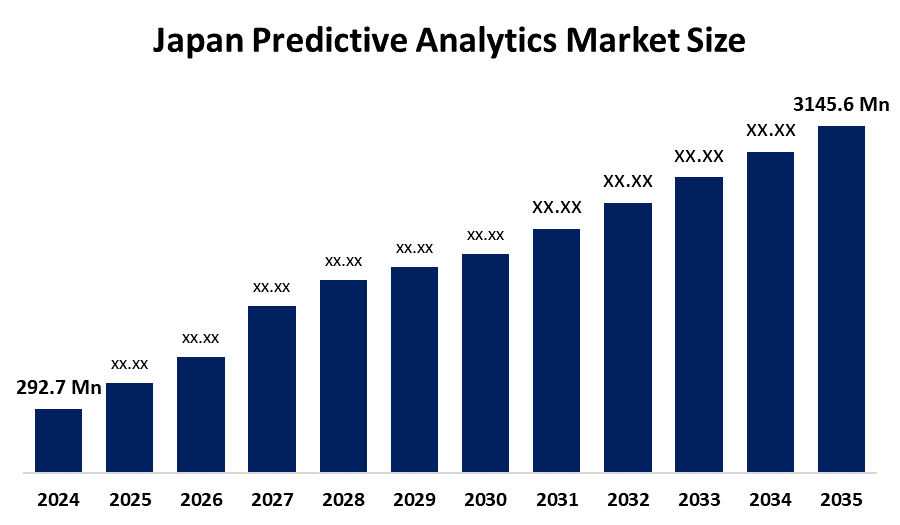
- Japan Predictive Analytics Market Size 2024: USD 292.7 Mn
- Japan Predictive Analytics Market Size 2035: USD 3145.6 Mn
- Japan Predictive Analytics Market CAGR 2024: 24.09%
- Japan Predictive Analytics Market Segments: Component and End-Use.
Get more details on this report -
The Japanese predictive analytics market encompasses a comprehensive ecosystem of technology and solutions that leverage historical and real-time data and employ advanced algorithmic and statistical modelling techniques to predict future trends, behaviours, and outcomes. The predictive analytics market in Japan leverages technology such as artificial intelligence (AI) and machine learning (ML), along with the use of large amounts of data and cloud computing, to allow organisations to use data in decision-making across various sectors, including finance, retail, healthcare, manufacturing, telecommunications, and supply chain.
The Japanese government actively supports the growth of the predictive analytics industry through the implementation of several national digital strategies that promote data usage, integration of AI, and digital literacy. As part of its goal to build a Data Inclusive Society, the Japanese Government has developed policies and initiatives that promote the application of advanced digital technologies (including but not limited to AI, Machine Learning, and Predictive Analytics.
Technological developments are rapidly changing the predictive analytics landscape in Japan. Recent developments in predictive analytics include the integration of AI/ML models with big data platforms to increase forecasting accuracy and speed, as well as the ability for organisations to quickly and easily access the cost-effective, scalable, and flexible capabilities of cloud-based predictive analytics solutions. Predictive analytics is becoming an integral part of the internet of things (IoT) ecosystem as well. Companies within the manufacturing and logistics industries are utilising predictive analytics to forecast maintenance issues in real-time by integrating best-practice-based manufacturing execution systems (MES) into their supply chain operations.
Japan Predictive Analytics Market Report Coverage
| Report Coverage | Details |
|---|---|
| Base Year: | 2024 |
| Market Size in 2024: | USD 292.7 Million |
| Forecast Period: | 2025-2035 |
| Forecast Period CAGR 2025-2035 : | 24.09% |
| 2035 Value Projection: | USD 3145.6 Million |
| Historical Data for: | 2020-2023 |
| No. of Pages: | 190 |
| Tables, Charts & Figures: | 120 |
| Segments covered: | By Component, By End-Use |
| Companies covered:: | IBM, SAS Institute, Microsoft, Oracle, SAP, Fujitsu, Hitachi, TIBCO Software, Qlik & Alteryx, and other key players |
| Pitfalls & Challenges: | COVID-19 Empact, Challenge, Future, Growth, & Analysis |
Get more details on this report -
Market Dynamics of the Japan Predictive Analytics Market:
The Japanese predictive analytics market is driven by significant movement toward data-driven decision-making, the widespread use of AI and machine learning technology, and rapid digital transformation in industries such as finance, retail, healthcare, and manufacturing. Cloud-based analytics usage improves scalability and lowers infrastructure costs, making predictive analytics more affordable for organisations. Growing demand for operational efficiency, predictive maintenance, individualised customer experiences, and risk management is also driving market expansion.
the Japan predictive analytics market is restrained by data privacy and governance problems, the complexities of integrating predictive analytics with older systems, and a lack of sophisticated analytics and AI expertise. High implementation costs and low analytics maturity among small and medium-sized businesses might stymie adoption.
Growth opportunities of the Japanese predictive analytics market include AI-powered analytics, IoT and edge analytics integration, industry-specific solutions, and other cloud-native analytics services. Japan's commitment to digital innovation through Society 5.0, as well as increased expenditures in data infrastructure, is driving growing demand for predictive analytics, notably in smart manufacturing, smart cities, and supply chain optimisation.
Market Segmentation
The Japan Predictive Analytics Market share is classified into component and end-use.
By Component:
The Japan Predictive Analytics market is divided by component into solutions and services. Among these, the solutions segment dominated the market share in 2024 and is anticipated to grow at the highest CAGR during the predicted timeframe. This is due to the increasing demand for enhanced analytical tools that enable data-driven decision-making. Organisations across all sectors are investing extensively in predictive analytics solutions to optimise operational efficiency, improve customer experiences, and gain a competitive edge.
By End-Use:
The Japan Predictive Analytics market is divided by end-use into aerospace & defense, automotive & transportation, BFSI, healthcare, IT & telecommunication, media & entertainment, retail and e-commerce, and others. Among these, the BFSI segment dominated the market share in 2024 and is anticipated to grow at a significant CAGR during the forecast period. This is because data analytics are increasingly used for risk management, fraud detection, and regulatory compliance. As the BFSI sector undergoes digital transformation, implementing predictive analytics solutions improves client experiences and simplifies processes.
Competitive Analysis:
The report offers the appropriate analysis of the key organisations/companies involved within the Japan Predictive Analytics market, along with a comparative evaluation primarily based on their product offering, business overviews, geographic presence, enterprise strategies, segment market share, and SWOT analysis. The report also provides an elaborative analysis focusing on the current news and developments of the companies, which includes product development, innovations, joint ventures, partnerships, mergers & acquisitions, strategic alliances, and others. This allows for the evaluation of the overall competition within the market.
Top Key Companies in Japan Predictive Analytics Market:
- IBM
- SAS Institute
- Microsoft
- Oracle
- SAP
- Fujitsu
- Hitachi
- TIBCO Software
- Qlik & Alteryx
- Others
Key Target Audience
- Market Players
- Investors
- End-Uses
- Government Authorities
- Consulting and Research Firm
- Venture capitalists
- Value-Added Resellers (VARs)
Market Segment
This study forecasts revenue at the Japan, regional, and country levels from 2020 to 2035. Spherical Insights has segmented the Japan Predictive Analytics market based on the below-mentioned segments:
Japan Predictive Analytics Market, By Component
- Solutions
- Services
Japan Predictive Analytics Market, End-Use
- Aerospace & Defense
- Automotive & Transportation
- BFSI
- Healthcare
- IT & Telecommunication
- Media & Entertainment
- Retail and E-commerce
- Others
Frequently Asked Questions (FAQ)
-
Q: What is the market size and growth forecast for Japan predictive analytics?A: The predictive analytics market was valued at USD 292.7 million in 2024 and is projected to reach USD 3145.6 million by 2035, growing at a CAGR of 24.09% during the forecast period 2025–2035.
-
Q: Which component segment dominates the Japan predictive analytics market?A: The solutions segment dominates the market due to rising demand for advanced analytical tools that enable organisations to make data-driven decisions, optimise efficiency, and gain a competitive edge.
-
Q: Which end-use segment is the largest in Japan's predictive analytics?A: The BFSI (Banking, Financial Services, and Insurance) sector holds the largest market share, driven by the need for risk management, fraud detection, regulatory compliance, and improved client experiences.
-
Q: What are the key drivers of the Japan predictive analytics market?A: Market growth is driven by the adoption of AI and machine learning, digital transformation across industries, the need for operational efficiency, predictive maintenance, personalised customer experiences, and risk management.
-
Q: What are the challenges restraining market growth?A: Restraining factors include data privacy and governance issues, integration complexities with legacy systems, lack of advanced analytics expertise, high implementation costs, and low analytics maturity among SMEs.
-
Q: Who are the major players in the Japan predictive analytics market?A: Key players include IBM, SAS Institute, Microsoft, Oracle, SAP, Fujitsu, Hitachi, TIBCO Software, Qlik, Alteryx, and other regional and international vendors providing analytics solutions and services in Japan.
-
Q: Who are the target audiences for this market report?A: The report targets market players, investors, End-Uses, government authorities, consulting and research firms, venture capitalists, and value-added resellers (VARs).
Need help to buy this report?