Japan Methionine Market Size, Share, By Type (Dl-Methionine, Methionine Hydroxy Analog, and L-Methionine), By Application (Animal Feed, Food & Dietary Supplements, Pharmaceuticals, and Others), Japan Methionine Market Insights, Industry Trend, Forecasts to 2035.
Industry: Chemicals & Materials
Japan Methionine Market Insights Forecasts to 2035
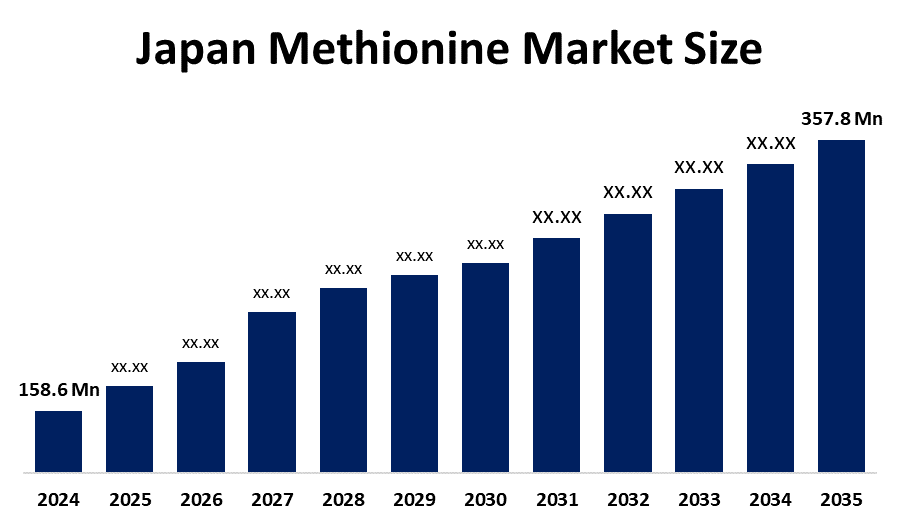
- Japan Methionine Market Size 2024: USD 158.6 Mn
- Japan Methionine Market Size 2035: USD 357.8 Mn
- Japan Methionine Market CAGR 2024: 7.68%
- Japan Methionine Market Segments: Type and Application.
Get more details on this report -
Japan's methionine market represents the overall business environment for methionine, which is an essential sulfur-based amino acid that is used for protein synthesis in humans and livestock and is found within a variety of products. Methionine serves as an important feed/vitamin additive in the poultry and aquaculture industries to promote growth and maximize protein utilization. There has been a growing trend to produce methionine using bio-based production methods and to increase the amount of pharmaceutical grade high purity methionine produced in Japan to meet the growing nutritional needs of an ageing population.
Government and private entities are determining how this marketplace will develop over the next few years. Government regulations regarding food safety and animal health are stringent in Japan, and therefore, the Japanese Government has granted a lot of encouragement, through its establishment of several initiatives and programs, for the application of methionine and other nutritional supplements that can be utilized to decrease the amount of nitrogen that is emitted by livestock producers.
In Japan, advances in production technology for methionine and advances in its use are changing how we think about producing and using methionine. The introduction of new fermentation technologies combined with metabolic engineering techniques allows for the use of an environmentally friendly method of producing L-methionine instead of relying on traditional methods that utilize petroleum or other fossil fuels. Also, with the integration of AI technology into animal feeding, the introduction of precision feeding provides a means to provide the optimum amount of methionine to our livestock at the time of feeding.
Japan Methionine Market Report Coverage
| Report Coverage | Details |
|---|---|
| Base Year: | 2024 |
| Market Size in 2024: | USD 158.6 Million |
| Forecast Period: | 2025-2035 |
| Forecast Period CAGR 2025-2035 : | CAGR Of 7.68% |
| 2035 Value Projection: | USD 357.8 Million |
| Historical Data for: | 2020-2023 |
| No. of Pages: | 223 |
| Tables, Charts & Figures: | 154 |
| Segments covered: | By Type,By Application |
| Companies covered:: | Sumitomo Chemical Co., Ltd., Ajinomoto Co., Inc., Kyowa Hakko Bio Co., Ltd., Tokyo Chemical Industry Co., Ltd.,and Others key players |
| Pitfalls & Challenges: | COVID-19 Empact, Challenge, Future, Growth, & Analysis |
Get more details on this report -
Market Dynamics of the Japan Methionine Market:
The Japanese Methionine market is driven by the need for high-quality animal proteins and growth within aquaculture. The aquaculture industry needs to add methionine as a supplement to feed fish and shrimp for optimal growth. Another contributor to growth is the increasing awareness of the importance of healthy diets and the demand for dietary supplements and functional foods enriched with methionine. Additionally, the use of advanced husbandry techniques and precision nutrition systems will also be major contributors to the increase in consumption of methionine within Japan.
The Japanese methionine market is restrained by the cost and complexity of multi-step petrochemical manufacturing processes, along with the high costs and strict government safety and emission requirements of these processes, which present significant barriers to market entry for potential new entrants.
On the other hand, there is an opportunity to develop low-carbon bio-fermentation production routes, which align with the sustainability movement. Additionally, there is a significant opportunity to develop a high-value niche for the pharmaceutical-grade methionine used in the clinical nutrition and therapy protein synthesis markets. In addition, there is potential for additional market growth through the expansion of specialized encapsulated methionine products designed specifically for ruminants.
Market Segmentation
The Japan methionine market share is classified into type and application.
By Type:
The Japanese methionine market is divided by type into Dl-methionine, methionine hydroxy analog, and L-methionine. Among these, the Dl-methionine segment held the majority share in 2024 and is anticipated to grow at a significant CAGR during the forecast period. DL-methionine, which is produced by chemical synthesis, has been extensively used as a cost-effective and thermally stable feed additive in the industrial animal nutrition business.
By Application:
The Japan methionine market is divided by application into animal feed, food & dietary supplements, pharmaceuticals, and others. Among these, the Animal feed segment dominated the market in 2024 and is anticipated to grow at a remarkable CAGR during the forecast period. Methionine, a crucial amino acid, is an important constituent in animal feeds because it promotes development and production. As a result, there is an increasing trend of employing methionine-based feed additives to improve animal health and production.
Competitive Analysis:
The report offers the appropriate analysis of the key organisations/companies involved within the Japan Methionine market, along with a comparative evaluation primarily based on their product offering, business overviews, geographic presence, enterprise strategies, segment market share, and SWOT analysis. The report also provides an elaborative analysis focusing on the current news and developments of the companies, which includes product development, innovations, joint ventures, partnerships, mergers & acquisitions, strategic alliances, and others. This allows for the evaluation of the overall competition within the market.
Top Key Companies in Japan Methionine Market:
- Sumitomo Chemical Co., Ltd.
- Ajinomoto Co., Inc.
- Kyowa Hakko Bio Co., Ltd.
- Tokyo Chemical Industry Co., Ltd.
- Others
Key Target Audience
- Market Players
- Investors
- End-users
- Government Authorities
- Consulting and Research Firm
- Venture capitalists
- Value-Added Resellers (VARs)
Market Segment
This study forecasts revenue at the Japan, regional, and country levels from 2020 to 2035. Spherical Insights has segmented the Japan methionine market based on the below-mentioned segments:
Japan Methionine Market, By Type
- Dl-Methionine
- Methionine Hydroxy Analog
- L-Methionine
Japan Methionine Market, By Application
- Animal Feed
- Food & Dietary Supplements
- Pharmaceuticals
- Others
Frequently Asked Questions (FAQ)
-
Q: What is the market size and growth forecast for the Japan methionine market?A: The market was valued at USD 158.6 million in 2024 and is expected to reach USD 357.8 million by 2035, growing at a CAGR of 7.68% during the forecast period 2025–2035.
-
Q: Which type of segment dominates the Japan methionine market?A: The DL-methionine segment dominated the market in 2024 due to its cost-effectiveness, thermal stability, and widespread use as a feed additive in industrial animal nutrition.
-
Q: Which application segment holds the largest share in the Japan methionine market?A: The animal feed segment led the market in 2024, driven by strong demand from poultry, livestock, and aquaculture industries to enhance growth performance and feed efficiency.
-
Q: What are the key drivers of the Japan methionine market?A: Major drivers include rising demand for high-quality animal protein, growth in aquaculture, increasing health awareness among consumers, expansion of dietary supplements, and adoption of precision nutrition practices.
-
Q: What challenges restrain the growth of the Japan methionine market?A: The market is restrained by the high cost and complexity of petrochemical-based manufacturing processes, strict environmental and safety regulations, and high barriers to entry for new market participants.
-
Q: Who are the target audiences for the Japan methionine market report?A: The report targets market players, investors, end-users, government authorities, consulting and research firms, venture capitalists, and value-added resellers (VARs).
Need help to buy this report?