Japan Healthcare Fraud Analytics Market Size, Share, and COVID-19 Impact Analysis, By Type (Descriptive, Predictive, and Prescriptive), By Delivery Mode (On-Premises, Cloud-Based), By End User (Payers, Providers, Government agencies, Third-Party Administrators, and Consulting Firms), and Japan Healthcare Fraud Analytics Market Insights, Industry Trend, Forecasts to 2035
Industry: Healthcare
Japan Healthcare Fraud Analytics Market Insights Forecasts to 2035
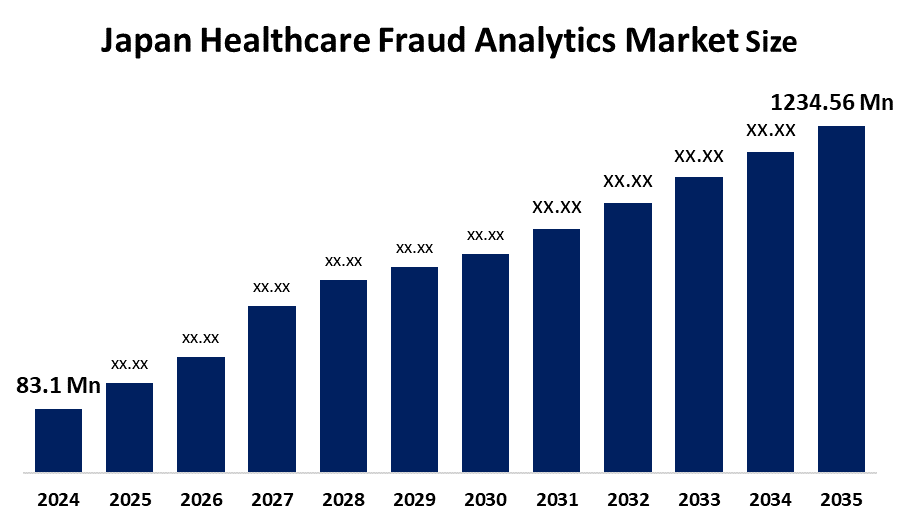
- The Japan Healthcare Fraud Analytics Market Size Was Estimated at USD 83.1 Million in 2024
- The Market Size is Expected to Grow at a CAGR of Around 27.8% from 2025 to 2035
- The Japan Healthcare Fraud Analytics Market Size is Expected to Reach USD 1234.56 Million by 2035
Get more details on this report -
According to a research report published by Spherical Insights & Consulting, The Japan Healthcare Fraud Analytics Market Size is anticipated to reach USD 1234.56 Million by 2035, Growing at a CAGR of 27.8% from 2025 to 2035. The market for healthcare fraud analytics in Japan is mostly driven by the growth in the number of people seeking health insurance as a result of the aging population and the increasing prevalence of chronic diseases, which raises the need for healthcare fraud analytics. The healthcare fraud analytics market has prospects as a result of technical advancements in AI, ML, and data analytics that have improved the capacity to identify and address healthcare fraud.
Market Overview
A type of white-collar crime known as healthcare fraud is defined by the false filing of medical claims for illegal financial benefit, typically by dishonest medical professionals and organized crime groups. Data is now a crucial part of healthcare in the digital age. Due to the quick advancements in data sensing and acquisition technology, hospitals and other healthcare facilities have started collecting enormous volumes of patient healthcare data.
Healthcare organizations and providers are investing in AI-powered fraud analytics as a result of digital transformation projects and stricter regulatory frameworks. The goal of these initiatives is to minimize monetary losses while preserving the integrity of healthcare delivery.
84% of Japan respondents are concerned about artificial intelligence (AI)-generated phony digital identification documents. To combat scam mules, the Japan Police Force (SPF), Government Technology Agency of Japan (GovTech Japan), Monetary Authority of Japan (MAS), and Infocomm Media Development Authority (IMDA) are collaborating with business partners and limiting their access to services like banking, telecommunications, and Singpass/Corppass that could be used to enable scams.
Report Coverage
This research report categorizes the market for Japan healthcare fraud analytics market based on various segments and regions, and forecasts revenue growth and analyses trends in each submarket. The report analyses the key growth drivers, opportunities, and challenges influencing the Japan healthcare fraud analytics market. Recent market developments and competitive strategies, such as expansion, product launch, development, partnership, merger, and acquisition have been included to draw the competitive landscape in the market. The report strategically identifies and profiles the key market players and analyses their core competencies in each sub-segment of the Japan healthcare fraud analytics market.
Japan Healthcare Fraud Analytics Market Report Coverage
| Report Coverage | Details |
|---|---|
| Base Year: | 2023 |
| Market Size in 2023: | USD 83.1 Million |
| Forecast Period: | 2025-2035 |
| Forecast Period CAGR 2025-2035 : | 27.8% |
| 2035 Value Projection: | USD 1234.56 Million |
| Historical Data for: | 2020-2023 |
| No. of Pages: | 210 |
| Tables, Charts & Figures: | 103 |
| Segments covered: | By Type, By Delivery Mode, By End User |
| Companies covered:: | LAC Co., Ltd., Mitsubishi Chemical Group Corp., Takeda Pharmaceutical Co., Ltd., Sompo Japan Insurance Inc, Others, and key players. |
| Pitfalls & Challenges: | COVID-19 Impact, Challenges, Future, Growth, & Analysis |
Get more details on this report -
Driving Factors
The healthcare fraud analytics market in Japan is driven by the rising medical costs that create opportunities for false claims, which makes the use of advanced analytics essential. Additionally, a broad adoption of AI and data analytics in healthcare facilities for the detection and prevention of false claims. Additionally, as healthcare organizations face an increase in healthcare fraud related to identity theft, billing errors, and the manipulation of patients' medical records, the need for protective detection grows and propels market expansion. This is due to regulatory pressures and complaints that are mandated.
Restraining Factors
The Japan healthcare fraud analytics market is constrained by the expenses related to the implementation, integration, and upkeep of fraud analytics systems. restricted funding and resources, undertrained staff, inadequate training, and sometimes erroneous and incomplete medical data, which hinders the process of identifying fraudulent claims and wastes money.
Market Segmentation
The Japan healthcare fraud analytics market share is classified into type, delivery mode, and end user.
- The descriptive accounted for the largest revenue market share in 2024 and is expected to grow at a significant CAGR during the forecast period.
The Japan healthcare fraud analytics market is segmented by type into descriptive, predictive, and prescriptive. Among these, the descriptive segment accounted for the largest revenue market share in 2024 and is expected to grow at a significant CAGR during the forecast period. The growth of the segment is driven by Governmental organizations, insurance providers, and healthcare providers can identify strange billing practices, systemic inefficiencies, and abnormal claim trends with the help of this technique. Descriptive analytics, which provides user-friendly dashboards and visualizations that facilitate the identification of possible fraud hotspots by stakeholders, is a crucial initial step in the fraud detection cycle. Its affordability and ease of connection with existing healthcare IT systems are other factors contributing to its high adoption rate.
- The on-premises segment dominated the market in 2024 and is projected to grow at a substantial CAGR during the forecast period.
The Japan healthcare fraud analytics market is segmented by delivery mode into on-premises, cloud-based. Among these, the on-premises segment accounted for the largest revenue share in 2024 and is expected to grow at a significant CAGR during the forecast period. The segmental growth is driven by the analytics solution should be integrated into the healthcare organization's physical infrastructure. Healthcare data is frequently sensitive, and strict privacy laws frequently apply to it. By utilizing on-premises deployment, companies may guarantee adherence to industry norms and have more authority over security protocols.
- The government agencies segment accounted for the largest revenue market share in 2024 and is expected to grow at a significant CAGR during the forecast period.
The Japan healthcare fraud analytics market is segmented by end user into payers, providers, government agencies, third-party administrators, and consulting firms. Among these, the government agencies segment accounted for the largest revenue market share in 2024 and is expected to grow at a significant CAGR during the forecast period. The growth of the segment is driven by a rise in the number of patients in government hospitals and the increased vulnerability of government institutions to fraudulent activities, particularly in developing nations with less advanced infrastructure.
Competitive Analysis:
The report offers the appropriate analysis of the key organizations/companies involved within the Japan healthcare fraud analytics market, along with a comparative evaluation primarily based on their product offering, business overviews, geographic presence, enterprise strategies, segment market share, and SWOT analysis. The report also provides an elaborate analysis focusing on the current news and developments of the companies, which includes product development, innovations, joint ventures, partnerships, mergers & acquisitions, strategic alliances, and others. This allows for the evaluation of the overall competition within the market.
List of Key Companies
- LAC Co., Ltd.
- Mitsubishi Chemical Group Corp.
- Takeda Pharmaceutical Co., Ltd.
- Sompo Japan Insurance Inc
- Others
Key Target Audience
- Market Players
- Investors
- End-users
- Government Authorities
- Consulting and Research Firm
- Venture capitalists
- Value-Added Resellers (VARs)
Market Segment
This study forecasts revenue at the Japan, regional, and country levels from 2020 to 2035. Spherical Insights has segmented the Japan Healthcare Fraud Analytics Market based on the below-mentioned segments:
Japan Healthcare Fraud Analytics Market, By Type
- Descriptive
- Predictive
- Prescriptive
Japan Healthcare Fraud Analytics Market, By Delivery Mode
- On-Premises
- Cloud-Based
Japan Healthcare Fraud Analytics Market, By End User
- Payers
- Providers
- Government agencies
- Third-Party Administrators
- Consulting Firms
Frequently Asked Questions (FAQ)
-
Q: What is the Japan Healthcare Fraud Analytics market size?A: The Japan Healthcare Fraud Analytics Market size is expected to grow from USD 83.1 million in 2024 to USD 1234.56 billion by 2035, growing at a CAGR of 27.8% during the forecast period 2025-2035.
-
Q: What are the key growth drivers of the market?A: Market growth is driven by the rising medical costs that create opportunities for false claims, which makes the use of advanced analytics essential. Additionally, a broad adoption of AI and data analytics in healthcare facilities for the detection and prevention of false claims. Additionally, as healthcare organizations face an increase in healthcare fraud related to identity theft, billing errors, and the manipulation of patients' medical records, the need for protective detection grows and propels market expansion. This is due to regulatory pressures and complaints that are mandated.
-
Q: What factors restrain the Japan healthcare fraud analytics market?A: Constraints include the expenses related to the implementation, integration, and upkeep of fraud analytics systems. restricted funding and resources, undertrained staff, inadequate training, and sometimes erroneous and incomplete medical data, which hinders the process of identifying fraudulent claims and wastes money.
-
Q: How is the market segmented by type?A: The market is segmented into descriptive, predictive, and prescriptive.
-
Q: Who are the target audiences for this market report?A: The report targets market players, investors, end user, government authorities, consulting and research firms, venture capitalists, and value-added resellers (VARs).
Need help to buy this report?