Japan Healthcare Cybersecurity Market Size, Share, By Type (Solutions and Services), By Type of Threat (Malware, DDoS, Advanced Persistent Threat, Spyware, Lost or Stolen Devices, and Others), By End-Use (Pharmaceuticals, Medical Devices, Payers, Hospitals, and Others), Japan Healthcare Cybersecurity Market Insights, Industry Trend, Forecasts to 2035
Industry: Healthcare
Japan Healthcare Cybersecurity Market Insights Forecasts to 2035
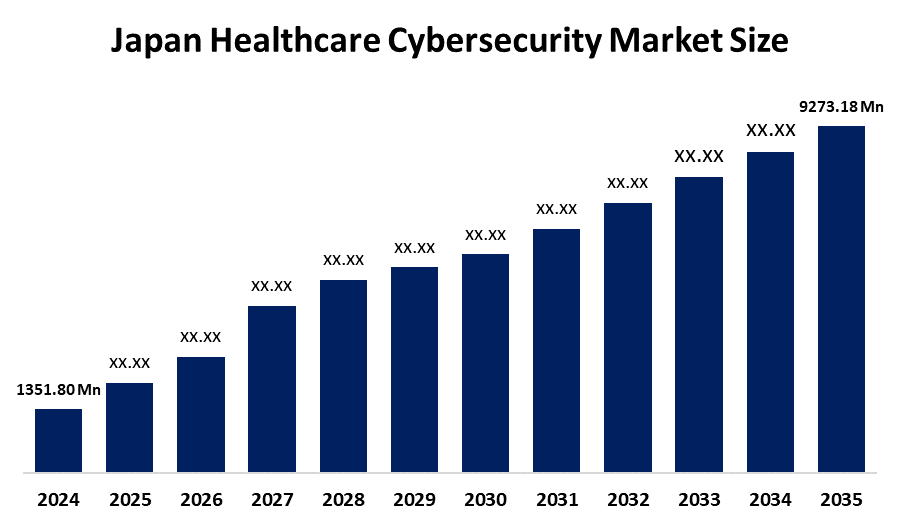
- Japan Healthcare Cybersecurity Market Size 2024: USD 1351.80 Million
- Japan Healthcare Cybersecurity Market Size 2035: USD 9273.18 Million
- Japan Healthcare Cybersecurity Market CAGR 2024: 19.13%
- Japan Healthcare Cybersecurity Market Segments: Type, Type of Threat, and End-Use.
Get more details on this report -
Cybersecurity in healthcare in Japan is a combination of specific types of processes, protocols, solutions, and technologies that are used to keep hospitals electronic medical record systems, equipment, and patient information safe from unauthorized access, theft, and other malicious manipulation. The main drivers of growth in this segment are the increasing number of healthcare facilities that are transitioning to digital-first business models, and the fact that the availability of digital resources is becoming increasingly important to the continued success of the healthcare sector as it relates to protecting patient confidentiality and maintaining operational continuity.
The focus of the Japanese government on healthcare security has increased through the "Roadmap for the Promotion of Medical DX, which focuses on developing a unified electronic medical record nationwide by 2030, along with strong security systems. To mitigate risks or vulnerabilities, the Ministry of Health, Labour and Welfare (MHLW) has undertaken to conduct security audits of the networked connections of Japanese hospitals and has updated its "guidelines for the safe management of medical information systems.
The advancement of technology in the marketplace has come from the use of artificial intelligence (AI) and machine learning (ML) together for real-time threat detection and automating the response to threats. Increasingly, blockchain has been used for the creation of decentralized, immutable ledgers to provide secure management of patient data, as well as allow hospitals to share that information. As a result of the growth of IoT, endpoint security solutions have been created specifically to protect devices like pacemakers and insulin pumps that are connected to the internet.
Japan Healthcare Cybersecurity Market Report Coverage
| Report Coverage | Details |
|---|---|
| Base Year: | 2024 |
| Market Size in 2024: | USD 1351.80 Million |
| Forecast Period: | 2024-2035 |
| Forecast Period CAGR 2024-2035 : | 19.13% |
| 2035 Value Projection: | USD 9273.18 Million |
| Historical Data for: | 2020-2023 |
| No. of Pages: | 140 |
| Tables, Charts & Figures: | 100 |
| Segments covered: | By Type ,By Type of Threat |
| Companies covered:: | Trend Micro Incorporated, NEC Corporation, Fujitsu Limited, NTT Security (NTT Ltd.), Hitachi Systems, Ltd., Cybertrust Japan Co., Ltd., LAC Co., Ltd., FFRI Security, Inc., Nihon Cyber Defense, and Other Key Players |
| Pitfalls & Challenges: | COVID-19 Empact, Challenges, Future, Growth, & Analysis |
Get more details on this report -
Market Dynamics of the Japan Healthcare Cybersecurity Market:
The primary catalyst for the growth of the Japan Healthcare Cybersecurity Market Size in Japan is the increasing number of sophisticated cyberattacks, especially ransomware. Japanese medical services have experienced tremendous disruption due to these cyberattacks. As a result of rapid digital transformation in healthcare, including widespread implementation of electronic health records (EHRs) and telemedicine, the size of attack surfaces has increased, and that requires increasingly sophisticated security solutions. Moreover, there is a strong motivation for both the government and healthcare organizations to protect sensitive patient information, particularly in the context of Japan's aging society.
The Japan Healthcare Cybersecurity Market Size in japan restrained by the cost of implementation and ongoing maintenance, which is often prohibitive for many smaller healthcare providers and clinics, making it difficult for them to adopt a comprehensive multi-layered cybersecurity framework. Additionally, there is a severe shortage of adequately trained cybersecurity professionals in the healthcare industry, which limits the ability of many healthcare organizations to effectively manage threats and utilize advanced cybersecurity solutions.
The rapid adoption of the Internet of Medical Things (IoMT) provides an enormous market opportunity for vendors that specialize in providing cybersecurity solutions for connected medical devices. The development of AI-driven autonomous systems also creates a growing market for proactive threat hunting and real-time threat mitigation.
Market Segmentation
The Japan healthcare cybersecurity market share is classified into type, type of threat, and end-use.
By Type:
The Japan Healthcare Cybersecurity Market Size is divided by type into solutions and services. Among these, the solution segment dominated the market in 2024 and is anticipated to grow at a significant CAGR during the forecast period. Several solutions have been developed to address the various dangers. Identity and access management, risk and compliance management, Security Information and Event Management (SIEM), data encryption software, firewalls, antivirus, and antimalware software, among other things, are important solutions.
By Type of Threat:
The Japan Healthcare Cybersecurity Market Size is divided by type of threat into malware, DDoS, advanced persistent threat, spyware, lost or stolen devices, and others. Among these, the malware segment dominated the market in 2024 and is anticipated to grow at a significant CAGR during the forecast period. Malware that threatens system integrity and patient privacy, as well as Distributed Denial of Service (DDoS) assaults that impair providers' capacity to offer effective patient care.
By End-Use:
The Japan Healthcare Cybersecurity Market Size is divided by end-use into pharmaceuticals, medical devices, payers, hospitals, and others. Among these, the hospital segment held the largest market revenue share in 2024 and is anticipated to grow at a remarkable CAGR during the forecast period. Hospitals are highly vulnerable to cyber-attacks because they keep vast amounts of patient data. These attacks increased throughout the epidemic, jeopardizing private information and patient care. Such situations encourage the adoption and use of cybersecurity technologies.
Competitive Analysis:
The report offers the appropriate analysis of the key organisations/companies involved within the Japan Healthcare Cybersecurity Market Size, along with a comparative evaluation primarily based on their product offering, business overviews, geographic presence, enterprise strategies, segment market share, and SWOT analysis. The report also provides an elaborative analysis focusing on the current news and developments of the companies, which includes product development, innovations, joint ventures, partnerships, mergers & acquisitions, strategic alliances, and others. This allows for the evaluation of the overall competition within the market.
Top Key Companies in Japan Healthcare Cybersecurity Market:
- Trend Micro Incorporated
- NEC Corporation
- Fujitsu Limited
- NTT Security (NTT Ltd.)
- Hitachi Systems, Ltd.
- Cybertrust Japan Co., Ltd.
- LAC Co., Ltd.
- FFRI Security, Inc.
- Nihon Cyber Defense
- Others
Key Target Audience
- Market Players
- Investors
- End-users
- Government Authorities
- Consulting and Research Firm
- Venture capitalists
- Value-Added Resellers (VARs)
Market Segment
This study forecasts revenue at the Japan, regional, and country levels from 2020 to 2035. Spherical Insights has segmented the Japan Healthcare Cybersecurity Market Size based on the below-mentioned segments:
Japan Healthcare Cybersecurity Market, By Type
- Solutions
- Services
Japan Healthcare Cybersecurity Market, By Type of Threat
- Malware
- DDoS
- Advanced Persistent Threat
- Spyware
- Lost or Stolen Devices
- Others
Japan Healthcare Cybersecurity Market, By End-Use
- Pharmaceuticals
- Medical Devices
- Payers
- Hospitals
- Others
Frequently Asked Questions (FAQ)
-
What is the current size of the Japan healthcare cybersecurity market?The Japan healthcare cybersecurity market was valued at USD 13,510.8 million in 2024 and is projected to reach USD 92,731.8 million by 2035, growing at a CAGR of 19.13% during the forecast period.
-
What factors are driving the growth of healthcare cybersecurity in Japan?Growth is driven by rising cyberattacks such as ransomware, rapid digitalization of healthcare systems, increased use of EHRs and telemedicine, government initiatives for Medical DX, and the need to protect sensitive patient data.
-
Which segment dominates the healthcare cybersecurity market by type?The solutions segment dominated the market in 2024 due to widespread adoption of identity and access management, data encryption, SIEM, firewalls, and antimalware solutions across healthcare organizations.
-
Which type of threat holds the largest market share?Malware and DDoS attacks held the largest share in 2024 as they pose significant risks to system integrity, operational continuity, and patient privacy in hospitals and healthcare networks.
-
Which end-use segment leads the Japan healthcare cybersecurity market?Hospitals accounted for the largest market share in 2024 because they store large volumes of sensitive patient data and are highly vulnerable to cyberattacks disrupting clinical operations.
-
What are the major challenges faced by the Japanese healthcare cybersecurity market?Key challenges include high implementation and maintenance costs, limited cybersecurity budgets among smaller providers, and a shortage of skilled cybersecurity professionals in the healthcare sector.
-
Who are the key players in the Japan healthcare cybersecurity market?Major companies include Trend Micro Incorporated, NEC Corporation, Fujitsu Limited, NTT Security, Hitachi Systems Ltd., Cybertrust Japan, LAC Co., Ltd., FFRI Security, Nihon Cyber Defense, and others.
Need help to buy this report?