Japan Green Building Materials Market Size, Share, By Application (Framing & Building Structure, Insulation, Roofing, Exterior Siding, Interior Finishing, and Others), Japan Green Building Materials Market Insights, Industry Trend, Forecasts to 2035
Industry: Construction & Manufacturing
Japan Green Building Materials Market Insights Forecasts to 2035
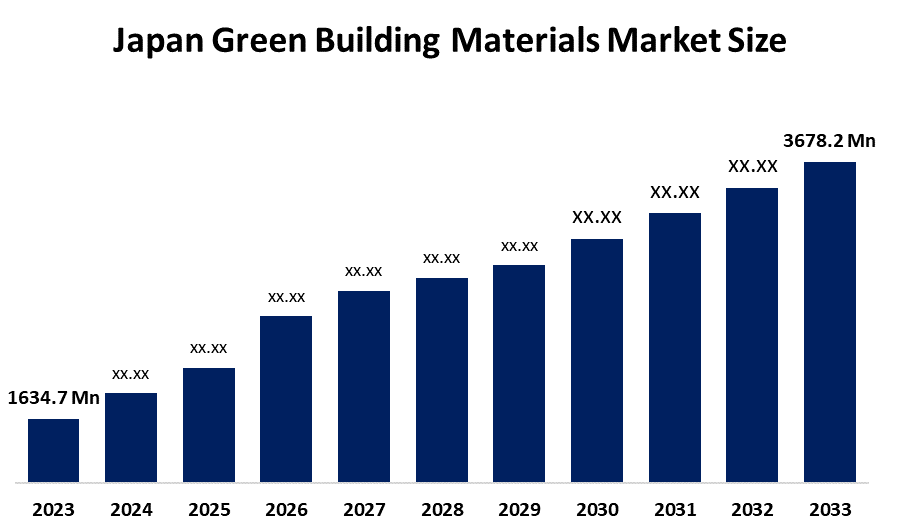
- Japan Green Building Materials Market Size 2024: USD 1634.7 Mn
- Japan Green Building Materials Market Size 2035: USD 3678.2 Mn
- Japan Green Building Materials Market CAGR 2024: 7.65%
- Japan Green Building Materials Market Segments: Application
Get more details on this report -
The Japan green building materials market is the use of environmentally sustainable, resource, efficient, and eco, friendly materials in the planning, construction, and operation of buildings. Such materials allow for energy, saving, better air quality, long, lasting, and less environmental impact. These materials are used in residential, commercial, and public infrastructure projects for applications such as framing and building structures, insulation, roofing, exterior siding, interior finishing, and other construction components. Energy, efficient buildings, disaster, resilient structures (due to seismic risks), healthier indoor environments, and reduced lifecycle operating costs are the major factors driving the demand. There are no authorized import/export data; hence this section is deliberately not included.
The market is largely driven by advanced technology smart building systems, high, performance insulation, energy, saving HVAC, BIM, IoT, AI, based monitoring, modular construction, and innovative materials like perovskite solar elements, self, healing concrete, and sustainable timber. Carbon neutrality goals of Japan, Zero Energy Building initiatives, energy efficiency regulations, and CASBEE evaluation systems that encourage low carbon, high, performance buildings, are the government supports. Future opportunities will come from the integration of renewable energy rising in use, green retrofitting of existing buildings, nature, based solutions like green roofs and vertical greenery, and the increasing demand for resilient, low, emission buildings in urban and infrastructure development.
Market Dynamics of the Japan Green Building Materials Market:
The Japan green building materials market is fueled by the government’s commitment to becoming a carbon-neutral nation by 2050, stringent energy efficiency standards, a rise in demand for disaster-proof buildings, and an adoption rate of smart building solutions. Government incentives and a drift in urban redevelopment and a pro-preference in environmentally sound and low-carbon-emission buildings pull this market forward.
The market faces challenges in high setup costs of the green material, the unavailability of specialized products in rural areas, the shortage of qualified workers in the green construction industry, and the price variance of the imported raw materials. Risk aversion of the developers and the non-standardized adoption in different regions hinder the large-scale adoption of the technology.
Market opportunity includes green retrofits of existing buildings, growth in the construction of net-zero buildings and smart buildings, the use of earthquake-resistant sustainable materials, prefabricated green buildings, and green financing. Grants for sustainability and the development of eco-materials with advanced technologies will drive the growth of the market.
Japan Green Building Materials Market Report Coverage
| Report Coverage | Details |
|---|---|
| Base Year: | 2024 |
| Market Size in 2024: | USD 1634.7 Million |
| Forecast Period: | 2025-2035 |
| Forecast Period CAGR 2025-2035 : | CAGR of 7.65% |
| 2035 Value Projection: | USD 3678.2 Million |
| Historical Data for: | 2020-2023 |
| No. of Pages: | 210 |
| Tables, Charts & Figures: | 90 |
| Segments covered: | By Application, |
| Companies covered:: | Lixil Group,Sumitomo Forestry,Sojitz Building Materials Corporation,Watanabe Eco-Build,EcoStructure Japan And Others Players |
| Pitfalls & Challenges: | COVID-19 Empact, Challenge, Future, Growth, & Analysis |
Get more details on this report -
Market Segmentation
The Japan green building materials market share is classified by application.
By Application:
The Japan green building materials market is divided by application into framing & building structure, insulation, roofing, exterior siding, interior finishing, and others. Among these, the framing & building structure segment dominated the share in 2024 and is anticipated to grow at a remarkable CAGR during the forecast period. Large-scale construction projects, government incentives for energy-efficient and seismic-resistant structures, and rising adoption of sustainable materials all contribute to the framing & building structure segment’s dominance and higher spending on green building materials compared to other applications.
Competitive Analysis:
The report offers the appropriate analysis of the key organisations/companies involved within the Japan green building materials market, along with a comparative evaluation primarily based on their product offering, business overviews, geographic presence, enterprise strategies, segment market share, and SWOT analysis. The report also provides an elaborative analysis focusing on the current news and developments of the companies, which includes product development, innovations, joint ventures, partnerships, mergers & acquisitions, strategic alliances, and others. This allows for the evaluation of the overall competition within the market.
Top Key Companies in The Japan Green Building Materials Market:
- Lixil Group
- Sumitomo Forestry
- Sojitz Building Materials Corporation
- Watanabe Eco-Build
- EcoStructure Japan
Recent Developments in Japan Green Building Materials Market:
In February 2024, BASF launched the new HFO-blown PIR core insulation technology in the Japanese market for sandwich panels. The technology has increased the levels of energy conservation and low GWP in Japan's green building schemes.
Key Target Audience
- Market Players
- Investors
- End-users
- Government Authorities
- Consulting and Research Firm
- Venture capitalists
- Value-Added Resellers (VARs)
Market Segment
This study forecasts revenue at the Japan, regional, and country levels from 2020 to 2035. Spherical Insights has segmented the Japan green building materials market based on the below-mentioned segments:
Japan Green Building Materials Market, By Application
- Framing & Building Structure
- Insulation
- Roofing
- Exterior Siding
- Interior Finishing
- Others
Frequently Asked Questions (FAQ)
-
Q: What is the Japan green building materials market size?A: Japan green building materials market is expected to grow from USD 1634.7 million in 2024 to USD 3678.2 million by 2035, growing at a CAGR of 7.65% during the forecast period 2025-2035.
-
Q: What are the key growth drivers of the market?A: Market growth is driven by Japan’s carbon neutrality goals, stringent energy efficiency standards, rising demand for disaster-resilient and sustainable buildings, adoption of smart building technologies, government incentives, and the use of innovative materials such as perovskite solar elements, self-healing concrete, and sustainable timber.
-
Q: What factors restrain the Japan green building materials market?A: Constraints include high initial costs of green materials, limited availability of specialized products in rural areas, shortage of skilled labor in green construction, price volatility of imported raw materials, risk aversion among developers, and lack of standardized adoption across regions.
-
Q: How is the market segmented by application?A: The market is segmented into framing & building structure, insulation, roofing, exterior siding, interior finishing, and others.
-
Q: Who are the key players in the Japan green building materials market?A: Key companies include Lixil Group, Sumitomo Forestry, Sojitz Building Materials Corporation, Watanabe Eco-Build, EcoStructure Japan.
-
Q: Who are the target audiences for this market report?A: The report targets market players, investors, end-users, government authorities, consulting and research firms, venture capitalists, and value-added resellers (VARs).
Need help to buy this report?