Japan Geosynthetics Market Size, Share, By Product (Geotextiles, Geomembranes, Geogrids, Geonets, and Geocells), By Application (Separation, Reinforcement, Filtration, Drainage, and Barrier), Japan Geosynthetics Market Insights, Industry Trend, Forecasts to 2035.
Industry: Advanced Materials
Japan Geosynthetics Market Insights Forecasts to 2035
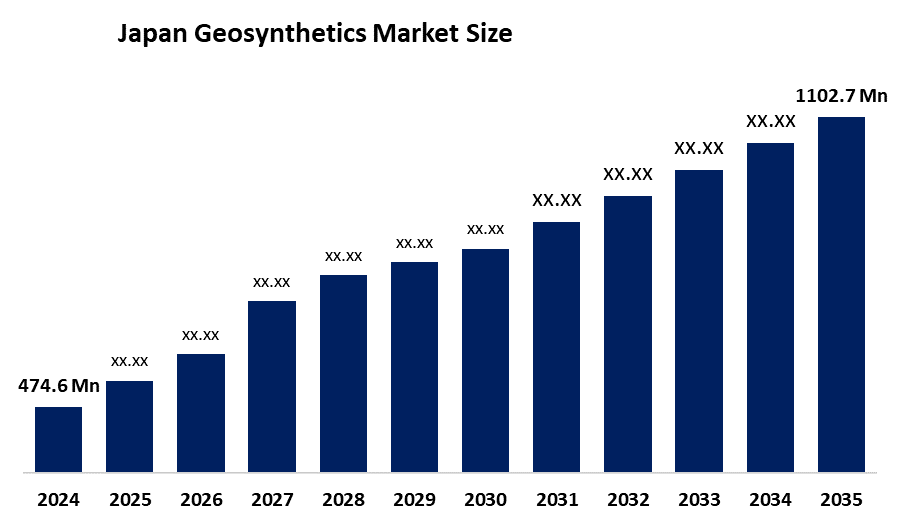
- Japan Geosynthetics Market Size 2024: USD 474.6 Mn
- Japan Geosynthetics Market Size 2035: USD 1102.7 Mn
- Japan Geosynthetics Market CAGR 2024: 7.97%
- Japan Geosynthetics Market Segments: Product and Application.
Get more details on this report -
The Japanese geosynthetics market consists of polymer-derived manmade materials that assist the civil engineering community in addressing soil stabilization, drainage, and erosion issues. The competitive nature of the geosynthetics market in Japan reflects a strong need for performance characteristics. A growing trend within the geosynthetics marketplace is using "Smart Geosynthetics,” which combine sensing devices and systems to monitor geosynthetic materials in real-time for structural integrity. In addition to Smart Geosynthetics, the trend is moving to more sustainable material options as a means for meeting the goals and priorities of Japan's "Green Growth Strategy" and circular economy initiatives.
To respond to the rapidly changing technological and economic conditions affecting the geotechnical industry, the Japanese government has supported the implementation of multiple initiatives managed by the Ministry of Land, Infrastructure, Transport, and Tourism (MLIT) to provide structural reinforcement of the country’s older infrastructure in preparation for future natural disasters. Many of these initiatives require the use of advanced materials such as geogrids and geomembranes for the construction of items like seawalls, embankments, and tunnels. Likewise, construction companies are collaborating with geosynthetic material manufacturers to create automated installation technologies that will reduce labour costs while improving the performance and accuracy of future projects due to the current shortage of skilled labour in Japan.
Technological innovation in Japan’s geosynthetics sector is led by the integration of the Internet of Things (IoT) and sensor-embedded materials. These advancements allow for continuous monitoring of soil strain and moisture levels, transforming passive materials into active diagnostic tools. Furthermore, breakthroughs in polymer science have led to the creation of multi-functional geocomposites that combine filtration, drainage, and reinforcement in a single, easy-to-install layer. The development of high-tensile, earthquake-resistant geomembranes specifically designed for Japan's unique geological profile remains a top priority for local R&D centers.
Market Dynamics of the Japan Geosynthetics Market:
The Japanese geosynthetics market is driven by the high seismic susceptibility of Japan, and the rapid urbanization of the metropolitan areas makes it imperative that the infrastructure in these locations be built to withstand disasters. There are additional pressures from environmental regulations about the disposal of waste and the containment of landfills, which are driving further use of geomembranes for such purposes. Furthermore, the increased use of smart monitoring and Internet of Things (IoT) technologies in civil engineering is also contributing to the acceleration of the civil engineering materials market as it relates to predictive maintenance on long-term projects.
The Japanese geosynthetics market is restrained by the civil engineering materials market with respect to the costs associated with the initial purchase of these materials, which tend to be higher than traditional soil stabilization methods. Another challenge for the market is going to be a continued shortage of skilled labour and specialized engineers trained in the precise placement and installation of advanced geosynthetic systems, which can lead to extended project timelines and/or potential structural failure.
There is an opportunity for expansion into "green infrastructure" projects that provide some promising potential for civil engineering materials, particularly as they relate to urban water management and manufacturing systems for flood control. The opportunity for the development of bio-based geosynthetics that support Japan's goal of carbon neutrality by the year 2050 is a growing niche that allows manufacturers to create innovative products to meet new environmental segments of the market.
Japan Geosynthetics Market Report Coverage
| Report Coverage | Details |
|---|---|
| Base Year: | 2024 |
| Market Size in 2024: | USD 474.6 Million |
| Forecast Period: | 2024-2035 |
| Forecast Period CAGR 2024-2035 : | 7.97% |
| 2035 Value Projection: | USD 1102.7 Million |
| Historical Data for: | 2020-2023 |
| No. of Pages: | 240 |
| Tables, Charts & Figures: | 105 |
| Segments covered: | By Type, By Application |
| Companies covered:: | Asahi Kasei Advance Corporation, Maeda Kosen Co., Ltd., Mitsui Chemicals, Inc., Unitika Ltd., Okasan Livic Co., Ltd., Tanaka Sangyo Co., Ltd., Others, and Key Players. |
| Pitfalls & Challenges: | COVID-19 Empact, Challenge, Future, Growth, & Analysis |
Get more details on this report -
Market Segmentation
The Japan geosynthetics market share is classified into product and application.
By Product:
The Japanese geosynthetics market is divided by product into geotextiles, geomembranes, geogrids, geonets, and geocells. Among these, the geotextiles segment held the largest market in 2024 and is anticipated to grow at a significant CAGR during the forecast period. The class dominated the market because of its superior performance and functional benefits over other materials. Natural geotextiles, on the other hand, are gaining popularity for short-term use or as temporary reinforcement due to increased awareness of their eco-friendly features, which is contributing to market expansion.
By Application:
The Japanese geosynthetics market is divided by application into separation, reinforcement, filtration, drainage, and barrier. Among these, the separation segment accounted for the largest market share in 2024 and is anticipated to grow at a remarkable CAGR during the forecast period. The separation segment leads due to its use in road construction and infrastructure projects, preventing soil mixing, improving load distribution, reducing maintenance costs, and extending pavement lifespan.
Competitive Analysis:
The report offers the appropriate analysis of the key organisations/companies involved within the Japan Geosynthetics market, along with a comparative evaluation primarily based on their product offering, business overviews, geographic presence, enterprise strategies, segment market share, and SWOT analysis. The report also provides an elaborative analysis focusing on the current news and developments of the companies, which includes product development, innovations, joint ventures, partnerships, mergers & acquisitions, strategic alliances, and others. This allows for the evaluation of the overall competition within the market.
Top Key Companies in Japan Geosynthetics Market:
- Asahi Kasei Advance Corporation
- Maeda Kosen Co., Ltd.
- Mitsui Chemicals, Inc.
- Unitika Ltd.
- Okasan Livic Co., Ltd.
- Tanaka Sangyo Co., Ltd.
- Others
Key Target Audience
- Market Players
- Investors
- End-users
- Government Authorities
- Consulting and Research Firm
- Venture capitalists
- Value-Added Resellers (VARs)
Market Segment
This study forecasts revenue at the Japan, regional, and country levels from 2020 to 2035. Decisions Advisors has segmented the Japan geosynthetics market based on the below-mentioned segments:
Japan Geosynthetics Market, By Product
- Geotextiles
- Geomembranes
- Geogrids
- Geonets
- Geocells
Japan Geosynthetics Market, By Application
- Separation
- Reinforcement
- Filtration
- Drainage
- Barrier
Frequently Asked Questions (FAQ)
-
Q: What is the Japan geosynthetics market?A: The Japan geosynthetics market comprises polymer-based materials used in civil engineering for soil stabilization, drainage, reinforcement, filtration, and barrier applications across infrastructure projects.
-
Q: What is the market size of the Japan geosynthetics market in 2024?A: In 2024, the Japan geosynthetics market was valued at USD 474.6 million.
-
Q: What is the expected growth rate of the Japan geosynthetics market?A: The market is expected to grow at a CAGR of 7.97% during the forecast period 2025–2035.
-
Q: Which product segment dominates the Japan geosynthetics market?A: Geotextiles dominate the market due to their versatility, cost-effectiveness, and wide application in separation, filtration, and drainage projects.
-
Q: Why does the separation application segment hold the largest share?A: The separation segment leads due to extensive use in road construction and infrastructure projects to prevent soil mixing and enhance pavement durability.
-
Q: What are the key drivers of the Japan geosynthetics market?A: Key drivers include high seismic activity, increased infrastructure development, stringent environmental regulations, and growing adoption of smart geosynthetics.
-
Q: Who are the major players in the Japan geosynthetics market?A: Major players include Asahi Kasei Advance Corporation, Maeda Kosen Co., Ltd., Mitsui Chemicals, Inc., Unitika Ltd., and Okasan Livic Co., Ltd.
Need help to buy this report?