Japan Generative AI Healthcare Market Size, Share, By Component (Solution and Service), By Function (Administrative Process Optimization, Virtual Nursing Assistants, Robot-Assisted AI Surgery, and Medical Imaging Analysis), By End Use (Diagnostic Centre, Clinical Research, Medical Centres, and Others), By Application (System and Clinical), Japan Generative AI in Healthcare Market Insights, Industry Trends, Forecasts to 2035
Industry: Healthcare
Japan Generative AI Healthcare Market Insights Forecasts to 2035
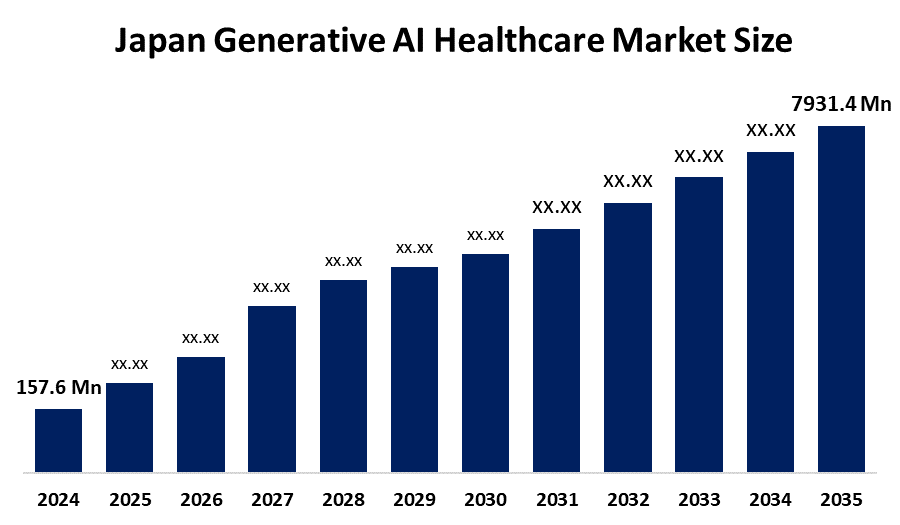
- Japan Generative AI Healthcare Market Size 2024: USD 157.6 Mn
- Japan Generative AI Healthcare Market Size 2035: USD 7931.4 Mn
- Japan Generative AI Healthcare Market CAGR 2024: 42.79%
- Japan Generative AI Healthcare Market Segments: Component, Function, End Use, and Application
Get more details on this report -
Generative AI in healthcare is referred to as AI that generate, examine, and optimize healthcare-related output, leveraging massive medical data or vast healthcare knowledge and experience. In Japan, such technologies are used in medical image analyses, healthcare support, nursing support agents, robotic support systems, healthcare research, and administrative processing in healthcare organizations. Factors that have contributed to the development and expansion of the healthcare AIs industry include healthcare digitalization and a shortage of medical staff.
Technological innovation is concentrated on explainable AI, a secure Japanese data centre, multi-modal analytics, and linkages to electronic medical records. Government initiatives are increasing the adoption of technology in the country, including support of the AI promotion act (2025), medical DX initiatives headlined by the ministry of health, labour and welfare, fast-track approval procedures for software as a medical device, and public spending of about 22 billion in FY2023 on the development of a secure medical generative AI. Future sectors in Japan that could be explored in the development of generative AIs include personalized medicine, AI-supported clinical trials, hospital automation, and interoperability of medical data in Japan.
Japan Generative AI Healthcare Market Report Coverage
| Report Coverage | Details |
|---|---|
| Base Year: | 2024 |
| Market Size in 2024: | USD 157.6 Million |
| Forecast Period: | 2024-2035 |
| Forecast Period CAGR 2024-2035 : | CAGR Of 42.79% |
| 2035 Value Projection: | USD 7931.4 Million |
| Historical Data for: | 2020-2023 |
| No. of Pages: | 240 |
| Tables, Charts & Figures: | 110 |
| Segments covered: | By Component, By Function |
| Companies covered:: | ThinkCyte AI Medical Service Midcore HACARUS ABEJA Google Microsoft NVIDIA IBM Others Key Players |
| Pitfalls & Challenges: | COVID-19 Empact, Challenge, Future, Growth, & Analysis |
Get more details on this report -
Market Dynamics of the Japan Generative AI Healthcare Market:
The Japan generative AI healthcare market is fuelled by advancements in the digitalization of healthcare, enhanced usage of AI-driven diagnostic solutions and decision-making support solutions, increasing healthcare data, and the need to optimize resources due to a lack of staff and aging population demographics. Support for DX-based healthcare solutions, fast-tracking of software for a medical device, and increasing investment in AI-driven healthcare solutions are propelling the market.
The Japan generative AI healthcare market is hampered by the high cost of implementation/integration, stringent regulations for protecting patient healthcare data and cyber-security laws, difficult approval mechanisms for healthcare regulations, lack of qualified professionals in the field of AI technology in healthcare, and a cautious approach by healthcare service providers for patient safety reasons.
The outlook in the generative AI in the Japan healthcare market appears positive, and opportunities are emerging in the realms of personalized medicine, AI-powered clinical trials, predictive diagnosis, hospital automation, and immediate clinical support. Further, developments in the areas of transparent AI, a secure Japanese data infrastructure, multimodal analytics, and integration of the Japanese electronic medical records system are also anticipated to boost adoption, efficacy, and compliance in the Japanese healthcare space.
Market Segmentation
The Japan generative AI healthcare market share is classified into component, function, end use, and application.
By Component:
The Japan generative AI in healthcare market is divided by component into solution and service. Among these, the solution segment dominated the share in 2024 and is anticipated to grow at a remarkable CAGR during the forecast period. The major drivers promoting growth are adoption of integrated AI solutions in hospitals, diagnostic centres, and research institutions offering end-to-end automation, decision support systems, efficiency, and scalability, thereby reducing manual efforts and errors and aiding regulatory compliance in Japan’s thriving health ecosystem.
By Function:
The Japan generative AI in healthcare market is divided by function into administrative process optimization, virtual nursing assistants, robot-assisted AI surgery, and medical imaging analysis. Among these, the medical imaging analysis segment dominated the share in 2024 and is anticipated to grow at a remarkable CAGR during the forecast period. The driving factors for growth include the need for accelerated diagnosis, precision medicine, and automation. The potential applications of AI-enabled imaging, virtual assistants, and surgical solutions include enhanced accuracy, reduced physician burden, faster throughput, better outcomes, and addressing manpower shortages in the aging Japanese healthcare infrastructure.
By End Use:
The Japan generative AI in healthcare market is divided by end use into diagnostic centres, clinical research, medical centres, and others. Among these, the medical centres segment dominated the share in 2024 and is anticipated to grow at a remarkable CAGR during the forecast period. This is because the driver for growth in the medical segment is the adoption of generative AI among medical facilities, which is supported by large patient bases, complex medical processes, high budgets, integrated information systems, and the motivation to offer high-quality healthcare.
By Application:
The Japan generative AI in healthcare market is divided by application into system and clinical. Among these, the clinical application segment dominated the share in 2024 and is anticipated to grow at a remarkable CAGR during the forecast period. It is driven by the growing use of generative AI in clinical areas such as diagnosis, treatment, personalized medicine, and post-treatment monitoring by providers who want improved patient outcomes, lower error rates, quicker clinical decisions, and solutions that easily interface with existing infrastructure and clinical operations in Japan.
Competitive Analysis:
The report offers the appropriate analysis of the key organisations/companies involved within the Japan generative AI healthcare market, along with a comparative evaluation primarily based on their product offering, business overviews, geographic presence, enterprise strategies, segment market share, and SWOT analysis. The report also provides an elaborative analysis focusing on the current news and developments of the companies, which includes product development, innovations, joint ventures, partnerships, mergers & acquisitions, strategic alliances, and others. This allows for the evaluation of the overall competition within the market.
Top Key Companies in Japan Generative AI Healthcare Market:
- ThinkCyte
- AI Medical Service
- Midcore
- HACARUS
- ABEJA
- Microsoft
- NVIDIA
- IBM
- Others
Key Target Audience
- Market Players
- Investors
- End-users
- Government Authorities
- Consulting and Research Firm
- Venture capitalists
- Value-Added Resellers (VARs)
Market Segment
This study forecasts revenue at the Japan, regional, and country levels from 2020 to 2035. Spherical Insights has segmented the Japan generative AI healthcare market based on the below-mentioned segments:
Japan Generative AI Healthcare Market, By Component
- Solution
- Service
Japan Generative AI Healthcare Market, By Function
- Administrative Process Optimization
- Virtual Nursing Assistants
- Robot-Assisted AI Surgery
- Medical Imaging Analysis
Japan Generative AI Healthcare Market, By End Use
- Diagnostic Centres
- Clinical Research
- Medical Centres
- Others
Japan Generative AI Healthcare Market, By Application
- System
- Clinical
Frequently Asked Questions (FAQ)
-
What is the expected growth outlook of the Japan generative AI healthcare market?The Japan generative AI healthcare market is expected to grow from USD 157.6 million in 2024 to USD 7,931.4 million by 2035, driven by rapid adoption of AI technologies across healthcare delivery, research, and operational workflows
-
What are the key growth drivers of the Japan generative AI healthcare market?Market growth is driven by healthcare digitalization, rising healthcare data volumes, shortages of medical professionals, demand for operational efficiency, growing adoption of AI-based diagnostics, and government support for medical DX and AI-enabled healthcare solutions
-
What factors restrain the Japan generative AI healthcare market?Market restraints include high implementation and integration costs, stringent patient data protection regulations, complex healthcare approval processes, cybersecurity concerns, limited availability of skilled AI professionals, and cautious adoption by healthcare providers due to patient safety considerations.
-
How is the market segmented by component?The Japan generative AI healthcare market is segmented into solution and service components, with solutions accounting for the dominant share due to widespread deployment of integrated AI platforms in healthcare institutions.
-
How is the market segmented by function?By function, the market is categorized into administrative process optimization, virtual nursing assistants, robot-assisted AI surgery, and medical imaging analysis.
-
Who are the key players in the Japan generative AI healthcare market?Key companies operating in the market include ThinkCyte, AI Medical Service, Molcure, HACARUS, ABEJA, Google, Microsoft, NVIDIA, IBM, and other emerging participants.
-
What are the key target audiences for this market report?The report targets market players, investors, end-users, government authorities, consulting and research firms, venture capitalists, and value-added resellers (VARs).
Need help to buy this report?