Japan Extended Reality Market Size, Share, By Types (Consumer Engagement, Business Engagement), By Application (Virtual Reality, Augmented Reality and Mixed Reality), By End User (Education, Retail, Industrial and Manufacturing, Healthcare, Media and Entertainment, and Others), Japan Extended Reality Market Industry Trend, Forecasts to 2035.
Industry: Electronics, ICT & Media
Japan Extended Reality Market Insights Forecasts to 2035
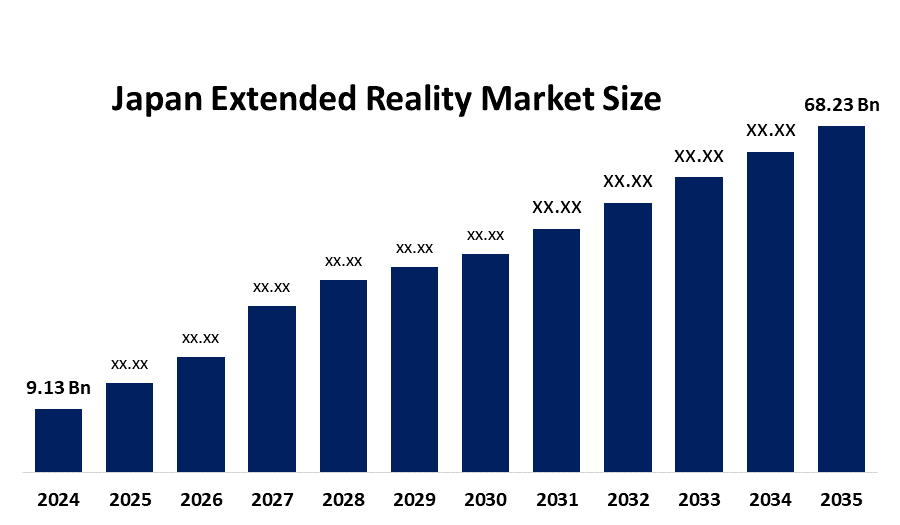
- Japan Extended Reality Market Size 2024: USD 9.13 Billion
- Japan Extended Reality Market Size 2035: USD 68.23 Billion
- Japan Extended Reality Market CAGR 2024: 20.06%
- Japan Extended Reality Market Segments, Types, Application, and End Use.
Get more details on this report -
The Japan extended reality market includes immersive technologies such as augmented reality, virtual reality, and mixed reality used across gaming, education, healthcare, training, retail, and industrial applications. Extended reality blends digital content with the real world or fully immerses users in virtual environments, transforming how people interact with data, experiences, and workplaces across multiple sectors. Furthermore, the Japan extended reality market is growing rapidly due to increasing adoption across industries including gaming, healthcare, education, manufacturing, and retail. Technological advances in hardware, software, and 5G connectivity support richer and more immersive experiences. A tech-savvy population, rising enterprise investment, and expanding use cases for training, simulation, and customer engagement further fuel market expansion and commercialization.
The Japan government supports XR through digital transformation initiatives and national strategies like Society 5.0, which emphasises advanced technologies to innovate society and industry. Agencies such as the Digital Agency promote digitalisation and integration of immersive technologies, and specific grant programs help fund AR/VR content and applications. Policies encourage industry collaboration, R&D investment, and deployment of XR solutions in tourism, culture, and enterprise.
Japan extended reality market trends include rising use of extended reality in gaming and entertainment, enterprise training, and remote collaboration. Integration of AR/VR with AI and 5G enables better performance and more immersive experiences. Industries like healthcare, manufacturing, retail, and tourism increasingly use XR for simulations, visualisation, and customer engagement. Consumer demand for high-quality immersive content and wearable devices continues to shape the market.
Market Dynamics of the Japan Extended Reality Market:
The Japan Extended Reality Market is driven by Japan’s strong technology ecosystem and innovation culture, robust digital infrastructure, increasing enterprise focus on digital transformation, and consumer enthusiasm for immersive experiences. Adoption in gaming, education, and healthcare supports extended reality expansion, while 5G rollout and improvements in AR/VR hardware enhance user experience. Growing investments by domestic and international companies further catalyse growth.
The Japan extended reality market is restraints from high initial costs of XR hardware and software, which limit adoption among smaller businesses and individual users. Challenges like limited content quality, technical issues such as latency and motion discomfort, and concerns about data security and user health (e.g., motion sickness) also hinder widespread acceptance and slow market penetration for some applications.
The Japan extended reality market offers opportunities through expansion in enterprise training, remote collaboration, and industrial simulations. XR adoption in tourism, cultural preservation, and retail enhances customer experiences. Integration with AI, robotics, and 5G opens new immersive use cases. Custom XR solutions for specific sectors—healthcare training, manufacturing, education and increasing content development offer growth potential for startups and established tech companies alike
Japan Extended Reality Market Report Coverage
| Report Coverage | Details |
|---|---|
| Base Year: | 2024 |
| Market Size in 2024: | USD 9.13 Billion |
| Forecast Period: | 2025-2035 |
| Forecast Period CAGR 2025-2035 : | CAGR of 20.06 % |
| 2035 Value Projection: | USD 68.23 Billion |
| Historical Data for: | 2020-2023 |
| No. of Pages: | 210 |
| Tables, Charts & Figures: | 95 |
| Segments covered: | By Type, By Application |
| Companies covered:: | Sonly Group Corporation, NTT DOCOMO, Inc., Nikon Corporation, Capcom Co., Ltd., DeNA Co., Ltd., CyberAgent, Inc., Panasonic Holdings Corporation, STYLY Inc., Mogura Inc., Nihon XR Centre, Other, and Key Players |
| Pitfalls & Challenges: | COVID-19 Empact, Challenge, Future, Growth, & Analysis |
Get more details on this report -
Market Segmentation
The Japan extended reality market share is classified into types, applications, and end use.
By Types:
The Japan extended reality market is divided by types into consumer engagement and business engagement. Among these, the business engagement segment dominated the share in 2024 and is anticipated to grow at a remarkable CAGR during the forecast period. The business engagement systems segment dominates because Japan enterprises widely adopt extended reality for training, simulation, remote collaboration, and process optimisation. These industrial and professional applications generate higher revenue and consistent demand compared to consumer-focused uses like gaming or entertainment.
By Application:
The Japan extended reality market is divided by application into virtual reality, augmented reality, and mixed reality. Among these, the virtual reality segment dominated the share in 2024 and is anticipated to grow at a remarkable CAGR during the forecast period. The virtual reality segment dominates due to its immersive experiences, widespread use in gaming, entertainment, education, and healthcare, and strong adoption by enterprises, generating higher revenue than Augmented Reality and Mixed Reality applications.
By End Use:
The Japan extended reality market is divided by end use into education, retail, industrial and manufacturing, healthcare, media and entertainment, and others. Among these, the industrial and manufacturing segment dominated the share in 2024 and is anticipated to grow at a remarkable CAGR during the forecast period. The industrial and manufacturing dominates because companies widely use XR for training, simulation, maintenance, and design visualisation. These applications improve efficiency, reduce costs, and enhance productivity, generating higher adoption and revenue than other sectors.
Competitive Analysis:
The report offers the appropriate analysis of the key organisations/companies involved within the Japan extended reality market, along with a comparative evaluation primarily based on their product offering, business overviews, geographic presence, enterprise strategies, segment market share, and SWOT analysis. The report also provides an elaborate analysis focusing on the current news and developments of the companies, which includes product development, innovations, joint ventures, partnerships, mergers & acquisitions, strategic alliances, and others. This allows for the evaluation of the overall competition within the market.
Top Key Companies in Japan Extended Reality Market:
- Sonly Group Corporation
- NTT DOCOMO, Inc.
- Nikon Corporation
- Capcom Co., Ltd.
- DeNA Co., Ltd.
- CyberAgent, Inc.
- Panasonic Holdings Corporation
- STYLY Inc.
- Mogura Inc.
- Nihon XR Centre
- Other
Key Target Audience
- Market Players
- Investors
- End-users
- Government Authorities
- Consulting and Research Firm
- Venture capitalists
- Value-Added Resellers (VARs)
Market Segment
This study forecasts revenue at the Japan, regional, and country levels from 2020 to 2035. Spherical Insights has segmented the Japan extended reality market based on the below-mentioned segments:
Japan Extended Reality Market, By Types.
- Consumer Engagement
- Business Engagement
Japan Extended Reality Market, By Application
- Virtual Reality
- Augmented Reality
- Mixed Reality
Japan Extended Reality Market, By End Use.
- Education
- Retail
- Industrial and Manufacturing
- Healthcare
- Media and Entertainment
- Others
Frequently Asked Questions (FAQ)
-
Q 1: What is the Japan extended reality market size?Japan extended reality market is expected to grow from USD 9.13 billion in 2024 to USD 68,23 billion by 2035, growing at a CAGR of 20.06 % during the forecast period 2025-2035.
-
Q 2: What are the key growth drivers of the Japan extended reality market?Japan extended reality market is growth drivers of Japan’s extended reality market advanced technology adoption, gaming industry expansion, enterprise training, AR/VR devices, 5G rollout, and government support.
-
Q 3: What factors restrain the Japan extended reality market?The Japan extended reality market is restraining Japan’s extended reality market: high device costs, limited content, privacy concerns, technical complexity, slow consumer adoption, infrastructure challenges and regulatory uncertainties
-
Q 4: How is the Japan extended reality market segmented by application?The Japan extended reality market is segmented into virtual reality, augmented reality and mixed reality.
-
Q 5: Who are the key players in the Japan extended reality market?Key companies include Sony Group Corporation, NTT DOCOMO, Nikon, Capcom, DeNA, CyberAgent, Panasonic, STYLY, Mogura, Nihon XR Centre, and others.
Need help to buy this report?