Japan Electronic Medical Records (EMR) Market Size, Share, and COVID-19 Impact Analysis, By Product (Core Hospital EMR/HIS, Ambulatory/Clinic EMR, Clinical & Ancillary Systems, Interoperability & Clinical Support, Patient Engagement Solutions, and Others), By Deployment (On-Premise, Cloud / SaaS, Hosted Private Cloud, and Hybrid), By Care Setting (Acute Care, Ambulatory Care, and Post-Acute Care), By Business Model (Perpetual License, Subscription/SaaS, Managed Service/Hosted Model, Implementation & Professional Services, and Maintenance & Support Services), and Japan Electronic Medical Records (EMR) Market Insights, Industry Trend, Forecasts to 2035
Industry: Healthcare
Japan Electronic Medical Records (EMR) Market Size Insights Forecasts to 2035
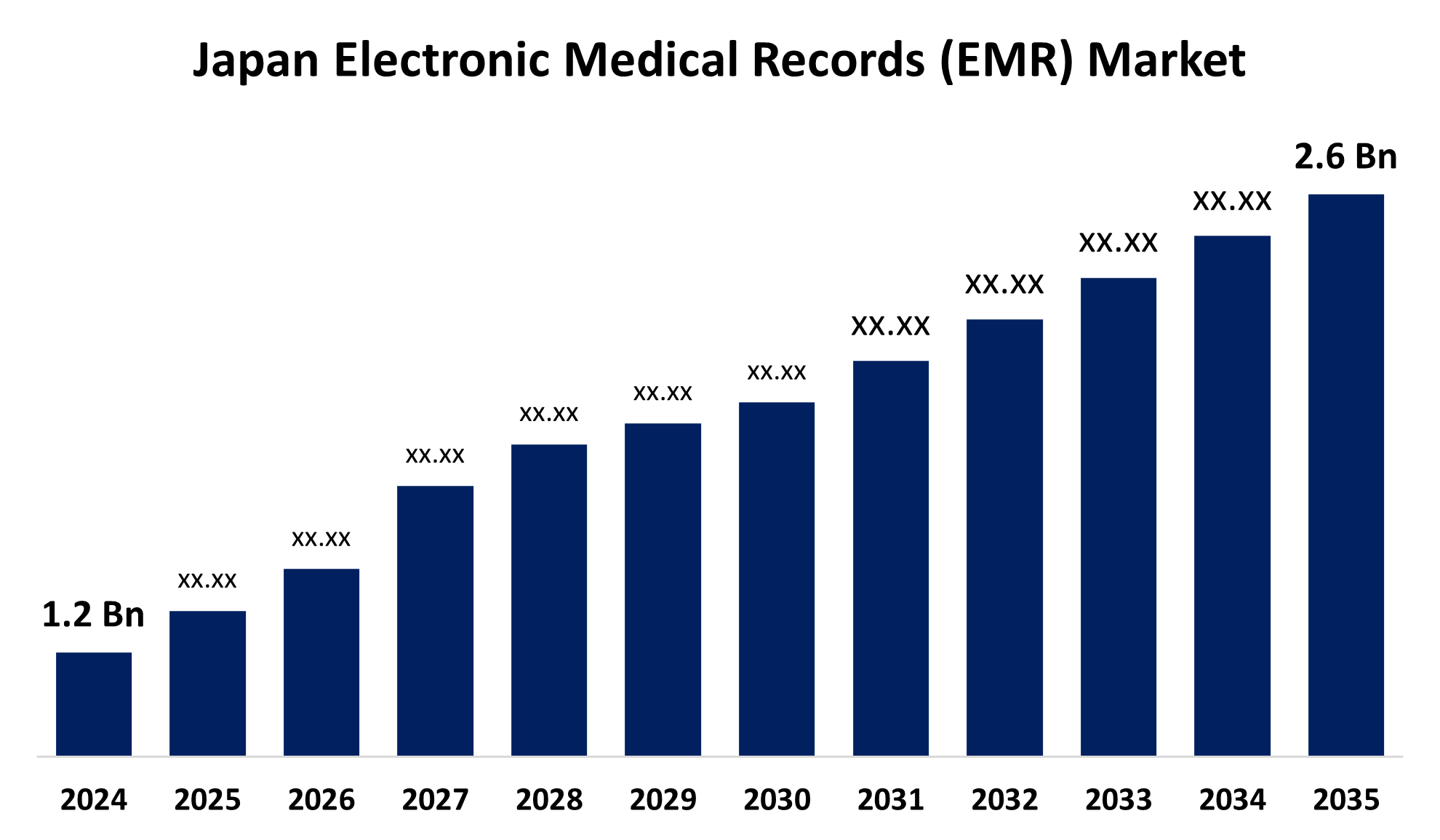
- The Japan Electronic Medical Records (EMR) Market Size Was Estimated at USD 1.2 Billion in 2024.
- The Market Size is Growing at a CAGR of 7.28% between 2025 and 2035.
- The Japan Electronic Medical Records (EMR) Market Size is Anticipated to Reach USD 2.6 Billion by 2035.
Get more details on this report -
According to a research report published by Spherical Insights & Consulting, The Japan Electronic Medical Records (EMR) Market Size is Anticipated to hold USD 2.6 Billion by 2035, Growing at a CAGR of 7.28% from 2025 to 2035. Japan’s electronic medical records (EMR) market presents strong future opportunities, supported by over 80% EMR adoption in large hospitals and government targets for nationwide health data interoperability, driving AI integration, cloud-based systems, and improved care coordination.
Market Overview
The Japan Electronic Medical Records (EMR) Market Size refers to the digital management of patient health information, including clinical data, diagnostics, prescriptions, and treatment histories, across healthcare facilities. Market growth is driven by Japan’s aging population, rising healthcare costs, and strong demand for efficient clinical workflows and data accuracy. Government-led healthcare digitalization policies and interoperability initiatives are accelerating EMR adoption, with EMR penetration exceeding 80% in large hospitals. The push toward standardized health data exchange and integrated care is further supporting market expansion.
Report Coverage
This research report categorizes the market for the Japan Electronic Medical Records (EMR) Market Size based on various segments and regions and forecasts revenue growth and analyzes trends in each submarket. The report analyses the key growth drivers, opportunities, and challenges influencing the Japan electronic medical records (EMR) market. Recent market developments and competitive strategies such as expansion, product launch, and development, partnership, merger, and acquisition have been included to draw the competitive landscape in the market. The report strategically identifies and profiles the key market players and analyses their core competencies in each sub-segment of the Japan electronic medical records (EMR) market. The Japanese government is promoting nationwide EMR adoption through digital health policies, interoperability standards, and incentives for electronic data exchange. Initiatives like the My Number health data linkage and healthcare IT modernization aim to improve care coordination, efficiency, and patient outcomes.
Japan Electronic Medical Records (EMR) Market Report Coverage
| Report Coverage | Details |
|---|---|
| Base Year: | 2024 |
| Market Size in 2024: | USD 1.2 Billion |
| Forecast Period: | 2025-2035 |
| Forecast Period CAGR 2025-2035 : | 7.28% |
| 2035 Value Projection: | USD 2.6 Billion |
| Historical Data for: | 2020-2023 |
| No. of Pages: | 225 |
| Tables, Charts & Figures: | 110 |
| Segments covered: | By Product, By Deployment |
| Companies covered:: | Fujitsu Limited, NEC Corporation, IBM Japan, NTT DATA, Wemex (PHC Holdings), Canon Medical Systems, M3 DigiKar, Nihon Kohden Corporation, DONUTS Co. Ltd., MEDLEY, INC. |
| Pitfalls & Challenges: | and COVID-19 Impact Analysis |
Get more details on this report -
Driving Factors
The Japan Electronic Medical Records (EMR) Market Size is driven by an aging population, rising chronic disease burden, and the need for efficient healthcare delivery. Increasing adoption of digital healthcare systems to improve clinical accuracy, workflow efficiency, and patient data management is supporting growth. Government initiatives promoting healthcare digitalization and interoperability, along with growing use of cloud-based platforms and AI-enabled clinical decision support, are further accelerating EMR adoption across hospitals and clinics.
Restraining Factors
The Japan EMR market faces restraints from high implementation and maintenance costs, data security and privacy concerns, system integration challenges with legacy infrastructure, and limited IT expertise among small healthcare facilities.
Market Segmentation
The Japan electronic Medical Records (EMR) Market share is classified into product, deployment, care setting, and business model.
- The core hospital EMR/HIS segment held a significant share in 2024 and is expected to grow at a significant CAGR during the forecast period.
The Japan electronic Medical Records (EMR) Market Size is segmented by product into core hospital EMR/HIS, ambulatory/clinic EMR, clinical & ancillary systems, interoperability & clinical support, patient engagement solutions, and others. Among these, the Core hospital EMR/HIS segment held a significant share in 2024 and is expected to grow at a significant CAGR during the forecast period. This is due to the extensive digitization of hospital workflows, strong demand for comprehensive patient data management systems in large medical institutions, and ongoing investments in advanced core EMR solutions that support clinical and administrative functions across Japan’s healthcare facilities.
- The cloud / SaaS segment held a significant share in 2024 and is expected to grow at a significant CAGR during the forecast period.
The Japan Electronic Medical Records (EMR) Market Size is segmented by deployment into on-premise, cloud / SaaS, hosted private cloud, and hybrid. Among these, the cloud / SaaS segment held a significant share in 2024 and is expected to grow at a significant CAGR during the forecast period. Cloud-based EMRs are increasingly preferred due to lower upfront costs, scalability, reduced infrastructure requirements, and growing adoption across hospitals and clinics in Japan. This deployment model continues to attract healthcare providers seeking flexible, cost-effective digital record solutions.
- The acute care segment held a significant share in 2024 and is expected to grow at a significant CAGR during the forecast period.
The Japan Electronic Medical Records (EMR) Market Size is segmented by care setting into acute care, ambulatory care, and post-acute care. Among these, the acute care segment held a significant share in 2024 and is expected to grow at a significant CAGR during the forecast period. This is due to the extensive use of EMR systems in hospitals and acute care facilities to manage complex, high-volume patient data and support urgent, multidisciplinary clinical workflows efficiently. Acute care settings demand robust EMR solutions for detailed documentation, rapid decision-making, and seamless data access, driving ongoing adoption and growth.
- The subscription/SaaS segment held a significant share in 2024 and is expected to grow at a significant CAGR during the forecast period.
The Japan Electronic Medical Records (EMR) Market Size is segmented by business model into perpetual license, subscription/SaaS, managed service/hosted model, implementation & professional services, and maintenance & support services. Among these, the subscription/SaaS segment held a significant share in 2024 and is expected to grow at a significant CAGR during the forecast period. This is because healthcare providers increasingly prefer subscription-based cloud solutions that offer lower upfront costs, scalability, regular updates, and reduced IT infrastructure burden compared to traditional perpetual license models, driving wider adoption across hospitals and clinics.
Competitive Analysis:
The report offers the appropriate analysis of the key organizations/companies involved within the Japan Electronic Medical Records (EMR) Market Size along with a comparative evaluation primarily based on their product offering, business overviews, geographic presence, enterprise strategies, segment market share, and SWOT analysis. The report also provides an elaborative analysis focusing on the current news and developments of the companies, which includes product development, innovations, joint ventures, partnerships, mergers & acquisitions, strategic alliances, and others. This allows for the evaluation of the overall competition within the market.
List of Key Companies
- Fujitsu Limited
- NEC Corporation
- IBM Japan
- NTT DATA
- Wemex (PHC Holdings)
- Canon Medical Systems
- M3 DigiKar
- Nihon Kohden Corporation
- DONUTS Co. Ltd.
- MEDLEY, INC.
Key Target Audience
- Market Players
- Investors
- End-users
- Government Authorities
- Consulting and Research Firm
- Venture capitalists
- Value-Added Resellers (VARs)
Market Segment
This study forecasts revenue at Europe, regional, and country levels from 2020 to 2035. Spherical Insights has segmented the Japan Electronic Medical Records (EMR) Market Size based on the following segments:
Japan Electronic Medical Records (EMR) Market, By Product
- Core Hospital EMR/HIS
- Ambulatory/Clinic EMR
- Clinical & Ancillary Systems
- Interoperability & Clinical Support
- Patient Engagement Solutions
- Others
Japan Electronic Medical Records (EMR) Market, By Deployment
- On-Premise
- Cloud / SaaS
- Hosted Private Cloud
- Hybrid
Japan Electronic Medical Records (EMR) Market, By Care Setting
- Acute Care
- Ambulatory Care
- Post-Acute Care
Japan Electronic Medical Records (EMR) Market, By Business Model
- Perpetual License
- Subscription/SaaS
- Managed Service/Hosted Model
- Implementation & Professional Services
- Maintenance & Support Services
Frequently Asked Questions (FAQ)
-
Q: What is the Japan electronic medical records (EMR) market size?A: Japan electronic medical records (EMR) market size is expected to grow from USD 1.2 Billion in 2024 to USD 2.6 Billion by 2035, growing at a CAGR of 7.28% during the forecast period 2025-2035.
-
Q: What are the key growth drivers of the market?A: The Japan electronic medical records (EMR) market is driven by an aging population, rising chronic disease burden, and the need for efficient healthcare delivery.
-
Q: What factors restrain the Japan electronic medical records (EMR) market?A: The Japan EMR market faces restraints from high implementation and maintenance costs, data security and privacy concerns, system integration challenges with legacy infrastructure, and limited IT expertise among small healthcare facilities.
-
Q: How is the market segmented by product?A: The market is segmented into product into core hospital EMR/HIS, ambulatory/clinic EMR, clinical & ancillary systems, interoperability & clinical support, patient engagement solutions, and others.
-
Q: Who are the key players in the Japan electronic medical records (EMR) market?A: Key companies include Fujitsu Limited, NEC Corporation, IBM Japan, NTT DATA, Wemex, Canon Medical Systems, M3 DigiKar, Nihon Kohden Corporation, DONUTS Co. Ltd., and MEDLEY, INC.
-
Q: Who are the target audiences for this market report?A: The report targets market players, investors, end-users, government authorities, consulting and research firms, venture capitalists, and value-added resellers (VARs).
-
Q: What is the Japan electronic medical records (EMR) market size?A: Japan electronic medical records (EMR) market size is expected to grow from USD 1.2 Billion in 2024 to USD 2.6 Billion by 2035, growing at a CAGR of 7.28% during the forecast period 2025-2035.
-
Q: What are the key growth drivers of the market?A: The Japan electronic medical records (EMR) market is driven by an aging population, rising chronic disease burden, and the need for efficient healthcare delivery.
-
Q: What factors restrain the Japan electronic medical records (EMR) market?A: The Japan EMR market faces restraints from high implementation and maintenance costs, data security and privacy concerns, system integration challenges with legacy infrastructure, and limited IT expertise among small healthcare facilities.
-
Q: How is the market segmented by product?A: The market is segmented into product into core hospital EMR/HIS, ambulatory/clinic EMR, clinical & ancillary systems, interoperability & clinical support, patient engagement solutions, and others.
-
Q: Who are the key players in the Japan electronic medical records (EMR) market?A: Key companies include Fujitsu Limited, NEC Corporation, IBM Japan, NTT DATA, Wemex, Canon Medical Systems, M3 DigiKar, Nihon Kohden Corporation, DONUTS Co. Ltd., and MEDLEY, INC.
-
Q: Who are the target audiences for this market report?A: The report targets market players, investors, end-users, government authorities, consulting and research firms, venture capitalists, and value-added resellers (VARs).
Need help to buy this report?