Japan Dynamic Random Access Memory (DRAM) Market Size, Share, By Architecture (DDR3, DDR4, DDR5, DDR2, and Other Architecture), By Application (Smartphones/Tablets, PC/Laptops, Data centers, Graphics, Consumer Products, Automotive, and Other Applications), Japan Dynamic Random Access Memory (DRAM) Market Insights, Industry Trend, Forecasts to 2035
Industry: Semiconductors & Electronics
Japan Dynamic Random Access Memory (DRAM) Market Insights Forecasts to 2035
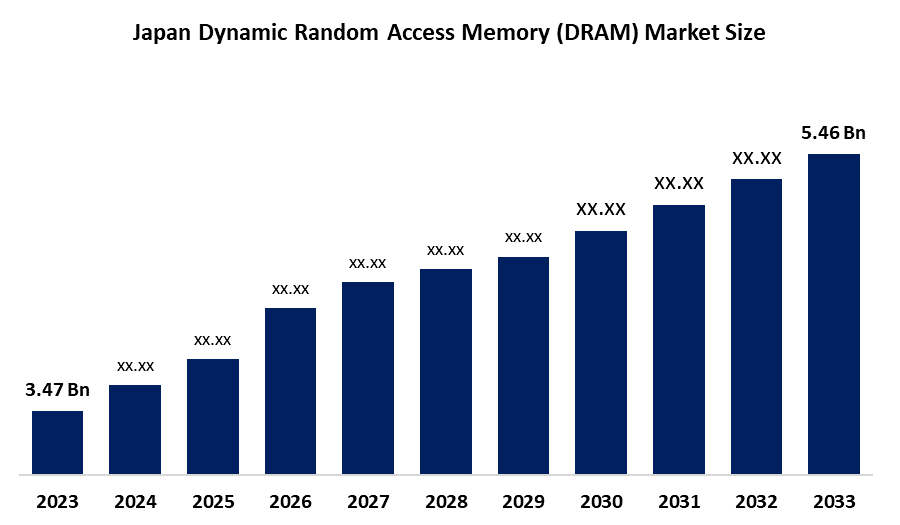
- Japan Dynamic Random Access Memory (DRAM) Market Size 2024: USD 3.47 Bn
- Japan Dynamic Random Access Memory (DRAM) Market Size 2035: USD 5.46 Bn
- Japan Dynamic Random Access Memory (DRAM) Market CAGR 2024: 4.2%
- Japan Dynamic Random Access Memory (DRAM) Market Segments: Architecture and Application
Get more details on this report -
Dynamic Random Access Memory (DRAM) is a type of memory device based on semiconductor technology, mainly used for temporary storage and quick data retrieval in electronic systems. It is a key component that allows high, speed processing, multitasking, and real, time computing in all kinds of modern digital devices. DRAM is present in a wide range of products such as smartphones, personal computers, servers, graphics systems, automotive electronics, and sophisticated industrial equipment that runs within the technology, driven economy of Japan. The demand for DRAM in Japan is a result of the country's robust electronics manufacturing base and its emphasis on data, intensive applications. The increasing adoption of artificial intelligence, cloud computing, high, performance computing, and connected devices is the main driver of the need for memory solutions that are both fast and efficient. The continuous refresh of consumer electronics and enterprise infrastructure is also contributing to the growing use of DRAM in various application areas.
The Japanese semiconductor ecosystem, which includes the local industry and the government, is reaping the benefits of active government intervention aimed at boosting domestic chip production and lessening supply, chain dependency. Cooperation between the public and private sectors, policy support for advanced semiconductor manufacturing, and initiatives directed towards next, generation chip technologies are some of the factors that are making the country more capable in the field of memory innovation. The technological advancement in memory architecture, such as the use of higher, density and energy, efficient DRAM, is leading to better performance and reliability. Japan's future technology landscape is set to position DRAM as a strategically important component with opportunities expected to emerge from advanced computing, automotive electronics, smart infrastructure, and localized semiconductor manufacturing.
Market Dynamics of the Japan Dynamic Random Access Memory (DRAM) Market:
The Japan DRAM market is driven by the growing demand for high, performance memory in smartphones, laptops, data centers, graphics systems, and automotive electronics. The growth of artificial intelligence, cloud computing, edge computing, and advanced consumer electronics is creating the demand for faster and more power, efficient memory solutions. Continuous upgrades in DRAM architectures and higher memory densities are also fueling the demand for DRAM in various end, use industries.
The market is restrained by high capital requirements, complex manufacturing processes, and stiff global competition from large international semiconductor manufacturers. Technology transitions happening frequently, pricing being volatile, and supply chain dependencies causing operational difficulties. Moreover, fabrication facilities require advanced process control and skilled labor, which makes it difficult to increase capacity rapidly and thus raises production risks.
Moreover, the Japan DRAM market prospects are bolstered by semiconductor revival measures funded by the government, incentives for domestic production, and collaborations with global technology leaders. The demand for DRAM is expected to rise with the increasing applications of automotive electronics, AI servers, and next, generation consumer devices. The innovations in energy, efficient memory, the next, generation DRAM architectures, and the localized semiconductor ecosystems will further strengthen the long, term potential of the market.
Japan Dynamic Random Access Memory (DRAM) Market Report Coverage
| Report Coverage | Details |
|---|---|
| Base Year: | 2024 |
| Market Size in 2024: | USD 3.47 Billion |
| Forecast Period: | 2025-2035 |
| Forecast Period CAGR 2025-2035 : | CAGR of 4.2 |
| 2035 Value Projection: | USD 5.46 Billion |
| Historical Data for: | 2020-2023 |
| No. of Pages: | 176 |
| Tables, Charts & Figures: | 90 |
| Segments covered: | By Architecture,By Application |
| Companies covered:: | Samsung Electronics Co., Ltd,Micron Technology Inc,SK Hynix Inc,Elpida Memory Inc And Others Players |
| Pitfalls & Challenges: | COVID-19 Empact, Challenge, Future, Growth, & Analysis |
Get more details on this report -
Market Segmentation
The Japan Dynamic Random Access Memory (DRAM) Market share is classified into architecture and application.
By Architecture:
The Japan DRAM market is divided by architecture into DDR3, DDR4, DDR5, DDR2, and other architectures. Among these, the DDR5 segment dominated the share in 2024 and is anticipated to grow at a remarkable CAGR during the forecast period. The growth is primarily led by the increasing need for high, bandwidth memory in AI workloads, data centers, advanced PCs, and servers. Additionally, the growth is also supported by Japan where next, generation computing platforms are widely adopted; there the demand for faster data transfer rates, better power efficiency, and overall higher performance is also strong.
By Application:
The Japan DRAM market is divided by application into smartphones/tablets, PC/laptops, data centers, graphics, consumer products, automotive, and other applications. Among these, the data centers segment dominated the share in 2024 and is anticipated to grow at a remarkable CAGR during the forecast period. Expanding cloud infrastructure AI model training Hyperscale server deployments Increasing enterprise data traffic Japan's focus on strengthening domestic digital and semiconductor infrastructure Growth is fueled by all these five factors.
Competitive Analysis:
The report offers the appropriate analysis of the key organisations/companies involved within the Japan DRAM market, along with a comparative evaluation primarily based on their product offering, business overviews, geographic presence, enterprise strategies, segment market share, and SWOT analysis. The report also provides an elaborative analysis focusing on the current news and developments of the companies, which includes product development, innovations, joint ventures, partnerships, mergers & acquisitions, strategic alliances, and others. This allows for the evaluation of the overall competition within the market.
Top Key Companies in Japan DRAM market:
- Samsung Electronics Co., Ltd.
- Micron Technology Inc.
- SK Hynix Inc.
- Elpida Memory Inc.
- Others
Recent Developments in Japan DRAM market:
In May 2023, Taiwan Semiconductor Manufacturing Company (TSMC) has decided to increase its semiconductor investments in Japan. The new project is a foundry in Kumamoto Prefecture, developed in collaboration with Sony Group Corporation, aimed at strengthening Japan’s advanced semiconductor manufacturing base and supply chain resilience.
In March 2023, Micron Technology Inc. revealed its intention to pump in a capital of up to 500 billion yen in Japan to further the production of advanced DRAM and to introduce the use of extreme ultraviolet (EUV) lithography. This move, which is aimed at making the next generation of memory and increasing domestic semiconductor capabilities, will be facilitated by the Japanese government.
Key Target Audience
- Market Players
- Investors
- End-users
- Government Authorities
- Consulting and Research Firm
- Venture capitalists
- Value-Added Resellers (VARs)
Market Segment
This study forecasts revenue at the Japan, regional, and country levels from 2020 to 2035. Spherical Insights has segmented the Japan Dynamic Random Access Memory (DRAM) market based on the following segments:
Japan Dynamic Random Access Memory (DRAM) Market, By Architecture
- DDR2
- DDR3
- DDR4
- DDR5
- Other Architectures
Japan Dynamic Random Access Memory (DRAM) Market, By Application
- Smartphones/Tablets
- PC/Laptops
- Data Centers
- Graphics
- Consumer Products
- Automotive
- Other Applications
Frequently Asked Questions (FAQ)
-
Q: What is the Japan Dynamic Random Access Memory (DRAM) market size?A: Japan Dynamic Random Access Memory (DRAM) Market is expected to grow from USD 3.47 billion in 2024 to USD 5.46 billion by 2035, growing at a CAGR of 4.2% during the forecast period 2025-2035.
-
Q: What are the key growth drivers of the market?A: Market growth is driven by the rising demand for high-performance memory in smartphones, laptops, data centers, graphics systems, and automotive electronics; expansion of AI, cloud computing, and next-generation consumer devices; continuous upgrades in DRAM architectures; and Japan’s focus on strengthening domestic semiconductor manufacturing capabilities
-
Q: What factors restrain the Japan DRAM market?A: Constraints include high capital investment requirements, complex manufacturing processes, frequent technology transitions, volatile pricing, global competition, and supply chain dependencies that create operational challenges.
-
Q: How is the market segmented by architecture?A: The market is segmented into DDR2, DDR3, DDR4, DDR5, and other architectures
-
Q: How is the market segmented by application?A: The market is segmented into smartphones/tablets, PC/laptops, data centers, graphics, consumer products, automotive, and other applications.
-
Q: Who are the key players in the Japan DRAM market?A: Key companies include Samsung Electronics Co., Ltd., Micron Technology Inc., SK Hynix Inc., Elpida Memory Inc., and others.
-
Q: Who are the target audiences for this market report?A: The report targets market players, investors, end-users, government authorities, consulting and research firms, venture capitalists, and value-added resellers (VARs).
Need help to buy this report?