Japan Digital Front Door Market Size, Share, By Component (Software, Services), By Deployment Mode (Cloud-based, On-Premise, Hybrid), By Application (Appointment Management, Patient Engagement, Virtual Consultation, Billing & Payment, Care Navigation & Way-finding), By End-User (Hospitals & Health Systems, Clinics & Physician Practices, Payers & Insurance Companies, Retail & Urgent-care Centers), Japan Digital Front Door Market Insights, Industry Trend, Forecasts to 2035
Industry: Electronics, ICT & Media
Japan Digital Front Door Market Insights Forecasts to 2035
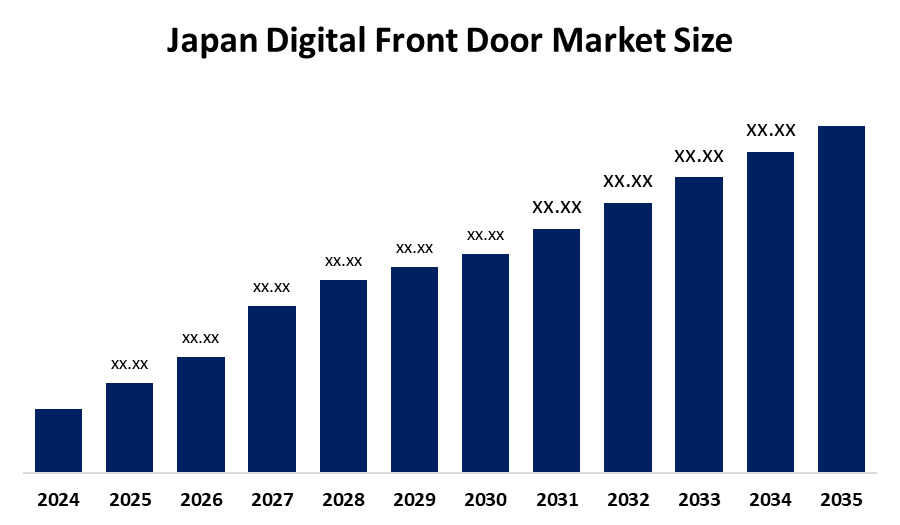
- Japan Digital Front Door Market CAGR 2024: 13.8%
- Japan Digital Front Door Market Segments: Component, Deployment Mode, Application, and End User
Get more details on this report -
The Japan digital front door market contains digital access platforms which enable patients to reach healthcare providers through combined technological systems. The solutions enable patients to navigate their healthcare paths because they connect various healthcare services which include online appointment scheduling and telemedicine and patient portals and mobile health applications and electronic health records and remote monitoring systems. The market is growing because of three factors which include rising demand for healthcare access and increasing chronic disease cases and Japan's fast growing elderly population which puts pressure on existing healthcare systems. Digital touchpoints which healthcare institutions use to enhance their operational performance and patient experience are becoming their main area of focus.
The national digital health initiatives which promote interoperability and standardized electronic medical records and telemedicine utilization create a foundation which supports market development. The introduction of regulatory reforms enables healthcare providers to offer more extensive online consultation services which hospitals and clinics now use at a faster rate. The healthcare sector uses artificial intelligence to develop triage systems which analyze patient needs and deploy chatbot systems for patient assistance and establish connections with wearable devices and create predictive analytics to enhance care management. Hybrid care models which combine virtual and in-person services create better access to healthcare services while preserving ongoing patient treatment. Digital front door platforms utilize advanced data analytics and interoperable systems to deliver personalized healthcare services while improving clinical processes throughout Japan.
Market Dynamics of the Japan Digital Front Door Market:
The Japan digital front door market is driven by the growing demand for seamless patient access, the rising burden of chronic diseases, and the increasing need for efficient healthcare delivery. The rapid adoption of telemedicine, mobile health applications, and online appointment systems is accelerating digital platform implementation. Government initiatives supporting healthcare digitalization, expansion of interoperable electronic health records, and the integration of AI, data analytics, and remote monitoring technologies are further strengthening market growth.
The Japan digital front door market is restrained by high implementation and operational costs, cybersecurity and data privacy concerns, interoperability challenges with legacy hospital systems, and limited digital readiness among smaller healthcare providers, which may slow large-scale adoption and increase operational complexity.
The future of the Japan digital front door market is promising, with strong opportunities emerging from hybrid care models, AI-assisted virtual triage, personalized digital engagement, remote patient monitoring, and predictive analytics integration. The incorporation of cloud-based platforms, wearable connectivity, and advanced data tools will enhance patient participation, improve care coordination, and ensure efficient, patient-centric healthcare delivery across Japan.
Japan Digital Front Door Market Report Coverage
| Report Coverage | Details |
|---|---|
| Base Year: | 2024 |
| Forecast Period: | 2024-2035 |
| Forecast Period CAGR 2024-2035 : | CAGR of 13.8% |
| Historical Data for: | 2020-2023 |
| No. of Pages: | 210 |
| Tables, Charts & Figures: | 90 |
| Segments covered: | By Component |
| Companies covered:: | M3, Inc., Medley, Inc., MICIN, Inc., Ubie, Inc., NTT Data Corporation, Fujitsu Limited, NEC Corporation, Sony Group Corporation, and Other key players |
| Pitfalls & Challenges: | COVID-19 Empact, Challenge, Future, Growth, & Analysis |
Get more details on this report -
Market Segmentation
The Japan digital front door market share is classified into component, deployment mode, application, and end user.
By Component:
The Japan digital front door market is divided by component into software and services. Among these, the software segment dominated the share in 2024 and is anticipated to grow at a remarkable CAGR during the forecast period. The software segment dominates due to increasing hospital investment in integrated patient portals, telehealth platforms, AI-driven scheduling systems, and interoperable electronic health record interfaces that streamline digital access points and enhance coordinated care delivery across Japan’s healthcare institutions.
By Deployment Mode:
The Japan digital front door market is divided by deployment mode into cloud-based, on-premise, and hybrid. Among these, the cloud-based segment dominated the share in 2024 and is anticipated to grow at a remarkable CAGR during the forecast period. The cloud-based segment dominates because Japanese healthcare providers prioritize scalable infrastructure, secure remote access, reduced capital expenditure, faster implementation timelines, and seamless multi-location connectivity supporting expanding digital healthcare ecosystems nationwide.
By Application:
The Japan digital front door market is divided by application into appointment management, patient engagement, virtual consultation, billing & payment, and care navigation & way-finding. Among these, the virtual consultation segment dominated the share in 2024 and is anticipated to grow at a remarkable CAGR during the forecast period. The virtual consultation segment dominates due to rising telemedicine reimbursement policies, strong broadband penetration, increasing elderly patient demand for remote access, and hospital integration of video platforms enabling continuous care beyond physical facilities
By End-User:
The Japan digital front door market is divided by end-user into hospitals & health systems, clinics & physician practices, payers & insurance companies, and retail & urgent-care centers. Among these, the hospitals & health systems segment dominated the share in 2024 and is anticipated to grow at a remarkable CAGR during the forecast period. The hospitals & health systems segment dominates due to large-scale digital transformation budgets, centralized patient data management requirements, regulatory compliance obligations, and the need to optimize patient flow across complex multi-department healthcare networks.
Competitive Analysis:
The report offers the appropriate analysis of the key organisations/companies involved within the Japan digital front door market, along with a comparative evaluation primarily based on their product offering, business overviews, geographic presence, enterprise strategies, segment market share, and SWOT analysis. The report also provides an elaborative analysis focusing on the current news and developments of the companies, which includes product development, innovations, joint ventures, partnerships, mergers & acquisitions, strategic alliances, and others. This allows for the evaluation of the overall competition within the market.
Top Key Companies in Japan Digital Front Door Market:
- M3, Inc.
- Medley, Inc.
- MICIN, Inc.
- Ubie, Inc.
- NTT Data Corporation
- Fujitsu Limited
- NEC Corporation
- Sony Group Corporation
- Others
Key Target Audience
- Market Players
- Investors
- End-users
- Government Authorities
- Consulting and Research Firm
- Venture capitalists
- Value-Added Resellers (VARs)
Market Segment
This study forecasts revenue at the Japan, regional, and country levels from 2020 to 2035. Spherical Insights has segmented the Japan digital front door market based on the below-mentioned segments:
Japan Digital Front Door Market, By Component
- Software
- Services
Japan Digital Front Door Market, By Deployment Mode
- Cloud-based
- On-Premise
- Hybrid
Japan Digital Front Door Market, By Application
- Appointment Management
- Patient Engagement
- Virtual Consultation
- Billing & Payment
- Care Navigation & Way-finding
Japan Digital Front Door Market, By End-User
- Hospitals & Health Systems
- Clinics & Physician Practices
- Payers & Insurance Companies
- Retail & Urgent-care Centers
Frequently Asked Questions (FAQ)
-
What is the Japan digital front door market size?Japan digital front door market is expected to grow at a CAGR of 13.8% during the forecast period 2025-2035.
-
What are the key growth drivers of the market?Market growth is driven by rising demand for seamless patient access, increasing chronic disease prevalence, rapid telemedicine adoption, and government-backed healthcare digitalization initiatives. Integration of AI, interoperable electronic health records, remote monitoring, and mobile health platforms is further accelerating digital platform deployment.
-
What factors restrain the Japan digital front door market?Constraints include high implementation and operational costs, cybersecurity and data privacy concerns, interoperability challenges with legacy hospital systems, and limited digital readiness among smaller healthcare providers, which may slow adoption and increase system integration complexity.
-
Who are the key players in the Japan digital front door market?Key companies include M3, Inc., Medley, Inc., MICIN, Inc., Ubie, Inc., NTT Data Corporation, Fujitsu Limited, NEC Corporation, Sony Group Corporation, and others
-
Who are the target audiences for this market report?The report targets market players, investors, end-users, government authorities, consulting and research firms, venture capitalists, and value-added resellers (VARs).
Need help to buy this report?