Japan Cell Culture Supplements Market Size, Share, By Product Type (Basal Media, Complex Media, Serum-Free, Supplements, and Others), By Application (Regenerative Medicine, Biopharmaceutical Production, and Research) and By Cell Type (Animal Cells, Plant Cells, and Bacterial Cells), Japan Cell Culture Supplements Market Insights, Industry Trend, Forecasts to 2035
Industry: Healthcare
Japan Cell Culture Supplements Market Insights Forecasts to 2035
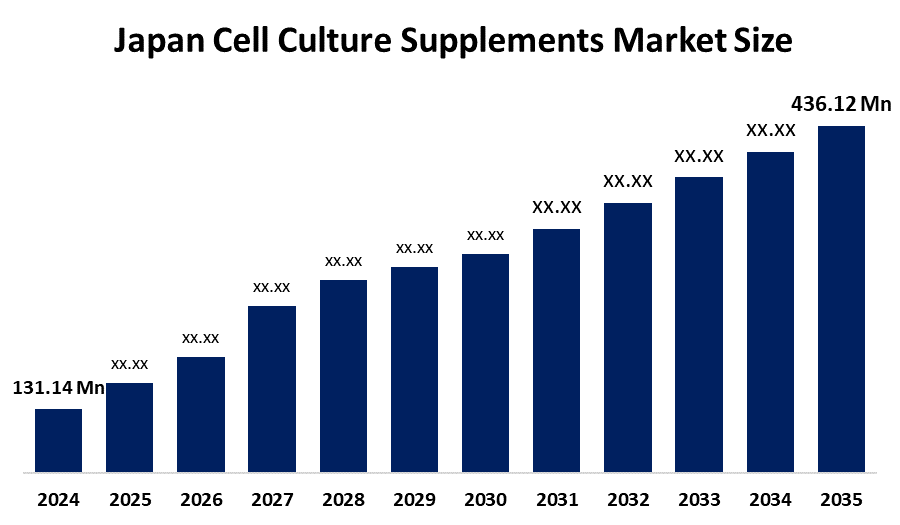
- Japan Cell Culture Supplements Market Size 2024: USD 131.14 million
- Japan Cell Culture Supplements Market Size 2035: USD 436.12 million
- Japan Cell Culture Supplements Market CAGR 2024: 11.54%
- Japan Cell Culture Supplements Market Segments: Product Types, Application, and Cell Types.
Get more details on this report -
The Japan Cell Culture Supplements Market Size is the commercial market in Japan that is concerned with the development, production, supply, and usage of supplementary components added to cell culture media for supporting cell growth, proliferation, differentiation, or maintaining cells in vitro. Cell culture supplements are used in combination with base culture media. They fall into several categories, for example, serum supplements, serum-free or chemically defined supplements, attachment factors, or recombinant proteins. Furthermore, The Japan cell culture supplements market is driven by increasing biopharmaceuticals and biologics production, a strong research focus on stem cells and regenerative medicine, an increasing adoption of serum-free and chemically defined supplements in biotechnology research, and steady technological development in cell culture methods. In addition to this, support for life science research by the government, a clinical application expansion of cell-based therapies, and a growing need for quality research tools are factors driving market growth.
The government of Japan is growing the market for cell culture supplements with its favourable policies for biotech and regenerative medicine. Financing from AMED helps to advance research in stem cells, IPS cells, and cell therapies; this increases the demand for high-quality supplements. METI supports the manufacture of pharmaceuticals and the development of capabilities in the country. There is the pharmaceuticals and medical devices act that allows fast tracks for approval.
Japan Cell Culture Supplements Market Size trends include a rise in the use of serum-free and chemically defined cell culture supplements to enhance quality and safety. The use of recombinant proteins, growth factors, and speciality cell culture additives is gaining prominence. The increasing use of automated high-throughput cell culture systems and their adaptation in biopharmaceutical production and stem cell research are some of the market trends.
Market Dynamics of the Japan Cell Culture Supplements Market:
The Japan Cell Culture Supplements Market Size is driven by the increased number of cell and protein productions related to the boom in the field of biopharmaceutical and biologics. Stem cell and regenerative cell research is on the rise, related to the development of IPSC-based treatments. The use of serum-free and chemically defined supplements improves cell culturing conditions related to increased safety and reproducibility. The development of automated and high-throughput platforms, along with the necessity for a one-handed and clinical-grade product, boosts the cell culture supplement market.
Japan Cell Culture Supplements Market Size restraints are high production and development prices, strict government regulations, and risks in their supply chain related to raw biological substances. Standardisation at a low level in these supplements further affects customer confidence, while an unskilled labour force and less adoption of efficient or synthetic supplements act as restraints in this market. High prices of these supplements also affect accessible or low-budget research industries.
The market for cell culture supplements in Japan presents a number of opportunities. This is attributed to increasing investments in regenerative medicine, stem cell research, and biopharmaceutical manufacturing. Increasing demand for serum-free media, chemically defined media, developments in cell therapy technologies, and the adoption of personalised medicine are fueling the market. Favourable policies for biotech developments in the healthcare sector, and joint ventures between institutions and companies, also help to promote developments in advanced cell culture supplements.
Japan Cell Culture Supplements Market Report Coverage
| Report Coverage | Details |
|---|---|
| Base Year: | 2024 |
| Market Size in 2024: | USD 131.14 Million |
| Forecast Period: | 2024-2035 |
| Forecast Period CAGR 2024-2035 : | CAGR Of 11.54% |
| 2035 Value Projection: | USD 436.12 Million |
| Historical Data for: | 2020-2023 |
| No. of Pages: | 240 |
| Tables, Charts & Figures: | 90 |
| Segments covered: | By Product Type, By Application |
| Companies covered:: | Kea Thermos Fisher Scientific Inc. Merck Danaher Corporation Sartorius AG Corning Inc. STEMCELL Technologies Hi Media Laboratories Religion Corporation Bio TechNet Corporation (R&D Systems) Protein tech Group Inc. And Other Key Players |
| Pitfalls & Challenges: | COVID-19 Empact, Challenge, Future, Growth, & Analysis |
Get more details on this report -
Market Segmentation
The Japan cell culture supplements market is classified into product types, application, and cell types
By Product Types:
The Japan Cell Culture Supplements Market Size is divided by product types into basal media, complex media, serum-free, supplements, and other. Among these, the basal media segment dominated the share in 2024 and is anticipated to grow at a remarkable CAGR during the forecast period. The basal media segment dominates because they offer consistent, animal-free formulations, reducing batch variability and regulatory risks, making it ideal for biopharmaceutical production. Basal media are foundational but less profitable, while complex media and supplements serve niche or research applications. Growth is driven by therapeutics, reproducibility, and ethical compliance
By Application:
The Japan Cell Culture Supplements Market Size is divided by application into regenerative medicine, biopharmaceutical production, and research. Among these, the biopharmaceutical production segment dominated the share in 2024 and is anticipated to grow at a remarkable CAGR during the forecast period. The biopharmaceutical production segment dominates because Japan has a strong biologics and vaccine manufacturing industry. Cell culture supplements are critical for high-yield, consistent, and regulatory-compliant production of monoclonal antibodies, recombinant proteins, and vaccines. Research and regenerative medicine are smaller markets with slower commercial-scale demand.
By Cell Types:
The Japan Cell Culture Supplements Market Size is divided by cell types into animal cells, plant cells, and bacterial cells. Among these, the animal cells segment dominated the share in 2024 and is anticipated to grow at a remarkable CAGR during the forecast period. The animal cells segment is dominant because Japan’s cell culture supplements are mainly used for biopharmaceutical production, including monoclonal antibodies, vaccines, and recombinant proteins, which rely on mammalian cells. Plant and bacterial cells are smaller markets, mainly for research or niche applications, with lower commercial-scale demand and revenue impact.
Competitive Analysis:
The report offers the appropriate analysis of the key organisations/companies involved within the Japan cell culture supplements market, along with a comparative evaluation primarily based on their product offering, business overviews, geographic presence, enterprise strategies, segment market share, and SWOT analysis. The report also provides an elaborate analysis focusing on the current news and developments of the companies, which includes product development, innovations, joint ventures, partnerships, mergers & acquisitions, strategic alliances, and others. This allows for the evaluation of the overall competition within the market.
Top Key Companies in the Japan Cell Culture Supplements Market:
- Kea
- Thermos Fisher Scientific Inc.
- Merck Danaher Corporation
- Sartorius AG
- Corning Inc.
- STEMCELL Technologies
- Hi Media Laboratories
- Religion Corporation
- Bio TechNet Corporation (R&D Systems)
- Protein tech Group Inc.
Recent Developments in Japan Cell Culture Supplements Market:
- In December 2025, Ajinomoto Cellist launched the Cellist AAV Production Supplement Developed in Tokyo in collaboration with Forge Biologics, this supplement increases viral vector productivity by 1.3 to 2 times for gene therapy
Key Target Audience
- Market Players
- Investors
- End-users
- Government Authorities
- Consulting and Research Firm
- Venture capitalists
- Value-Added Resellers (VARs)
Market Segment
This study forecasts revenue at the Japan, regional, and country levels from 2020 to 2035. Spherical Insights has segmented the Japan cell culture supplements market based on the below-mentioned segments:
Japan Cell Culture Supplements Market, By Product Types
- Basal Media
- Complex Media
- Serum-Free
- Supplements
- Others
Japan Cell Culture Supplements Market, By Application
- Regenerative Medicine
- Biopharmaceutical Production
- Research
Japan Cell Culture Supplements Market, By Cell Type
- Animal Cells
- Plant Cells
- Bacterial Cells
Frequently Asked Questions (FAQ)
-
Why is Japan’s cell culture supplements market important?Japan has a strong biotech, pharmaceutical, and regenerative medicine ecosystem that relies on high-quality cell culture supplements for research, drug development, and industrial bioproduction.
-
What is the cell culture supplements market?The cell culture supplements market includes nutrient additives (e.g., proteins, growth factors, vitamins, serum replacements, chemically defined components) used to support cell growth, viability and productivity in lab and biomanufacturing settings especially in biopharma, regenerative medicine, and R&D
-
How is technology influencing Japan cell culture supplement market?Advances like serum-free chemically defined media, high-productivity supplements, and optimised formulations improve cell growth, reproducibility, and scalability
-
What was the size of the Japan cell culture supplement market?Japan Cell Culture Supplements Market is expected to grow from USD 131.14 million in 2024 to USD 436.12 million by 2035, growing at a CAGR of 11.54% during the forecast period 2025-2035.
-
How does the Japan cell culture supplements market relate to broader cell culture products?Cell culture supplements are part of the larger cell culture ecosystem in Japan, which includes media, reagents, and consumables, with the overall cell culture market valued at over USD 131.14 million in 2024.
Need help to buy this report?