Japan Cancer Monoclonal Antibodies Market Size, Share, By Molecule Type (Naked (unconjugated) MAbs, Antibody-drug conjugates, Bispecific antibodies, and Others), By Cancer Type (Breast, Lung, Colorectal, Melanoma, and Others), By Distribution Channel (Direct to Hospitals, Speciality Distributors & Wholesalers, Retail & Speciality Pharmacies, and Others), Japan Cancer Monoclonal Antibodies Market Insights, Industry Trend, Forecasts to 2035
Industry: Healthcare
Japan Cancer Monoclonal Antibodies Market Insights Forecasts to 2035
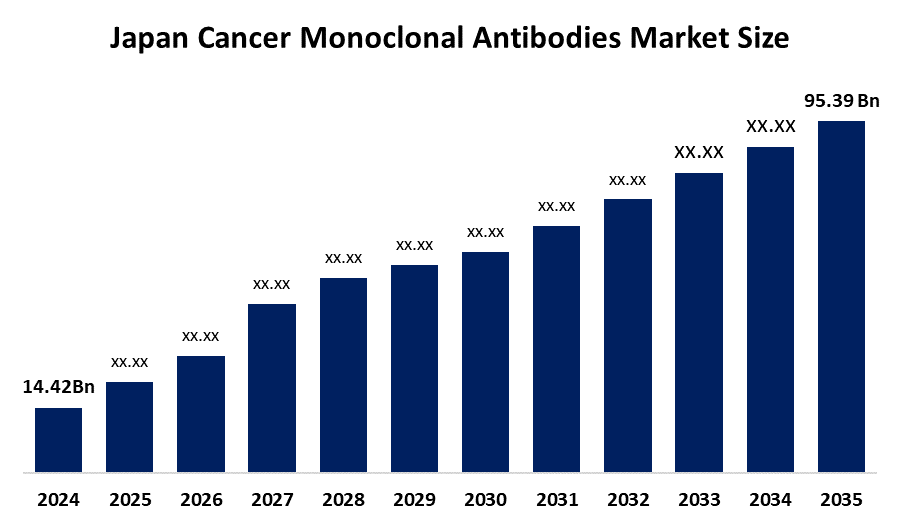
- Japan Cancer Monoclonal Antibodies Market Size 2024: USD 14.42 Billion
- Japan Cancer Monoclonal Antibodies Market Size 2035: USD 95.39 Billion
- Japan Cancer Monoclonal Antibodies Market CAGR 2024: 18.74%
- Japan Cancer Monoclonal Antibodies Market Segments: Molecule Types, Cancer Types, Distribution Channel.
Get more details on this report -
The Japan Cancer Monoclonal Antibodies Market Size refers to the segment of Japan’s pharmaceutical and biotechnology industry focused on the research, development, production, and commercialisation of monoclonal antibody–based therapies for cancer treatment, including targeted therapies and immunotherapies used across various oncology indications. Furthermore, the growth of the market is supplemented by robust R&D capabilities, a well-developed healthcare infrastructure network, early diagnosis strategies, and supportive regulatory and reimbursement environments. Increasing trends of biosimilars and joint ventures between domestic and foreign pharmaceutical firms also accelerate market expansion for cancer drugs.
The Japan government actively supports the cancer monoclonal antibodies market by creating policies which enhance biopharmaceutical innovation, expedite regulatory pathways, and enhance biosimilar use. Financial incentives are provided in addition to a revised set of guidelines by MHLW and PMDA to promote biosimilar use, along with faster review processes. National strategies further provide increasing funding for research, support national manufacturing and drug discovery, and improve access while lowering the cost of targeted therapies.
Trends include fast revenue growth with a very high expected CAGR due to a rising number of targeted therapies and an aging population. Humanised mAbs currently lead, with emerging next-generation modalities such as bispecifics and AD Cs on the rise. Biosimilars and patient-friendly subcutaneous formulations are on the increase, with digital/AI technology assisting in real-world treatment practices.
Japan Cancer Monoclonal Antibodies Market Report Coverage
| Report Coverage | Details |
|---|---|
| Base Year: | 2024 |
| Market Size in 2024: | USD 14.42 billion |
| Forecast Period: | 2024-2035 |
| Forecast Period CAGR 2024-2035 : | 18.74% |
| 2035 Value Projection: | USD 95.39 billion |
| Historical Data for: | 2020-2023 |
| No. of Pages: | 180 |
| Tables, Charts & Figures: | 100 |
| Segments covered: | By Molecule Type ,By Cancer Type |
| Companies covered:: | Genmab A/S, Regeneron Pharmaceuticals, Inc., F. Hoffmann-La Roche Ltd (Roche), Bristol-Myers Squibb, Merck & Co., Inc., Johnson & Johnson, Bayer, GSK plc, Sanofi, Pfizer Inc., AstraZeneca, and Other Key Players |
| Pitfalls & Challenges: | COVID-19 Empact, Challenge, Future, Growth, & Analysi |
Get more details on this report -
Market Dynamics of the Japan Cancer Monoclonal Antibodies Market:
The Japan Cancer Monoclonal Antibodies Market Size is driven by cancer awareness and early diagnosis of the disease, which results in a higher number of patients being identified at stages where targeted therapies can be used most effectively. Awareness through education, screening programs, and physician initiatives leads to early detection, thus timely intervention with advanced treatments such as monoclonal antibodies becomes possible. The Japan monoclonal antibodies market in cancer treatment is driven due to factors such as an increased incidence rate of cancer, an older population, and a greater emphasis on personalised medicine. Moreover, increased awareness regarding screening and treatment of cancer, immunotherapy, and R&D expenditures in the pharmaceutical industry are also contributing to this growth.
The Japan Cancer Monoclonal Antibodies Market Size faces restraining factors such as high treatment costs, low reimbursement rates, and tough approval processes, which tend to slow down adoption in the market. Complexity in their production process and possible side effects could also create hurdles in their adoption process. Moreover, the presence of biosimilars and other rival classes of cancer treatments, such as small-molecule and immunotherapies, could also restrain the adoption process in various markets.
The Japan Cancer Monoclonal Antibodies Market Size presents significant opportunities due to the rise in cancer awareness and an increase in the older population. The support of governments worldwide for cancer research, the emergence of personalised therapy, and the development of ‘next-generation’ monoclonal antibodies create growth opportunities. Growth opportunities are also emerging due to an increase in combination therapies, support for biotech, and the focus on ‘precision’ immunotherapy, which provides opportunities for pharmaceutical organisations to develop innovative products that can help increase their market share.
Market Segmentation
The Japan Cancer Monoclonal Antibodies Market share is classified into molecule types, cancer types, and distribution channels.
By Molecular Types:
The Japan Cancer Monoclonal Antibodies Market Size is divided by molecular type into naked (unconjugated) mAbs, antibody–drug conjugates, bispecific antibodies, and others. Among these, the naked (unconjugated) mAbs segment dominated the share in 2024 and is anticipated to grow at a remarkable CAGR during the forecast period. The naked (unconjugated) mAbs segment dominates because they are well-established, widely approved, and extensively used across multiple cancer types. Their proven clinical efficacy, safety profile, physician familiarity, and strong reimbursement support drive higher adoption compared with newer formats.
By Cancer Types:
The Japan Cancer Monoclonal Antibodies Market Size is divided by cancer types into breast, lung, colorectal, melanoma, and others. Among these, the breast segment dominated the share in 2024 and is anticipated to grow at a remarkable CAGR during the forecast period. The breast segment dominates due to high disease prevalence and extensive use of targeted mAbs such as trastuzumab and pertuzumab. Early diagnosis, strong clinical evidence, long-term therapy use, and favorable reimbursement policies further support higher adoption and revenue generation.
By Distribution Channels
The Japan Cancer Monoclonal Antibodies Market Size is divided by distribution channel into direct to hospitals, speciality distributors & wholesalers, retail & speciality pharmacies, and others. Among these, the direct to hospitals segment dominated the share in 2024 and is anticipated to grow at a remarkable CAGR during the forecast period. The breast direct to hospitals due to most cancer mAb therapies are administered in hospital settings. These treatments require specialised storage, infusion facilities, oncologist supervision, and monitoring for adverse effects, making hospitals the primary and most reliable distribution channel.
Competitive Analysis:
The report offers the appropriate analysis of the key organisations/companies involved within the Japan Cancer Monoclonal Antibodies Market Size ,along with a comparative evaluation primarily based on their product offering, business overviews, geographic presence, enterprise strategies, segment market share, and SWOT analysis. The report also provides an elaborate analysis focusing on the current news and developments of the companies, which includes product development, innovations, joint ventures, partnerships, mergers & acquisitions, strategic alliances, and others. This allows for the evaluation of the overall competition within the market.
Top Key Companies in Japan Cancer Monoclonal Antibodies Market:
- Genmab A/S
- Regeneron Pharmaceuticals, Inc.
- F. Hoffmann-La Roche Ltd (Roche)
- Bristol-Myers Squibb
- Merck & Co., Inc.
- Johnson & Johnson
- Bayer
- GSK plc
- Sanofi
- Pfizer Inc.
- AstraZeneca
- Others
Key Target Audience
- Market Players
- Investors
- End-users
- Government Authorities
- Consulting and Research Firm
- Venture capitalists
- Value-Added Resellers (VARs)
Market Segment
This study forecasts revenue at the Japan, regional, and country levels from 2020 to 2035. Spherical Insights has segmented the Japan Cancer Monoclonal Antibodies Market Size based on the below-mentioned segments:
Japan Cancer Monoclonal Antibodies Market, By Molecular Types
- Naked (unconjugated) MAbs
- Antibody–drug conjugates
- Bispecific antibodies
- Others
Japan Cancer Monoclonal Antibodies Market, By Cancer Type
- Breast
- Lung
- Colorectal
- Melanoma
- Others
Japan Cancer Monoclonal Antibodies Market By Distribution Channel
- Direct to Hospitals
- Speciality Distributors & Wholesalers
- Retail & Speciality Pharmacies
- Others
Frequently Asked Questions (FAQ)
-
What is the Japan cancer monoclonal antibodies market?Japan cancer monoclonal antibodies market is expected to grow from USD 14.42 billion in 2024 to USD 95.39 billion by 2035, growing at a CAGR of 18.74% during the forecast period 2025-2035.
-
What are the key growth drivers of the Japan cancer monoclonal antibodies market?The Japan cancer monoclonal antibodies market key growth drivers include strong R&D, favourable government reimbursement policies, and a growing influx of cost-effective biosimilars.
-
What factors restrain the Japan cancer monoclonal antibodies market?Constraints include the High treatment costs, strict regulatory approval, pricing controls, biosimilar competition, complex manufacturing, cold-chain logistics, limited rural access, and lengthy reimbursement processes, which restrain Japan’s cancer monoclonal antibodies market.
-
How is the Japan cancer monoclonal antibodies market segmented by cancer type?Japan cancer monoclonal antibodies market is segmented into breast, lung, colorectal, melanoma, and others.
-
Who are the key players in the Japan cancer monoclonal antibodies market?Key companies include Genmab A/S, Regeneron Pharmaceuticals, Inc., F. Hoffmann-La Roche Ltd (Roche), Bristol-Myers Squibb, Merck & Co., Inc., Johnson & Johnson, Bayer, GSK plc, Sanofi, Pfizer Inc., AstraZeneca and other
Need help to buy this report?