Japan Bispecific Antibodies Market Size, Share, By Type (Trifunctional Antibody, Bi-specific T-cell Engager (BiTE), Chemically linked Fab, Other), By Indication (Oncology, Autoimmune Disease, Others), By Route (Intravenous, Subcutaneous, Others), Japan Bispecific Antibodies Market Insights, Industry Trend, Forecasts to 2035.
Industry: Healthcare
Japan Bispecific Antibodies Market Insights Forecasts to 2035
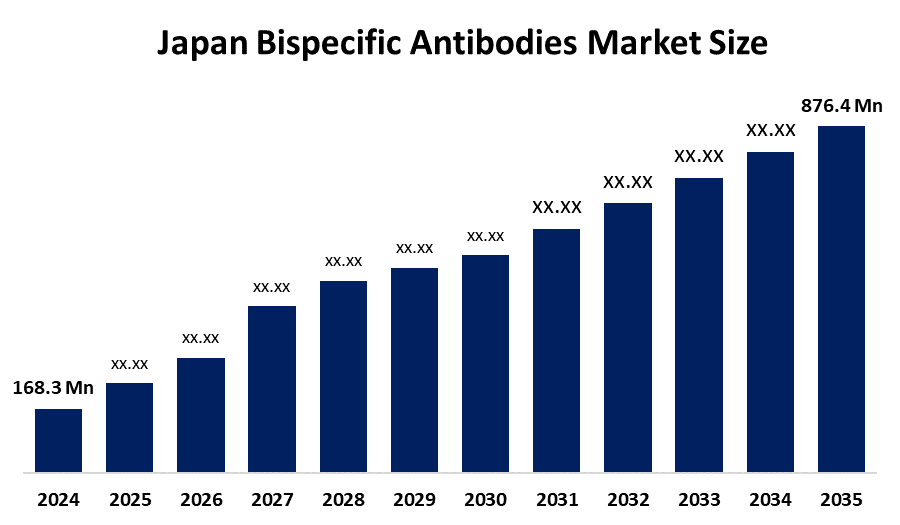
- Japan Bispecific Antibodies Market Size 2024: USD 168.3 Mn
- Japan Bispecific Antibodies Market Size 2035: USD 876.4 Mn
- Japan Bispecific Antibodies Market CAGR 2024: 16.18%
- Japan Bispecific Antibodies Market Segments: Type, Indication, and Route
Get more details on this report -
The Japan bispecific antibodies market is primarily based on therapeutic antibodies designed to target two separate antigens. These antibodies enhance the accuracy of treatments for cancers and autoimmune diseases. These antibodies support two mechanisms: T-cell redirection and blocking for receptor-based mechanisms, thereby promoting outcomes with these treatments where traditionally available therapies were insufficient. Trends supporting market expansion of bispecific antibodies can be attributed to increasing incidence of cancer, increasing demands for targeted biologic treatments, and investigative work involving novel bispecific formats.
Government backing is a market strength because of easy regulatory processes and incentives to perform research and development within the biopharma industry. Strategic investments enable partnerships between Japanese and foreign firms. Precision medicine strategies are future opportunities to deal with the aging and prevalence of diseases. Other opportunities are based on broadening bispecific antibodies to non-cancer diseases and using them in personalized therapies. Japan is a future destination for the development of the next generation of antibody drugs.
Market Dynamics of the Japan Bispecific Antibodies Market:
The Japan bispecific antibodies market is driven by the presence of an elderly population, a large number of cancer and autoimmune diseases, and an increase in the adoption of personalized medicine. The country has an advanced healthcare system, a strong R&D base, and favourable regulatory frameworks, making it an attractive market. Innovations in the field of bispecific antibodies, such as T-cell engagers, are rapidly increasing the potential for safety & efficacy.
High complexity manufacturing, high cost of production, and lack of scalability contribute to supply constraints and increase the cost of treatment. Technical issues such as immunogenicity, Cytokine Release Syndrome, neurotoxicity, and logistics issues affect adoption. Strict regulatory approval procedures in Japan impede commercialization.
Expanded approvals like approval for Vabysmo (Faricimab) in eye conditions by MHLW in May 2025 reflect government approval. Collaborations between Japanese companies and international biopharma players for antibody therapeutics, future developments in next-generation BsAbs, hold immense potential in cancer, immunological disorders, and ophthalmology.
Japan Bispecific Antibodies Market Report Coverage
| Report Coverage | Details |
|---|---|
| Base Year: | 2024 |
| Market Size in 2024: | USD 168.3 Million |
| Forecast Period: | 2024-2035 |
| Forecast Period CAGR 2024-2035 : | CAGR of 16.18% |
| 2035 Value Projection: | USD 876.4 Million |
| Historical Data for: | 2020-2023 |
| No. of Pages: | 210 |
| Tables, Charts & Figures: | 115 |
| Segments covered: | By Type, By Application |
| Companies covered:: | Amgen Inc, Astellas Pharma Inc, Takeda Pharmaceutical Company Ltd, Chugai Pharmaceutical Co Ltd, AbbVie Inc, Genmab A/S, ImmunoGen Inc, Sanofi S.A., Roche Holding AG, Johnson & Johnson, and Key Players |
| Pitfalls & Challenges: | COVID-19 Empact, Challenge, Future, Growth, & Analysis |
Get more details on this report -
Market Segmentation
The Japan bispecific antibodies market share is classified into type, indication, and route.
By Type:
The Japan bispecific antibodies market is divided by type into trifunctional antibody, bi-specific T-cell engager (BiTE), chemically linked Fab, and other. Among these, the BiTE segment dominated the share in 2024 and is anticipated to grow at a remarkable CAGR during the forecast period. The BiTE segment is growing because it has dual capabilities of engaging T cells and tumor cells together with high efficacy and can be easily incorporated within complex treatment protocols for cancer. This segment is highly preferred in hospitals because it contributes towards increased efficacy and precise targeting with less off-target efficacy.
By Indication:
The Japan bispecific antibodies market is divided by indication into oncology, autoimmune disease, and others. Among these, the oncology segment dominated the share in 2024 and is expected to grow at a remarkable CAGR during the forecast period. The driving factors include the ageing population, prevalence of cancer, uptake of targeted therapies, as well as the capacity of bispecific antibodies to act on several pathways involved in tumours, thus enhancing response rates, recurrence, and the capacity to complement existing therapies.
By Route:
The Japan bispecific antibodies market is divided by route into intravenous, subcutaneous, and others. Among these, the intravenous segment dominated the share in 2024 and is projected to grow at a remarkable CAGR during the forecast period. It can be administered after achieving precise dosing control, compatibility with the infusion protocols in hospitals, safe and complex drug administration, ease of monitoring by the clinical community during the infusion process, and physician preferences for the infusion approach in specialized cancer treatment.
Competitive Analysis:
The report offers the appropriate analysis of the key organisations/companies involved within the Japan bispecific antibodies market, along with a comparative evaluation primarily based on their product offering, business overviews, geographic presence, enterprise strategies, segment market share, and SWOT analysis. The report also provides an elaborative analysis focusing on the current news and developments of the companies, which includes product development, innovations, joint ventures, partnerships, mergers & acquisitions, strategic alliances, and others. This allows for the evaluation of the overall competition within the market.
Top Key Companies in Japan Bispecific Antibodies Market:
- Amgen Inc
- Astellas Pharma Inc
- Takeda Pharmaceutical Company Ltd
- Chugai Pharmaceutical Co Ltd
- AbbVie Inc
- Genmab A/S
- ImmunoGen Inc
- Sanofi S.A.
- Roche Holding AG
- Johnson & Johnson
Key Target Audience
- Market Players
- Investors
- End-users
- Government Authorities
- Consulting and Research Firm
- Venture capitalists
- Value-Added Resellers (VARs)
Market Segment
This study forecasts revenue at the Japan, regional, and country levels from 2020 to 2035. Spherical Insights has segmented the Japan bispecific antibodies market based on the below-mentioned segments:
Japan Bispecific Antibodies Market, By Type
- Trifunctional antibody
- Bi-specific T-cell engager (BiTE)
- Chemically linked Fab
- Other
Japan Bispecific Antibodies Market, By Indication:
- Oncology
- Autoimmune Disease
- Others
Japan Bispecific Antibodies Market, By Route
- Intravenous
- Subcutaneous
- Others
Frequently Asked Questions (FAQ)
-
Q:What is the Japan bispecific antibodies market size?A:Japan bispecific antibodies market is expected to grow from USD 168.3 million in 2024 to USD 876.4 million by 2035, growing at a CAGR of 16.18% during the forecast period 2025-2035.
-
Q:What are the key growth drivers of the market?A:Market growth is driven by the presence of an elderly population, a large number of cancer and autoimmune diseases, and an increase in the adoption of personalized medicine. The country has an advanced healthcare system, a strong R&D base, and favourable regulatory frameworks, making it an attractive market. Innovations in the field of bispecific antibodies, such as T-cell engagers, are rapidly increasing the potential for safety & efficacy.
-
Q:What factors restrain the Japan bispecific antibodies market?A:High complexity manufacturing, high cost of production, and lack of scalability contribute to supply constraints and increase the cost of treatment. Technical issues such as immunogenicity, Cytokine Release Syndrome, neurotoxicity, and logistics issues affect adoption. Strict regulatory approval procedures in Japan impede commercialization.
-
Q:How is the market segmented by type?A:The market is segmented into trifunctional antibody, bi-specific T-cell engager (BiTE), chemically linked fab, other.
-
Q:Who are the target audiences for this market report?A:The report targets market players, investors, end-users, government authorities, consulting and research firms, venture capitalists, and value-added resellers (VARs).
Need help to buy this report?