Japan Biosurfactants Market Size, Share, By Product (Rhamnolipids, Sophorolipids, Methyl Ester Sulfonates, Alkyl Poly-glucosides, and Others), By Application (Household, Detergents, Personal Care, Industrial Cleaners, Agriculture Chemicals, and Food processing), Japan Biosurfactants Market Insights, Industry Trend, Forecasts to 2035
Industry: Chemicals & Materials
Japan Biosurfactants Market Insights Forecasts to 2035
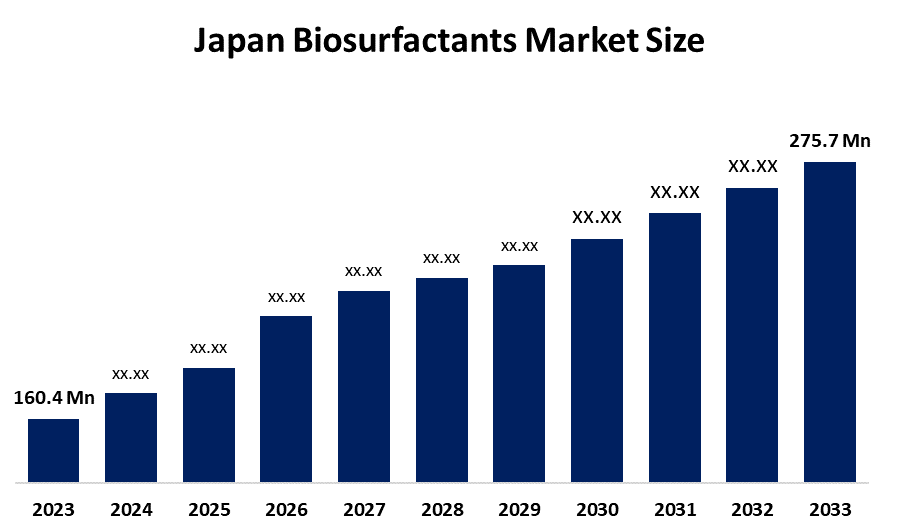
- Japan Biosurfactants Market Size 2024: USD 160.4 Mn
- Japan Biosurfactants Market Size 2035: USD 275.7 Mn
- Japan Biosurfactants Market CAGR: 5.05%
- Japan Biosurfactants Market Segments: Product and Application
Get more details on this report -
The biosurfactants market of Japan is on a constant upward trajectory, as various industries are increasingly accepting more and more of the eco-friendly, biodegradable substitutes to the conventional chemical surfactants. Biosurfactants have specific benefits such as low toxicity, high biodegradability, and enhanced performance, which are the main factors of demand in the sectors that are focused on sustainability and compliance with regulations.
Japan's policy landscape is increasingly favouring sustainable chemicals and green innovation. The government regulations that limit the use of conventional chemical surfactants and put an emphasis on environmental impact assessments and product safety standards are instrumental in this scenario as they help the biosurfactant adoption. The public funding and R&D support for sustainable industrial biotechnology, which includes partnerships between universities and industries, are directed towards innovating in the area of biosurfactant production and commercialization.
The advances are mainly aimed at microbial fermentation and bioprocess optimization to attain higher production rates and lower costs. The developments in strain engineering, downstream processing, and characterization technologies are making biosurfactants competitive with synthetic ones. The improved production methods, along with the increasing use of natural and green materials in cosmetic and household products, are the major technological factors that drive the market growth in Japan.
Market Dynamics of the Japan Biosurfactants Market:
Increasing preference for environmentally friendly and biodegradable options across various product categories, such as cosmetics, detergents, and special applications. More and more Japanese customers and companies are choosing products that are environmentally friendly, which contributes to the switch to biosurfactants. On top of that, the strict environmental regulations and the industry's high standards are pushing the producers to be less dependent on synthetic surfactants, thus fueling the market even more. The developing fermentation technologies and bioprocessing methods are working towards more efficient and competitive production, which will ultimately lead to product performance and cost-effectiveness enhancement through time.
The huge interest has not been enough to overcome the negatives of high production costs that the market confronts, coming from complex fermentation processes, expensive substrates and purification requirements, making biosurfactants not cost-competitive with traditional surfactants. These production costs are barriers to both large-scale commercialization and price competitiveness. Besides, the slow adoption of biosurfactants in all potential application sectors is due to limited awareness and technical understanding about the benefits of biosurfactants among some end-users.
There are significant opportunities for growth through technological innovation in microbial strain engineering and bioprocess improvements that can reduce costs and increase yields. Expanding applications in agriculture, oil recovery, and environmental remediation open new use cases beyond traditional sectors. Strategic partnerships between biotech firms, cosmetic and detergent manufacturers, and research institutions can accelerate product development and awareness. Additionally, Japan’s commitment to sustainability and green chemistry initiatives may create favorable regulatory and funding environments to support market expansion.
Japan Biosurfactants Market Report Coverage
| Report Coverage | Details |
|---|---|
| Base Year: | 2024 |
| Market Size in 2024: | USD 160.4 Million |
| Forecast Period: | 2025-2035 |
| Forecast Period CAGR 2025-2035 : | CAGR of 5.05 % |
| 2035 Value Projection: | USD 275.7 Million |
| Historical Data for: | 2020-2023 |
| No. of Pages: | 210 |
| Tables, Charts & Figures: | 90 |
| Segments covered: | By Product, By Application |
| Companies covered:: | Mitsubishi Chemical Corporation,Saraya Co., Ltd,Kao Corporation,Allied Carbon Solutions,BASF SE,Soliance (Givaudan Active Beauty) And Others • Saraya Co., Ltd. • Kao Corporation • Allied Carbon Solutions • BASF SE • Soliance (Givaudan Active Beauty) • Other |
| Pitfalls & Challenges: | COVID-19 Empact, Challenge, Future, Growth, & Analysis |
Get more details on this report -
Market Segmentation
Japan's Biosurfactants Market share is classified into product and application.
By Product:
Japan's biosurfactants Market is divided by product into rhamnolipids, sophorolipids, methyl ester sulfonates, alkyl poly-glucosides, and others. Among these, the methyl ester sulfonates segment dominated the market share in 2024 and is anticipated to grow at a significant CAGR during the forecast period. MES’s stronghold in the market can be mainly credited to its affordability, superb cleaning performance, and eco-friendliness, which together have opened up its use in household detergents, industrial cleaning agents, and cosmetic products.
By Application:
Japan's biosurfactants Market is categorised by application into household, detergents, personal care, industrial cleaners, agriculture chemicals, and food processing. Among these, the household segment leads the market share in 2024 and is projected to grow at a remarkable CAGR during the forecast period. The primary factor for this ascendancy is the growing consumer preference for eco-friendly and biodegradable cleaning products, which is backed by the heightened environmental sustainability awareness and health issues related to the use of synthetic surfactants.
Competitive Analysis:
The report offers the appropriate analysis of the key organisations/companies involved within the Japan biosurfactants Market, along with a comparative evaluation primarily based on their product offering, business overviews, geographic presence, enterprise strategies, segment market share, and SWOT analysis. The report also provides an elaborative analysis focusing on the current news and developments of the companies, which includes product development, innovations, joint ventures, partnerships, mergers & acquisitions, strategic alliances, and others. This allows for the evaluation of the overall competition within the market.
Top Key Companies in Japan Biosurfactants Market:
- Mitsubishi Chemical Corporation
- Saraya Co., Ltd.
- Kao Corporation
- Allied Carbon Solutions
- BASF SE
- Soliance (Givaudan Active Beauty)
- Other
Key Target Audience
- Market Players
- Investors
- End-users
- Government Authorities
- Consulting and Research Firm
- Venture capitalists
- Value-Added Resellers (VARs)
Market Segment
This study forecasts revenue at the Japan, regional, and country levels from 2020 to 2035. Spherical Insights has segmented the Japan biosurfactants Market based on the following segments:
Japan Biosurfactants Market, By Product
- Rhamnolipids
- Sophorolipids
- Methyl Ester Sulfonates
- Alkyl Poly-glucosides
- Others
Japan Biosurfactants Market, By Application
- Household
- Detergents
- Personal Care
- Industrial Cleaners
- Agriculture Chemicals
- Food processing
Frequently Asked Questions (FAQ)
-
What is the base year and forecast period for the Japan Biosurfactants Market?The base year for the market analysis is 2024, with historical data covering 2020–2023. The forecast period extends from 2025 to 2035.
-
What is the expected market size of the Japan biosurfactants industry by 2035?The Japan biosurfactants Market is expected to grow from USD 160.4 million in 2024 to USD 275.7 million by 2035, registering a CAGR of 5.05% during the forecast period.
-
What factors are driving the growth of the Japan biosurfactants market?Key growth drivers include rising demand for eco-friendly and biodegradable surfactants, increasing environmental awareness, stringent regulations limiting synthetic surfactants, and expanding applications in household detergents, personal care, agriculture, industrial cleaning, and pharmaceuticals.
-
Which product segment dominated the market in 2024?The methyl ester sulfonates (MES) segment dominated the market in 2024 due to its cost-effectiveness, excellent cleaning performance, and biodegradability, making it widely used in detergents, industrial cleaners, and cosmetic formulations.
-
Which application segment held the largest market share in 2024?The household segment held the largest market share in 2024, driven by growing consumer preference for sustainable and biodegradable cleaning products and increasing health concerns associated with chemical surfactants.
-
Who are the key players in the Japanese biosurfactants industry?Key companies include Mitsubishi Chemical Corporation, Saraya Co., Ltd., Kao Corporation, Allied Carbon Solutions, BASF SE, and Soliance (Givaudan Active Beauty), along with other emerging players.
Need help to buy this report?