Japan AR Cloud Market Size, Share, By Component (Hardware, Software, Services), Organization Size (Large Enterprises Small, Medium Enterprises), By Type (Marker Based AR, Marker Less AR), By Deployment (Public Cloud, Private Cloud, Hybrid Cloud), By End Use (Automotive, Aerospace & Defense, Healthcare, Manufacturing, Retail, Media & Entertainment, Real Estate & Construction, IT & Telecommunications, Others), Japan AR Cloud Market Insights, Industry Trend, Forecasts to 2035.
Industry: Electronics, ICT & Media
Japan AR Cloud Market Insights Forecasts to 2035
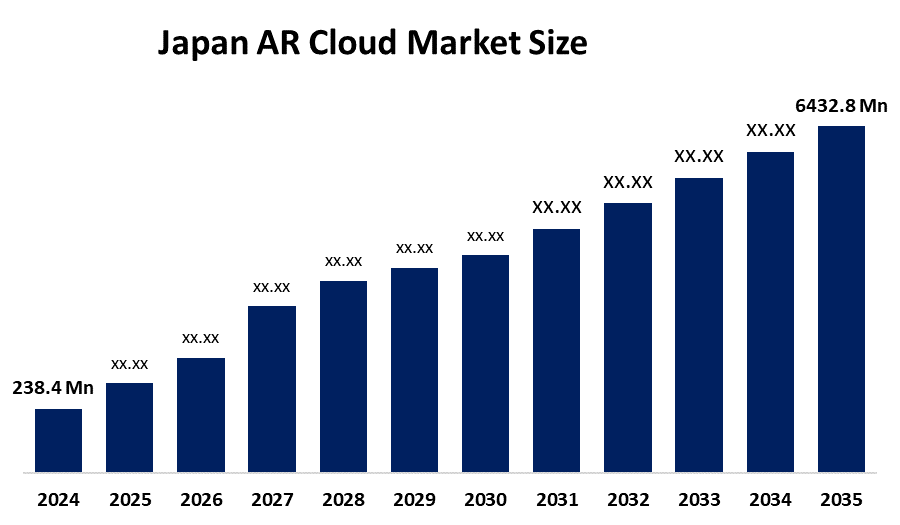
- Japan AR Cloud Market Size 2024: USD 238.4 Mn
- Japan AR Cloud Market Size 2035: USD 6432.8 Mn
- Japan AR Cloud Market CAGR 2024: 34.93%
- Japan AR Cloud Market Segments: Component, Organization Size, Type, Deployment, and End Use
Get more details on this report -
Japan AR cloud market refers to cloud-based platforms which are utilized for the purpose of creating augmented reality experiences. This involves the physical environment being mapped, and digital data being associated with real-world locations. Such platforms are utilized for the purpose of smart city visualization, urban navigation, augmented tourism experiences, retail experiences, maintenance, and collaboration. Demand for the Japan AR cloud market is driven by a sophisticated digital infrastructure, high rates of smartphones and 5G, high adoption rates of augmented reality in gaming and business applications, and the increasing need for real-time visualization.
Technological innovation in Japan is centered on high-precision spatial mapping, computer vision, AI-based environment identification, edge computing, and cloud processing to ensure efficient AR experiences even for multiple users. Various government initiatives associated with the national digital transformation strategies, development of smart cities, and policies of Society 5.0 encourage the adoption of spatial data, AR technologies, and cloud technologies in various sectors. Future development in AR cloud innovation can be expected in city-scale AR solutions, digital twin solutions for enterprises, infrastructure observation, and connection to the metaverse and spatial data ecosystem to enhance Japan’s innovation in AR cloud technology.
Market Dynamics of the Japan AR Cloud Market:
The market for AR cloud solutions in Japan is driven by the rapid digitization of cities and businesses, enhanced immersive spatial experience needs, and widespread use of augmented reality technology in gaming, tourism, industry, and retail visualization applications. The prevalence of smartphone and 5G networks is increasing real-time AR interaction, and there is a demand for accurate spatial information of cities and premises, thus driving investments in AR Cloud platforms.
The growth is hampered by the lack of standardized formats for AR contents, as well as interoperability across devices and platforms, which makes their large-scale adoption and implementation difficult. Additionally, the high development costs for cloud infrastructure related to augmented reality and the lack of qualified personnel well-versed in spatial computing and computer visions are also impeding the accelerated adoption of augmented reality.
Opportunities exist in the areas of smart cities, enterprise digital twin solutions, and infrastructure solutions using persistent AR experiences and spatial data. Opportunities also exist in areas such as integration of AR cloud and metaverse, edge computing, and AI analysis, which give Japan a leading role in using advanced AR cloud technology.
Japan AR Cloud Market Report Coverage
| Report Coverage | Details |
|---|---|
| Base Year: | 2024 |
| Market Size in 2024: | USD 238.4 Million |
| Forecast Period: | 2024-2035 |
| Forecast Period CAGR 2024-2035 : | CAGR of 34.93% |
| 2035 Value Projection: | USD 6432.8 Million |
| Historical Data for: | 2020-2023 |
| No. of Pages: | 210 |
| Tables, Charts & Figures: | 115 |
| Segments covered: | By Type, By Application |
| Companies covered:: | Niantic, Microsoft Corporation, Amazon Web Services, Google, Blippar, Magic Leap, PTC, Meta Platforms Inc, Apple Inc, Oracle Corp, and Key players |
| Pitfalls & Challenges: | COVID-19 Empact, Challenge, Future, Growth, & Analysis |
Get more details on this report -
Market Segmentation
The Japan AR cloud market share is classified into component, organization size, type, deployment, and end use.
By Component:
The Japan AR cloud market is divided by component into hardware, software, and services. Among these, the software segment dominated the share in 2024 and is anticipated to grow at a remarkable CAGR during the forecast period. Software leads, as AR cloud platforms need continuous updates, spatial mapping algorithms, cloud-based content management, integration with AI, scalability on different devices, subscription-based services, and regular enterprise application usage for visualization, collaboration, and location-based augmented reality.
By Organization Size:
The Japan AR cloud market is divided by organization size into large enterprises and small & medium enterprises. Among these, the large enterprises segment dominated the share in 2024 and is anticipated to grow at a remarkable CAGR during the forecast period. Large corporations drive the AR market due to their increased digital transformation expenditures, complicated business operations, multi-location implementations, early adoption of AR, well-developed IT infrastructure, availability of trained staff, and existing investments in AR and virtual solutions.
By Type:
The Japan AR cloud market is divided by type into marker-based AR and marker-less AR. Among these, the marker-less AR segment dominated the share in 2024 and is anticipated to grow at a remarkable CAGR during the forecast period. The demand for real-world spatial mapping, outdoor usability, low dependency on physical markers, enhanced accuracy of computer vision, seamless user experience, and smart city, navigation, and industrial applications is driving the market growth.
By Deployment:
The Japan AR cloud market is divided by deployment into public cloud, private cloud, and hybrid cloud. Among these, the public cloud segment dominated the share in 2024 and is anticipated to grow at a remarkable CAGR during the forecast period. The public clouds are more popular due to scalability, quicker deployment time, lower infrastructure expenses, remote accessibility, high availability, flexible pricing plans, and integrability into AR platforms, business applications, and real-time processing activities.
By End Use:
The Japan AR cloud market is divided by end use into automotive, aerospace & defense, healthcare, manufacturing, retail, media & entertainment, real estate & construction, IT & telecommunications, and others. Among these, the media & entertainment segment dominated the share in 2024 and is anticipated to grow at a remarkable CAGR during the forecast period. The drivers of growth are driven by the adoption of AR in gaming, immersive storytelling, content creation, virtual events, consumer engagement, location experiences, and innovation in digital entertainment platforms.
Competitive Analysis:
The report offers the appropriate analysis of the key organisations/companies involved within the Japan AR cloud market, along with a comparative evaluation primarily based on their product offering, business overviews, geographic presence, enterprise strategies, segment market share, and SWOT analysis. The report also provides an elaborative analysis focusing on the current news and developments of the companies, which includes product development, innovations, joint ventures, partnerships, mergers & acquisitions, strategic alliances, and others. This allows for the evaluation of the overall competition within the market.
Top Key Companies in Japan AR Cloud Market:
- Niantic
- Microsoft Corporation
- Amazon Web Services
- Blippar
- Magic Leap
- PTC
- Meta Platforms Inc
- Apple Inc
- Oracle Corp
Recent Developments in Japan AR Cloud Market:
In April 2024, Oracle has announced an investment of over 8 billion dollars in Japan for the next decade, which will help build Oracle Cloud Infrastructure and AI Watson, introducing sovereign cloud and high performance cloud infrastructure necessary for high-end AR Cloud data processing and spatial computing workloads.
Key Target Audience
- Market Players
- Investors
- End-users
- Government Authorities
- Consulting and Research Firm
- Venture capitalists
- Value-Added Resellers (VARs)
Market Segment
This study forecasts revenue at the Japan, regional, and country levels from 2020 to 2035. Spherical Insights has segmented the Japan AR cloud market based on the below-mentioned segments:
Japan AR Cloud Market, By Component
- Hardware
- Software
- Services
Japan AR Cloud Market, By Organization Size
- Large Enterprises
- Small & Medium Enterprises (SMEs)
Japan AR Cloud Market, By Type
- Marker Based AR
- Marker Less AR
Japan AR Cloud Market, By Deployment
- Public Cloud
- Private Cloud
- Hybrid Cloud
Japan AR Cloud Market, By End Use
- Automotive
- Aerospace & Defense
- Healthcare
- Manufacturing
- Retail
- Media & Entertainment
- Real Estate & Construction
- IT & Telecommunications
- Others
Frequently Asked Questions (FAQ)
-
Q:What is the Japan AR cloud market size?A:Japan AR cloud market is expected to grow from USD 238.4 million in 2024 to USD 6432.8 million by 2035, growing at a CAGR of 34.93% during the forecast period 2025-2035.
-
Q:What are the key growth drivers of the market?A:Market growth is driven by the rapid digitization of cities and businesses, enhanced immersive spatial experience needs, and widespread use of augmented reality technology in gaming, tourism, industry, and retail visualization applications. The prevalence of smartphone and 5G networks is increasing real-time AR interaction, and there is a demand for accurate spatial information of cities and premises, thus driving investments in AR Cloud platforms.
-
Q:What factors restrain the Japan AR cloud market?A:The growth is hampered by the lack of standardized formats for AR contents, as well as interoperability across devices and platforms, which makes their large-scale adoption and implementation difficult. Additionally, the high development costs for cloud infrastructure related to augmented reality and the lack of qualified personnel well-versed in spatial computing and computer visions are also impeding the accelerated adoption of augmented reality.
-
Q:How is the market segmented?A:The market is segmented into component, organization size, type, deployment, and end use.
-
Q:Who are the target audiences for this market report?A:The report targets market players, investors, end-users, government authorities, consulting and research firms, venture capitalists, and value-added resellers (VARs).
Need help to buy this report?