Japan Antibiotic Resistance Market Size, Share, By Disease (HABP, cIAI, BSI, CDI, ABSSSI, CABP, and cUTI), By Pathogen (H. influenzae, Enterococcus faecium, E. coli, S. aureus, Streptococcus pneumoniae, Clostridioides difficile, Klebsiella pneumoniae, P. aeruginosa, and A. baumannii), By Drug Class (Combination Therapies, Tetracyclines, Oxazolidinones, Lipoglycopeptides, Cephalosporins, and Others), By Mechanism of Action (Protein Synthesis Inhibitors, Cell Wall Synthesis Inhibitors, DNA Synthesis Inhibitors, RNA Synthesis Inhibitors, and Others), By Distribution Channel (Hospital Pharmacies, Retail Pharmacies, and Online Pharmacies), Japan Antibiotic Resistance Market Insights, Industry Trends, Forecasts to 2035
Industry: Healthcare
Japan Antibiotic Resistance Market Insights Forecasts To 2035
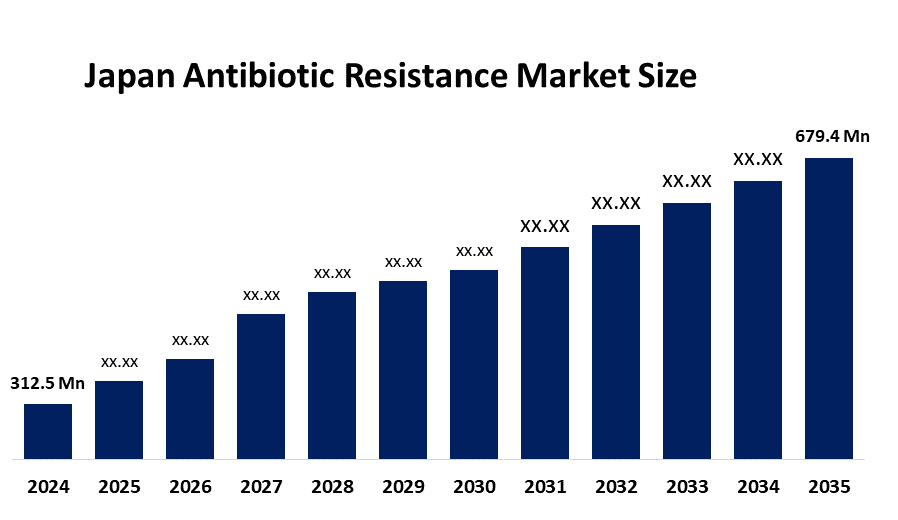
- Japan Antibiotic Resistance Market Size 2024: USD 312.5 Mn
- Japan Antibiotic Resistance Market Size 2035: USD 679.4 Mn
- Japan Antibiotic Resistance Market Size CAGR 2024: 7.32%
- Japan Antibiotic Resistance Market Size Segments: Disease, Pathogen, Drug Class, Mechanism Of Action, And Distribution Channel
Get more details on this report -
Antibiotic Resistance Is A Situation When Bacteria Develop Resistance Mechanisms Making Antimicrobial Drugs Less Effective In Killing Bacteria. Japan has been adopting antibiotic resistance therapies mainly in hospital and acute care settings as this is where resistant infections are most prevalent. Most of these applications are in treating of hospital, acquired pneumonia, bloodstream infections, complicated urinary tract infections, intra, abdominal infections, and skin and soft tissue infections. These conditions are of great clinical risk, with limited treatment options and a long stay in hospital which further intensify the need for targeted and effective antimicrobial therapies in Japan's healthcare system.
Technological innovations in the market size are directed towards rapid diagnostics, antimicrobial susceptibility testing, and stewardship systems that not only help in the precise selection of antibiotics but also reduce the inappropriate use. Research is mostly focused on new drug classes, combination therapies, and resistance, specific mechanisms of action. Government roles involve providing R&D funding to the Global Antibiotic Research & Development Partnership, supporting AMED, led initiatives such as the CiCLE project for clinical innovation, reducing prescriptions under the National Action Plan since 2016, and collaborating on regional surveillance through the JANIS system. Unmet clinical needs, increasing uptake of diagnostic, guided therapy, and ongoing public private antimicrobial R&D collaborations are the main drivers of future market opportunities.
Japan Antibiotic Resistance Market Report Coverage
| Report Coverage | Details |
|---|---|
| Base Year: | 2024 |
| Market Size in 2024: | USD 312.5 Million |
| Forecast Period: | 2020-2023 |
| Forecast Period CAGR 2020-2023 : | CAGR Of 7.32% |
| 2023 Value Projection: | USD 679.4 Million |
| Historical Data for: | 2020-2023 |
| No. of Pages: | 250 |
| Tables, Charts & Figures: | 120 |
| Segments covered: | By Mechanism of Action, By Pathogen |
| Companies covered:: | Astellas Pharma Inc., Daiichi Sankyo Company, Limited, Shionogi & Co., Ltd., Takeda Pharmaceutical Company Limited, Sumitomo Pharma Co., Ltd., Meiji Seika Pharma Co., Ltd., Pfizer Japan Inc., Merck Sharp & Dohme K.K., GlaxoSmithKline K.K., and Others, Key Players |
| Pitfalls & Challenges: | COVID-19 Empact, Challenge, Future, Growth, & Analysis |
Get more details on this report -
Market Dynamics of the Japan Antibiotic Resistance Market:
The driving forces in the market size are the rising numbers of multidrug-resistant infections in hospital and acute care settings. An aging population, as well as an elevated rate of hospitalization, exposes patients more to resistant bacteria such as E. coli, Klebsiella pneumoniae, and P. aeruginosa. A high requirement in clinical settings for innovative treatments in severe infections, such as pneumonia, bloodstream, and complicated UTIs, maintains the usage in the market. Antimicrobial stewardship and surveillance initiatives by governments maintain structured demand for specific antibacterial therapies.
The development and progress in The Market Size are impeded by stringent antibiotic stewardship practices that restrict unnecessary prescription and use. Long development periods, research and development expenses, and regulatory complexities hinder a substantial number of antibiotics from entering commercialization successfully within the market. Low commercial gains, relative to those gained by treatments used for chronic diseases, further discourage private sector development.
There are opportunities in the development of innovative antibiotic agents, combination therapies, and mechanisms of action targeted at resistance. Diagnostic-driven treatment registries and susceptibility testing drive the need for personalized medicines. Public-private collaboration in research, AMED-supported initiatives, and global collaborations facilitate the development pipeline. The unmet need for viable hospital-based medicines guarantees the strategic relevance of the market.
Market Segmentation
The Japan Antibiotic Resistance Market share is classified into disease, pathogen, drug class, mechanism of action, and distribution channel.
By Disease:
The Japan Antibiotic Resistance Market Size is divided By Disease Into HABP, Ciai, BSI, CDI, ABSSSI, CABP, And cUTI. Among these, the HABP segment dominated the share in 2024 and is anticipated to grow at a remarkable CAGR during the forecast period. The catalysts for growth include high hospitalization rates, high rates of severe outcomes from the disease, long course of treatments, intense antibiotic usage, and high rates of multidrug resistance in hospital-acquired pneumonia, particularly in the elderly and the critically ill.
By Pathogen:
The Japan Antibiotic Resistance Market Size Is Divided By Pathogen Into H. Influenzae, Enterococcus Faecium, E. coli, S. aureus, streptococcus pneumoniae, clostridioides difficile, klebsiella pneumoniae, P. aeruginosa, and A. baumannii. Among these, E. coli dominated the share in 2024 and is anticipated to grow at a remarkable CAGR during the forecast period. Factors that drive segment growth include the widespread distribution of the pathogen in complicated urinary tract infections and bloodstream infections, the emerging resistance to primary anti-bacterial antibiotics, the high hospitalization rate, and the persistent demand for a specific treatment.
By Drug Class:
The Japan Antibiotic Resistance Market Size is divided By Drug Class Into Combination Therapies, Tetracyclines, Oxazolidinones, Lipoglycopeptides, Cephalosporins, And Others. Among these, combination therapies dominated the share in 2024 and is anticipated to grow at a remarkable CAGR during the forecast period. This is because of enhanced efficacy, expanded antimicrobial activity, lower resistance potential, and the evolving preference of clinicians to combination therapies in the management of severe and multidrug-resistant bacterial infection.
By Mechanism of Action:
The Japan Antibiotic Resistance Market Size is divided by mechanism of action into protein synthesis inhibitors, cell wall synthesis inhibitors, DNA Synthesis Inhibitors, RNA Synthesis Inhibitors, And Other Mechanisms. Among these, protein synthesis inhibitors dominated the share in 2024 and is anticipated to grow at a remarkable CAGR during the forecast period. This is because of their broad-spectrum activity, their efficacy against resistant bacterial pathogens, proven safety profiles, and the persistence of their usage in the hospital-based treatment of bacterial infections.
By Distribution Channel:
The Japan Antibiotic Resistance Market Size is divided by distribution channel into hospital pharmacies, retail pharmacies, And Online Pharmacies. Among these, hospital pharmacies dominated the share in 2024 and is anticipated to grow at a remarkable CAGR during the forecast period. It is fueled by the demands associated with inpatient treatment, hospital antimicrobial stewardship programs, intravenous antibiotic use, prescribing restrictions, and concentrated resistant infection care in hospital settings.
Competitive Analysis:
The report offers the appropriate analysis of the key organisations/companies involved within The Japan Antibiotic Resistance Market Size, along with a comparative evaluation primarily based on their product offering, business overviews, geographic presence, enterprise strategies, segment market share, and SWOT analysis. The report also provides an elaborative analysis focusing on the current news and developments of the companies, which includes product development, innovations, joint ventures, partnerships, mergers & acquisitions, strategic alliances, and others. This allows for the evaluation of the overall competition within the market.evaluation of the overall competition within the market.
Top Key Companies in Japan Antibiotic Resistance Market:
- Astellas Pharma Inc.
- Daiichi Sankyo Company, Limited
- Shionogi & Co., Ltd.
- Takeda Pharmaceutical Company Limited
- Sumitomo Pharma Co., Ltd.
- Meiji Seika Pharma Co., Ltd.
- Pfizer Japan Inc.
- Merck Sharp & Dohme K.K.
- GlaxoSmithKline K.K.
- Others
Key Target Audience
- Market Players
- Investors
- End-users
- Government Authorities
- Consulting and Research Firm
- Venture capitalists
- Value-Added Resellers (VARs)
Market Segment
This study forecasts revenue at the Japan, regional, and country levels from 2020 to 2035. Spherical Insights has segmented the Japan antibiotic resistance market based on the below-mentioned segments:
Japan Antibiotic Resistance Market, By Disease
- HABP
- cIAI
- BSI
- CDI
- ABSSSI
- CABP
- cUTI
Japan Antibiotic Resistance Market, By Pathogen
- H. influenzae
- Enterococcus faecium
- E. coli
- S. aureus
- Streptococcus pneumoniae
- Clostridioides difficile
- Klebsiella pneumoniae
- P. aeruginosa
- Baumannii
Japan Antibiotic Resistance Market, By Drug Class
- Combination Therapies
- Tetracyclines
- Oxazolidinones
- Lipoglycopeptides
- Cephalosporins
- Others
Japan Antibiotic Resistance Market, By Mechanism of Action
- Protein Synthesis Inhibitors
- Cell Wall Synthesis Inhibitors
- DNA Synthesis Inhibitors
- RNA Synthesis Inhibitors
- Others
Japan Antibiotic Resistance Market, By Distribution Channel
- Hospital Pharmacies
- Retail Pharmacies
- Online Pharmacies
Frequently Asked Questions (FAQ)
-
What is the Japan antibiotic resistance market size?Japan antibiotic resistance market is expected to grow from USD 312.5 million in 2024 to USD 679.4 million by 2035, growing at a CAGR of 7.32% during the forecast period 2025-2035.
-
What is the Japan Antibiotic Resistance Market?The Japan antibiotic resistance market includes therapies used to treat bacterial infections that have become resistant to standard antibiotics, mainly in hospital and acute care settings.
-
Where are antibiotic resistance treatments most commonly used in Japan?These treatments are primarily used in hospitals to manage hospital-acquired pneumonia, bloodstream infections, complicated urinary tract infections, intra-abdominal infections, and skin and soft tissue infections.
-
Which disease segment dominates the market?Hospital-acquired bacterial pneumonia (HABP) dominates due to high hospitalization rates, severe clinical outcomes, prolonged treatment duration, and elevated multidrug resistance in critically ill patients.
-
Which pathogens drive the highest demand in Japan?E. coli, Klebsiella pneumoniae, and Pseudomonas aeruginosa drive demand because of their widespread presence in resistant hospital-based infections.
-
Which mechanism of action is most widely used?Protein synthesis inhibitors are widely used due to their broad-spectrum activity, proven safety, and effectiveness against resistant bacterial pathogens.
-
What role does the Japanese government play in addressing antibiotic resistance?The government supports R&D through AMED programs, implements the National Action Plan on AMR, collaborates with GARDP, and monitors resistance through the JANIS surveillance system.
-
What opportunities exist in the Japan antibiotic resistance market?Opportunities include developing novel antibiotics, resistance-targeted mechanisms, combination therapies, diagnostic-guided treatments, and expanded public-private R&D collaborations.
Need help to buy this report?