Japan Anti-Caking Market Size, Share, By Type (Calcium Compounds, Sodium Compounds, Magnesium Compounds, and Other Types), By Application (Food and Beverage, Cosmetic and Personal Care, Feed, and Other Applications), Japan Anti-Caking Market Insights, Industry Trend, Forecasts to 2035
Industry: Chemicals & Materials
Japan Anti-Caking Market Size Insights Forecasts to 2035
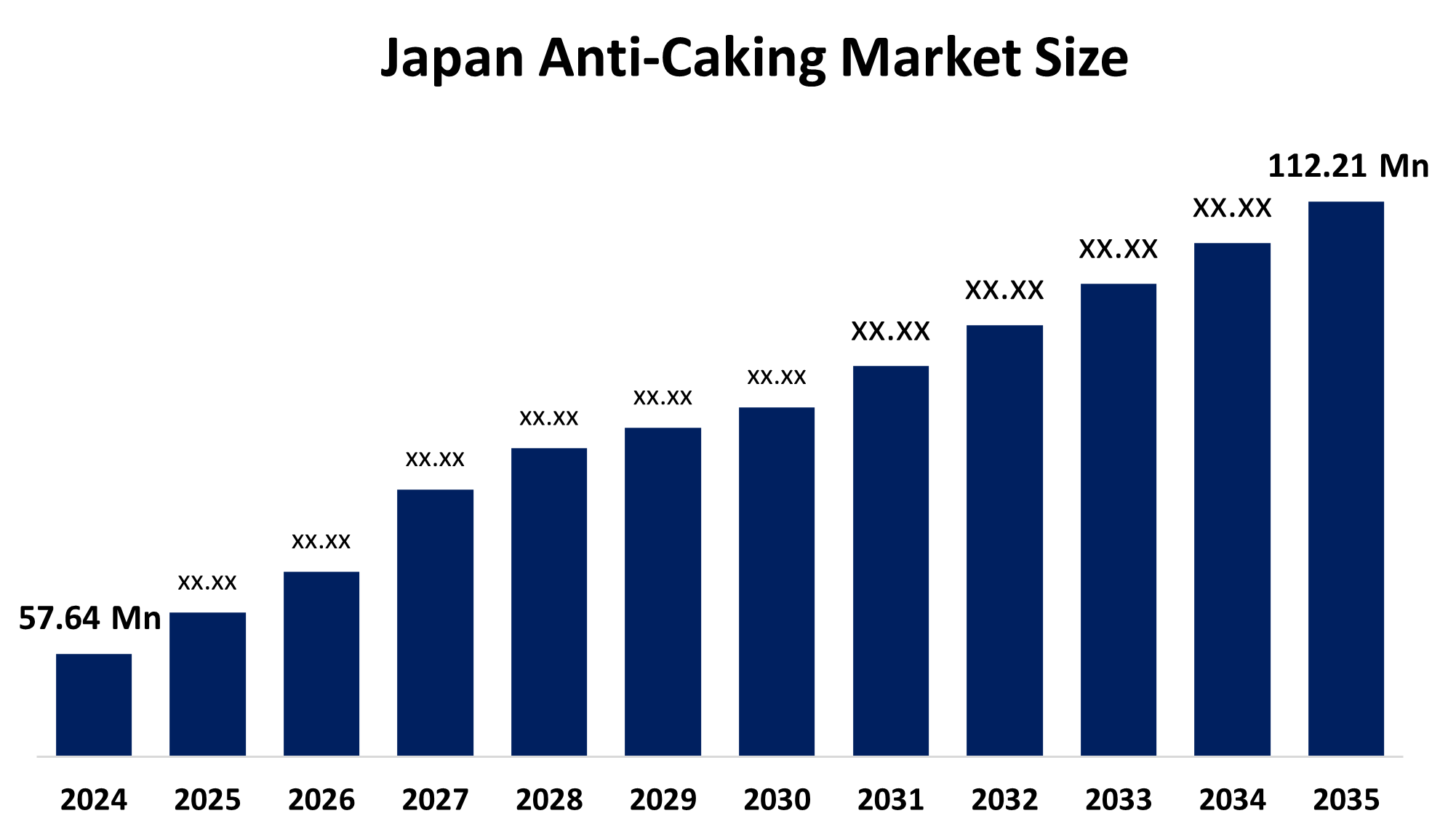
- Japan Anti-Caking Market Size 2024: USD 57.64 Mn
- Japan Anti-Caking Market Size 2035: USD 112.21 Mn
- Japan Anti-Caking Market CAGR 2025-2035: 6.24%
- Japan Anti-Caking Market Segments: Type and Application
Get more details on this report -
Japan Anti-Caking Market Size refers to a market comprising substances that are added to powders and granular substances to suppress clumping. It is well-known that such substances are commonly employed as food additives to improve their texture, as cosmetics to ensure product uniformity, as animal feed to improve nutritional values, and as such for various industries to facilitate easy processing. Japan Anti-Caking Market Size is driven by the increasing sheer number of food-processing lines that are automated, increasing usage of powders as ingredients, as well as the growing importance of clean labels.
Technological developments such as environment-friendly calcium silicate agents will result in improved product quality and government-led efforts for automating the processing of food will indirectly fuel the demand for anti-caking agents. Opportunities for the market in the future include the growth of usage in the cosmetics industry, animal feed industry, specialty Industrial segments, or the development of environment-friendly agents with the clean label approach.
Market Dynamics of the Japan Anti-Caking Market:
The Japan Anti-Caking Market Size is propelled by the demand for free, flowing powders in food and beverages, cosmetics, and feed industries. Automation in the food industry and the rising clean, label trend are two major factors that are leading to increased adoption of anti, caking agents. Innovations such as eco, friendly calcium silicate agents and sustainable formulations are also playing a significant role in the expansion of the market.
The Japan Anti-Caking Market Size is restrained by the high prices of raw materials, complicated manufacturing processes, and strict quality standards for food and feed products. The reliance on imported specialty agents and limited availability of advanced formulations also hinder the growth of the market.
There are potential opportunities in the Japan Anti-Caking Market Size through sustainable and clean, label products, the cosmetics, feed, and specialty industrial sectors. The investments in automated food production and the development of environmentally friendly formulations are likely to accelerate the market growth over the next ten years.
Japan Anti-Caking Market Report Coverage
| Report Coverage | Details |
|---|---|
| Base Year: | 2024 |
| Market Size in 2024: | USD 57.64 million |
| Forecast Period: | 2025-2035 |
| Forecast Period CAGR 2025-2035 : | 6.24% |
| 2035 Value Projection: | USD 112.21 million |
| Historical Data for: | 2020-2023 |
| No. of Pages: | 195 |
| Tables, Charts & Figures: | 102 |
| Segments covered: | By Type, By Application |
| Companies covered:: | Merck KGaA, BASF SE, Evonik Industries AG, Kao Corporation, Shin-Etsu Chemical, Mitsubishi Chemical and Other Key Players |
| Pitfalls & Challenges: | and COVID-19 Impact Analysis |
Get more details on this report -
Market Segmentation
The Japan Anti-Caking Market share is classified into type and application.
By Type:
The Japan Anti-Caking Market Size is divided by type into Calcium Compounds, Sodium Compounds, Magnesium Compounds, and Other Types. Among these, the Calcium Compounds segment dominated the share in 2024 and is anticipated to grow at a remarkable CAGR during the forecast period. Demand is fueled by its use in food powders and animal feed, ease of moisture absorption, its acceptance as safe for use in food, as well as the growing popularity of eco-friendly formulations in Japan.
By Application:
The Japan Anti-Caking Market Size is divided by application into Food and Beverage, Cosmetic and Personal Care, Feed, and Other Applications. Among these, the Food and Beverage segment dominated the share in 2024 and is anticipated to grow at a remarkable CAGR during the forecast period. The market's expansion is aided by the increasing demand for powdered foodstuff, the development of automated food processing systems, the emphasis on quality, and the incorporation of anti-caking agents.
Competitive Analysis:
The report offers the appropriate analysis of the key organisations/companies involved within the Japan Anti-Caking Market Size, along with a comparative evaluation primarily based on their product offering, business overviews, geographic presence, enterprise strategies, segment market share, and SWOT analysis. The report also provides an elaborative analysis focusing on the current news and developments of the companies, which includes product development, innovations, joint ventures, partnerships, mergers & acquisitions, strategic alliances, and others. This allows for the evaluation of the overall competition within the market.
Top Key Companies in Japan Anti-Caking Market:
- Merck KGaA
- BASF SE
- Evonik Industries AG
- Kao Corporation
- Shin-Etsu Chemical
- Mitsubishi Chemical
Key Target Audience
- Market Players
- Investors
- End-users
- Government Authorities
- Consulting and Research Firm
- Venture capitalists
- Value-Added Resellers (VARs)
Market Segment
This study forecasts revenue at the Japan, regional, and country levels from 2020 to 2035. Spherical Insights has segmented the Japan Anti-Caking Market Size based on the below-mentioned segments:
Japan Anti-Caking Market, By Type
- Calcium Compounds
- Sodium Compounds
- Magnesium Compounds
- Other Types
Japan Anti-Caking Market, By Application
- Food and Beverage
- Cosmetic and Personal Care
- Feed
- Other Applications
Frequently Asked Questions (FAQ)
-
Q: What is the Japan Anti-Caking Market size?A: The Japan Anti-Caking Market is expected to grow from USD 57.64 million in 2024 to USD 112.21 million by 2035, registering a CAGR of 6.24% during the forecast period 2025-2035.
-
Q: What are the key growth drivers of the Japan Anti-Caking Market?A: Growth is driven by the increasing automation of food production, rising demand for powdered ingredients, and the growing clean-label trend. Technological innovations like eco-friendly calcium silicate agents and sustainable formulations are also supporting market expansion.
-
Q: What factors restrain the Japan Anti-Caking Market?A: High raw material prices, complex manufacturing processes, strict quality standards for food and feed, reliance on imported specialty agents, and limited availability of advanced formulations restrict market growth.
-
Q: How is the Japan Anti-Caking Market segmented by type?A: The market is segmented into Calcium Compounds, Sodium Compounds, Magnesium Compounds, and Other Types.
-
Q: How is the Japan Anti-Caking Market segmented by application?A: The market is segmented into Food and Beverage, Cosmetic and Personal Care, Feed, and Other Applications.
-
Q: Which type segment dominates the Japan Anti-Caking Market?A: The Calcium Compounds segment dominated the market in 2024 due to its safe use in food, moisture absorption properties, popularity in eco-friendly formulations, and extensive use in food powders and animal feed.
-
Q: Which application segment dominates the Japan Anti-Caking Market?A: The Food and Beverage segment dominated the market in 2024, driven by rising powdered food demand, automated food processing systems, quality emphasis, and widespread incorporation of anti-caking agents.
-
Q: Who are the key players in the Japan Anti-Caking Market?A: Key companies include Merck KGaA, BASF SE, Evonik Industries AG, Kao Corporation, Shin-Etsu Chemical, and Mitsubishi Chemical.
-
Q: Who is the target audience for this market report?A: The report targets market players, investors, end-users, government authorities, consulting and research firms, venture capitalists, and value-added resellers (VARs).
Need help to buy this report?