Japan AI Medical Scheduling Software Market Size, Share, By Product (Care Provider Scheduling, Patient Scheduling, and Other Products), By Deployment Model (Cloud-Based, On-Premise), By End Use (Hospitals, Clinics, and Others), and Japan AI Medical Scheduling Software Market Insights, Industry Trend, Forecasts to 2035
Industry: Information & Technology
Market Insights Forecasts to 2035
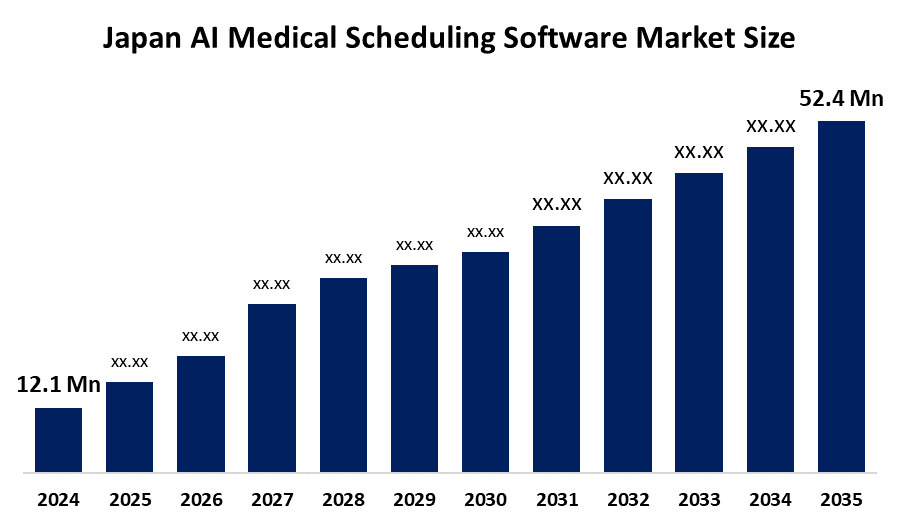
- Japan AI Medical Scheduling Software Market Size 2024: USD 12.1 Million
- Japan AI Medical Scheduling Software Market Size 2035: USD 52.4 Million
- Japan AI Medical Scheduling Software Market CAGR: 14.25%
- Japan AI Medical Scheduling Software Market Segments: Product, Deployment Model, and End Use
Get more details on this report -
The Japan AI Medical Scheduling Software Market Comprises Software Solutions That Use AI To Automate And Optimize Scheduling Tasks In Healthcare Settings, Including Appointment Scheduling, Provider Rostering, And Resource Allocation. By utilizing AI algorithms and data analytics, these solutions increase overall care delivery, cut patient wait times, decrease administrative burden, and improve operational efficiency. This market is a part of the larger AI in healthcare ecosystem, which is growing quickly in Japan as a result of rising demand for digital solutions that facilitate patient monitoring and clinical processes.
Japan’s government has provided extensive support through initiatives for AI adoption in healthcare through national strategies such as Society 5.0. Funding for smart hospital and health IT projects, data interoperability standards, and regulatory frameworks that strike a balance between innovation and patient protection under legislation like the Act on the Protection of Personal Information are other examples of policy efforts. AI development is aided by initiatives such as the Next-Generation Medical Infrastructure Law, which permits safe secondary use of medical data.
Technological advancements driving the market include the application of machine learning, predictive analytics, cloud computing, and natural language processing in healthcare workflows. These technologies allow for scalable, cloud-based systems that support hybrid in-person and virtual care models, real-time scheduling optimization, and interaction with electronic health records. Innovation and the practical use of AI scheduling tools are accelerated when tech companies and healthcare organizations collaborate.
Japan AI Medical Scheduling Software Market Report Coverage
| Report Coverage | Details |
|---|---|
| Base Year: | 2023 |
| Market Size in 2023: | USD 12.1 Million |
| Forecast Period: | 2025-2035 |
| Forecast Period CAGR 2025-2035 : | 14.25% |
| 2035 Value Projection: | USD 52.4 Million |
| Historical Data for: | 2020-2023 |
| No. of Pages: | 210 |
| Tables, Charts & Figures: | 110 |
| Segments covered: | By Product, By Deployment Model, By End Use |
| Companies covered:: | Needswell Inc., EUCALIA Inc., Ubie, LPixel, Molcure, IBM Japan, Hacarus, ThinkCyte, BIPROGY, Hitachi, Ltd., Microsoft Japan, Rakuten Medical, Cardio Intelligence, moCal (moCal.ai), Others |
| Pitfalls & Challenges: | COVID-19 Empact, Challenge, Future, Growth, & Analysis |
Get more details on this report -
Market Dynamics of the Japan AI Medical Scheduling Software Market:
The Japan AI medical scheduling software market is driven by factors, including healthcare providers dealing with rising patient volumes and staff shortages, and the need for operational efficiency in hospitals and clinics. AI-powered scheduling tools minimize no-shows, optimize staffing, automate appointment scheduling, and shorten wait times. Furthermore, the need for effective patient flow management is growing due to Japan's rapidly aging population and rising incidence of chronic illnesses. The increasing use of cloud-based healthcare IT systems and government programs encouraging healthcare digitization both contribute to the market's expansion.
Despite strong momentum, the Japan AI medical scheduling software market faces certain restraints. Vendors must pay more to comply with Japan's healthcare and personal information protection laws' stringent data privacy and security standards. Rapid adoption is also hampered by integration issues with electronic medical records and older hospital information systems, especially in smaller clinics. Further limiting market penetration are high initial implementation costs and opposition from medical personnel used to traditional scheduling techniques.
However, the Japan AI medical scheduling software market presents significant opportunities, including increasing adoption of telemedicine, which creates demand for AI scheduling solutions that manage hybrid in-person and virtual appointments. Efficiency is increased by customized scheduling and demand forecasting made possible by developments in machine learning and predictive analytics. AI medical scheduling software is positioned as a crucial part of Japan's developing healthcare ecosystem by expanding into long-term care, home healthcare, and specialized outpatient services, all of which provide significant growth potential.
Market Segmentation
The Japan AI medical scheduling software market share is classified into product, deployment model, and end use.
By Product:
On the basis of product, the Japan AI medical scheduling software market is categorized into care provider scheduling, patient scheduling, and other products. Among these, the patient scheduling segment held the majority market share in 2024 and is predicted to grow at a remarkable rate during forecast period. To handle large patient numbers, shorten wait times, and lower no-show rates, hospitals and clinics have widely adopted AI-enabled appointment scheduling systems. The patient experience and operational efficiency have been greatly enhanced by features like automatic appointment reminders, real-time schedule optimization, and interaction with hospital information systems.
By Deployment Model:
Based on the deployment model, the Japan AI medical scheduling software market is divided into cloud-based and on-premise. Among these, the cloud-based segment accounted for the largest market share in 2024 and is expected to grow at a significant rate of CAGR during the projected period. The strong adoption of cloud-based solutions is attributed to their scalability, lower upfront costs, and ease of integration with electronic health records (EHRs) and other hospital information systems. Healthcare providers in Japan are increasingly favoring cloud deployment due to its ability to support real-time scheduling updates, remote access, automated data backups, and AI-driven analytics without heavy IT infrastructure investments.
By End Use:
The Japan AI medical scheduling software market is classified by end use into hospitals, clinics, and others. Among these, the hospital segment dominated the market share in 2024 and is anticipated to grow at a remarkable CAGR during the forecast period. The rising patient volume in hospitals and the growing need to effectively handle complicated scheduling needs, including doctors, nurses, diagnostic equipment, and patient visits, are the main causes of this dominance.
Competitive Analysis:
The report offers the appropriate analysis of the key organisations/companies involved within the Japan AI medical scheduling software market, along with a comparative evaluation primarily based on their product offering, business overviews, geographic presence, enterprise strategies, segment market share, and SWOT analysis. The report also provides an elaborative analysis focusing on the current news and developments of the companies, which includes product development, innovations, joint ventures, partnerships, mergers & acquisitions, strategic alliances, and others. This allows for the evaluation of the overall competition within the market.
Top Key Companies in the Japan AI Medical Scheduling Software Market:
- Needswell Inc.
- EUCALIA Inc.
- Ubie
- LPixel
- Molcure
- IBM Japan
- Hacarus
- ThinkCyte
- BIPROGY
- Hitachi, Ltd.
- Microsoft Japan
- Rakuten Medical
- Cardio Intelligence
- moCal (moCal.ai)
- Others
Key Target Audience
- Market Players
- Investors
- End-users
- Government Authorities
- Consulting and Research Firm
- Venture capitalists
- Value-Added Resellers (VARs)
Market Segment
This study forecasts revenue at the China, regional, and country levels from 2020 to 2035. Spherical Insights has segmented the Japan AI medical scheduling software market based on the following segments:
Japan AI Medical Scheduling Software Market, By Product
- Care Provider Scheduling
- Patient Scheduling
- Other Products
Japan AI Medical Scheduling Software Market, By Deployment Model
- Cloud-Based
- On-Premise
Japan AI Medical Scheduling Software Market, By End Use
- Hospitals
- Clinics
- Others
Frequently Asked Questions (FAQ)
-
1. What is the expected market size of the Japan AI Medical Scheduling Software Market by 2035?The market is projected to grow from USD 12.1 million in 2024 to USD 52.4 million by 2035.
-
2. What is the forecast CAGR of the market during 2025–2035?The Japan AI medical scheduling software market is expected to grow at a CAGR of 14.25% during the forecast period 2025–2035.
-
3. Which product segment dominated the market in 2024?The patient scheduling segment dominated the market in 2024, driven by widespread adoption of AI-based appointment scheduling systems to reduce wait times and no-shows.
-
4. Which deployment model holds the largest market share?The cloud-based deployment model held the largest market share in 2024 due to its scalability, cost efficiency, and easy integration with EHR systems.
Need help to buy this report?