Japan Agriculture IoT Market Size, Share, By Component (Hardware, Software, and Services), By Deployment (On-Premise and Cloud), By Connectivity (Wi-Fi, Bluetooth, Cellular, and Others), By Farm Type (Large, Mid-Sized, and Small), By Application (Precision Farming, Livestock Monitoring, Smart Greenhouse, Aquaculture, and Others), Japan Agriculture IoT Market Insights, Industry Trends, Forecasts to 2035
Industry: Agriculture
Japan Agriculture IoT Market Insights Forecasts to 2035
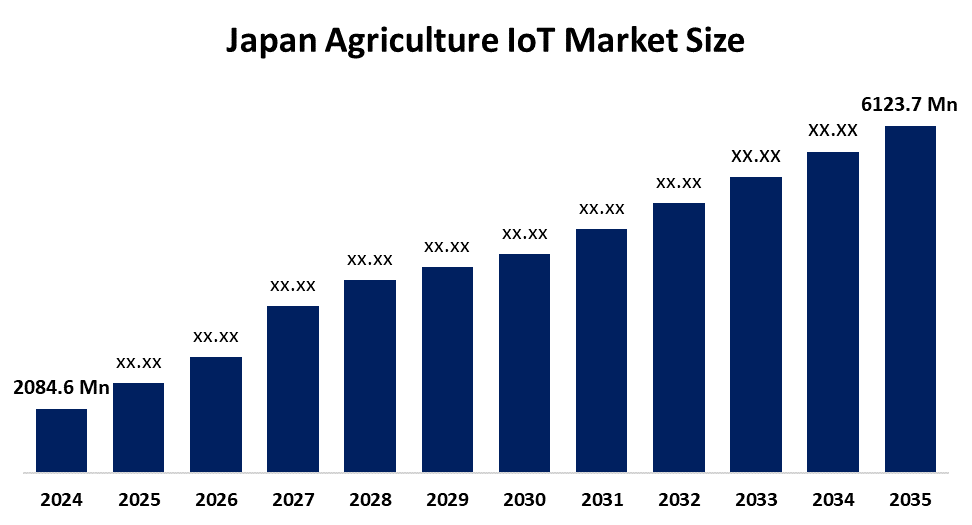
- Japan Agriculture IoT Market Size 2024: USD 2084.6 Million
- Japan Agriculture IoT Market Size 2035: USD 6123.7 Million
- Japan Agriculture IoT Market CAGR 2024: 10.29%
- Japan Agriculture IoT Market Segments: Component, Deployment, Connectivity, Farm Type, and Application
Get more details on this report -
Agriculture IoT means using connected sensors, devices, software platforms, and analytics to monitor, automate, and optimize agricultural activities by collecting real, time data and making smart decisions. Japan's Agriculture IoT application covers precision farming, animal husbandry monitoring, smart greenhouses, seafood farming management, irrigation control, soil monitoring, and machinery tracking to increase the productivity and performance of the farm. Farmers' shortage, the aging of farmers, and the necessity to improve the stability of yields and the efficient use of resources drive the market adoption.
Technological innovations in Japan's agriculture IoT market are extremely diversified and include, among other things, sensor systems and farm management platforms that utilize the cloud, AI, enabled analytics, GPS, guided machinery, robotics integration, and improved cellular and LPWAN connectivity in rural areas. The government of Japan is fully committed to supporting farmers and local producers thus facilitating the development and application of smart farming technologies. Its ministry of agriculture, forestry and fisheries run a series of led initiatives. One is the smart agriculture demonstration project that is implemented in 217 districts throughout the country. Another is the law for promoting the use of smart agriculture technology that allows certification and speeds up the deployment of IoT, based agricultural solutions. The future opportunities involve development of scalable IoT platforms for small and medium, sized farms, AI, driven decision, support systems, autonomous farming technologies, and export, oriented agri tech development which is why the agriculture IoT is going to be the core pillar of Japan's agricultural modernization and food security.
Japan Agriculture IoT Market Report Coverage
| Report Coverage | Details |
|---|---|
| Base Year: | 2024 |
| Market Size in 2024: | USD 2084.6 Million |
| Forecast Period: | 2025-2035 |
| Forecast Period CAGR 2025-2035 : | 10.29% |
| 2035 Value Projection: | USD 6123.7 Million |
| Historical Data for: | 2020-2023 |
| No. of Pages: | 210 |
| Tables, Charts & Figures: | 110 |
| Segments covered: | By Component, By Deployment, By Application |
| Companies covered:: | Kubota Corporation, Yanmar Holdings Co., Ltd., Topcon Corporation, Mitsubishi Electric Corporation, Panasonic Holdings Corporation, NEC Corporation, Fujitsu Limited, Hitachi, Ltd., Yamaha Motor Co., Ltd., Sony Group Corporation, NTT Data Corporation, SoftBank Corp. |
| Pitfalls & Challenges: | COVID-19 Empact, Challenges, Future, Growth, & Analysis |
Get more details on this report -
Market Dynamics of the Japan Agriculture IoT Market:
Japan agriculture IoT market is driven by severe labor shortages, an aging farming population, and the increasing need to boost agricultural productivity and operational efficiency. Farms are becoming more IoT, driven due to the growing use of precision farming, smart greenhouse systems, livestock monitoring, and aquaculture management solutions. Smart agriculture government support, rural infrastructure digitization, and the use of data, driven decision, making tools are some of the factors that keep the market growing.
Japan agriculture IoT market is hindered by the fact that small and mid, sized farms are the hardest hit when it comes to high initial investment costs for IoT hardware, connectivity infrastructure, and system integration. Besides that, the adoption of technology is delayed due to digital skill deficiencies among older farmers, difficulties in the compatibility of legacy equipment with new systems, data handling worries, and erratic rural connectivity.
The Japan agriculture IoT market is expected to be flooded with opportunities in the future as cloud, based platforms, AI, enabled analytics, autonomous farming equipment, and scalable IoT solutions raise the level and tailor the capability to small and mid, sized farms. The rising need for environment, friendly farming methods, real, time monitoring, and maximum productivity, along with continuous technological breakthroughs, will most probably open the doors for long, term growth in the agricultural community of Japan.
Market Segmentation
The Japan agriculture IoT market share is classified into component, deployment, connectivity, farm type, and application.
By Component:
The Japan agriculture IoT market is divided by component into hardware, software, and services. Among these, the hardware segment dominated the share in 2024 and is anticipated to grow at a remarkable CAGR during the forecast period. Hardware segment growth is fueled by the increasing adoption of sensors, IoT devices, gateways, automation solutions, labor shortages, government-backed smart farming projects, the need for real-time field information, ruggedization requirements, decreasing device prices, and the increasing adoption of precision agriculture solutions in Japan.
By Deployment:
The Japan agriculture IoT market is divided by deployment into on-premise and cloud. Among these, the cloud segment dominated the share in 2024 and is anticipated to grow at a remarkable CAGR during the forecast period. Cloud segment growth is fueled by the scalability benefits, reduced infrastructure costs, remote farm monitoring, centralized data management, real-time analytics access, rapid system upgrades, enhanced cybersecurity infrastructure, IoT platform integration, and the increasing demand for flexible digital solutions among Japanese farms.
By Connectivity:
The Japan agriculture IoT market is divided by connectivity into Wi-Fi, bluetooth, cellular, and others. Among these, the cellular segment dominated the share in 2024 and is anticipated to grow at a remarkable CAGR during the forecast period. Cellular connectivity growth is fueled by the increasing rural network coverage, the need for reliable long-range communication, real-time data transmission, cloud platform compatibility, increasing IoT device density, LPWAN integration, cost-effective deployment, government-backed digital infrastructure development, and the increasing adoption of mobile-based farm monitoring solutions in Japan.
By Farm Type:
The Japan agriculture IoT market is divided by farm type into large, mid-sized, and small. Among these, large farms dominated the share in 2024 and are anticipated to grow at a remarkable CAGR during the forecast period. Large farm segment growth is fueled by the increasing availability of capital, early technology adoption, large-scale automation requirements, labor shortages, productivity optimization, integration of advanced analytics, adherence to sustainability standards, economies of scale, and enhanced ROI realization from IoT-based agricultural operations in Japan.
By Application:
The Japan agriculture IoT market is divided by application into precision farming, livestock monitoring, smart greenhouse, aquaculture, and others. Among these, precision farming dominated the share in 2024 and is anticipated to grow at a remarkable CAGR during the forecast period. The factors that drive the growth of precision farming include the demand for yield optimization, efficient water and fertilizer management, climate variability management, real-time crop monitoring, adoption of GPS-enabled equipment, cost reduction, sustainability, data-driven decision-making, and government support for smart agriculture practices.
Competitive Analysis:
The report offers the appropriate analysis of the key organisations/companies involved within the Japan agriculture IoT market, along with a comparative evaluation primarily based on their product offering, business overviews, geographic presence, enterprise strategies, segment market share, and SWOT analysis. The report also provides an elaborative analysis focusing on the current news and developments of the companies, which includes product development, innovations, joint ventures, partnerships, mergers & acquisitions, strategic alliances, and others. This allows for the evaluation of the overall competition within the market.
Top Key Companies in Japan Agriculture IoT Market:
- Kubota Corporation
- Yanmar Holdings Co., Ltd.
- Topcon Corporation
- Mitsubishi Electric Corporation
- Panasonic Holdings Corporation
- NEC Corporation
- Fujitsu Limited
- Hitachi, Ltd.
- Yamaha Motor Co., Ltd.
- Sony Group Corporation
- NTT Data Corporation
- SoftBank Corp.
Key Target Audience
- Market Players
- Investors
- End-users
- Government Authorities
- Consulting and Research Firm
- Venture capitalists
- Value-Added Resellers (VARs)
Market Segment
This study forecasts revenue at the Japan, regional, and country levels from 2020 to 2035. Spherical Insights has segmented the Japan agriculture IoT market based on the below-mentioned segments:
Japan Agriculture IoT Market, By Component
- Hardware
- Software
- Services
Japan Agriculture IoT Market, By Deployment
- On-Premise
- Cloud
Japan Agriculture IoT Market, By Connectivity
- Wi-Fi
- Bluetooth
- Cellular
- Others
Japan Agriculture IoT Market, By Farm Type
- Large
- Mid-Sized
- Small
Japan Agriculture IoT Market, By Application
- Precision Farming
- Livestock Monitoring
- Smart Greenhouse
- Aquaculture
- Others
Frequently Asked Questions (FAQ)
-
Q: What is the Japan agriculture IoT market size?A: Japan agriculture IoT market is expected to grow from USD 2084.6 million in 2024 to USD 6123.7 million by 2035, growing at a CAGR of 10.29% during the forecast period 2025-2035.
-
Q: What are the key growth drivers of the market?A: Market growth is driven by the rise in pharmaceutical and biotechnology R&D activities, the increase in the number of chronic and rare disease cases, and the demand for quicker drug development. The regulatory standards and intricate trial designs make it necessary for companies to outsource to specialized service providers. Besides the government's actions in favor of clinical research, the introduction of digital and decentralized trial models, and the increasing use of AI, data analytics, and e-clinical platforms are the factors that will continue to push the market forward.
-
Q: What factors restrain the Japan agriculture IoT market?A: Constraints include the high costs of operation and compliance, long regulatory approval periods, a small number of patients that can participate in the trials, difficulties in communication and culture, and a lack of experienced professionals in clinical research, all of which result in slowing down the execution of trials and increasing the total cost of development.
-
Q: Who are the key players in the Japan Agriculture IoT Market?A: Key companies include CMIC Group, EPS Corporation, PRA Health Sciences Japan, I’rom Group, Cliantha Research Japan, Shonan Health Innovation Park, Translational Research Informatics Center (TRI), Medical Network Systems (MNS), and Others.
-
Q: Who are the target audiences for this market report?A: The report targets market players, investors, end-users, government authorities, consulting and research firms, venture capitalists, and value-added resellers (VARs).
Need help to buy this report?